
Navigating Life Transitions: A Practical Guide

Navigating a life transition goes better when you name the kind of change you are in, take stock of what you have to draw on, and get support before the pressure builds. Moves, breakups, new jobs, new babies, empty nests and retirements all call for the same skills: slowing down, sorting what you can and cannot control, and not doing it alone. This guide walks through the four types of transitions, why even good change hurts, a simple framework you can use this week, and how to tell when it is time to bring in a professional.
TL;DR
- Transitions come in four types: anticipated, unanticipated, non-event and sleeper. Knowing which one you are in changes what helps.
- Even happy changes, like marriage or a baby, raise stress. Struggling does not mean you are handling it badly.
- Check four things: your situation, your sense of self, your support and your strategies. A weakness in one can be offset by strength in another.
- Start support early and keep it going until new routines settle. One conversation rarely does it.
- If irritability, anger, conflict with a partner or burnout is taking over, counseling, couples work or coaching can help, in person or online.
Table of Contents
- What counts as a life transition
- The four types of life transitions
- Why transitions are so hard
- A framework you can use: the 4 S’s
- A step-by-step approach to the first 90 days
- When transitions strain relationships
- Why talking to a professional helps
- Culturally responsive care during major change
- Does online therapy work during a transition?
- Our perspective: transitions are where patterns show up
- How we can help
- FAQ
- Sources
What counts as a life transition
A life transition is a period when your roles, routines, relationships or sense of identity shift enough that the old way of living no longer fits. The event itself can be a single day: a funeral, a wedding, a layoff. The transition is the longer stretch of adjusting that follows.
That difference matters. You can sign the divorce papers in an afternoon and still be working through what it means for your identity two years later. You can start a dream job on a Monday and spend months feeling like an impostor in it. Most people expect the event to be the hard part. Often the in-between is.
The four types of life transitions
Practitioners commonly sort transitions into four types. Each has its own emotional texture.
| Type | What it is | Examples | What tends to help |
|---|---|---|---|
| Anticipated | A predictable milestone you can see coming | Starting a career, getting married, having a first child, retiring | Planning early, rehearsing the change, lining up support before it arrives |
| Unanticipated | A sudden event you did not choose | Divorce, job loss, a diagnosis, a death | Stabilizing basics first, leaning on people, getting professional support sooner rather than later |
| Non-event | Something you expected that never happened | Not having children, not getting a promotion, not marrying | Naming the loss out loud, since others may not see it as a loss |
| Sleeper | A gradual shift that builds under the surface | Slow burnout, drifting apart from a partner, a changing sense of identity | Regular check-ins with yourself, honest conversations, looking at patterns over months |
The non-event and sleeper types are the ones people miss. Nobody sends a card for the baby you did not have, and nobody notices the month your marriage quietly became two roommates. Because these transitions have no clear start date, the grief or frustration can look like moodiness or “just stress” until it spills into everything else.
Why transitions are so hard
There are a few reasons, and none of them mean something is wrong with you.
Your brain treats uncertainty as a threat. During major transitions, stress and anxiety are often triggered by fear of change and an unknown future. That can show up as low mood, poor sleep, racing thoughts or a short fuse.
Good change is still change. The World Health Organization notes that some events we think of as happy, such as getting married or having a baby, can also be stressful because they bring new demands on daily life. Many people feel guilty for struggling with something they wanted. That guilt adds a second layer of stress.
Your roles get rearranged. A transition rarely changes only you. When one partner changes jobs, retires or becomes a parent, the whole household has to renegotiate who does what, who earns what and who decides what.
Unmanaged stress can compound. The WHO’s mental health and psychosocial support work points out that failing to manage stress after major disruptions can lead to long-term impairment. That finding comes from emergency settings, but the principle applies more broadly: stress that is acknowledged and worked through tends to fade, and stress that is ignored tends to leak into relationships, work and health.
Researchers writing in 2025 describe life transitions such as adolescence, starting higher education or employment, and parenthood as universally experienced yet psychologically demanding. If you are finding yours demanding, you are in very ordinary company.
A framework you can use: the 4 S’s
Counselors who work with adults in transition often use Nancy Schlossberg’s model, which looks at four factors: Situation, Self, Support and Strategies. It is laid out in a textbook on counseling adults in transition that links the theory to practice. Practitioners use it to work out which factor needs the most attention, because a shortfall in one area, such as support, can be balanced by strength in another, such as strategies.
You can run a rough version of it on yourself with a notebook and 30 minutes.
Situation
What exactly changed, and when? Was it expected? Is it permanent or temporary? Do you have any say in how it unfolds? Write down the facts without commentary. Then circle the parts you can influence, even slightly.
Self
What is this transition doing to your identity? “I was the one who held the family together.” “I was the person who worked sixty hours a week.” Notice which roles you are losing and which you are gaining. Then ask how you have handled hard change before. What worked? What made things worse?
Support
List who is actually in your corner: a partner, friends, family, a faith community, a mentor, a therapist. Be honest about who is helpful and who adds pressure. If the list is short, that is useful information, not a verdict. It tells you where to put effort first.
Strategies
What are you doing to cope, and is it working? Exercise, sleep, structure, journaling and talking things through are strategies. Drinking more, snapping at people, scrolling late into the night and withdrawing are strategies too, just costly ones. Keep what works and swap out what does not.
After you have filled in all four, pick the weakest one and make one concrete change to it this week. If your support is thin, call one person or book one appointment. If your strategies are shaky, build one daily routine and protect it.
A step-by-step approach to the first 90 days
- Name the transition and its type. Say it plainly: “I am in an unanticipated transition because my marriage ended.” Naming it reduces the sense that you are simply failing at life.
- Protect the basics. Sleep, food, movement and a daily rhythm come before big decisions. Delay irreversible choices where you can.
- Let the feelings be there. Sadness, anger, relief and excitement can all show up in the same afternoon. Writing or talking them through beats pushing them down.
- Tell the people it touches. Practitioners who work on transitions for young people warn against “transitioning around” family instead of including them, which can create confusion and anxiety on both sides. The same applies to partners and adult relatives. Include them early.
- Build a simple transition folder. The same protocol recommends a personal folder of key information that travels with the person between old and new services. Adapt the idea: keep a note with your key contacts, appointments, goals and what has helped before, so you are not rebuilding from memory when you are tired.
- Set small, dated goals. Pick two or three weekly actions rather than a life overhaul.
- Schedule a check-in. At 30, 60 and 90 days, review the four S’s again and adjust.
The same framework suggests that support works best as a process, not a one-off. For planned changes it can start up to six months before the milestone and continue until new routines are stable. If you can see a transition coming, such as a retirement date or a child leaving for college, start earlier than feels necessary.
When transitions strain relationships
Transitions test couples and families because everyone is adjusting at once, often at different speeds. One partner may be excited about a move while the other is grieving. A new parent may feel isolated while the other is exhausted at work.
Harvard Health notes that life stages like the empty nest or retirement can bring previously ignored relationship issues to the surface, and that couples therapy can help partners reconnect and redefine their roles for the new stage. When we see couples at these points, the problem is rarely a lack of love. It is usually that the old agreements, spoken or not, stopped working and nobody renegotiated them.
Signs that a transition is straining your relationship:
- Small disagreements escalate quickly into big fights.
- You are talking less, or only about logistics.
- One of you has started to avoid conflict entirely, or to explode.
- Anger feels out of proportion to what happened.
- You find yourselves rehashing the same argument with no resolution.
Anger is worth a special mention. Many people do not recognize it as a transition symptom. Loss, fear and loss of control often come out as irritability, sarcasm or rage, especially in people who were never taught another way to express vulnerability. If that is you, it is a solvable problem, and addressing it early protects your relationships and your job.
Why talking to a professional helps
Friends and family matter, but a therapist offers something different. The American Psychological Association explains that psychologists do more than listen: they can identify underlying thought and behavior patterns that even close friends or family might miss, within a relationship designed to be neutral, objective and confidential. During a transition, that neutral space is often what lets you say the things you cannot say at home.
See a licensed mental health professional if:
- Low mood, anxiety or sleeplessness lasts more than a couple of weeks and is getting worse.
- You are using alcohol or other substances to get through the day.
- Your anger is damaging your marriage, your parenting or your work.
- You feel stuck in a loop and your own strategies are not shifting it.
If you are thinking about harming yourself or feel you are in crisis, do not wait for an appointment. In the United States you can call or text 988, the Suicide & Crisis Lifeline, or call 911 in an emergency. Outside the US, contact your local emergency number or crisis service.
Culturally responsive care during major change
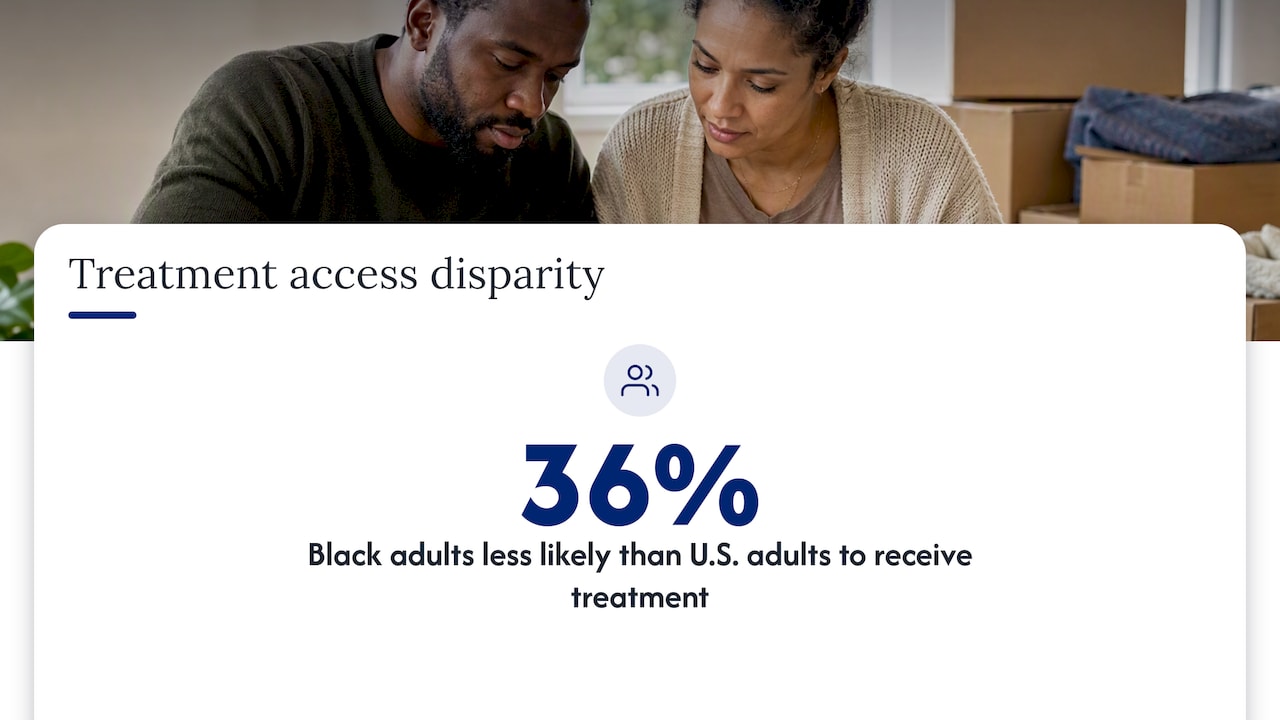
Who you talk to matters as much as whether you talk to anyone. According to the U.S. Office of Minority Health, as of 2024 Black adults were 36% less likely than U.S. adults overall to receive mental health treatment, and barriers include a lack of culturally competent providers, stigma and distrust of the healthcare system. Transitions can carry extra weight when you are also managing discrimination, code-switching at work or being the only one in the room.
Research on remote care points the same way. A systematic review argues that telepsychiatry programs must be designed for the populations they serve, with community involvement and attention to cultural safety. In practice, that means finding a clinician who understands your context without making you explain it first.
If you want to read more, we have written about finding culturally responsive Black psychologists, breaking Black mental health stigma, barriers and support for Black men and counseling for Black families. Professionals who are working through career pressure alongside identity can also find useful ideas in this piece on reducing environmental pressure on Black professionals.
Does online therapy work during a transition?
Transitions often come with moves, new schedules and new childcare, which can make a weekly office visit hard. The evidence on remote care is encouraging. One review reports that teletherapy is as effective as in-person care for conditions like depression and anxiety, citing studies of 1,192 patients that found no significant difference in outcomes between in-person therapy before the pandemic and teletherapy during it. The same source describes a systematic review of telecounseling in minority ethnic communities with moderate to large improvements in quality of life and psychosocial functioning.
For best results, pick a private room, test your connection beforehand and treat the session like any other appointment. Our own notes on teletherapy best practices cover the setup in more detail.
Our perspective: transitions are where patterns show up
We work with people at the point where change meets conflict, and our view is simple: a transition rarely creates a problem out of nothing. It exposes one that was already there.
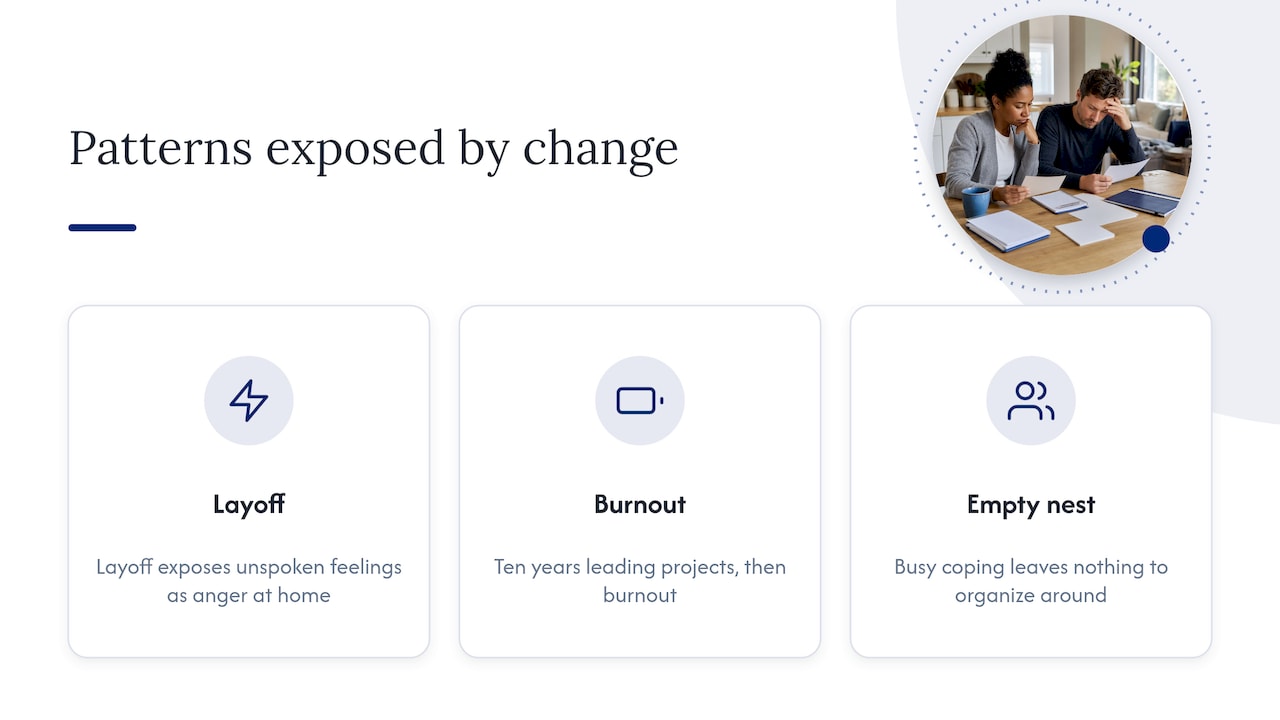
The man who has never needed to talk about what he feels gets laid off, and his temper at home becomes the family’s main weather. The woman who has led every project for ten years hits a wall, and burnout looks like “I just don’t care anymore.” The couple who coped by staying busy finds the kids gone and nothing left to organize around. In each case the transition is the trigger, and the pattern is the thing worth working on.
That is why we do not treat transitions as problems to be hurried through. We look at the situation, the person, the support around them and the tools they already use, and we build from there. Our approach blends clinical rigor with practical, actionable tools, because insight alone does not help at 6 p.m. when an argument is starting. You need something you can actually do.
We also believe the fit between client and clinician matters. People from communities that have often been underserved should not have to educate their provider before they can get help. And change that goes unaddressed tends to travel: from one partner to the other, from parent to child, from work to home. Getting help early is not weakness. It is the most efficient move there is.
— Carlos
How we can help
We are Mastering Conflict, led by Dr. Carlos Todd, a licensed clinical mental health counselor and psychologist. If a transition is driving conflict, anger or burnout, these are the places to start:
- Couples: sessions are $175 per hour, and the same page lists longer programs, including the Relationship Renewal Starter Program at $1,100 and the Weekend to Renewal program at $2,000. For a concentrated block of time, the 6 Hour Couples Intensive is $1,995.
- Anger: our online anger management classes start at $24.99 for the 1 Hour class, with 6 Hour ($79) and 8 Hour ($85) options.
- Individual and family counseling: counseling for women, men and teens, plus infidelity recovery and more, is listed under clinical services. Pricing for these services is not published, so contact us for details.
- Burnout: the Women In Balance Coaching Program is built for women leaders. Not sure whether you need coaching or therapy? Our comparison of the two can help you decide.
FAQ
What are the 4 types of life transitions?
They are anticipated (predictable milestones such as starting a career), unanticipated (sudden events such as divorce or job loss), non-event (expected changes that never happen) and sleeper (gradual shifts that build over time). Each calls for a slightly different approach, so naming yours is a good first step.
How do you cope with major life transitions?
Start with sleep, food and routine, then name what is changing and let yourself feel it. Tell the people it affects, and build a small support network. Review how you are doing at regular intervals, and add professional help if stress, anger or low mood is not easing.
Why are transitions so hard?
Change brings uncertainty, and uncertainty triggers stress and anxiety. Even welcome events, like marriage or a new baby, add new demands. Transitions also shift roles and identity, which takes time to absorb.
How long does it take to adjust?
There is no fixed timeline. Support tends to work best as an ongoing process that continues until new routines are stable, not a single conversation. If you are still struggling after a few months, or getting worse, talk to a licensed therapist.
Can couples therapy help during a transition?
Yes, especially at stages such as retirement or the empty nest, when long-ignored issues surface. Therapy gives both partners a neutral space to redefine roles and reconnect. It works best when you start before resentment hardens.
Sources
- The Impact of Transitions and How to Cope with Them, Cruse Scotland
- Stress, World Health Organization Regional Office for the Eastern Mediterranean
- Improving mental health and psychosocial support programs, WHO
- Navigating life transitions and mental wellbeing in the digital age, Child and Adolescent Psychiatry and Mental Health
- Counseling adults in transition, University of California Davis Library
- Mental Health Transitions Framework, Richmond and Wandsworth
- Could couples therapy be right for you?, Harvard Health
- Psychotherapy myths, American Psychological Association
- 988 Suicide & Crisis Lifeline, SAMHSA
- Mental Health and Black/African Americans, Office of Minority Health
- Telehealth is Transforming the Therapeutic Landscape, AllPsych
- Telepsychiatry systematic review, PubMed Central