
Get Approval Before You Pay: Anger Management Classes Near Lincoln

If a court, probation officer, or employer sent you looking for anger management classes near Lincoln, the safest move is to confirm acceptance before you pay for anything. Most accepted programs are short, certificate-bearing courses or an approved online option. Call the referring authority first, ask what wording they require on a completion certificate, then book a class that matches.
TL;DR:
- Ask the referring authority to approve the course in writing, then verify required certificate wording, hours, instructor details, and whether live attendance is necessary.
- Workshops typically take 6 to 8 hours, short modules take 1 to 2 hours, and multiweek groups run 8 to 12 or more hours.
- Favor CBT courses that include trigger recognition, thought challenging, role play, homework, and relapse prevention over longer lectures with little practice.
- Low cost local options include county programs, nonprofit centers, community clinics, and university training clinics, but confirm current fees, availability, and wait times before committing.
- Mayo Clinic says consistent use of anger management techniques can help highly angry people improve regulation over roughly 8 to 10 weeks.
Table of Contents
- Will an online or in-person class satisfy court, probation, or employer requirements?
- Common formats, durations, and what classes typically cost
- What a CBT-based anger management class actually teaches
- Checklist and exact questions to ask before you enroll
- Where to find anger management classes and low-cost options locally
- Why clinical credentials matter when a certificate is on the line
- What to expect when you enroll and attend your first session
- What matters more than the class length
- How we can help you find an accepted class now
- FAQ
- Sources
Will an online or in-person class satisfy court, probation, or employer requirements?
The person who referred you sets the rules, not the class provider. A judge, court clerk, probation officer, or HR representative decides whether a certificate counts, and their requirements can vary even within the same county.
Before you enroll, get something in writing. Most offices will confirm acceptance over email or during a short phone call, and that confirmation protects you if a certificate later gets questioned.
- Ask the provider for a sample completion certificate showing hours, instructor name, and program description.
- Request a short curriculum summary you can forward to your probation officer or employer.
- Get the instructor’s credentials and the program’s official contact information in writing.
- Save the approval you receive, whether it is an email reply or a signed form.
Enrolling without this step is the most common mistake people make. A certificate that is missing required wording, hours, or instructor information can be rejected after you have already paid and completed the course.
Pro Tip: Email your probation officer or court clerk a link to the course description and ask them to reply confirming it meets the requirement, then save that email with your certificate.
Common formats, durations, and what classes typically cost
Anger management classes come in a handful of standard shapes, and knowing the typical hour counts helps you match a class to what was ordered.
- One-day workshops: typically 6 to 8 hours, completed in a single session.
- Multi-session groups: 8 to 12 or more hours spread across several weeks.
- Short modules: 1 to 2 hours, often used for lower-level referrals or awareness training.
- Online certificate courses may be self-paced or scheduled.
Many court orders simply specify a number of hours or reference an “anger management program” by name, so verify exact wording rather than assuming a popular format will qualify. Local nonprofit and municipal programs, along with community mental health clinics, sometimes offer lower-cost options, and free home-study programs exist online, though these need extra verification before you rely on them for a court requirement. In-person classes are often easier to verify quickly because a staff member can confirm details by phone, while online courses may require more documentation up front.
What a CBT-based anger management class actually teaches
Look past marketing claims and focus on curriculum substance. Evidence-based anger programs are built around cognitive behavioral therapy, or CBT, which helps participants identify triggers, challenge distorted thinking, and replace reactive habits with planned responses. Programs typically add relaxation and breathing techniques, role-play exercises for practicing new responses, and homework such as behavior logs, closing with a relapse-prevention plan for handling future situations.
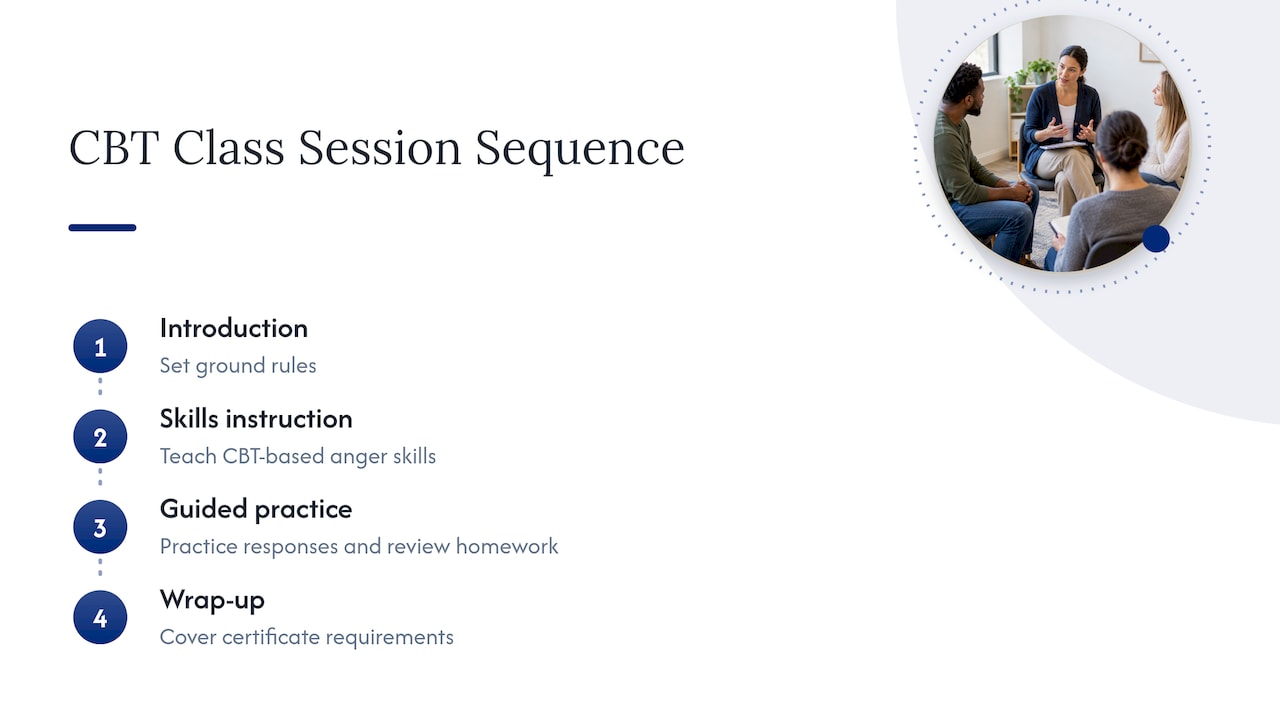
A typical session often follows a predictable sequence: introduction and ground rules, skills instruction, guided practice with homework review, and a wrap-up that covers certificate requirements for anyone who needs documentation.
CBT-informed programs are identified as an evidence-based approach to anger treatment in systematic reviews and government evaluations, meaning the techniques taught in a quality class are grounded in research rather than general advice. Mayo Clinic’s guidance adds a practical benchmark: with consistent use of anger management techniques, a highly angry person can move toward better-regulated anger over roughly 8 to 10 weeks. You can see several of these techniques broken down in our anger management exercises for adults, including journaling prompts used between sessions.
Checklist and exact questions to ask before you enroll
Before you hand over payment, confirm these six things in order:
- The referring authority has confirmed, in writing, that this type of class is acceptable.
- You know the exact wording that must appear on the completion certificate.
- The course hours match or exceed what was ordered.
- The instructor’s credentials are available and verifiable.
- You understand whether the format is live, recorded, or self-paced.
- You have read the refund or transfer policy in case your situation changes.
When you call a provider, ask directly: “Will this certificate be accepted by a court or probation officer, and what exact wording appears on it?” A provider confident in their program will answer specifically, with hours, instructor name, and certificate language, rather than a vague assurance.
- Ask whether sessions are live or recorded, since some courts require live instruction.
- Ask what happens if you miss a session or need to reschedule.
- Ask for the instructor’s license type and how long they have practiced; for guidance on selecting counseling professionals, see how to choose a counselor in Melbourne.
Pro Tip: Request written confirmation by email rather than a verbal answer, then forward that same email to your probation officer or court clerk so everyone has the same documentation on file.
Once you have a provider’s written answers, send them along with the course description to whoever referred you, and keep a copy for your own records.
Where to find anger management classes and low-cost options locally
A handful of local categories cover most of what Lincoln-area residents need. County mental health services, community colleges, community mental health clinics, and nonprofit community centers often run or refer out to anger management programs, and some list cost and duration directly on their pages. The city maintains a list of local mental health resources, including organizations such as the National Safety Council Nebraska and CenterPointe, which can be a starting point for in-person options.
- Search with specific phrases like “anger management class Lincoln NE certificate” rather than generic terms.
- Check Findhelp for current local programs and contact details.
- Call ahead to verify a provider’s contact information and confirm acceptance before paying.
- Ask community clinics and university training clinics about sliding-scale or low-cost sessions.
County-sponsored programs and university training clinics tend to be the most affordable in-person route, though availability and wait times vary, so confirm scheduling alongside cost before committing.
Why clinical credentials matter when a certificate is on the line
When a completion certificate needs to hold up with a court or employer, the instructor’s background matters as much as the curriculum. Our anger management programs are built by Dr. Carlos Todd, using modules that match the structure referenced in program evaluations and research reviews. Our anger management classes, along with online alternatives, follow the certificate-bearing formats described earlier in this guide. If you need to confirm certificate wording or instructor credentials for a specific court or probation requirement, our team can provide that information directly before you enroll.
What to expect when you enroll and attend your first session
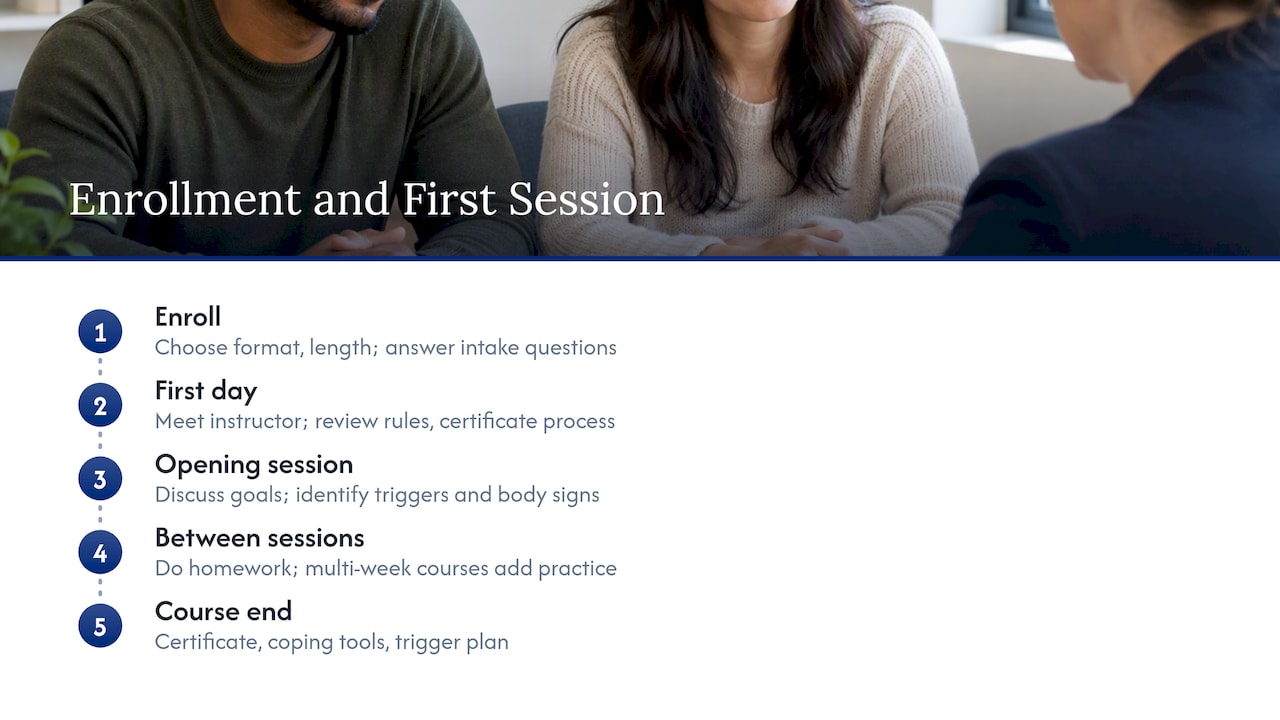
Enrollment usually starts with choosing a format, in-person or online, and a length that matches what your court, probation officer, or employer specified. Most providers ask basic intake questions about your situation and the reason for referral, which helps them confirm you are enrolling in the right course rather than one that is too short or too long for the requirement.
On the first day, expect an introduction to the instructor, a review of ground rules, and a brief explanation of how the certificate process works, including what information will appear on it and when you will receive it. Sessions typically open with a discussion of goals and move into the first skills module, often focused on recognizing anger triggers and understanding the physical signs of escalating anger.
Homework is common even after a single-day class: a short log of anger episodes, a breathing exercise to practice, or a worksheet connecting a recent situation to a coping strategy. Multi-week programs add structured practice and review between sessions, giving you a chance to apply skills before the next meeting. For mindfulness and breathing techniques you might see introduced early on, our mindfulness exercises tailored for anger give a preview of what a typical module covers.
By the end of the course, you should leave with a signed or digital certificate, a basic set of coping tools, and a plan for handling triggers that come up after the class ends.
What matters more than the class length
The number of hours on a certificate gets more attention than it deserves. A 4-hour class with a skilled instructor and real CBT content can teach more than an 8-hour class run as a lecture with no practice time. The conventional advice to “just find the cheapest class that meets the hour requirement” skips the part that actually determines whether anger management sticks: whether you practiced new responses, not just heard about them.
Readers in Lincoln often focus first on finding any class that fits a deadline, when the better first move is confirming acceptance in writing and then choosing based on instructor quality and curriculum substance. A class without role-play, homework, or a relapse-prevention component is missing the pieces that research on CBT-informed anger treatment points to as the ones that make a difference. Prioritize verification first, substance second, and convenience last.
— Carlos
How we can help you find an accepted class now
We offer certificate-bearing anger management classes, including a 1-hour option, 6-hour and 8-hour classes, and a one-day 6 to 8 hour class for readers who need an all-day, certificate-bearing format. Online alternatives are available for those who need flexible scheduling.
- Browse our full course listings to compare hour lengths and formats.
- Contact us to request sample certificate wording or instructor credentials before you enroll.
- Book directly once your referring authority confirms the format works for your situation.
Reach out through our course listings page to book a class or request certificate details for your court or probation officer.
FAQ
What is the best therapy for anger issues?
Cognitive behavioral therapy, or CBT, is the approach most consistently identified as effective in systematic reviews of anger treatment. It works by helping you recognize triggers, challenge distorted thinking, and build practical coping and problem-solving skills.
Where should I go if I have anger issues?
Start with your primary care provider, a licensed counselor, or a structured anger management class, depending on how much support you need. The NHS guidance on anger recommends combining self-help techniques like breathing and mindfulness with structured therapy when anger persists or affects daily life.
Are there free anger management classes?
Some community mental health clinics, university training clinics, and county-sponsored programs offer free or low-cost anger management services, though availability varies by location. Directories like findhelp.org’s Lincoln listings are a practical way to check what is currently available in your area.
How do I know if an anger class will meet a court requirement?
Confirm directly with the judge, court clerk, or probation officer before enrolling, since they set the exact wording and hour requirements. Ask the class provider for a sample certificate and curriculum summary so you can forward both for approval ahead of time.