
Conflict and Mediation: How Mediation Works and When to Use It

Conflict is a disagreement in which people feel their needs, values or goals collide. Mediation is one way to work through it: a neutral third person helps the people involved talk, understand each other and reach their own agreement. The mediator does not judge or decide. This guide covers how the process runs, what the “4 Cs” mean, which ground rules matter, and how to tell when mediation is the right tool and when something else is.
TL;DR
- Mediation is facilitated negotiation. An impartial third party helps you reach a voluntary agreement, and you keep the decision.
- The process usually runs in six stages, from planning to negotiation, and can take hours or months depending on complexity.
- Its main advantages are the “4 Cs”: cost, confidentiality, control and creativity.
- Mediation is a poor fit when there is abuse or fear. Safety comes first, and a private conversation with a professional comes before any joint session.
- For ongoing relationship conflict, such as a marriage or a family, therapy often does the deeper work that mediation is not designed to do.
Table of Contents
- What conflict and mediation actually mean
- The six stages of a mediation
- The 4 Cs of mediation
- Ground rules that make mediation work
- What makes a good mediator
- How well does mediation work?
- When mediation is not the right tool
- Mediation versus therapy for couples and families
- Our perspective: what we see in the room
- Preparing for a mediation or a hard conversation
- Conflict mediation in different settings
- When you want more than a conversation: working with us
- FAQ
- Sources
What conflict and mediation actually mean
Conflict is not the same as a fight. A fight is one way conflict shows up. Underneath, there is usually a gap between what two people want, expect or fear. Scottish Conflict Resolution’s overview of conflict notes that people need a sense of control and predictability to respond to conflict well. When that is missing, even small disagreements escalate.
Mediation steps into that gap. According to a World Bank guide to mediation, it is similar to negotiation, but an impartial third party helps the disputants communicate so they can reach a mutually acceptable, voluntary agreement. Unlike litigation, which looks back at fault and ends in a binding ruling, mediation looks forward. It tries to surface the interests behind each position and, where possible, preserve the relationship.
The U.S. Department of Commerce describes mediation as familiar from labor-management and international disputes, but also used for contract, interpersonal, human resources and EEO conflicts. In other words, the same basic method works for a workplace complaint, a business dispute or a family disagreement.
Mediation, negotiation, arbitration and litigation
These four are often confused. The difference is who decides.
| Approach | Who decides | Voluntary outcome? | Focus |
|---|---|---|---|
| Negotiation | The parties themselves | Yes | Reaching a deal directly |
| Mediation | The parties, with a neutral helper | Yes | Interests, communication, future |
| Arbitration | A neutral decision maker | No, the arbitrator rules | Evidence and arguments |
| Litigation | A judge or jury | No, the ruling is binding | Past fault and legal rights |
The key point: a mediator has no power to impose anything. If you do not like a proposal, you do not have to accept it.
The six stages of a mediation
Harvard’s Program on Negotiation outlines a typical mediation in six stages. Knowing them removes most of the anxiety about what happens in the room.
- Planning. Logistics are settled: who attends, where, when, and what information each side brings.
- The mediator’s introduction. The mediator explains their role, confidentiality and the ground rules.
- Opening remarks. Each party says, uninterrupted, how they see the situation.
- Joint discussion. The parties talk directly, with the mediator steering toward the real issues.
- Caucuses. The mediator meets with each side privately.
- Negotiation. Options are tested and, if things go well, an agreement is drafted.
How long it takes varies a lot. The same source notes that duration ranges from hours to months depending on complexity. A neighbor dispute over a fence might resolve in one afternoon. A multi-party business conflict can run for weeks.
Why caucuses matter
Some people insist on staying in the same room throughout. But when a joint session produces more heat than light, mediators often move between separate rooms, a practice described by Harvard’s Program on Negotiation as shuttle diplomacy. Private meetings let people say what they cannot say in front of the other side, and let the mediator test ideas without anyone losing face.
The 4 Cs of mediation
Searchers ask about “the 4 Cs” because the phrase has more than one meaning. Two versions are common, and both are useful.
The advantages version: cost, confidentiality, control, creativity
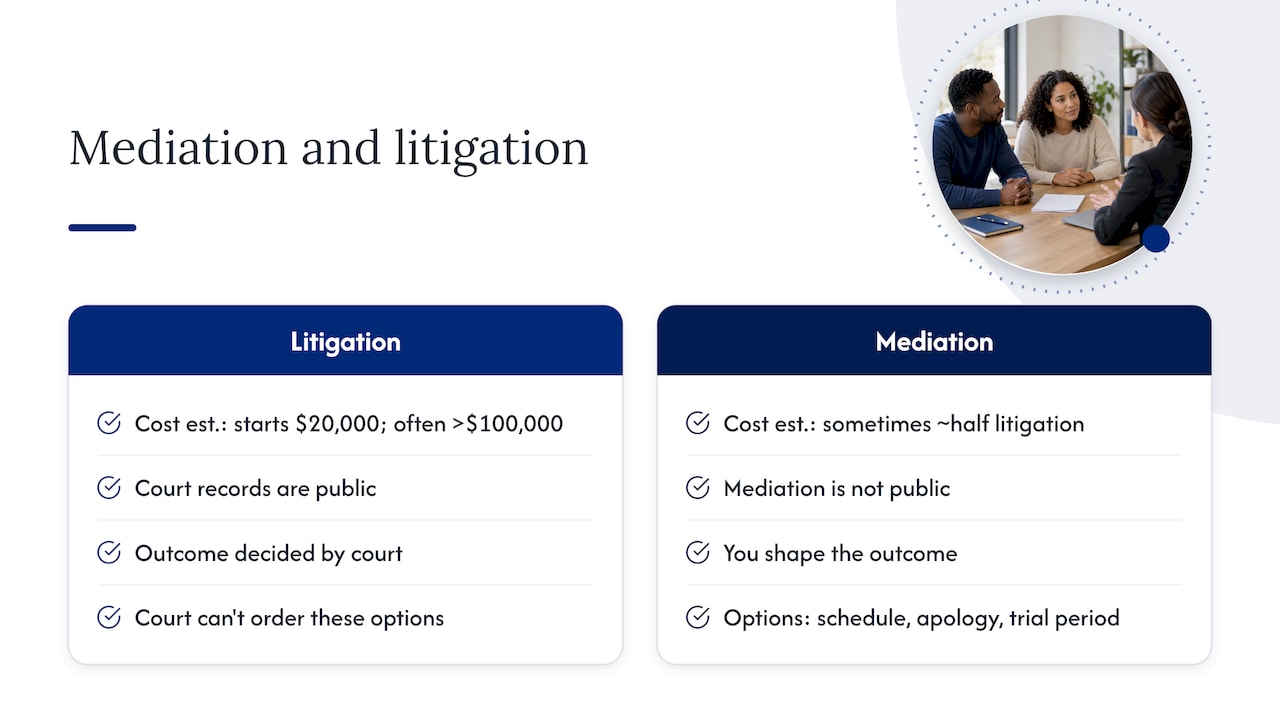
This is the version used to explain why people choose mediation over court. ADR Systems states that family law litigation usually starts at $20,000 and, for many families, exceeds $100,000, while mediation is substantially cheaper, sometimes about half the cost. Confidentiality matters as well, since court records are public and a mediation is not. Control means you shape the outcome. Creativity means you can agree on solutions a court could never order, such as a revised schedule, an apology or a trial period.
The behaviors version: candor, cooperation, creativity, courage
Retired Judge Gerald Rosen, a prominent bankruptcy mediator, frames the four Cs as candor, cooperation, creativity and courage. His point is that courage is needed from both the mediator and the parties. It often takes a leap of faith to break through denial and the scar tissue of a long-running conflict. This version is more about what you bring into the room than what the process gives you.
Ground rules that make mediation work
Most mediators set ground rules in the introduction. The ones that matter most, according to Harvard’s mediation training overview, are taking turns without interrupting, tackling the problem rather than the person, and using “I” statements to reduce defensiveness.
In practice, that sounds like this:
- Instead of “You never tell me anything,” try “I feel left out when I find out about plans after they are made.”
- Instead of “Your department always drops the ball,” try “When the report arrives late, my team has to work over the weekend, and I need a different arrangement.”
The change is small, but it moves the conversation from accusation to a request the other person can actually answer.
What makes a good mediator
Impartiality is the foundation. The model standards of conduct for mediators say mediators should decline a case if they cannot remain free from bias or if there is a conflict of interest, and that parties keep the right to make free, uncoerced decisions throughout. If a mediator pressures you to settle, that is a warning sign.
Other qualities to look for:
- They listen closely, take notes and avoid choosing sides.
- They ask about interests (“What would that solve for you?”) rather than only positions.
- They explain confidentiality clearly before anyone speaks.
- They are comfortable with silence and with emotion.
How well does mediation work?
The figure most often quoted is that roughly 80% of mediated disputes reach a resolution. It appears in both the World Bank guide and Harvard’s description of the process. Treat it as a rough indication, not a promise. Success depends on the type of dispute, whether both sides came voluntarily, and how ready they are to compromise. A “resolution” also does not always mean everyone is happy. It means everyone can live with the agreement.
When mediation is not the right tool
Mediation assumes two people with roughly equal ability to speak up and to say no. That assumption fails in some situations.
Abuse, coercion and fear
If one person is afraid of the other, a joint session can be dangerous or can simply reproduce the power imbalance. The U.S. Department of Justice’s national protocol on intimate partner violence says screening for intimate partner violence is an ongoing process rather than a one-time event, and that it should happen in private, one-on-one settings. Screening where others can overhear can lead to underreporting or to danger if an abuser is present.
If you are afraid of a partner or family member, speak first with a clinician, a domestic violence advocate or a legal professional on your own, before agreeing to any joint meeting. In the U.S., the National Domestic Violence Hotline is available at 1-800-799-7233. If you are in immediate danger, call 911.
Conflicts that are really about the relationship
Mediation is good at settling a defined issue: who pays, what the schedule is, how a task is divided. It is less suited to recurring patterns, such as the same argument returning every month, a breach of trust or a long history of resentment. Those call for a different kind of help, which is where counseling comes in.
Disputes that need a ruling
Sometimes a party wants a precedent or a legal finding, or refuses to negotiate at all. In those cases, arbitration or court may be the only route.
Mediation versus therapy for couples and families
People in a struggling marriage or family often search for mediation when what they need is counseling, or the other way around. The goals differ.
| Mediation | Couples or family therapy | |
|---|---|---|
| Main goal | Reach an agreement on specific issues | Change the patterns behind the conflict |
| Led by | A neutral facilitator | A licensed clinician |
| Typical use | Divorce terms, parenting plans, workplace disputes | Communication breakdown, repeated fights, rebuilding trust |
| Outcome | A written agreement | Skills, insight and a healthier relationship |
The two can work together. A couple might use therapy to understand why every conversation about money becomes a fight, then use mediation to settle a specific financial question. Research on the therapy side is encouraging too. A study published through the American Psychological Association found that brief, web-based interventions for couples can reduce conflict, even in low-income populations, with improvements in relationship satisfaction and child functioning lasting at least a year.
Our perspective: what we see in the room
We are clinicians, not mediators, and we think that distinction is worth being honest about. Mediation is a valuable process for resolving a specific dispute. But most of the people who come to us are not stuck on a single issue. They are stuck on a pattern: the escalating tone, the shutdown, the same argument with different details.
What we see again and again is that people do not lack solutions. They lack a way to hear each other long enough to use them. The ground rules mediators use, taking turns, attacking the problem and not the person, speaking in “I” statements, are the same skills we teach couples and families in counseling. They work, but only when each person can stay regulated enough to use them. When anger takes over, the first job is not negotiation. It is learning to notice anger rising and slow it down.
That is why we pair communication tools with clinical work. If you want to practice, our six-step conflict resolution guide with exact scripts gives you wording you can use tonight, and our article on conflict resolution steps for couples, families and professionals shows how the same structure applies across settings.
One more point from experience: courage matters as much in a living room as in a courtroom. Saying “I want to understand you” before “here is what you did wrong” is hard. It is also the single move that most often changes the direction of a conversation.
— Carlos
Preparing for a mediation or a hard conversation
Whether you are going into formal mediation or a conversation at the kitchen table, preparation changes the result.
- Write down your interests, not just your demands. “I want the schedule changed” is a position. “I need predictable evenings with the kids” is an interest, and it has more than one possible solution.
- Identify what you can give. Agreements need trade-offs. Decide in advance what is flexible.
- Plan for the other side’s view. What would they say if asked to describe the problem? If you cannot answer, listen more in the opening.
- Choose your setting. Quiet, private, no deadline right after. Avoid starting during a crisis.
- Know your walk-away point. Mediation is voluntary. You can pause or stop, and knowing your alternatives lowers pressure.
- Bring a plan for staying calm. Agree on a break signal. Short pauses stop escalation more reliably than willpower.
Harvard’s Program on Negotiation also points out that a mediator’s private conversations with the other side can reveal underlying interests, which can help shape settlement proposals that the other side will find more acceptable. Be open in caucus about what matters most to you. The mediator can only work with what you share.
Conflict mediation in different settings
At work
Workplace mediation usually involves two employees, a manager or HR, and a trained mediator. The goal is a working agreement about behavior and communication, not a verdict on who is right. Managers increasingly build basic mediation skills into their own teams, as Harvard’s Program on Negotiation observes, so small disputes are handled before they harden.
In families
Family conflicts have the added layer of shared history and ongoing contact. Parents and teens, adult siblings caring for a parent, and blended families all benefit from structure. Our guides to conflict resolution for families and family counseling strategies for better communication go deeper.
In couples
Couples often need both skills and support. These pieces cover conflict resolution for couples and communication techniques for resolving conflict.
When you want more than a conversation: working with us
If your conflict is a pattern rather than a one-time dispute, or anger is part of the picture, counseling gives you something mediation does not: sustained work on the reasons things keep going wrong. Our founder, Dr. Carlos Todd, is a licensed clinical mental health counselor and psychologist, and we offer in-person and online options.
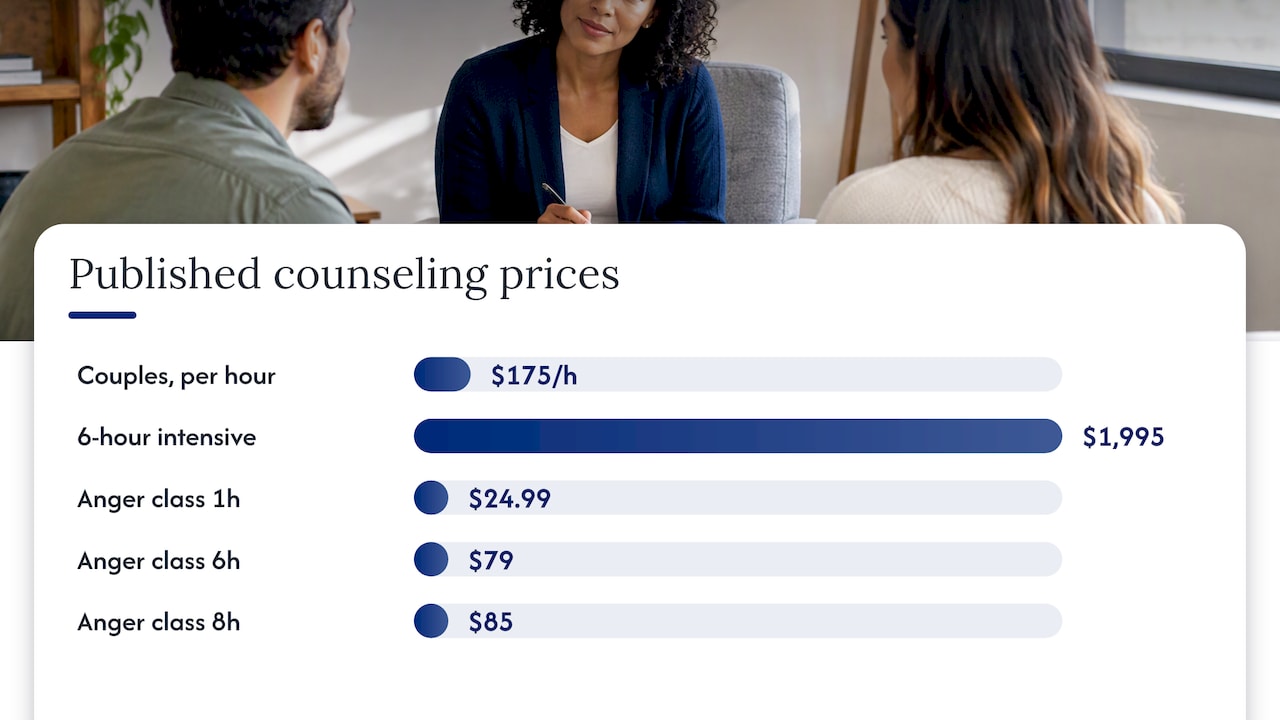
Here is what is available, with published prices:
- Couples sessions at $175 per hour.
- A 6 Hour Couples Intensive at $1,995, for couples who want concentrated work rather than weekly appointments.
- Self-paced anger management classes: 1 hour at $24.99, 6 hours at $79, and 8 hours at $85.
- Counseling for couples, women, men, teens and families, with pricing provided on request.
If you are unsure whether you need a coach or a therapist, our page on coaching versus therapy explains the difference. If safety is a concern, start with an individual session rather than a joint one.
FAQ
What is conflict and mediation?
Conflict is a clash of needs, goals or values between people. Mediation is a voluntary process in which a neutral third party helps them talk and craft their own agreement. The mediator guides the conversation but does not decide the outcome.
What are the six rules for conflict mediation?
There is no single official list, but commonly cited ground rules include taking turns without interrupting, focusing on the problem rather than the person, and using “I” statements. Others are keeping the discussion confidential, being honest about interests, participating voluntarily and respecting the mediator’s role. Your mediator will state the specific rules at the start.
What are the 4 Cs of mediation?
The most common version is cost-effectiveness, confidentiality, control and creativity. Another, from Judge Gerald Rosen, is candor, cooperation, creativity and courage. The first describes why mediation appeals, the second describes what participants need to bring.
Is mediation or counseling better for a struggling marriage?
It depends on the goal. Mediation helps settle specific questions, such as divorce terms or a parenting schedule. Counseling addresses the communication patterns and emotional injuries behind repeated conflict. If you are deciding whether to stay together, counseling is usually the better first step.
Should I mediate if I feel unsafe with the other person?
Not without professional guidance first. Talk privately with a clinician, advocate or attorney before agreeing to a joint session. A good mediator or clinician will screen for safety in one-on-one conversations, not in front of the other person.
Sources
- Mediation Training: What Can You Expect? (Program on Negotiation, Harvard Law School)
- How Mediation Works: Managing the Dispute Resolution Process (Program on Negotiation)
- Mediation Essentials (World Bank)
- The Four Cs of Family Law Mediation (ADR Systems)
- The Four Cs of Mediation from Judge Rosen (Mediatbankry)
- Model Standards of Conduct for Mediators
- What is Mediation? (U.S. Department of Commerce)
- Conflict Approaches (Scottish Conflict Resolution)
- National Protocol for Intimate Partner Violence Medical Forensic Examinations (U.S. Department of Justice)
- Brief web-based interventions for couples (APA PsycNet)