
Master Couple Communication Techniques for Conflict Resolution

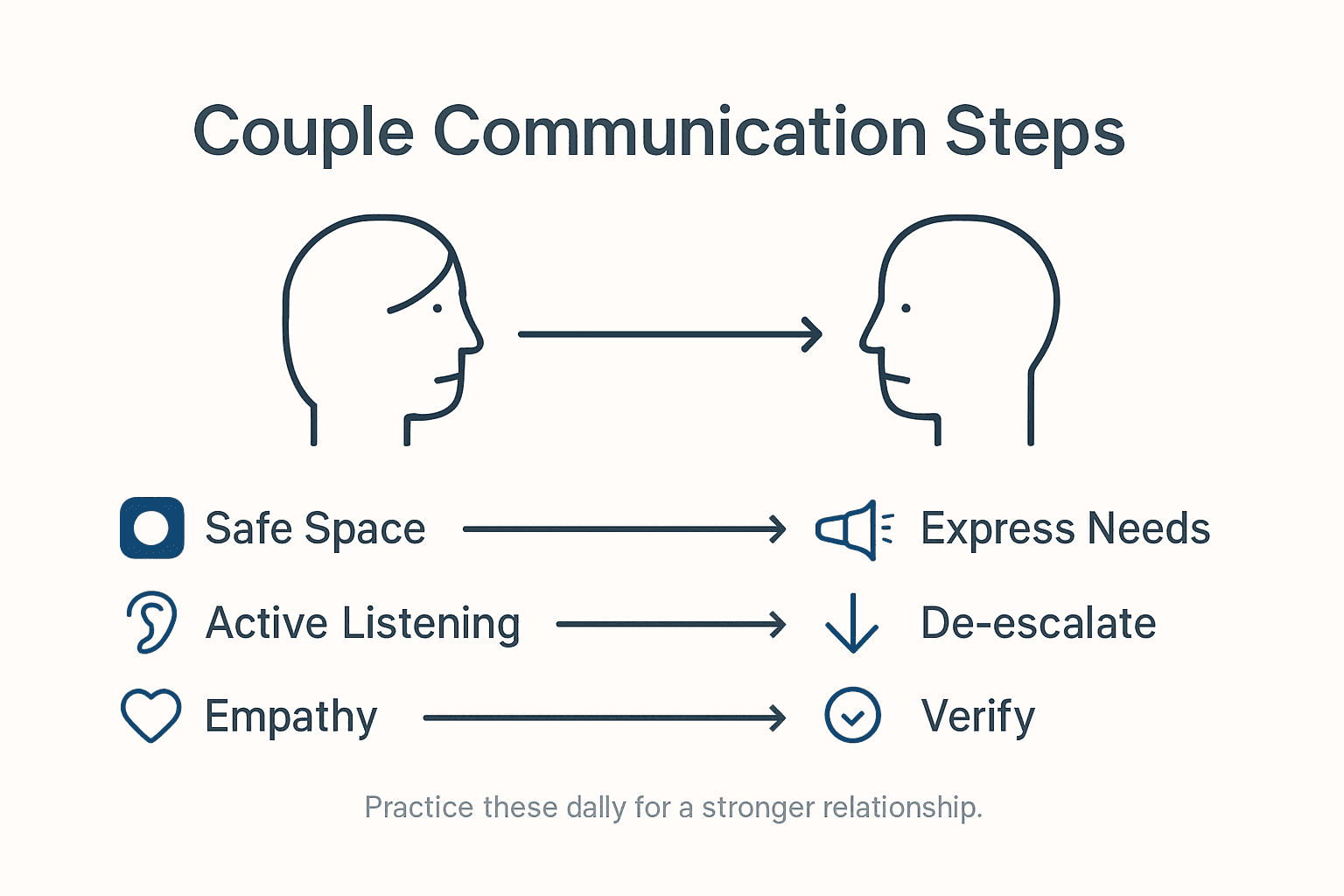
Conflict does not have to ruin connection for couples in North Carolina and South Carolina. In fact, research shows that over 60 percent of American couples cite communication issues as their biggest relationship hurdle. Choosing evidence-based strategies to talk through disagreements can transform tension into deeper trust and satisfaction. This guide reveals practical methods to help you create a safe space, listen actively, and express your needs clearly so your partnership grows stronger with every conversation.
Table of Contents
- Step 1: Establish A Safe Space For Dialogue
- Step 2: Practice Active Listening And Empathy
- Step 3: Express Needs And Feelings Clearly
- Step 4: Utilize Conflict De-escalation Strategies
- Step 5: Apply Verification Techniques For Understanding
Quick Summary
| Key Point | Explanation |
|---|---|
| 1. Create a Safe Dialogue Space | Establish ground rules for respect and listening to foster open communication during conflicts. |
| 2. Practice Active Listening | Engage fully with your partner’s emotions by focusing on understanding without preparing responses. |
| 3. Express Needs Clearly | Use “I feel” statements to articulate your emotional needs without blaming, inviting healthier dialogue. |
| 4. Use Conflict De-escalation Strategies | Maintain a calm demeanor, utilize reflective listening, and create physical space to reduce tension. |
| 5. Apply Verification Techniques | Summarize your partner’s messages and ask for confirmation to ensure mutual understanding and clarity. |
Step 1: Establish a Safe Space for Dialogue
Creating a safe emotional environment is fundamental to resolving conflicts effectively. When couples learn to communicate openly without fear of judgment, they transform potential arguments into opportunities for deeper understanding.
To establish a safe dialogue space, start by setting clear ground rules that prioritize respect and active listening. This means agreeing to hear each other without interrupting, criticizing, or becoming defensive. Promoting diverse viewpoints and respectful communication allows both partners to share their experiences honestly. Choose a neutral location in your home where both of you feel comfortable talking without distractions – perhaps a quiet living room corner or a peaceful outdoor space.
The key is creating an atmosphere of trust and vulnerability. Use gentle body language, maintain soft eye contact, and sit at an equal level to demonstrate you are truly listening. When your partner speaks, practice reflective listening by summarizing what you heard to ensure you understand their perspective. Avoid attacking statements and instead use “I feel” phrases that express your emotions without blaming.
This table summarizes key body language signals and their impact on relationship communication:
| Body Language Signal | Communication Impact | When to Use |
|---|---|---|
| Soft eye contact | Builds trust and openness | During sensitive discussions |
| Relaxed posture | Reduces tension | In conflict or emotional talks |
| Nodding | Demonstrates attentive listening | When partner shares feelings |
| Equal physical level | Conveys partnership | Throughout meaningful conversations |
Pro Tip: Schedule regular communication check-ins at consistent times, ensuring both partners are mentally prepared and have sufficient uninterrupted time to discuss important relationship topics.
Step 2: Practice Active Listening and Empathy
Active listening and empathy are powerful communication techniques that transform conflict into connection. By fully engaging with your partner’s emotional experience, you create a foundation of understanding that can heal even the deepest relationship wounds.

To practice active listening, start by giving your partner your undivided attention. Put away electronic devices, maintain open body language, and focus completely on understanding their perspective. This means listening to comprehend, not to respond or defend yourself. Use nonverbal cues like nodding and maintaining soft eye contact to show you are genuinely hearing them. When they finish speaking, reflect back what you heard using phrases like “What I understand you’re saying is…” or “It sounds like you feel…” This demonstrates that you are truly processing their emotional experience.
Empathy goes beyond simply hearing words it means connecting with the underlying emotions. Try to imagine yourself in your partner’s situation without judgment. Validate their feelings by acknowledging them directly: “I can see why you would feel frustrated” or “That must have been really challenging for you.” Remember that empathy does not mean agreeing with everything your partner says, but showing that you respect their emotional reality.
Pro Tip: Practice a 5-minute daily listening exercise where one partner speaks uninterrupted while the other listens completely, then summarizes what they heard without defensiveness or counterarguments.
Step 3: Express Needs and Feelings Clearly
Communicating your emotional needs effectively is an art that transforms relationship dynamics. Learning to articulate your feelings without blame creates a pathway for genuine understanding and collaborative problem solving.
Start by understanding the difference between observations and interpretations. When expressing your feelings, focus on describing specific behaviors rather than making accusatory statements. Use “I feel” statements that center your emotional experience. For example, instead of saying “You never listen to me,” try “I feel frustrated when I sense you are not fully hearing my perspective.” This approach invites dialogue instead of triggering defensive reactions. Be precise about your emotions use words that accurately capture your internal experience like “disappointed,” “overwhelmed,” or “uncertain” rather than broad terms like “bad” or “upset.”
Structure your emotional communication using a clear framework. Begin with a neutral observation of the situation, then describe your emotional response, and finally articulate the specific need or request you have. This method helps your partner understand the full context of your feelings. For instance, “When I noticed we didn’t discuss our weekend plans (observation), I felt anxious and disconnected (emotion), and I would appreciate if we could schedule a 15-minute planning conversation (need).” By breaking down your communication into these components, you create a compassionate space for mutual understanding.
Pro Tip: Practice your emotional expression in a mirror beforehand to build confidence and clarity in communicating your feelings without becoming emotionally overwhelmed.
Step 4: Utilize Conflict De-escalation Strategies
Conflict de-escalation requires strategic communication skills that transform heated moments into opportunities for understanding. Learning to navigate emotional intensity can turn potential arguments into constructive conversations that strengthen your relationship.
Effective de-escalation begins with purposeful actions that reduce tension, starting with your own emotional state. When conflict emerges, focus on maintaining a calm demeanor by taking deep breaths and speaking in a measured tone. Your body language matters significantly lower your shoulders, unclench your hands, and maintain a relaxed posture that signals openness. Avoid crossing your arms or standing too close, which can feel confrontational. Instead, create physical and emotional space that allows both partners to feel safe and heard.
Verbal de-escalation techniques are equally critical. Use reflective listening to demonstrate that you understand your partner’s perspective without immediately defending yourself. Acknowledge their feelings with statements like “I hear that you are feeling frustrated” or “It sounds like this situation is really challenging for you.” Ask open ended questions that invite dialogue rather than making accusatory statements. Recognize and name the emotions you observe without judgment. When tensions start rising, suggest a temporary pause in the conversation with a compassionate phrase like “I care about resolving this together. Would it help if we took a 10 minute break and came back when we both feel calmer?”
Pro Tip: Create a mutual “pause signal” with your partner beforehand something like a specific hand gesture or code word that either of you can use to temporarily halt an escalating conversation without feeling attacked.
Step 5: Apply Verification Techniques for Understanding
Effective communication is not just about speaking but ensuring your message is truly understood. Verification techniques help transform potential misunderstandings into opportunities for deeper connection and mutual clarity.
Verification methods are essential for confirming accurate message transmission and preventing communication breakdowns. Begin by practicing reflective listening where you summarize what your partner has said in your own words. For example, after they share their perspective, respond with something like “So what I hear you saying is…” This approach allows your partner to confirm or clarify their message. Ask open ended questions that invite detailed explanation rather than questions that can be answered with simple yes or no responses. When your partner speaks, focus on understanding their underlying emotions and experiences rather than preparing your defensive response.
Structure your communication using precise language and emotional transparency. Use “I feel” statements that clearly articulate your emotional experience without blaming. For instance, instead of saying “You always ignore me,” try “I feel disconnected when I sense you are not fully engaging with my thoughts.” After making a statement, explicitly request confirmation from your partner. Ask “Does this resonate with your experience?” or “Have I understood your perspective correctly?” This demonstrates your genuine commitment to understanding their point of view and creates a collaborative communication environment where both partners feel heard and valued.
Pro Tip: Practice the 3-step verification method pause after your partner speaks, reflect back what you heard, and then ask for confirmation to ensure complete understanding.
Here’s a comparison of common communication pitfalls versus recommended strategies in relationships:
| Challenge Area | Typical Pitfall | Recommended Strategy |
|---|---|---|
| Dialogue Environment | Expressing criticism | Setting ground rules of respect |
| Listening | Interrupting the speaker | Practicing active listening |
| Empathy | Invalidating emotions | Acknowledging and validating feelings |
| Expressing Needs | Using blaming statements | Stating specific feelings and needs |
| Conflict Resolution | Escalating tension quickly | Using de-escalation techniques |
| Message Verification | Assuming understanding | Asking for confirmation |
Strengthen Your Relationship with Expert Guidance on Communication and Conflict Resolution
The article highlights the challenges couples face when trying to establish safe dialogue, practice active listening, and express needs without blame. If you or your partner struggle with de-escalating conflicts or verifying understanding during tough conversations, you are not alone. These communication hurdles can cause emotional distance and frustration. Mastering Conflict offers specialized couples therapy and conflict resolution coaching designed to help you develop these essential skills with professional support.

Take control of your relationship today by learning effective strategies directly from licensed clinicians led by Dr. Carlos Todd. Visit Mastering Conflict to explore tailored programs that address anger management, emotional expression, and empathy building. Don’t wait for conflicts to escalate. Act now to create a partnership rooted in respect, safety, and genuine understanding.
Frequently Asked Questions
How can I create a safe space for communication in my relationship?
Creating a safe space for communication involves setting ground rules that prioritize respect and active listening. Start by choosing a neutral location in your home, agree on behaviors such as no interrupting, and remind each other to use “I feel” statements while discussing feelings.
What are effective techniques for practicing active listening with my partner?
Active listening can be practiced by giving your partner your full attention, maintaining open body language, and summarizing what they say. After they finish speaking, reflect back their thoughts to ensure you understand their perspective, using phrases like “What I understand you’re saying is…”.
How should I express my needs and feelings without blaming my partner?
To express your needs clearly, focus on using “I feel” statements that highlight your emotional experience rather than accusatory remarks. For example, instead of saying, “You make me angry,” try, “I feel upset when our plans change unexpectedly.” This encourages understanding and reduces defensiveness.
What strategies can help de-escalate conflicts when they arise?
De-escalation strategies include maintaining a calm demeanor, using reflective listening, and suggesting breaks during heated moments. For instance, try saying, “Can we take a 10-minute break to clear our heads and come back to this?” to prevent further escalation.
How can I ensure my partner truly understands my perspective during discussions?
To verify understanding, practice reflective listening by summarizing what your partner has said and then asking for confirmation. Use phrases like, “Does this resonate with your experience?” This encourages open dialogue and ensures both partners feel heard.
Can you provide a quick summary of what to avoid in couple communication?
Avoid common pitfalls like interrupting your partner, using accusatory language, and escalating tensions quickly. Instead, aim to establish respectful dialogue, validate each other’s feelings, and utilize de-escalation techniques during conflicts.
Recommended
- How to Deal With Parenting Conflicts
- Enhance Your Relationship: Couples Communication Exercises – Mastering Conflict
- Communication Skills for Couples: Guide to Connection and Conflict Resolution – Mastering Conflict
- Effective Conflict Resolution Steps for Couples, Families, and Professionals 2025 – Mastering Conflict
- blog | siift | Business Communication Skills for Aspiring Entrepreneurs 2025