Conflict Resolution Strategies for Teachers: A Practical Guide

The most reliable way to resolve classroom conflict is to lower the temperature first, then listen to each person, then solve the problem together and follow up. Teachers who do this in a predictable order, and teach students the same order before problems arise, spend less class time on disputes and keep relationships intact. This guide walks through the strategies that university teaching centers, education agencies and researchers recommend, with scripts and timings you can adapt to your grade level.
TL;DR
- Pause before you react: manage your own emotions and body language first, then address the behavior rather than the person.
- For student-to-student disputes, use a short protocol: cool off, each child speaks and is heard, both take responsibility, choose a solution, follow up.
- Teach the steps before you need them. A process students already know works faster than one introduced mid-argument.
- Prevent conflict with co-created class norms and strong relationships, and use private conversations for teacher-student friction.
- For persistent conflict or school-wide patterns, look at restorative practices, peer mediation and professional training.
Table of Contents
- Start with your own reaction
- A protocol for student-to-student conflict
- When you have ten minutes: a timed version
- A needs-based script for older students
- Listening tools for tense moments
- Handling disruptive behavior without a standoff
- When the conflict is with you
- Prevention: the strategies that work before conflict starts
- Strategies for the whole school
- Training for teachers
- Perspective
- Support from Mastering Conflict
- FAQ
- Sources
Start with your own reaction
Most advice on classroom conflict begins with the adult. Cornell’s Center for Teaching Innovation advises instructors to control their emotional reactions, watch their body language and address behaviors rather than people. It also suggests applying class norms consistently and asking to speak with a student privately instead of escalating in front of peers.
Cornell also offers a short framework called SOAR: stop, observe, assess, react. In practice it looks like this:
- Stop. Take one slow breath before you speak. Lower your voice rather than raise it.
- Observe. Notice what is actually happening: who is involved, what was said, what the rest of the class is doing.
- Assess. Decide whether this needs handling now, in the hallway, or after class. A public power struggle rarely ends well.
- React. Respond to the behavior with a calm, specific statement, such as “I need the phones away so we can finish this problem,” instead of a comment on the student’s character.
The point is not to look unmoved. It is to give yourself two seconds so that your response teaches the skill you want students to learn.
A protocol for student-to-student conflict
When two students are in a dispute, a fixed sequence gives everyone something to hold onto. Several sources describe almost the same sequence under different names. Waterford.org lays out six steps: cool off; share, listen and check using I-statements; take responsibility; brainstorm solutions; choose a solution; and affirm, forgive or thank. Responsive Classroom describes a seven-step version in which each child states the issue and the other paraphrases it, repeating until both feel fully heard. It also notes that the physical stress response impedes logical thinking and increases aggression, which is why cooling off comes first.
Here is a merged version that works for most elementary and middle school settings.
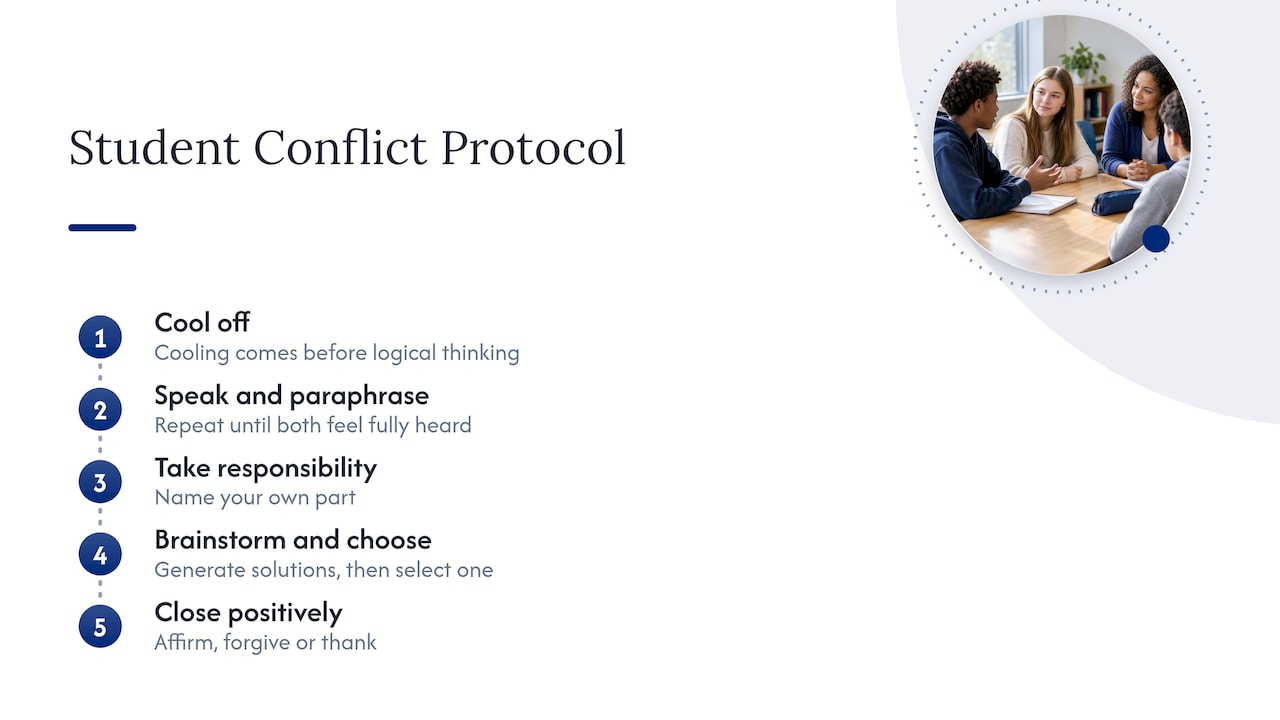
Step 1: Cool off
Give students a few minutes apart. A calm corner, a drink of water or a short walk with a buddy all work. Do not try to reason with a child who is still flooded with adrenaline.
Step 2: Each student speaks, the other paraphrases
One student describes what happened using an I-statement: “I felt left out when you walked away during the game.” The other repeats what they heard before replying. Switch roles. Continue until both say they feel understood. This is the step that takes the longest and does the most work.
Step 3: Name your own part
Ask each student, “What did you do that made this harder?” Students who have been heard are far more willing to answer this honestly.
Step 4: Brainstorm, then choose
Ask for two or three ideas from the students, not from you. The Teaching Channel’s four-step peace-making process ends with students choosing a solution together, and stresses that it works best when students learn the process before they need it.
Step 5: Close and follow up
Have each student restate the agreement. Then check in a day or two later. The CA Inclusion guide to conflict resolution steps finishes with teacher follow-up and positive descriptive praise, for example “You two worked that out and played together at recess. That took patience.”
When you have ten minutes: a timed version
Teachers rarely have an hour. Edutopia’s article on an effective student conflict protocol describes a roughly 10-minute structure:
| Phase | Time | What happens |
|---|---|---|
| Hear Them Out | 3 minutes | Each student shares their view without interruption |
| Affirm & Share | 3 minutes | Students acknowledge what the other said and share common ground |
| Meet Halfway | 3 minutes | Students propose and agree on a compromise |
| Reflection and Closure | 2 minutes | Each party restates the agreed solution |
This is useful for a conflict that surfaces during a transition or at the start of a period. If emotions are still high, go back to cooling off before starting the clock.
A needs-based script for older students
Middle and high school students often resist scripted steps but respond to a simple structure. Ilana Nankin, Ph.D., describes a four-part process: state an observation without judgment, name the feeling, name the underlying need, and make a specific, doable request. She notes that the needs step is the hardest for students and adults alike.
Example: “When you shared my message in the group chat (observation), I felt embarrassed (feeling). I need to know my private messages stay private (need). Can you delete it and ask me before sharing next time (request)?”
Practice the script on low-stakes scenarios first, such as someone borrowing a pencil without asking, so that it is familiar when the stakes are higher.
Listening tools for tense moments
Some conflicts erupt mid-lesson, especially when a discussion touches identity, politics or current events. UMass Amherst’s Center for Teaching & Learning recommends the LARA method for these “hot moments”: Listen, Affirm, Respond, Ask. It also suggests mindful breathing, acknowledging feelings and using the moment as a learning opportunity.
A LARA response might sound like this:
- Listen: let the student finish, without interrupting.
- Affirm: “I can hear this matters a lot to you.”
- Respond: address the content briefly and calmly.
- Ask: “What would help us keep discussing this respectfully?”
Cornell adds that dialogue goes better when it is focused on academic concepts rather than personal opinions. Redirecting to the text, the data or the question at hand gives students a way to disagree without attacking one another.
The European School Education Platform makes a related point: active listening can build trust between teacher and pupil and among pupils, and teachers resolve issues more effectively when they identify the conflict together with pupils and take in their ideas for solutions.
Handling disruptive behavior without a standoff
Disruption and conflict often overlap. A few habits keep the two from feeding each other:
- Correct privately when you can. A quiet word at the student’s desk or a short chat in the hall removes the audience.
- Use impromptu conferences. The Learning Policy Institute brief on secondary classroom relationships describes brief student conferences during instructional time to redirect behavior with minimal disruption.
- Use affective statements. The same brief describes statements that focus on the speaker’s own perceptions and feelings, such as “I feel worried when I see the class getting off track,” instead of accusations about what the student did.
- Apply norms the same way every time. Students read inconsistency as unfairness, and unfairness fuels conflict.
When the conflict is with you
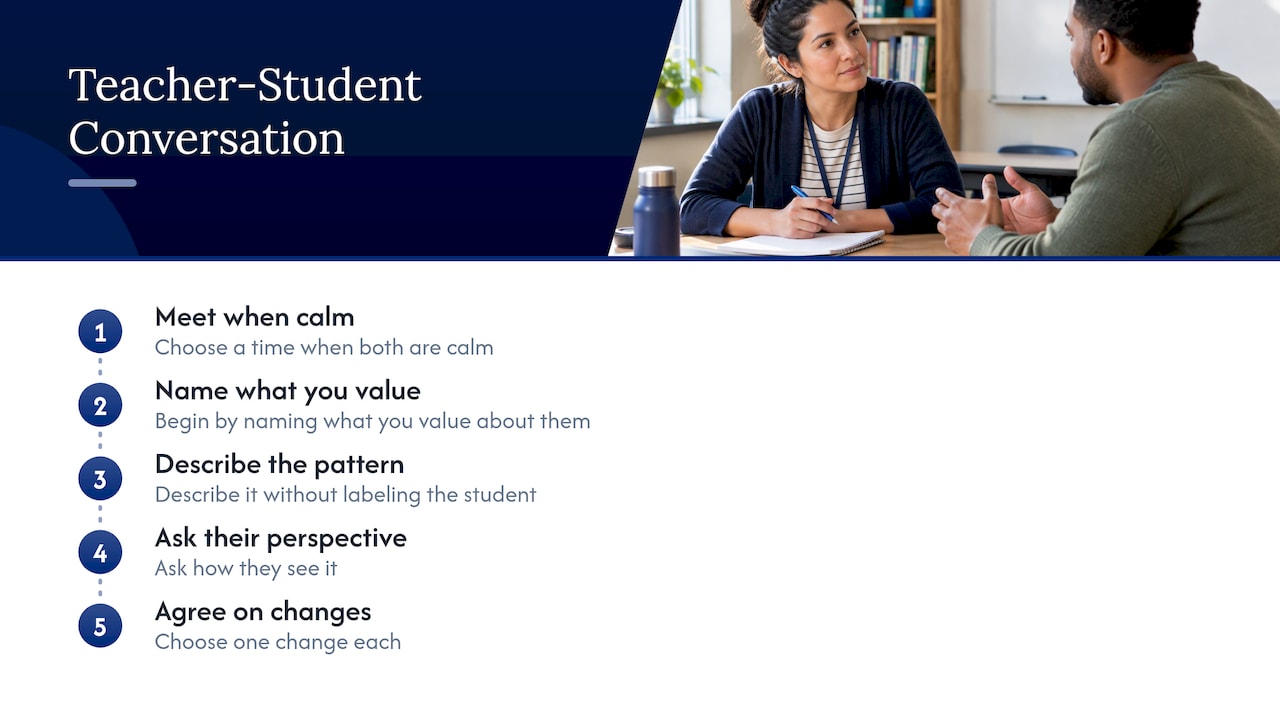
Teacher-student conflict needs a different tool than peer conflict, because power is unequal. One option is teacher-student mediation. Brookes Publishing’s guide, Restore the Respect, describes it as a voluntary meeting between a teacher, a student and a trained mediator, usually held in a private office over a 50-minute period. It rests on four principles adapted from the 2005 Model Standards of Conduct for Mediators: impartiality, confidentiality, self-determination and voluntariness.
Even without a formal mediator, you can borrow the spirit of it. Ask the student to meet when you are both calm, begin by naming what you value about them, describe the pattern you have seen without labeling them, and ask how they see it. Then agree on one change each of you will make.
Prevention: the strategies that work before conflict starts
A large share of classroom conflict can be reduced upstream.
Build norms together
The Learning Policy Institute authors emphasize that when classroom practices are developed collaboratively, students gain ownership of the norms and a clearer understanding of what is expected of them as members of the classroom community. In practice, spend the first week co-writing three to five agreements and revisit them after breaks.
Invest in relationships
A meta-analysis by Kincade, Cook and Goerdt found that universal, school-wide programs improving student-teacher relationships had the largest effects with the Establish-Maintain-Restore and BRIDGE programs. It identified 44 practices teachers can use to promote positive relationships, 14 of them proactive and direct. Greeting students at the door, learning something about their lives and repairing quickly after a rough moment are all examples of this kind of practice.
Teach the skills explicitly
Students cannot use a script they have never seen. Role-play disagreements, post the steps on the wall, and let students call for a “cool-off” without penalty. The NSW Department of Education’s conflict resolution guidance recommends a safe space, positive role modeling, helping students understand how the other person feels, teaching calming strategies, and practicing I-statements, reflective listening and problem-solving.
For younger children, the “Four C’s” are a memorable frame. One program for elementary students describes them as come together, compromise, change and celebrate. Note that other sources use “4 C’s” for different lists, so if your school adopts a version, teach that one consistently.
Strategies for the whole school
If conflict keeps recurring across classrooms, individual teacher skill is not enough. Restorative practices give schools a shared language. The RJ Partnership’s implementation guide describes dialogues, peace circles, conferencing and peer-led mediation as ways to address the root causes of student behavior, and says that restorative practices build community and teach the social-emotional and conflict-resolution skills that reduce conflict.
The research base deserves a realistic read. A systematic review of systematic reviews by Lester, Lawrence and Ward found that cognitive behavioral, social-emotional and peer mentoring or mediation programs showed promise in reducing peer aggression. The authors also noted that the evidence is hard to navigate and that more research is needed on long-term effects. The practical takeaway: choose a program, implement it consistently across staff, and review how it is working.
If you are weighing how to involve parents and clinicians in school conflict plans, our guide on conflict management in schools covers the safety side. For younger students, see our conflict resolution strategies for kids, and for a broader overview of models, our approaches to conflict resolution.
Training for teachers
Skills improve with practice and feedback. Useful professional development usually includes role-play of real scenarios, instruction in de-escalation and active listening, and a plan for applying restorative practices in your own building. Ask your district about professional learning time, and consider peer observation: watching a colleague handle a dispute teaches more than a slide deck.
Perspective
We work with couples, families, teens and adults whose conflicts did not begin in adulthood. Many began in rooms where nobody taught them how to disagree safely. That is why we believe the teacher’s role in conflict is larger than it looks: you are modeling, every day, what a calm response sounds like.
Our approach combines clinical rigor with tools people can actually use. The same principles that help a couple in our practice, such as slowing down, naming the feeling, listening until the other person feels heard and agreeing on a specific next step, are the ones teachers can use with students. They are not complicated, but they take repetition.
We also see how much teachers carry. Managing conflict all day, with little recovery time, wears people down. Learning conflict skills yourself, and getting support when a pattern at school or at home keeps repeating, is part of doing this work well. Skilled counseling and coaching can give you a space to practice that is separate from your classroom.
Carlos
Support from Mastering Conflict
If classroom stress is spilling into your own life, or a student’s anger and family conflict are a pattern you want help with, we offer several routes. Our anger management classes are available online, starting with a 1 Hour Anger Management Class at $24.99. For individuals, couples and teens, our counseling services include Counseling for Women, Counseling for Men and Teen Boys & Girls Counseling, and clinicians can explore clinical mentoring or clinical supervision. Dr. Carlos Todd, a licensed clinical mental health counselor and psychologist, founded the practice.
To see everything in one place, start at Mastering Conflict.
FAQ
How can a teacher resolve conflict in the classroom?
Stay calm, address the behavior rather than the person, and give students time to cool down before talking. Then let each student speak and be heard, agree on a solution together and follow up later. Cornell’s teaching center recommends the SOAR approach of stop, observe, assess and react.
What steps can teachers use to help students resolve a conflict?
A common sequence is cool off, each student shares using I-statements, each takes responsibility, brainstorm solutions, choose one and close with thanks or affirmation. When time is short, a 10-minute protocol of hearing each student, affirming, finding a compromise and restating the agreement works well.
What are the 4 C’s of conflict resolution?
There is no single universal list. One elementary program uses come together, compromise, change and celebrate. If you use a four-C model with students, pick one version and teach it consistently so they remember it under stress.
Should teachers handle conflict with a student in private?
Usually yes. Cornell’s guidance suggests asking to speak with a student privately, which avoids public power struggles. A short conversation after class or a brief conference at the student’s desk lets you describe the behavior and listen without an audience.
When should a conflict go beyond the teacher?
When it is recurring, involves safety, or is tied to what is happening at home, involve your school counselor, administrators and the student’s family. Restorative programs, peer mediation and counseling can support students when classroom strategies alone are not enough.
Sources
- Managing Classroom Conflict, Cornell Center for Teaching Innovation
- Managing the classroom in a positive way, European School Education Platform
- How Do I Navigate Hot Moments in the Classroom? UMass Amherst
- Restore the Respect, Brookes Publishing
- An Effective Protocol for Student Conflict Resolution, Edutopia
- Conflict resolution, NSW Department of Education
- Conflict Resolution Steps, CA Inclusion
- Resolving Conflict in the Classroom, Teaching Channel
- Coaching Children in Handling Everyday Conflicts, Responsive Classroom
- Classroom Conflict Resolution Techniques, Waterford.org
- How to Teach Conflict Resolution to Students, Ilana Nankin
- Cultivating Relationships in Secondary Classrooms, Learning Policy Institute
- Meta-Analysis of Universal Student-Teacher Relationship Programs
- School-Wide Restorative Implementation Guide, RJ Partnership
- What do we know about preventing school violence? Lester, Lawrence and Ward
- Help Students Compromise with the Four C’s, Wings for Kids