
How to Deal With Anger Issues in a Relationship

The most reliable way to deal with anger issues in a relationship is to learn your own early warning signs, pause before anger takes over, come back and talk about the issue calmly, and get structured professional help when the pattern keeps repeating. Anger is a normal emotion. The trouble starts when it runs the conversation, frightens your partner, or leaves you regretting what you said. Working with a licensed clinician on the pattern, rather than only trying to white-knuckle it, is what turns a few good intentions into lasting change. At Mastering Conflict, our founder Dr. Carlos Todd is a licensed clinical mental health counselor and psychologist, and we offer anger management classes, individual counseling and couples therapy, in person and online.
TL;DR
- Learn your body’s early signals (tight jaw, heat, racing heart) and act on them before you speak.
- Agree on a time-out plan with your partner in advance: how long, where you will be, and how you will check back in.
- Raise problems gently, with “I” statements, one issue at a time.
- Seek professional help if you cannot control your anger, your partner feels afraid, or the same fights keep coming back.
- If anyone is in danger, safety comes first, and couples work is not the right starting point.
Table of Contents
- Why anger shows up in relationships
- Signs your anger is becoming a problem
- Step 1: Learn your own warning signals
- Step 2: Pause in the moment
- Step 3: Come back and talk it through
- Step 4: Build habits that lower your baseline
- Can anger issues be cured?
- When to get professional help
- What working with us looks like
- Our perspective
- FAQ
- Sources
Why anger shows up in relationships
Close relationships touch our deepest needs: respect, closeness, security. So a small trigger, such as a forgotten chore or a tone of voice, can set off a big reaction. Washington State’s Department of Social and Health Services describes anger as the most common emotional state that comes before intimate partner violence, and notes that anger which doesn’t fit the facts, or is too strong, can lead to threatening behavior. The same guide shows how angry thinking often reads other people’s motives as hostile.
Anger can also feel like it pays off: you get your way, you release tension, you feel in control. The same guide points out that the costs to your partner and to you far outweigh those payoffs.
Other things make anger harder to manage. Healthy Male notes that depression, anxiety, stress, alcohol or substance use, poor sleep, chronic pain and difficult childhood or traumatic experiences all raise the chance of expressing anger in unhelpful ways. That matters because it means anger issues are rarely a character flaw. They are usually a pattern with causes you can work on.
Signs your anger is becoming a problem
The UK charity Mind lists signs that anger is a problem:
- You feel unable to control it.
- You express it through violence or self-harm.
- You worry your behavior may become abusive.
- It damages your relationships or work.
- You regularly frighten or upset people around you.
- You regret what you say or do.
- You use alcohol or drugs to cope.
From your partner’s side, Healthy Male describes anger that is out of control as being triggered by minor problems, escalating quickly, picking fights, staying angry for a long time, and involving threats, physical aggression or property damage. Partners often describe feeling like they are “walking on eggshells.” If that sounds like your home, it is a clear reason to get support. We cover the early cues in more detail in our guide to anger warning signs and how to respond early.
Step 1: Learn your own warning signals
Anger builds in the body before it reaches your words. The US Department of Veterans Affairs lists physical signs of escalating anger: an adrenaline rush, muscle tension, headaches, feeling hot, sweating, stomachache, shaking and holding your breath. It also points to the feelings (fear, rejection, hopelessness) and thoughts (“She doesn’t respect me”) that ride along.
Try this for two weeks: after each heated moment, jot down what happened, what your body did first, what you told yourself, and what you felt underneath. The Defense Health Agency’s Real Warriors Campaign recommends journaling to see how and why you get angry. Patterns appear quickly. Many people find the anger sits on top of something softer, such as feeling ignored or criticized.
Where this goes wrong: people keep the journal only when they are calm and skip it when they are furious. Write one line right after an episode, even if it is rough.
Step 2: Pause in the moment
Once you notice the signals, slow everything down. Two tools have good support.
A 10-second reset. Utah State University Extension teaches a P.A.U.S.E. routine: press your feet into the floor, unclench your jaw, drop your shoulders, open your hands, take a deep breath with a longer exhale, lower your voice, and slow your speech by about 10 percent.
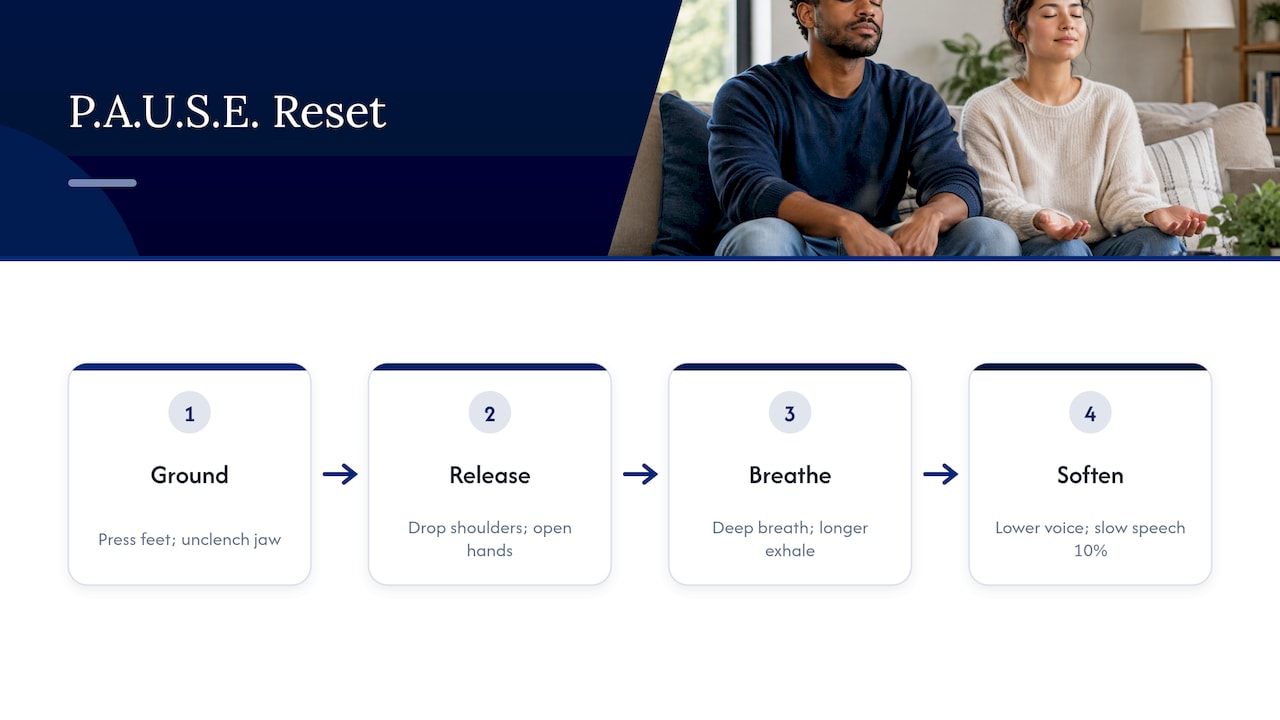
A real time-out. If either of you is flooded, the same source advises a break of at least 20 minutes, saying you will return, and using the time to calm down rather than rehearse your argument. The American Psychological Association adds that you should slow down before responding rather than saying the first thing that comes to mind, and that slow breathing from the diaphragm and repeating a calm word or phrase can help.
Agree on the time-out before you need it
A time-out only works when it is not read as stonewalling. The VA advises telling your partner how long the break will last, where you will be and how you will check back in, and settling that process when you are both calm. Some couples pick a hand signal. Others use a phrase such as “I need ten, and I’ll be back.”
Sample script: “I can feel myself getting heated and I want to handle this well. I’m going for a walk and I’ll be back in 20 minutes so we can finish this.”
Where this goes wrong: leaving without saying you will return, or coming back with a list of new accusations. The break is for regulating, not reloading.
Step 3: Come back and talk it through
The break only helps if the issue gets addressed afterward. Utah State University Extension’s de-escalation guide recommends:
- Start gently, with what Dr. John Gottman calls a “soft startup”: raise the issue without attacking.
- Use “I” statements and avoid “you,” “always” and “never.”
- Stick to one issue at a time.
- Show you are listening.
The Real Warriors Campaign gives a model: “I feel frustrated when we are not equally sharing household tasks.” Compare that to “You never help around here.” The first describes you. The second starts a trial.
The APA also suggests listening for what sits underneath your partner’s anger, for example a wish for more closeness, and not letting either person’s anger spin the discussion out of control. The CDC notes that deficits in communication skills raise the risk of both perpetrating and experiencing partner violence, and that prevention programs should teach conflict resolution, positive communication and anger management. In plain terms, these are skills, and skills can be learned. Our guides on communication skills for couples and couple communication techniques walk through them in more depth.
A simple weekly structure helps. The Real Warriors Campaign suggests a communication plan with scheduled discussions, active listening, boundaries and “I” statements, so hard topics are not raised at 11 p.m. in the middle of a bad day.
Step 4: Build habits that lower your baseline
In-the-moment tools work better when your baseline is lower. Mayo Clinic’s list of anger management tips includes physical exercise, looking for solutions rather than dwelling on what made you mad, and letting go of grudges. Sleep, alcohol and stress also matter, since Healthy Male links each to harder-to-control anger.
If you notice you are using alcohol or drugs to cope, treat that as part of the anger problem. The VA stresses getting help for untreated alcohol, drug or mental health issues because they make relationship problems harder to address.
Can anger issues be cured?
Anger problems are very treatable, even if “cured” is not quite how clinicians describe it. The goal is skills and insight that let you respond rather than react. The Association for Behavioral and Cognitive Therapies says cognitive behavior therapy techniques have been shown effective for reducing anger and often represent the treatment of choice.
Research backs this up. In a randomized trial of 92 post-9/11 veterans, cognitive behavioral therapy adapted from Novaco’s Anger Control Therapy improved anger severity, aggressive outbursts, social and interpersonal functioning, and quality of life more than supportive therapy. A smaller study of 30 men with high anger found significant drops in anger and improved interpersonal relationships after acceptance and commitment therapy and after CBT.
The practical takeaway: structured, skills-based work with a trained professional, with practice between sessions, is what moves the needle.
When to get professional help
Mind’s guidance is to seek support if you feel unable to control your anger, express it through violence or self-harm, worry your behavior may become abusive, or see it hurting your relationships, work, studies or health. Add to that the signs from your partner’s side: fear, eggshell-walking, or the same blow-up every week.
Who should you see?
- Individual counseling when the anger is yours and you want to understand your triggers and build skills. We offer counseling for men, counseling for women, and teen counseling for younger people whose anger is affecting home and school, along with anger management counseling and online anger management.
- Couples counseling when the fights are a shared pattern and both of you want to change it. See our couples counseling page.
- A class when you want a structured, self-paced start. Our anger management classes run 1, 6 or 8 hours online.
A safety note for couples
Couples therapy is not right for every situation. A peer-reviewed review published by the American Psychological Association states that couples therapy is not recommended when one partner uses violence to intimidate, control and gain power over the other, and that an in-depth assessment of violence is needed before couples-based treatment. If you are afraid of your partner, you can seek individual support first. In an emergency, call 911. The National Domestic Violence Hotline is available 24/7 at 1-800-799-7233.
Colorado State University Extension’s safety plan includes noticing escalation signals, removing yourself to a safe place, keeping weapons and alcohol out of reach, and contacting trusted people or a national hotline.
What working with us looks like
Our work is built around doctoral-level expertise and evidence-based frameworks developed by Dr. Todd, with practical tools you can use the same week. Options include:
| Option | What it is | Price |
|---|---|---|
| 1 Hour Anger Management Class | Short online class | $24.99 |
| 6 Hour Anger Management Class | Online class | $79 |
| 8 Hour Anger Management Class | Online class | $85 |
| 4-Hour Program | Anger management program | $149 |
| 8-Hour Program | Anger management program | $249 |
| Couples sessions | One-hour sessions | $175 per hour |
| 6 Hour Couples Intensive | Focused couples work | $1,995 |
Individual, family and teen counseling are also available, and online options mean you can work with us from outside the Carolinas and Florida. If a relationship has been hurt by an affair, we also offer RESTORE infidelity recovery.
A good first step is the anger management classes if you want to start today, or the clinical services page to book counseling.
For a deeper read on the topic, see our posts on controlling anger issues in a relationship and anger management in relationships.
Our perspective
Most people who come to us do not want to be angry people. They want to stop losing the person they love in the middle of an argument.
What we see as the real turning point is when anger stops being treated as the enemy and starts being treated as information. Underneath it is usually a need: respect, closeness, safety. Our approach pairs clinical rigor with tools you can use in the next argument, because insight with no practice rarely changes a Tuesday night.
We also believe the setting matters. Some people do best one on one first. Some couples do best together. Some want a class they can finish on their own schedule. Having all of these in one place, in person in the Carolinas and Florida and online anywhere, lets us fit the work to the person, and to the culture and background they bring with them.
If your anger is costing you your relationship, that is worth working on with a licensed professional, and it is very workable.
Carlos
FAQ
How do you control your anger in the moment?
Notice the first body signal, such as a clenched jaw or racing heart, and slow down. Breathe with a longer exhale, lower your voice and, if needed, take a break of at least 20 minutes, telling your partner you will come back. Use the break to calm down, not to rehearse your case.
How do I know if I have an anger issue?
It is worth getting help if you cannot control your anger, regret what you say or do, frighten the people around you, or notice it damaging your relationship or work. If you worry your behavior may become abusive, reach out to a licensed professional promptly.
Can couples work on anger together?
Often, yes. Couples can agree on a time-out plan, practice “I” statements and schedule hard conversations. When there is violence, intimidation or fear, a professional assessment should come first, and individual support may be the safer starting point.
Is online anger management a good option?
It suits people who want privacy and a flexible schedule, and it lets you work with us from anywhere. We offer online classes as well as online anger management counseling.
Sources
- CBT Guide for Intimate Partner Violence, Washington State DSHS
- When is anger a problem? Mind
- What to do when your partner has an anger problem, Healthy Male
- Intimate Partner Violence Assistance Program, US Department of Veterans Affairs
- Managing Anger in Your Relationship, Defense Health Agency
- When Emotions Take Over: Learning to P.A.U.S.E., USU Extension
- Control anger before it controls you, American Psychological Association
- During the Fight: Skills for De-escalating Conflicts, USU Extension
- Intimate Partner Violence Prevention Resource for Action, CDC
- Anger management: 10 tips to tame your temper, Mayo Clinic
- Anger fact sheet, ABCT
- Treatment of anger problems in previously deployed post-9/11 veterans
- Efficacy of Acceptance and Commitment Therapy compared to CBT for anger
- Couples therapy and intimate partner violence, APA
- Dealing with Our Anger, Colorado State University Extension