
Mediation and Dispute Resolution: How the Process Works

Mediation is a dispute resolution process in which a neutral third person, the mediator, helps the people in conflict talk, weigh options and reach their own agreement. The mediator does not decide who is right and cannot impose a result. You keep control of the outcome, and if you agree, the terms are written down and signed. This guide explains how that works, what happens in the room, how to prepare, and how mediation compares with arbitration and court.
TL;DR
- Mediation is voluntary and confidential. A neutral mediator guides the talk, and the parties decide whether to settle and on what terms.
- A typical session moves through preparation, an introduction with ground rules, opening remarks, joint discussion, private meetings (caucuses) and negotiation.
- Most mediated cases settle in the studies we cite below, but settlement is never guaranteed, and a signed agreement can become legally binding.
- Good preparation means knowing your interests, not just your bottom line, and staying open to options you had not considered.
- Mediation works best when people can stay regulated. Skills such as conflict resolution approaches make the process go further.
Table of Contents
- What mediation is and what it is not
- What happens step by step
- What the mediator actually does
- Mediation vs. arbitration vs. litigation
- How often does mediation work, and what do people settle for?
- How to prepare for mediation
- Getting the agreement in writing
- Our perspective
- Building the skills that make mediation work
- Work on the conflict before you sit down
- FAQ
- Sources
What mediation is and what it is not
The U.S. Department of Commerce describes mediation as the intervention of a third person into a dispute to help the parties negotiate a jointly acceptable resolution. Two words matter in that definition. The mediator is neutral, meaning they do not stand to benefit from any particular settlement. The mediator is also impartial, meaning they have no preconceived view of how the conflict should end.
The Canadian Department of Justice, quoting the Canadian Bar Association, adds a third point: the mediator has no decision-making power. People assist each other toward a settlement they reach voluntarily.
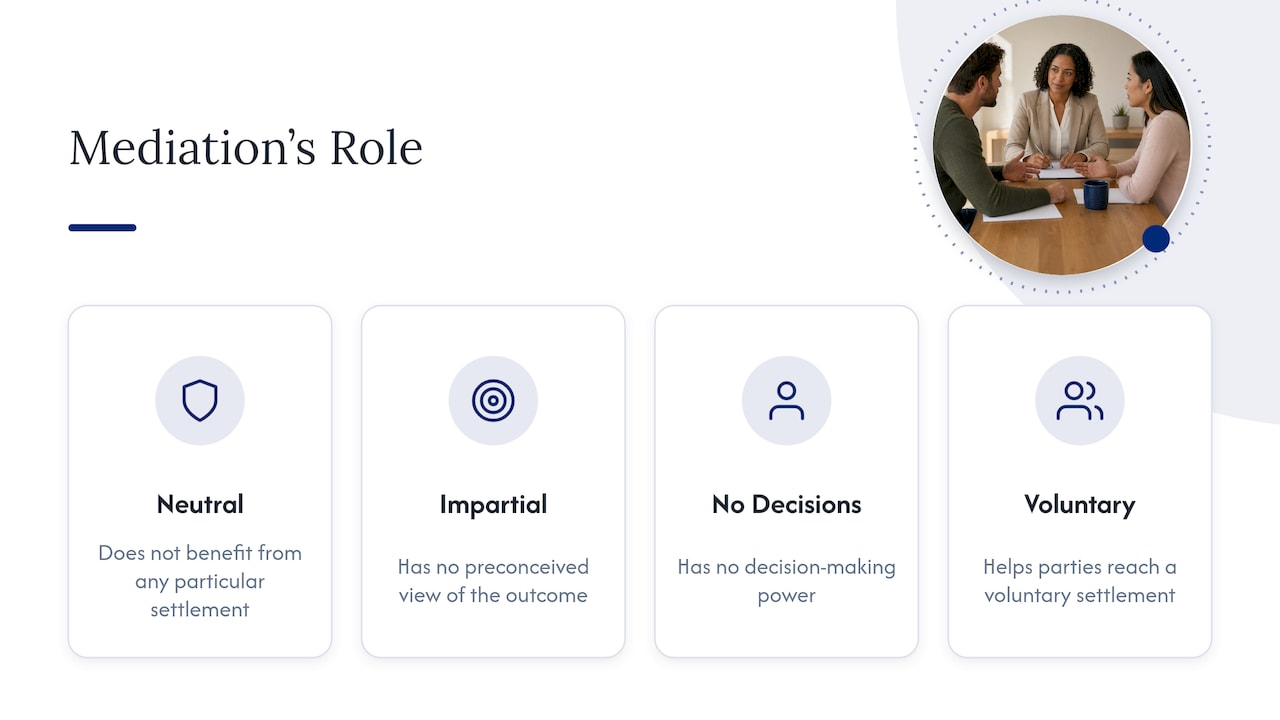
A mediator also does not act as your lawyer or your therapist. Courts in New South Wales, Australia, note that mediators help identify the disputed issues, develop options and consider alternatives, but they do not give legal, financial or other expert advice. If your dispute involves a legal right, an attorney can advise you before and during the process.
Disputes mediation can handle
The Kansas court system’s mediation FAQ lists workplace, neighborhood and family disputes among the matters mediation can help resolve. In practice that covers:
- Disagreements between co-workers or between a manager and an employee
- Neighbor disputes over noise, fences, shared spaces or boundaries
- Family conflicts, including divorce terms, parenting plans and care for aging parents
- Contract and business disagreements
- Civil rights and employment complaints brought to an agency, such as those mediated by California’s Civil Rights Department
Mediation is also common inside the court system. The ABA notes that courts require early mediation in various matters, so you may be sent to it even if you did not choose it.
What happens step by step
No two mediators run a session identically, but the shape is consistent. The Program on Negotiation at Harvard Law School outlines six stages: planning, the mediator’s introduction, opening remarks, joint discussion, caucuses and negotiation.
- Planning. Before the session, the mediator usually learns the basics of the dispute and each side gets ready. This is where your preparation matters most (see below).
- Introduction and ground rules. The mediator explains their role, how confidentiality works, and how the group will behave: one person speaks at a time, no interruptions, respectful language.
- Opening remarks. Each party describes the problem from their own perspective. Speak to the mediator and the other party, not to score points.
- Joint discussion. The mediator helps surface the issues, ask open-ended questions and clarify what each person actually needs. The U.S. General Services Administration describes the mediator as a catalyst with no vested interest in the outcome who improves communication by clarifying issues and testing priorities.
- Caucuses. These are private meetings between the mediator and one side. Harvard’s Program on Negotiation explains that caucuses let parties speak candidly under a promise of confidentiality, which can reveal hidden interests and move a stalled conversation forward.
- Negotiation and agreement. The parties trade proposals, often with the mediator carrying messages between rooms. If they agree, the terms are drafted. If not, the session ends without an agreement and nothing is imposed.
For a longer walk-through from our own team, see what happens at mediation, step by step.
Confidentiality in practice
Confidentiality is one reason people try mediation before court. The U.S. Nuclear Regulatory Commission’s ADR manual states that mediation is voluntary and confidential, and that conversations in mediation cannot be used later in litigation if the process does not lead to a resolution. The Department of Commerce notes that federal courts have held mediation matters privileged, with exceptions for issues such as fraud, waste and abuse, or criminal activity. Rules differ by state and by program, so ask your mediator how confidentiality applies to your session before you start.
What the mediator actually does
A useful way to think about the role: the mediator manages the process, and you own the content.
- Sets the structure. Ground rules, who speaks when, breaks, private meetings.
- Translates. A heated accusation becomes a clearer statement of what the person needs.
- Tests reality. Asking “what happens if this does not settle?” helps each side weigh its options.
- Narrows the issues. The ABA notes that mediation can narrow disputed issues and streamline later negotiation or litigation even when the matter does not settle.
- Follows a code of conduct. Mediators are generally bound by professional codes tied to their provider or local legal requirements.
The skills a mediator uses are teachable, and clinicians use many of them too. Our guide to evidence-based conflict mediation techniques breaks down the most useful ones.
Mediation vs. arbitration vs. litigation
The real difference is who decides.
| Mediation | Arbitration | Litigation | |
|---|---|---|---|
| Who decides | The parties | An arbitrator | A judge or jury |
| Voluntary outcome | Yes, you can walk away | No, the decision is imposed | No, the decision is imposed |
| Privacy | Confidential | Usually private | Usually public record |
| Formality | Informal, flexible | Semi-formal | Formal rules of evidence and procedure |
| If it fails | You can arbitrate or sue | Limited appeal options | Appeal |
The New York State Unified Court System describes ADR as the different ways people can resolve disputes without a trial, including mediation, arbitration and neutral evaluation. Because a mediator cannot impose a decision, you decide whether to settle and on what terms. If mediation does not work, you remain free to pursue arbitration or litigation.
How often does mediation work, and what do people settle for?
The honest answer is: often, but not always, and the numbers depend on the case type.
- Harvard’s Program on Negotiation reports that mediation leads to resolution in approximately 80 percent of mediated disputes.
- A paper presented at the Ohio Supreme Court’s Dispute Resolution Conference analyzed 223 civil cases mediated from 2013 to 2017. It found that 85.2 percent settled at mediation, with pre-suit cases settling at 90 percent.
- A USC Gould School of Law study of more than 400 employment mediations found that the mediator studied achieved a settlement rate above 94 percent.
These are specific samples, not promises. The Kansas courts say it plainly: benefits such as speed, lower cost and confidentiality are real, but settlement is not guaranteed.
Is there an “average” settlement offer?
People searching this usually want a number, but no single figure applies to every dispute. Two studies give a useful picture of how money cases tend to move:
- In the Ohio sample, cases settled for about one-third of the plaintiff’s demand and roughly six times the defendant’s offer.
- In the USC study, settlements landed about a quarter of the distance between the two opening offers, measured from the defendant’s first number. The authors also found that a mediator’s proposal was the most effective technique, used in almost 90 percent of cases.
The practical lesson: the first number on the table is rarely the last, and the final figure depends on the strength of the case, not on a formula.
How to prepare for mediation
The U.S. Court of Appeals for the Fourth Circuit advises participants to gather relevant information, identify their underlying values and interests, and consider the risks of not settling. It also recommends staying open-minded rather than arriving with rigid bottom lines.
A practical checklist:
- Write down your interests. A position is “I want $5,000.” An interest is “I need to cover the repair and feel the issue is acknowledged.” Interests give the mediator more to work with.
- Collect your documents. Contracts, messages, invoices, photos, timelines.
- Define your alternatives. What realistically happens if you do not settle? What would court cost in time, money and stress?
- Plan your opening. Two minutes, factual, free of insults.
- Expect anchoring. An extreme opening number can poison the room. The Ohio paper notes that anchoring causes distress and mistrust and makes for a long day, and that a mediator can defuse it by building a reasonable settlement bracket.
- Plan for your own reactions. If you know that criticism makes you shut down or snap, decide in advance how you will take a break.
That last step is where most people underprepare. A dispute is rarely just about the facts. If it is about a spouse, a business partner or a family member, emotions run high, and an angry person negotiates poorly. Our six-step conflict resolution guide with exact scripts gives you language you can rehearse beforehand.
Getting the agreement in writing
If you settle, the mediator or the parties draft the terms. The GOV.UK guide to civil mediation explains that in most types of mediation the parties sign a written settlement agreement and that, once written and signed, it can be formalized into a legally binding contract. The NRC’s program manual likewise describes the result as a legally binding agreement between the parties.
Read every line before you sign. Vague terms (“will communicate better”) invite a second dispute, so insist on who does what, by when, and what happens if someone does not follow through. Rules about how a mediated agreement is enforced vary by state. For example, you can read how mediated settlement agreements in Florida work in family matters and what alternatives exist if mediation falls short. An attorney in your state can confirm how your agreement will be treated.
Our perspective
Mediation succeeds or fails on one thing before any legal argument: whether the people in the room can stay regulated long enough to listen. A neutral mediator gives the conversation structure, but the structure only helps if you can use it.
In our work with couples, families, and individuals in conflict, we see the same pattern. People arrive with a strong case and a short fuse. The first ten minutes of a hard conversation decide whether the other person hears a request or an attack. That is why we teach the skills that sit underneath mediation: naming your actual interest, tolerating discomfort, and responding rather than reacting.
We build our approach on evidence-based frameworks and clinical training. Dr. Todd’s doctoral-level background in psychology and counseling shapes how we teach people to prepare, whether they are heading into a formal mediation, a family meeting, or a difficult talk with a partner. If anger tends to take over, anger management work before the session is not a detour. It is preparation.
Mediation is a tool for people who want a resolution they can live with. We want you to walk in able to use it.
Carlos
Building the skills that make mediation work
Mediation is a short event. The communication habits that make it succeed take longer to build, and they are the same habits that prevent the next dispute.
Here is where our resources fit, depending on what you are facing:
- Workplace disputes. Managers can use clinician-backed scripts for resolving workplace conflict before a complaint becomes a formal process.
- Family conflict. Our therapist’s guide to mediation in family law explains how the process fits alongside counseling.
- Schools and young people. Read about conflict resolution and peer mediation, or our guide to safety-first conflict management in schools.
- Professionals. Clinicians who want to build facilitation skills can start with mediation training for conflict skills or our guide to project management methods for clinical conflict mediation.
When the dispute is personal
If your conflict is with a partner or family member, a mediator can help settle specific terms, but the relationship itself may need attention. Couples counseling addresses the pattern behind the argument, not just the current disagreement.
Work on the conflict before you sit down
If anger, a stalled relationship or repeated blow-ups are what stand between you and a workable agreement, we can help you prepare.
- Anger management classes you can take online: a 1 Hour class is $24.99, a 6 Hour class is $79, and an 8 Hour class is $85. See the anger management classes.
- Couples sessions at $175 per hour, plus longer programs, including a 6 Hour Couples Intensive at $1,995. Browse the couples counseling packages.
- Individual, family, teen and online counseling. Prices for these are not published, so see our clinical services page to get started.
We serve clients in North and South Carolina and Florida in person, and online options are available beyond those states.
FAQ
Why would a lawyer suggest mediation?
Mediation can narrow the issues in dispute and streamline later negotiation or litigation, even if the case does not fully settle. Some courts also require early mediation in certain matters. A lawyer may recommend it because it is usually faster and more private than a trial, and you keep control over the result.
Is mediation legally binding?
The process itself is voluntary, and you can walk away without an agreement. If you do sign a written settlement agreement, it can be formalized as a legally binding contract. Check how your state enforces mediated agreements and read the terms with an attorney before signing.
Do I need a lawyer at mediation?
A mediator does not give legal advice, so a lawyer can explain your rights and options before you decide. Whether attorneys attend the session depends on the program and the dispute. Ask the mediation provider or court what is allowed.
What if mediation does not work?
You are free to pursue other options, such as arbitration or litigation. Even an unsuccessful session often clarifies the issues and each side’s priorities, which can make later negotiation more focused.
Can anything I say in mediation be used against me later?
Mediation is generally confidential, and federal ADR guidance states that conversations in mediation cannot be used later in litigation if the matter does not resolve. Exceptions exist, such as criminal activity, and rules vary by state, so confirm the rules with your mediator at the start.
Sources
- What is Mediation? U.S. Department of Commerce
- Dispute Prevention and Resolution Services, Department of Justice Canada
- Mediation, Local Court of New South Wales
- Mediation FAQ, Kansas Courts
- How to Prepare for an Effective Mediation, American Bar Association
- How Mediation Works, Program on Negotiation at Harvard Law School
- Navigating the Mediation Process, Program on Negotiation
- Using Alternative Dispute Resolution Techniques, GSA
- ADR Program, U.S. Nuclear Regulatory Commission
- What is ADR? New York State Unified Court System
- How the Mediation Process Works
- Overcoming Impasse by Effectively Using the Mediator’s Toolbox, Ohio Supreme Court
- Inside the Caucus, USC Gould School of Law
- Preparing for a Mediation, Fourth Circuit Court of Appeals
- A guide to civil mediation, GOV.UK