
Individual Therapy Cost: What a Session Really Runs

Individual therapy is almost always priced by the hour, and the fee you pay depends on who treats you, where, for how long and whether insurance is involved. The most reliable way to know your cost is to ask for the fee in writing before the first session. We publish fees where we can, for example $175 per hour for couples sessions and $24.99 to $249 for anger management classes and programs. Our individual counseling fees are quoted when you book on our clinical services page.
This guide explains how therapy fees are built, what changes them, what couples, family and teen sessions cost relative to individual work, what supervision costs for clinicians, and how to keep the total predictable.
TL;DR
- Individual therapy is billed per session, usually 45 to 60 minutes, and the fee reflects the clinician’s license level, experience, location and format.
- Couples and family sessions are priced higher than individual sessions in every professional fee survey we reviewed, because more than one person means more preparation and complexity.
- Self-pay clients in the US are entitled to a written good faith estimate of charges before care starts.
- Online sessions are generally priced at the same rate as in-person ones in professional fee schedules, so teletherapy rarely changes the hourly fee but saves travel and time.
- Clinical supervision for therapists is priced per hour, and group formats are priced per person.
Table of Contents
- What you are actually paying for in one session
- What moves the price of an individual session
- Individual vs couples vs family: how the fee changes
- Anger work: when a class costs less than weekly sessions
- How to find out your real cost before session one
- Carolinas and Florida: what local clients should know
- Supervision and mentoring for therapists
- Is the fee worth it?
- Promo: start with a known price
- Our perspective
- FAQ
- Sources
What you are actually paying for in one session
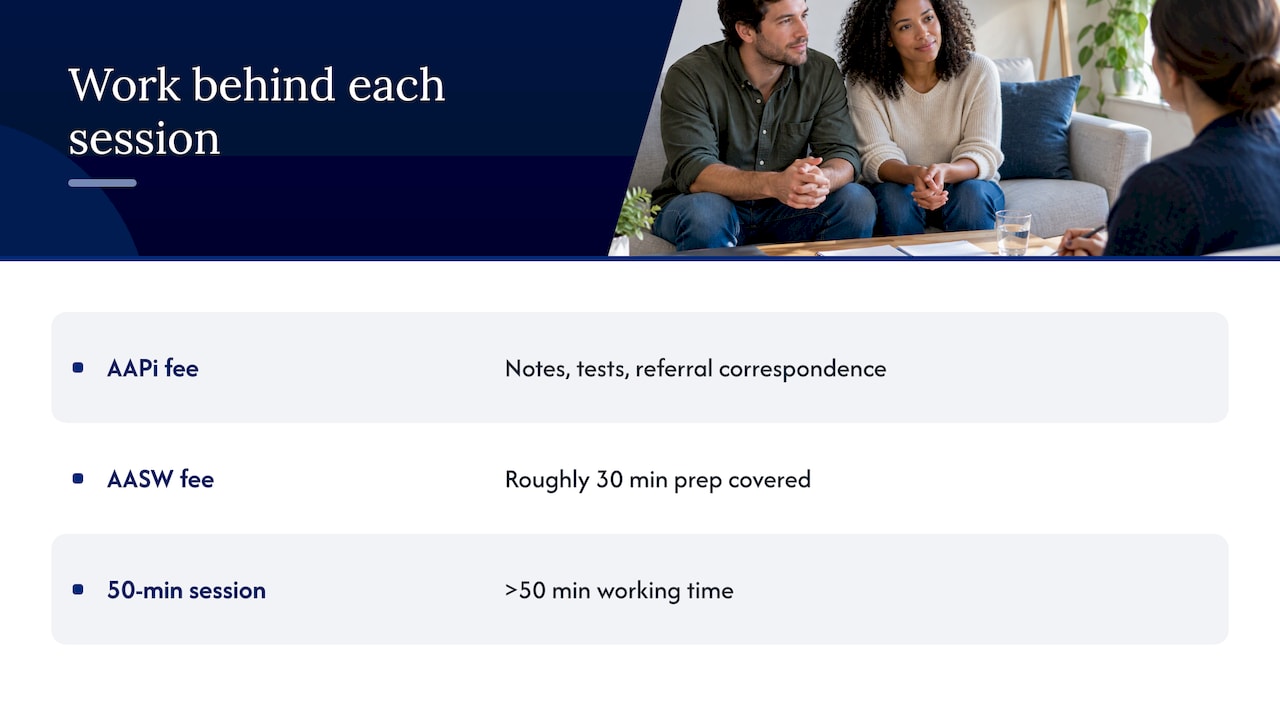
A therapy fee is not only the time in the room. Professional fee schedules say so directly. The Australian psychology body AAPi notes that its recommended fees include non-billable work such as note-taking, test scoring and referral correspondence. The Australian Association of Social Workers likewise says its suggested hourly fee covers roughly half an hour of preparation that is not billed separately. Those are Australian schedules, but the logic holds anywhere: a clinician with a full caseload spends more than 50 minutes of working time on every 50-minute session.
That is why a very low fee often comes with something else attached: a trainee clinician, a larger caseload or a shorter session. It is also why a higher fee is not automatically padding. When you compare, compare the same things: session length, license, format and what is included.
What moves the price of an individual session
Clinician credentials and experience
In the US, individual therapy is delivered by licensed professional counselors, marriage and family therapists, clinical social workers and psychologists. Doctoral-level clinicians generally set higher fees than master’s-level ones, and clinicians with specialty training (trauma, infidelity recovery, anger work) may charge more for that depth. Our founder, Dr. Carlos Todd, is a licensed clinical mental health counselor and psychologist, and our approach rests on evidence-based frameworks he developed.
Where you live
The same hour costs different amounts in different markets. A peer-reviewed survey of 671 private-practice clinicians in Quebec found an average individual fee of C$95.10 per hour, and the authors tied the low figure to competition: Quebec has far more registered psychologists per capita than the rest of Canada. A 2024 survey of 651 Ontario psychologists found the most common treatment fee was $250 per hour, with two-thirds between $211 and $275. Same country, same profession, very different markets. Inside the US you will see the same pattern between a large metro area and a small town in the Carolinas or Florida.
Session length
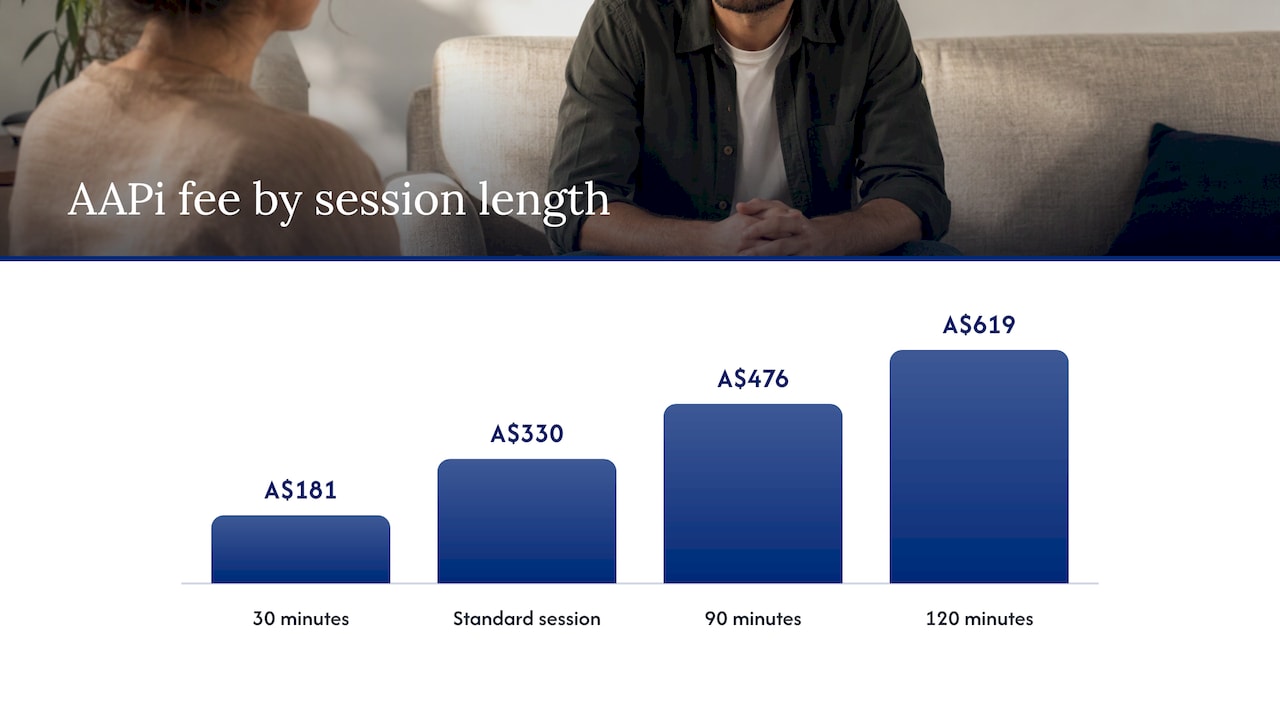
Most individual sessions run 45 to 60 minutes. Longer sessions are priced up proportionally. The AAPi schedule, for instance, lists a 30-minute consultation at A$181, a standard session at A$330, 90 minutes at A$476 and 120 minutes at A$619, so the rate per minute falls a little as sessions get longer. If you are working on a specific problem such as anger, a longer or intensive format can be a better use of money than many short visits.
Online or in person
Professional schedules do not discount teletherapy. The AASW lists telehealth individual sessions at the same hourly figure as in-person ones, and AAPi recommends the same for telephone consultations. What online therapy saves is the commute, parking, time off work and childcare. We offer online anger management and online sessions for clients locally and internationally, and for busy professionals that flexibility often matters more than any difference in the hourly fee. Our guide to teletherapy for busy professionals walks through how it fits a working week.
Individual vs couples vs family: how the fee changes
If you are deciding between one format and another, the price gap is real and consistent.
| Format | Example from published fee data | Why it differs |
|---|---|---|
| Individual | Quebec average C$95.10 per hour (2014 survey) | One client, one treatment plan |
| Couples or marital | Quebec average C$106.79 per hour; Ontario median $250 (2024) | Two people, more preparation |
| Family | Quebec average C$106.54 per hour; Ontario mean $249.30 (2024) | Several people, complex dynamics |
| Group | Ontario median $120 per person (2024) | Cost shared across participants |
The figures come from the Quebec survey and the Ontario report, and they are Canadian dollars and Canadian markets, shown to illustrate the pattern rather than to price a US session. The Ontario report found couples therapy had the highest intervention fees of any service it surveyed. AAPi explains its higher couples and family rate, A$396 against A$330 for a standard session, by the added complexity and preparation of working with more than one person.
Our own couples sessions are $175 per hour, as listed on our couples packages page. If you and your partner want a structured block instead of weekly visits, the same page lists the Relationship Renewal Starter Program at $1,100 and the Weekend to Renewal program at $2,000, and the 6 Hour Couples Intensive is $1,995. These are one-off prices for a defined program, which makes the total known before you start.
Not sure whether you need individual or joint work? Our article on individual vs couples counseling helps you decide, and it matters for cost: starting in the wrong format can mean paying for sessions that do not address the real issue. For parents, family therapy options for couples explains how family sessions work.
Anger work: when a class costs less than weekly sessions
If your reason for seeking help is anger, you have two price points to consider. One-to-one counseling gives you personal attention to your triggers and history. A structured class gives you the skills at a fixed, low price. Our online anger management classes are priced at:
| Program | Price |
|---|---|
| 1 Hour Anger Management Class | $24.99 |
| 6 Hour Anger Management Class | $79 |
| 8 Hour Anger Management Class | $85 |
| 4-Hour Program (groups) | $149 |
| 8-Hour Program (groups) | $249 |
The self-paced classes are on our all courses page and the group programs are on the anger management groups page. Many people begin with a class to build the basic skills and add individual sessions when they want to work on the patterns underneath. Our article on individual therapy and anger reduction describes what that work looks like over a series of sessions.
How to find out your real cost before session one
Step 1: Ask for the full fee in writing
Ask for the fee per session, the length of a session, the intake or assessment fee if there is one, and the cancellation policy. Intake sessions are often longer and priced higher than follow-up visits.
Step 2: Use your right to a good faith estimate
Under the federal No Surprises Act, providers must give uninsured and self-pay clients a good faith estimate of expected charges when care is scheduled or when you ask for it. If you plan to pay out of pocket, request it and keep it. It turns an open-ended hourly fee into a number you can budget around.
Step 3: Check insurance and employer benefits
If your plan covers outpatient mental health, your cost is usually a copay or a deductible-based amount instead of the full fee, and the clinician must be in your network. Ask your plan which providers and which session types are covered, and whether telehealth counts. Employee assistance programs often include a small number of free sessions, and our piece on EAP versus private couples therapy explains how those sessions can be used and when a longer plan makes sense. Some clinicians also provide a receipt you can submit to your plan for possible out-of-network reimbursement, so ask about that when you book.
Step 4: Ask about sliding-scale spots
Sliding scale means the fee is reduced according to income. It is less universal than people assume: in the Quebec survey, 27.1% of practitioners offered one, and the lowest reduced session averaged C$55.36. Availability is limited, so ask early.
Step 5: Match the format to the goal
A specific, skill-based goal may fit a class or a short program. A long-standing pattern may need ongoing sessions. Our comparison of therapy versus coaching clarifies which support fits which goal, which is the best way to avoid paying for the wrong service.
Carolinas and Florida: what local clients should know
We serve clients in North Carolina, South Carolina and Florida, and clients elsewhere through online sessions. Fees in Charlotte, Raleigh, Tampa or Miami reflect city-level demand, so the same clinician profile can price differently from a smaller town. Because telehealth fees match in-person fees in professional schedules, an online option lets you choose a clinician for fit and specialty and not only for postcode. Licensing rules for telehealth depend on the state where the client is located during the session, so confirm with your clinician that they can see you where you live. Our Charlotte office is described on our couples counseling page.
Supervision and mentoring for therapists
If you are a clinician looking at supervision costs, the same logic applies: hourly pricing with different rates for individual and group formats. The AASW suggests $289 per hour for individual supervision and an equivalent per-person rate for group supervision, and AAPi recommends A$330 per hour for supervision, noting that some practitioners discount for provisional or early-career psychologists. Those are Australian figures and show how supervision is structured, not what a US supervisor charges.
We offer clinical supervision and clinical mentoring for practitioners. Fees are provided on inquiry.
Is the fee worth it?
Cost per session is only half the picture. The other half is how many sessions you need and whether they target the right problem. A focused plan with a clear goal tends to be cheaper in total than open-ended weekly visits with no direction. Ask a prospective clinician how they set goals, how often they review progress and how long they expect the work to take. Our overview of individual therapy techniques shows what structured approaches look like, which helps you judge value before you commit.
Promo: start with a known price
If you want a fee you can plan around, our programs are priced up front: anger management classes from $24.99, couples sessions at $175 per hour and structured couples programs from $1,100. Individual counseling for women, men, teens and children, plus online anger management, is available through our clinical team.
See every option and book on our clinical services page, or start at Mastering Conflict.
Our perspective
We price therapy the way we want clients to think about it: as a plan with a start, a goal and a finish, not an open tab. That is why we publish fixed prices for classes and couples programs, and why we say plainly what a session costs before you book.
Individual therapy works best when the format matches the problem. Someone struggling with anger often gets real traction from a structured class first, then deeper work in one-to-one sessions. A couple in crisis often needs concentrated time together, which is why we built intensive and weekend formats alongside weekly sessions.
Our work is built on frameworks developed by a doctoral-level clinician and designed to give you tools you can use the same week, backed by clinical rigor. We also serve women, men, teens, children and Black and African American clients with counseling designed around their circumstances, in person in the Carolinas and Florida and online anywhere.
If you are weighing the cost of starting, call it what it is: an investment in how you handle your relationships, your work and your own mind. Ask us for the fee, ask us how long we expect the work to take, and decide with real numbers.
Carlos
FAQ
How much is one hour of therapy?
It depends on the clinician’s license, the market and the format, so it is best to ask for the exact fee. Professional fee schedules and surveys show wide ranges even within one country, and couples or family hours are priced above individual hours. Our published couples rate is $175 per hour.
Why do therapy fees differ so much between clinicians?
Fees reflect training level, specialty, local demand and the unbilled work behind each session, such as notes and coordination. Fee surveys in Ontario and Quebec found large gaps between provinces and between individual practitioners.
Does online therapy cost less than in-person?
Usually the hourly fee is the same. The savings come from not traveling, easier scheduling and less time off work. Our online sessions and online anger management serve clients locally and internationally.
Can I find out my total cost before I start?
Yes. If you are paying out of pocket, you can request a written good faith estimate of expected charges under the federal No Surprises Act. Ask for the session fee, intake fee and cancellation terms at the same time.
Sources
- Schedule of Suggested Fees, Australian Association of Social Workers, March 2025
- 2025-2026 AAPi Recommended Fees
- 2024 Ontario Psychological Services Report
- Psychotherapy in the Private Sector: A Survey of Licensed Practitioners, Canadian Journal of Counselling
- No Surprises Act Good Faith Estimate requirements, CMS