
Teletherapy for busy professionals: flexible mental health

TL;DR:
- Over half of therapy visits are now virtual due to convenience, flexibility, and reduced stigma.
- Teletherapy effectively supports anxiety and depression, especially for busy professionals with demanding schedules.
- It is unsuitable for crisis, severe mental health conditions, or cases requiring immediate in-person intervention.
More than half of therapy visits for anxiety and depression now happen virtually, and that shift is no accident. Busy professionals are quietly rewriting the rules of mental health care, choosing sessions that fit between back-to-back meetings rather than waiting weeks for an in-office slot. If you have ever canceled a therapy appointment because of a deadline or skipped it entirely because the commute felt impossible, you are not alone. This guide walks you through what teletherapy actually offers, where it works best, where it falls short, and how to make it a real, sustainable part of your life.
Table of Contents
- Why teletherapy appeals to busy professionals
- How teletherapy works and its effectiveness
- When teletherapy may not be suitable
- Making teletherapy work for your schedule
- A fresh perspective: What most teletherapy guides leave out
- Ready for flexible support? Get started with expert teletherapy
- Frequently asked questions
Key Takeaways
| Point | Details |
|---|---|
| Flexible scheduling | Teletherapy lets busy professionals access mental health support without missing work or family obligations. |
| Strong results | Clinical studies show teletherapy is as effective as in-person care for common concerns like anxiety and depression. |
| Know the limits | Some complex mental health issues still require in-person or intensive support for best outcomes. |
| Maximize privacy | Choose a quiet, private space and reliable tech setup to ensure effective, distraction-free sessions. |
Why teletherapy appeals to busy professionals
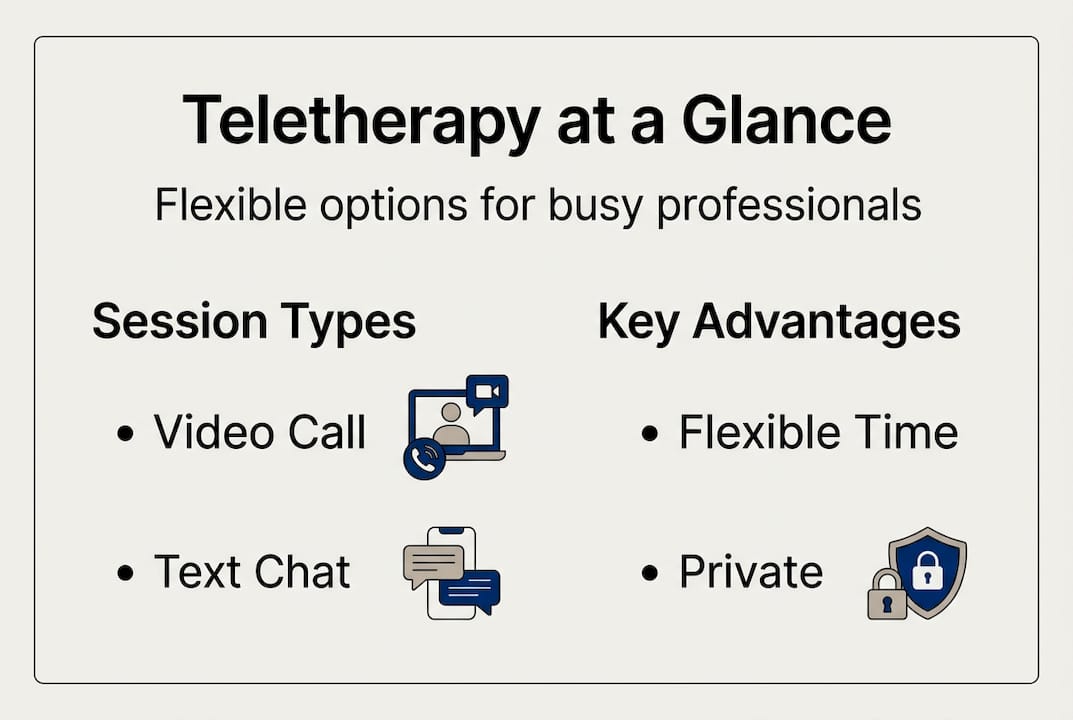
Teletherapy is simply therapy delivered through a screen or phone instead of a physical office. That one change removes more friction than most people expect. No travel time, no parking stress, no waiting rooms. You can connect with a licensed counselor from your car during lunch, your home office at 7 a.m., or a quiet corner of a hotel room while traveling for work.
The shift in workplace mental health culture has accelerated this trend. Employers increasingly recognize that untreated stress, burnout, and anxiety cost organizations billions each year in lost productivity. Professionals are responding by seeking support that fits their reality, not a rigid clinic schedule.
Key benefits that make teletherapy practical for professionals include:
- No commute required, freeing up 30 to 90 minutes per session
- Flexible time slots, including early morning and late evening appointments
- Better continuity of care, because it is easier to keep appointments you can actually reach
- Access to specialized providers regardless of your geographic location
- Reduced stigma, since no one sees you walking into a therapist’s office
Research backs this up. 60% of users prefer teletherapy specifically for its flexibility and accessibility, and that preference translates directly into higher engagement and fewer dropped sessions. Understanding the benefits for busy schedules can help you decide whether this model fits your life.
“Patients who use teletherapy report higher rates of session completion and greater satisfaction with their care compared to traditional in-person formats, particularly among working adults with demanding schedules.”
The evidence on teletherapy effectiveness shows that this is not just a convenience story. Engagement and outcomes are genuinely strong when the format matches the person’s lifestyle.
Pro Tip: Before your session, close unnecessary browser tabs, silence notifications, and use headphones. A two-minute setup routine signals to your brain that you are switching from work mode to reflection mode, which makes the session far more productive.
How teletherapy works and its effectiveness
Getting started is simpler than most professionals assume. Here is a straightforward path:
- Choose a licensed provider who specializes in your area of concern, whether that is stress, anxiety, relationship conflict, or burnout.
- Test your technology before the first session. Check your camera, microphone, and internet speed.
- Select your format. Video, phone, or message-based therapy each serve different needs.
- Schedule your first appointment and block it in your calendar like any other priority meeting.
- Set up a private space where you will not be interrupted or overheard.
The format you choose matters more than most guides acknowledge. Here is a practical comparison:
| Format | Pros | Cons | Best suited for |
|---|---|---|---|
| Video | Closest to in-person, nonverbal cues visible | Requires stable internet, camera | Weekly sessions, deeper work |
| Phone | No video setup, works on the go | No visual connection | Commutes, travel, low-bandwidth areas |
| Messaging | Flexible timing, written reflection | Slower feedback, less immediate | Between sessions, mild ongoing support |
The clinical data is reassuring. Teletherapy is as effective as in-person care for anxiety and depression, which are the two most common concerns among working professionals. Symptom reduction rates are comparable, and for many people, the reduced barrier to attendance actually improves outcomes over time.

Following teletherapy best practices from the start, like choosing a HIPAA-compliant platform and confirming your provider’s licensure, ensures you are getting care that is both safe and effective.
When teletherapy may not be suitable
Teletherapy is powerful, but it is not the right tool for every situation. Being honest about its limits protects you.
Teletherapy has limitations for certain complex mental health needs and crisis situations. Conditions and circumstances where in-person care is strongly advised include:
- Active suicidal ideation or self-harm, where immediate physical intervention may be needed
- Severe eating disorders requiring medical monitoring alongside psychological care
- Substance use disorders at a level requiring detox or intensive outpatient programs
- Psychotic episodes where a clinician needs to directly observe and assess behavior
- Acute trauma responses that require grounded, in-room stabilization techniques
Here is a side-by-side look at how the two formats compare:
| Need | Teletherapy | In-person care |
|---|---|---|
| Mild to moderate anxiety | Excellent fit | Also effective |
| Relationship conflict | Strong option | Strong option |
| Burnout and stress | Highly effective | Effective |
| Crisis intervention | Not recommended | Required |
| Complex trauma | Limited | Preferred |
| Severe psychiatric conditions | Not suitable | Necessary |
Technology and privacy challenges are also real. Common issues and practical solutions:
- Poor internet connection: Use a wired connection or move closer to your router
- Lack of private space: Book a private room at a library or coworking space
- Data privacy concerns: Confirm your platform is HIPAA-compliant before sharing anything personal
- Technical failures mid-session: Have your therapist’s phone number ready as a backup
If you are working through trauma-informed therapy, the modality and your therapist’s expertise matter enormously. Do not let convenience override clinical appropriateness.
Making teletherapy work for your schedule
Knowing teletherapy is available is one thing. Actually using it consistently is another. Here is how to build it into a demanding professional life:
- Treat sessions like client meetings. Block them in your calendar with the same protection you would give a high-priority call.
- Choose a consistent time slot. Routine reduces decision fatigue and makes attendance automatic.
- Prepare a short agenda. Spend two minutes before each session noting what has been weighing on you. This keeps sessions focused and efficient.
- Create a dedicated space. Even a corner of a room with headphones creates enough psychological separation from work.
- Follow up after sessions. Jot down one or two takeaways immediately after. This reinforces what you worked on.
Message-based and brief-session formats can help professionals maintain balance and therapeutic gains between longer sessions, which is a strategy that many high-performers underuse. Sending a short message to your therapist on a stressful day is not a crisis call. It is proactive care.
Pro Tip: Pair teletherapy with a simple wellness habit, like a five-minute breathing exercise before each session or a short walk afterward. The combination of structured therapy and daily micro-habits accelerates progress significantly.
Privacy and security deserve ongoing attention. Use a VPN on public networks, log out of platforms after sessions, and review your provider’s data policy. Understanding counseling confidentiality rules in your state gives you confidence that what you share stays protected.
If you are still searching for the right fit, resources on finding a therapist can narrow down providers who specialize in professional stress, burnout, and relationship challenges. For couples navigating dual-career pressure, exploring online couples therapy benefits may open up options you had not considered.
A fresh perspective: What most teletherapy guides leave out
Most articles about teletherapy focus on logistics. Book an appointment, test your Wi-Fi, show up. What they rarely address is the discipline required to actually be present during a virtual session.
When your therapy session happens in the same room where you answer emails, your brain does not automatically shift gears. Many professionals report feeling distracted or half-present during early teletherapy sessions, not because the format is inferior but because they never created a mental transition ritual.
There is also a quieter issue: not all teletherapy providers are equally skilled at adapting their approach to a virtual environment. Clinician expertise in online delivery matters, and that gap rarely gets discussed.
“Teletherapy is a tool, not a transformation. The work still requires your full attention, your honesty, and your willingness to apply what you learn outside the session.”
The professionals who get the most from teletherapy treat it as one part of a broader wellness strategy, not a standalone fix. Pairing it with consistent sleep, movement, and boundary-setting at work is what actually moves the needle. Review teletherapy best practices to build a setup that supports genuine engagement, not just attendance.
Ready for flexible support? Get started with expert teletherapy
If this article has made one thing clear, it is that quality mental health support no longer requires you to rearrange your entire week. The right provider, the right format, and a few intentional habits can make therapy a consistent part of your professional life.
At Mastering Conflict, we offer professional teletherapy options designed around real schedules, including flexible appointment times and specialized support for stress, burnout, and relationship conflict. You can also explore work-life balance courses for self-paced development, or access anger management support if workplace tension is part of the picture. Your next step is one click away.
Frequently asked questions
Is teletherapy as effective as in-person therapy for working professionals?
Yes, research confirms that teletherapy matches in-person care for common concerns like anxiety and depression, with comparable symptom reduction rates across both formats.
What types of tech do I need for teletherapy?
A stable internet connection and a private, quiet space are the most critical requirements. Tech reliability and privacy directly affect how safe and productive your sessions feel.
When should I avoid teletherapy and seek in-person care?
In-person care is essential for crisis situations, severe eating disorders, active suicidal ideation, and complex psychiatric conditions. Certain complex cases require direct observation and immediate physical intervention that a screen cannot provide.
How can teletherapy fit my unpredictable work schedule?
Many therapists now offer early morning, evening, and message-based sessions specifically to support professionals whose hours shift week to week.
Recommended
- Teletherapy Best Practices: Effective Online Counseling – Mastering Conflict
- Stress Management for Professionals: Achieve Calm and Focus – Mastering Conflict
- Online Couples Therapy: Transforming Relationships – Mastering Conflict
- Online therapy for teens: parent’s guide to support 2026 – Mastering Conflict
- Integrative Mental Health