
Step-by-step conflict mediation process for couples and families

TL;DR:
- Recurring relationship conflicts often stem from deep-rooted personality differences that can be managed but rarely eliminated. Mediation offers a structured, confidential process guided by a neutral facilitator that helps parties reach their own agreements, making it effective for family disputes and relational issues. Proper emotional and cultural preparation is essential, especially for diverse families, to ensure that the mediation process is safe, relevant, and conducive to lasting, respectful solutions.
Recurring conflict in relationships doesn’t always mean something is broken beyond repair. Research shows that 69% of relational conflicts are perpetual, meaning they stem from deep-rooted personality differences that can be managed but rarely eliminated entirely. That reality makes how you handle conflict more important than whether it exists. Mediation offers a structured, evidence-based path forward, one that helps couples and families work through disputes without the emotional carnage of litigation or the silence of avoidance. This article walks you through exactly what mediation is, how to prepare for it, the step-by-step process, what outcomes to expect, and why cultural and trauma-informed considerations matter deeply, especially for Black and African American families in the Carolinas and Florida.
Table of Contents
- What is the conflict mediation process?
- How to prepare for the mediation process
- Step-by-step guide to conflict mediation for couples and families
- Common outcomes and how to ensure success
- Why cultural humility and trauma-informed care are essential in mediation
- Support and services for conflict mediation in the Carolinas and Florida
- Frequently asked questions
Key Takeaways
| Point | Details |
|---|---|
| Mediation is structured | It involves clear steps led by a neutral facilitator to guide conflict resolution. |
| Preparation is vital | Taking time to emotionally and practically prepare increases mediation success. |
| Cultural humility matters | Culturally relevant mediation achieves better outcomes, especially for minorities. |
| Active listening works | Skills like active listening help resolve conflict and are central to mediation. |
| Support is available | Professional mediation and anger management services can help you break harmful cycles. |
What is the conflict mediation process?
Mediation is a collaborative problem-solving approach guided by a neutral third party, often called a mediator, who facilitates communication between people in conflict. Unlike a judge or arbitrator, the mediator doesn’t decide outcomes. Instead, they create the conditions for the parties involved to reach their own agreements.
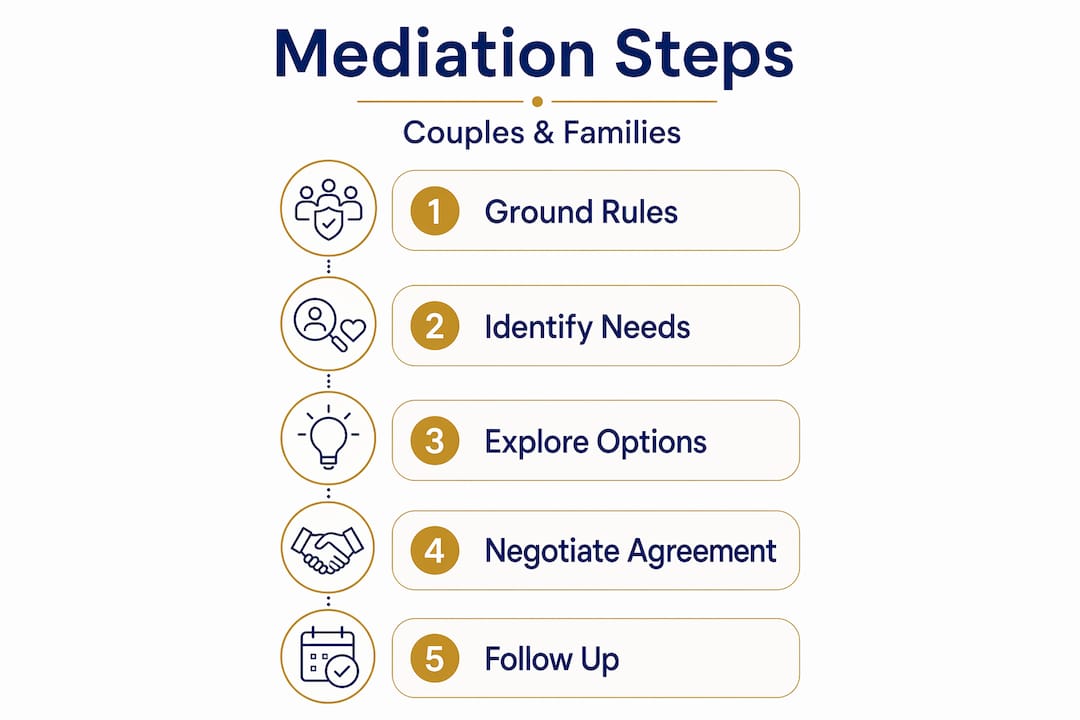
The mediation process typically unfolds through several structured stages: selecting a mediator, opening with ground rules and confidentiality agreements, identifying key issues, exchanging information and perspectives, negotiating options, and finally drafting a written agreement. Each stage serves a purpose, and skipping one often means the process breaks down later.
Understanding how mediation compares to other approaches helps clarify why it’s often the right first step.
| Method | Decision-maker | Cost | Privacy | Timeline | Best for |
|---|---|---|---|---|---|
| Mediation | The parties themselves | Low to moderate | High | Days to weeks | Relational conflicts, family disputes |
| Arbitration | Arbitrator (binding) | Moderate | Moderate | Weeks | Business or legal disputes |
| Litigation | Judge or jury | High | Low | Months to years | Legal rights, severe disputes |
| Therapy/counseling | No decision imposed | Moderate | High | Ongoing | Emotional healing, communication |
Mediation is not a magic fix, and it’s not appropriate for every situation. Here’s a quick breakdown:
Mediation IS:
- A voluntary, confidential process
- Guided by a neutral facilitator
- Focused on mutual agreement
- Effective for parenting plans, property, and relationship disputes
- A space to practice new communication patterns
Mediation is NOT:
- A legal proceeding or court-ordered judgment
- A therapy session, though it can complement therapy
- Appropriate for situations involving active abuse or power imbalances without safeguards
- A one-size-fits-all solution for every conflict
Learning about mediation in families can help you decide whether this process fits your specific situation. For couples or families locked in cycles of repeat arguments, mediation is often less adversarial, more private, and significantly faster than pursuing legal remedies.
How to prepare for the mediation process
Now that you know what mediation aims to achieve, the next step is getting prepared to participate effectively, both emotionally and logistically. This stage is often underestimated, but your preparation directly shapes how productive the sessions will be.

Emotional preparation matters more than most people realize. Before walking into mediation, take time to clarify what you actually want from the process. Not just the surface-level demands, but the underlying needs. Do you want to feel heard? Do you need a workable co-parenting schedule? Are you hoping to repair the relationship or simply manage it more peacefully? Knowing your goals helps you stay focused when emotions run high.
Here’s a practical preparation checklist:
- Documents: Gather any relevant records, parenting schedules, financial summaries, or written agreements
- Notes: Write down the key issues you want addressed and your preferred outcomes
- Emotional state: Practice grounding techniques before sessions, such as deep breathing or brief mindfulness exercises
- Support network: Consider attending individual therapy or talking with a trusted counselor before mediation begins
- Openness: Prepare to hear perspectives you may disagree with, because effective mediation requires flexibility
The following table outlines specific tools to support your preparation:
| Preparation tool | How it helps | Where to access |
|---|---|---|
| Individual therapy | Processes emotions, clarifies goals | Family therapy services |
| Anger management classes | Reduces reactivity in sessions | Mastering Conflict clinical services |
| Self-reflection journaling | Identifies core needs vs. surface demands | At home, guided by a therapist |
| Trauma-informed counseling | Addresses past trauma affecting current conflict | Trauma-informed counseling tips |
| Support person or advocate | Provides emotional grounding | Community support networks |
One critical and often overlooked barrier involves cultural context. A striking 89% of healthy marriage studies involving Black and African American couples fail to address class, structural barriers, or Eurocentric assumptions in their design. This means many standard mediation and relationship programs weren’t built with your community’s experiences in mind. If you’ve walked into a counseling setting and felt like the approach didn’t quite fit, that’s not your imagination.
Trauma-informed care is especially important here. Historical trauma, systemic stress, and lived experiences with racial inequity can all show up in mediation sessions. Choosing a mediator who understands these dynamics isn’t a luxury; it’s a necessity for real progress.
Pro Tip: Before your first session, write a brief statement of your core need, one sentence, not your position. For example, instead of “I want primary custody,” try “I need my children to feel secure and loved by both parents.” This reframing often unlocks breakthroughs in the negotiation phase.
Step-by-step guide to conflict mediation for couples and families
Once you’re prepared, you can approach mediation effectively by following this proven step-by-step process. Each stage builds on the last, and understanding what to expect at every point helps you stay grounded.
- Schedule the mediation. Both parties agree to participate and select a mutually acceptable mediator. The mediator should be neutral, experienced, and ideally familiar with your cultural context or family structure.
- Complete pre-mediation intake. Many mediators conduct brief individual meetings first to understand each person’s perspective privately. This builds trust and helps the mediator identify key issues before the joint session.
- Opening session with ground rules. The mediator establishes confidentiality, respectful communication standards, and the overall agenda. This sets the tone for everything that follows.
- Identify the core issues. Each party describes the conflict from their own perspective without interruption. The mediator helps distill complex emotions into specific, workable topics.
- Exchange information and perspectives. This is where active listening becomes critical. Better communication accounts for 64% of successful relationship reconciliations, and active listening is cited by 75% of participants as the most effective conflict-reducing tool.
- Negotiate options. Both parties brainstorm solutions together. The mediator guides this phase without imposing outcomes. This stage requires emotional regulation, especially when old grievances resurface.
- Draft the agreement. Once both parties reach consensus, the mediator documents the agreed terms. This written agreement becomes the foundation for moving forward.
- Follow-up planning. Healthy mediation doesn’t end with a signature. Plan for check-in sessions, especially for co-parenting arrangements or family dynamics that need ongoing adjustment. Co-parenting help resources can support this phase significantly.
“A neutral third party doesn’t just reduce the temperature in the room. They change the entire structure of the conversation, making it possible to hear what the other person is actually saying instead of just preparing your next rebuttal.”
Troubleshooting is part of the process. If a party stonewalls (refuses to engage), the mediator may call a break or shift to individual check-ins. If emotions escalate, grounding techniques drawn from anger management exercises can be introduced to restore focus. If the issues feel too broad, the mediator helps narrow the scope to one manageable topic at a time. Understanding the full range of conflict resolution steps that apply to your situation makes each session more productive.
Pro Tip: During the negotiation phase, ask the other party to summarize what they heard you say before responding. This single technique, often called reflective listening, breaks the cycle of reactive arguing and replaces it with genuine understanding.
Common outcomes and how to ensure success
Having completed mediation, it’s crucial to understand what outcomes are realistic and how to sustain the benefits moving forward. Expecting mediation to resolve everything permanently sets you up for disappointment. Expecting it to create a workable structure and reduce ongoing tension is a realistic and achievable goal.
Common outcomes after mediation include:
- A written agreement outlining responsibilities, parenting plans, or communication protocols
- Improved ability to communicate without escalating to full conflict
- Reduced emotional reactivity during disagreements
- Greater understanding of each other’s underlying needs and triggers
- A foundation for ongoing, healthier interactions
Research supports these outcomes even in high-conflict situations. A digital child-focused intervention reduced perceived post-divorce conflict with effect sizes of Cohen’s d between 0.62 and 0.81 for parents and 0.67 to 0.76 for youth. Those are meaningful, measurable changes, not just feel-good outcomes.
To reinforce mediation success over time, focus on these practices:
- Schedule follow-up sessions. Revisiting agreements after 30 to 60 days prevents backsliding and addresses anything that wasn’t fully resolved
- Practice the communication tools learned in mediation. Skills like active listening and “I” statements need repetition to become habits
- Pursue individual or couples therapy alongside mediation. These aren’t competing approaches; they complement each other
- Use anger management resources consistently. Ongoing work with anger reduction techniques helps prevent emotional flashpoints from derailing progress
- Celebrate small wins. When you navigate a disagreement without it escalating, that’s a real accomplishment worth acknowledging
One of the most important things to accept is that mediation doesn’t always resolve the underlying relationship. Sometimes it creates a respectful structure for two people who will remain in each other’s lives, through shared children or family connections, without full reconciliation. That outcome still counts as success. Learning how to improve co-parenting communication after mediation is a concrete next step for families in that situation.
Ongoing skill-building matters just as much as the mediation sessions themselves. The agreements you make in mediation only hold if both parties continue developing the emotional and communicative capacities that make those agreements livable.
Why cultural humility and trauma-informed care are essential in mediation
With outcomes in mind, let’s step back and look at what actually determines mediation success for diverse families and couples. After years of working with individuals and families across North and South Carolina and Florida, we’ve seen a pattern that standard mediation training rarely addresses: the process itself can unintentionally reinforce the very dynamics that caused harm in the first place.
Conventional mediation models were largely developed from Eurocentric frameworks that assume equal power dynamics, neutral institutional trust, and shared communication norms. For many Black and African American clients we serve, those assumptions simply don’t hold. When a mediator treats “cultural competence” as a checkbox, and standard programs lack cultural relevance for minority populations, the result isn’t neutral. It’s alienating.
Cultural humility goes further than cultural competence. Competence implies you’ve learned enough about a group to work with them. Humility means you recognize your understanding is always incomplete and you stay curious, ask questions, and adapt. A mediator practicing cultural humility doesn’t apply a template; they listen for what’s specific to this family, this history, this community.
Trauma-informed care adds another critical layer. SAMHSA’s framework for trauma-informed approaches emphasizes safety, trustworthiness, and collaboration as foundational principles for any mental health service. In mediation, this means creating an environment where clients aren’t required to relive trauma in order to move forward. It means recognizing that a client who goes quiet or becomes defensive may be responding to a trauma trigger, not acting in bad faith.
What we’ve seen in our work through master trauma-informed counseling approaches is that when clients feel genuinely safe and culturally respected, their capacity for honest communication and flexible negotiation increases dramatically. The most technically skilled mediation fails when the emotional and cultural foundation isn’t in place. Real change happens when the process is built around the client’s lived experience, not the other way around.
Support and services for conflict mediation in the Carolinas and Florida
If this process feels like something you need but aren’t sure where to start, you don’t have to figure it out alone. At Mastering Conflict, we offer evidence-based, culturally responsive services designed specifically for individuals, couples, and families navigating real conflict in their lives.
Whether you’re dealing with communication breakdowns, co-parenting disputes, or long-standing family tension, our team brings both clinical expertise and genuine cultural awareness to every session. Our clinical mediation services are tailored to your situation, not a generic model, and we understand the unique pressures facing Black and African American families in our communities. If you’re a couple looking for structured support, explore our couples mediation packages designed to address conflict at its roots and build lasting communication skills. Serving clients across North Carolina, South Carolina, Florida, and online, we’re here when you’re ready to take the next step.
Frequently asked questions
How long does the conflict mediation process usually take?
Mediation typically takes one to five sessions, but the exact timeline depends on the number of issues involved and how prepared both parties are to engage.
What if the other person refuses to attend mediation?
Mediation is entirely voluntary, but individual counseling or family therapy services can still create meaningful progress even when only one party participates.
Can mediation help with anger management during conflicts?
Yes, mediation often incorporates anger management strategies that reduce emotional escalation. Services like individual therapy and group sessions address anger directly and can run alongside the mediation process.
Is mediation confidential?
Yes, confidentiality is foundational to the mediation process and is established in the opening session as a core ground rule, unless both parties explicitly agree to disclose specific terms.
Does mediation work for families with past trauma or ongoing disagreements?
Trauma-informed mediation significantly improves outcomes for families dealing with chronic conflict or trauma history because it prioritizes safety, trust, and collaborative care throughout the process.
Recommended
- Role of Mediation in Families – Building Peaceful Solutions – Mastering Conflict
- Effective Conflict Resolution Steps for Couples, Families, and Professionals 2025 – Mastering Conflict
- Navigating Family Conflict for Positive Relationships – Mastering Conflict
- Conflict Resolution for Families: Tools, Tips, and Teletherapy 2025 – Mastering Conflict