
Anger Management Evidence Based Practice: What Works

TL;DR:
- Research indicates that labeling emotions reduces amygdala activity and helps regulate anger without suppression. Effective anger management involves understanding its message, practicing evidence-based therapies like CBT, ACT, and DBT, and applying proven techniques such as STARS in the Storm and box breathing. Comprehensive, tailored support from clinicians accelerates long-term change, especially when anger becomes uncontrollable or harms relationships.
Most people assume that controlling anger means suppressing it. Neuroscience tells a different story. Research shows that simply naming what you feel reduces amygdala activity and strengthens the prefrontal cortex response, shifting your brain from reactive to regulated without forcing anything down. That one finding changes how anger management evidence based practice looks in real life. You are not trying to eliminate anger. You are learning to work with it, understand what it is telling you, and respond in ways that do not cost you relationships, health, or peace of mind.
Table of Contents
- Key takeaways
- The neuroscience of anger you need to know
- Core evidence-based therapeutic approaches
- Practical techniques that are backed by research
- Applying these practices in different settings
- My perspective on what evidence-based practice actually requires
- Ready to work with a clinical team that gets it
- FAQ
Key takeaways
| Point | Details |
|---|---|
| Anger carries a message | Anger often signals underlying hurt or fear. Understanding that message is the starting point for real change. |
| CBT is the gold standard | Multiple meta-analyses confirm that cognitive behavioral anger management outperforms other single approaches for most adults. |
| Naming emotions is a technique | Labeling feelings reduces amygdala reactivity and gives your rational brain room to respond instead of react. |
| Multiple therapies work together | Combining CBT, ACT, and DBT skills gives you a richer set of tools than any one approach alone. |
| Professional support boosts outcomes | Group programs and individual therapy significantly improve coping effectiveness compared to self-help alone. |
The neuroscience of anger you need to know
Anger does not start in your thoughts. It starts deep in the brain’s threat detection center, the amygdala, which fires before your rational mind even processes what happened. Within milliseconds, your body floods with adrenaline, your heart rate spikes, and your muscles tense. The prefrontal cortex, which handles reasoning and impulse control, gets temporarily overridden. That is why you say things in anger that you would never say when calm.
Here is where the science gets genuinely useful. Studies consistently show that labeling emotions reduces amygdala activity while increasing prefrontal cortex engagement. Saying “I feel furious and disrespected” is not weakness. It is a neurological intervention. The same mechanism is behind why expressive writing for just 15 minutes improves both psychological health and immune function.
The fight-or-flight response also drives real physiological changes you need to recognize: pupils dilate, digestion slows, cortisol rises. Your body is preparing to fight or flee, not to have a productive conversation. That is not a character flaw. It is biology.
| Brain Region | Role in Anger | Implication for Practice |
|---|---|---|
| Amygdala | Detects threat, triggers emotional response | Breathing and grounding interrupt this first step |
| Prefrontal cortex | Regulates impulses, evaluates consequences | CBT and cognitive restructuring strengthen this area |
| Hypothalamus | Activates fight-or-flight response | Physical movement helps discharge the energy released |
| Anterior cingulate cortex | Bridges emotion and rational thought | Mindfulness practice builds this connection over time |
Pro Tip: If you feel your heart rate climbing above what feels normal during a conflict, call a brief time-out. Research on physiological arousal shows that waiting just 20 minutes before continuing a difficult conversation dramatically reduces aggressive responses.
Core evidence-based therapeutic approaches
Not every therapy works equally well for anger. Three approaches have the strongest research behind them, and each targets a different part of the problem.
Cognitive behavioral therapy
CBT is confirmed as effective and time-limited for anger problems by multiple meta-analyses. The core of cognitive behavioral anger management is identifying distorted thoughts, what clinicians call “hot cognitions,” that amplify anger. When you catch yourself thinking “she always does this” or “he never respects me,” CBT teaches you to challenge those absolutes with evidence, then replace them with thoughts that are more accurate and less inflammatory.
Cognitive restructuring is not about positive thinking. It is about accurate thinking. That distinction matters.
Acceptance and commitment therapy
ACT takes a different approach. Rather than restructuring thoughts, it teaches you to observe them without acting on them. ACT reduces anger responses especially under stress by building psychological flexibility. You learn to let an angry thought exist without letting it drive your behavior. Then you ask what your values require of you in this moment instead of what your emotion demands.

The real-world application: instead of rehearsing how you were wronged during a commute home, ACT techniques help you notice that rehearsal, name it, and choose to redirect attention toward what matters to you, like showing up for your family without carrying the workday’s charge.
Dialectical behavior therapy skills
DBT offers the most concrete toolkit for moments of high emotional intensity. DBT skills like paced breathing and opposite action activate the parasympathetic nervous system and calm emotional surges when they are at their peak. Distress tolerance techniques help you get through a crisis without making it worse.
What makes DBT especially powerful is that it does not ask you to feel differently before you act differently. It gives you behavioral tools you can use even when the emotion is still fully activated.
Pro Tip: If you are working with a therapist or seeing a counselor for anger, ask specifically about which modality they use. Knowing whether your sessions are CBT, ACT, or DBT-informed helps you understand the framework and practice skills between sessions.
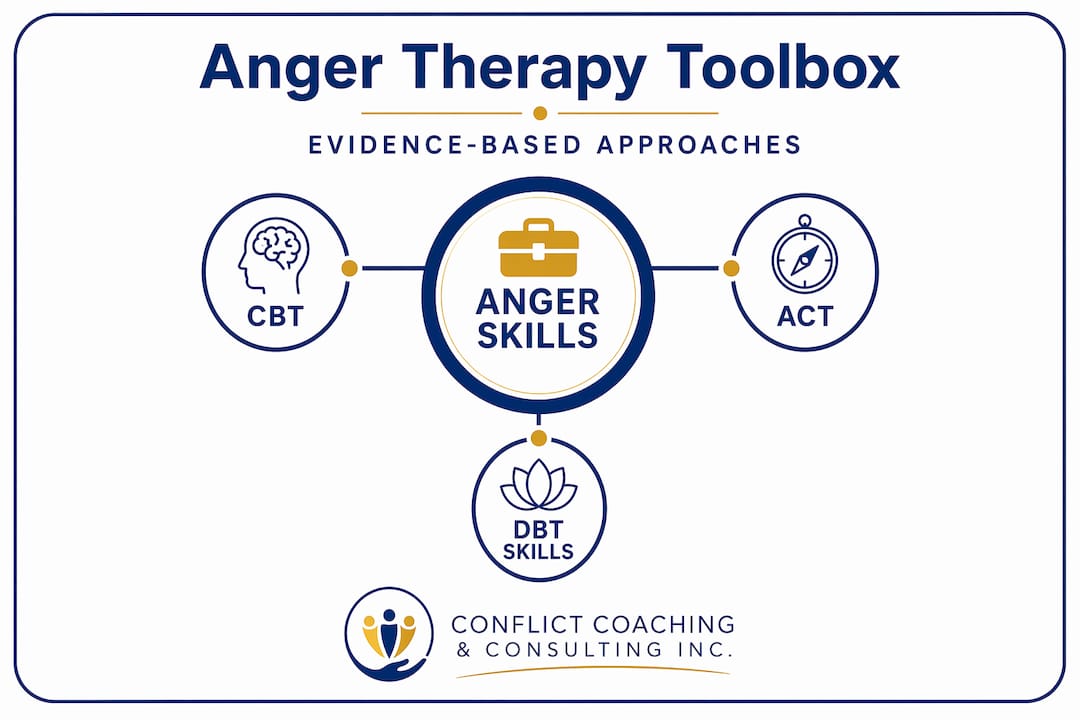
Combining all three, as the research on integrating multiple approaches supports, creates a richer toolbox than any single method. CBT addresses distorted thinking. ACT builds acceptance and value clarity. DBT provides crisis-level regulation skills. Together, they cover anger from the cognitive, behavioral, and emotional angles simultaneously.
Practical techniques that are backed by research
Knowing the theory is useful. Having specific practices you can use on a Tuesday afternoon when things go sideways is what actually changes behavior.
Here is a framework that pulls from the evidence: the STARS in the Storm method, developed as a practical structure for de-escalation in real time.
- Silence. Stop before you respond. Even two seconds of silence interrupts the reactive cycle.
- Think. Ask what is really happening here. Is this anger signaling a threat to something you value?
- Action. Choose your next move deliberately instead of automatically.
- Resolve. Commit to the course of action that fits your values, not your immediate emotional state.
- Scribe. Write about what happened afterward. Writing about emotions helps process and reduce their power over future behavior.
Beyond this framework, the following techniques each have solid research support for reducing anger in daily life:
- Box breathing. Three slow intentional breaths at a 4-count rhythm (inhale 4, hold 4, exhale 4) measurably reduce cortisol and restore prefrontal cortex function within minutes.
- Mindfulness. Mindfulness interventions reduce anger and aggressive behavior across multiple populations, including law enforcement personnel who face high-frequency stress exposure.
- Physical movement. Going for a brisk 10-minute walk when anger spikes serves as a critical outlet that discharges anger energy and restores mental clarity.
- Opposite action. From DBT, this means consciously doing the behavioral opposite of what anger demands. If anger says “confront and escalate,” opposite action says “step back and soften tone.”
- Assertive communication. Express what you need using specific, respectful language instead of blaming or generalizing. This channels anger’s signal into productive dialogue. You can explore clinical anger exercises that build this skill systematically.
Pro Tip: Anger logs are one of the most underused tools in evidence based anger therapy. Track what triggered you, what you felt physically, what you thought, and what you did. Over two weeks, patterns emerge that no amount of introspection alone will reveal.
Applying these practices in different settings
Evidence-based anger management does not look the same for everyone. Age, context, and the severity of anger problems all shape which interventions work best.
For children and adolescents, the research points clearly toward structured skill-building programs. An 11-session CBT intervention demonstrated reductions in aggressive behavior in youth by improving anger regulation and reducing the tendency to assume hostile intent from others. That second mechanism matters: children who interpret neutral behavior as threatening will trigger angry responses repeatedly until that cognitive pattern changes.
Parents managing their own anger benefit from tailored guidance that addresses family-specific triggers. The dynamics of parenting stress, sleep deprivation, and high-stakes emotional moments require strategies that account for relationship context, not just individual regulation. Masteringconflict offers specific parent-focused anger guidance that addresses exactly this.
The group versus individual therapy question also has a research answer. Anger management program outcomes from group-based programs show increased coping effectiveness and improved social skills, because group settings add accountability, modeling, and social support that individual therapy alone cannot replicate. Individual therapy goes deeper into personal history and specific triggers. For most people, a combination is ideal.
There is also a clinical reality that rarely gets discussed openly: some individuals need medication as a foundation before psychotherapy can be effective. When neurological or biochemical factors are amplifying emotional reactivity, medication stabilizes the baseline so that coping skills can actually take root. This is not failure. It is medicine meeting psychology where both are needed.
Finally, recognize the signs that self-help has reached its ceiling: anger episodes that result in physical aggression, repeated relationship ruptures despite genuine effort, or anger that follows you into every area of life. At that point, a questionnaire for anger management administered by a trained clinician is the most accurate way to assess severity and match you with the right level of care.
My perspective on what evidence-based practice actually requires
I have worked with hundreds of people who came in believing their anger was the problem. What I have learned, consistently, is that anger is rarely the actual problem. It is the signal that something deeper, a boundary violation, an unmet need, an old wound, has been activated. The moment I shifted my focus from “how do I stop this client’s anger” to “what is this client’s anger trying to protect,” the work became more honest and more effective.
The pitfall I see most often is people using techniques as escape hatches instead of entry points. Breathing exercises are real and powerful, but if you use them only to avoid feeling what the anger is pointing toward, you are managing symptoms, not changing the pattern. Evidence based anger therapy works best when you let the techniques calm the body enough to then do the harder work of examining the message underneath.
Integrating CBT, ACT, and DBT is not about using all three in every session. It is about knowing which tool the moment calls for. Sometimes a client needs cognitive restructuring. Sometimes they need radical acceptance. Sometimes they need a concrete behavioral skill to get through the next 20 minutes. Clinical judgment about which approach serves the person right now is what separates good therapy from a generic program.
The other thing I want you to hear directly: change takes longer than you think it should, and that is normal. Emotional patterns laid down over years do not shift in four sessions. But with intentional practice and the right support, they do shift. I have seen it happen more times than I can count.
— Carlos
Ready to work with a clinical team that gets it
If you have read this far, you are not looking for quick fixes. You want to understand your anger and change how you respond to it for the long term. That is exactly the kind of work Masteringconflict was built for.
Dr. Carlos Todd and the Masteringconflict clinical team provide evidence-based clinical services designed specifically for anger and emotional regulation, from structured anger management programs to individual therapy, couples counseling, and family sessions. If geography or schedule is a barrier, teletherapy access makes it possible to work with a trained clinician from wherever you are, on a schedule that fits your life. Every program draws from the same research-backed approaches covered in this article, applied with the individualization that self-help materials cannot provide. The path from understanding anger to genuinely changing your relationship with it runs through real clinical support. Book a session and start that work with a team that takes the evidence seriously.
FAQ
What is anger management evidence based practice?
Anger management evidence based practice refers to therapeutic approaches for anger regulation that are supported by research, including CBT, ACT, and DBT. These methods have been tested in clinical trials and shown to reduce anger intensity, frequency, and associated behaviors.
How effective is CBT for anger management?
CBT is highly effective for anger problems, confirmed by multiple meta-analyses as a time-limited and reliable treatment. It works by identifying and restructuring distorted thoughts that amplify anger responses.
Can children benefit from evidence-based anger therapy?
Yes. Structured CBT programs for children have shown meaningful reductions in aggression by targeting both anger regulation and hostile attribution, the tendency to assume others mean harm. Even short interventions of 11 sessions produced measurable behavioral improvement.
What is the fastest evidence-based technique for calming anger in the moment?
Box breathing at a 4-4-4 count is among the fastest-acting techniques, as three slow breaths measurably reduce cortisol and restore prefrontal cortex function within minutes of sustained practice.
When should I seek professional help for anger?
Seek professional support when anger leads to physical aggression, repeatedly damages important relationships, or persists despite your own genuine effort to change. A clinician can administer a formal questionnaire for anger management to assess severity and match you with the right program.
Recommended
- Anger management classes: Build emotional control that lasts – Mastering Conflict
- Anger Reduction Techniques: Building Healthier Relationships – Mastering Conflict
- Evidence-Based Anger Management: Proven Strategies for Change – Mastering Conflict
- Mindfulness for Anger: 7 Evidence-Based Practices That Work – Mastering Conflict