
How to Find an Anxiety Therapist Near Me in 2026

TL;DR:
- Finding a licensed anxiety therapist with the right credentials and specialization is essential for effective treatment.
- Initial sessions focus on safety and goals, not detailed histories, building trust for long-term progress.
An anxiety therapist is a licensed mental health professional who treats anxiety disorders using evidence-based methods tailored to your specific triggers and symptoms. Finding a qualified local anxiety counselor matters because timely access to specialized care directly affects how quickly you see results. Generic therapy from a non-specialized provider often falls short. This guide covers how to search for a licensed anxiety therapist nearby, what credentials to verify, what to expect in your first session, and how to recognize a good fit before committing to treatment.
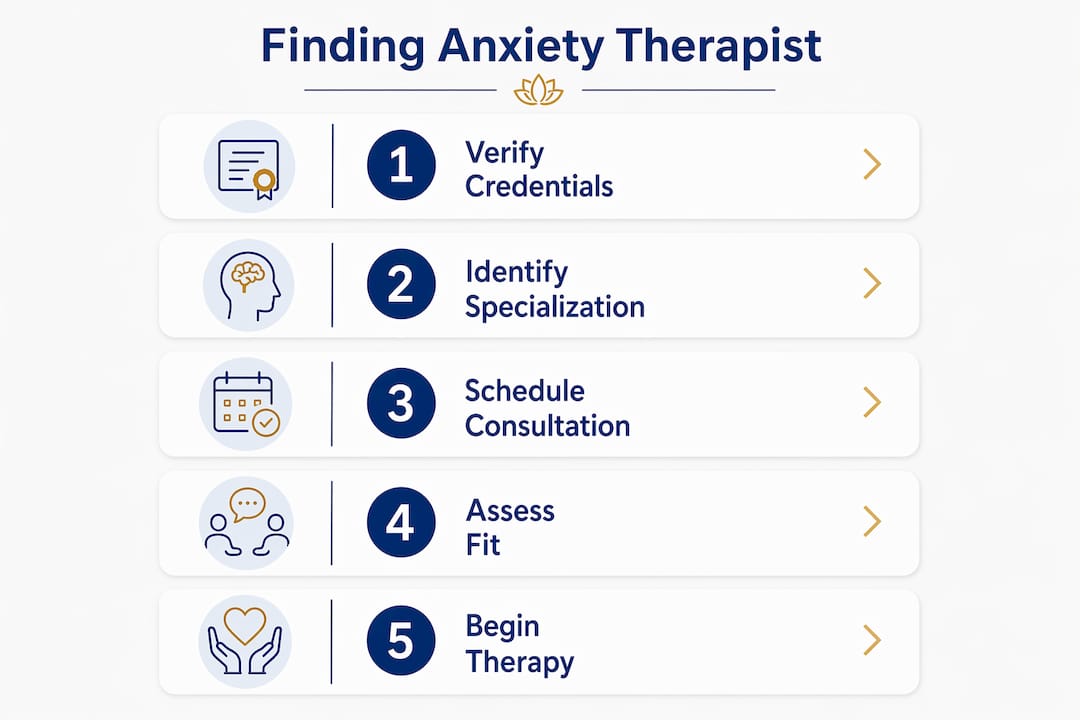
How to find an anxiety therapist near me with the right credentials

The most important filter when searching for a local anxiety therapist is licensure. Master-level credentials to look for include Licensed Clinical Social Worker (LCSW), Licensed Marriage and Family Therapist (LMFT), and Licensed Professional Counselor (LPC). Each credential requires graduate-level training and supervised clinical hours. Verifying these credentials through your state licensing board takes less than five minutes and protects you from unqualified practitioners.
Beyond licensure, specialization matters just as much. A therapist licensed in general mental health is not the same as one who specializes in anxiety disorders. The Anxiety and Depression Association of America (ADAA) maintains a therapist directory that filters by specialty, location, and insurance. Professional directories like GoodTherapy also allow you to filter by anxiety type, including social anxiety, panic disorder, and generalized anxiety disorder (GAD).
Here is what to check before booking a first appointment:
- State license status: Confirm active licensure on your state’s professional licensing board website.
- Anxiety specialization: Look for explicit mention of anxiety disorders, not just “stress” or “mood issues.”
- Evidence-based modalities: The therapist’s profile should list CBT, ERP, ACT, or similar approaches.
- Insurance or sliding scale: Confirm accepted insurance or ask about reduced-fee options upfront.
- Telehealth availability: Many licensed therapists offer remote sessions, which expands your local options significantly.
Pro Tip: Use the ADAA’s “Find a Therapist” tool and filter by your zip code and anxiety subtype. This narrows results to clinicians who treat your specific condition, not just anxiety in general.
When you search for a therapist using these filters, you cut the time spent on poor-fit consultations significantly. Most therapists offer a free 15-to-20-minute initial call specifically for this purpose.
What to expect in your first anxiety therapy session
The first session with a local anxiety therapist is not a deep dive into your history. Initial consultations typically last 15–20 minutes, are often free, and focus on determining whether the therapist’s expertise matches your triggers and goals. That framing alone removes a lot of pressure from the first contact.
Many people assume they must disclose every detail of their anxiety in session one. That assumption is wrong. Therapists prioritize establishing safety and setting goals first, not collecting a full history. Sharing too much too fast can actually work against you by causing retraumatization before trust is built. Your history unfolds gradually as comfort grows.
What a first session typically covers:
- Your primary concern: What is driving you to seek help right now?
- Your goals: What does improvement look like for you in three to six months?
- Therapist’s approach: How does this clinician work, and does it match your needs?
- Practical logistics: Session frequency, format (in-person or telehealth), and cost.
The format question is worth taking seriously. Telehealth for anxiety is as effective as in-person therapy and carries a distinct advantage. Remote sessions allow you to practice coping skills in the actual environments where anxiety shows up, like your home, your car, or your office. That real-world application accelerates progress in ways a clinical office setting cannot replicate.
Pro Tip: Treat the first consultation like an interview you are conducting, not one you are sitting for. Prepare two or three questions about the therapist’s approach to your specific anxiety type before the call.
What therapy approaches do anxiety specialists actually use?
Evidence-based treatment for anxiety centers on three primary modalities: Cognitive Behavioral Therapy (CBT), Exposure and Response Prevention (ERP), and Acceptance and Commitment Therapy (ACT). Each targets anxiety differently, and the best anxiety therapist in your area will match the approach to your specific diagnosis.
Choosing a generalist therapist over one specialized in anxiety disorders is one of the most common mistakes people make. Generic talk therapy may provide emotional support, but it does not systematically address the thought patterns and avoidance behaviors that sustain anxiety long-term.
| Therapy | Best suited for | Core mechanism |
|---|---|---|
| CBT | GAD, social anxiety, panic disorder | Identifies and restructures distorted thought patterns |
| ERP | OCD, specific phobias | Gradual exposure to feared triggers without avoidance |
| ACT | Chronic anxiety, health anxiety | Builds psychological flexibility and values-based action |
| Medication + therapy | Severe or treatment-resistant anxiety | Combines pharmacological support with behavioral change |
For some people, medication prescribed by a psychiatrist or primary care physician works best alongside therapy, not instead of it. A qualified anxiety therapist will recognize when a referral for medication evaluation is appropriate and will coordinate care with your prescribing provider. That coordination is a sign of clinical competence, not a limitation.
Understanding therapy for anxiety at this level helps you ask better questions during consultations and recognize whether a therapist is offering you real, targeted treatment.
Signs of a good fit and red flags to watch for
Emotional safety is the single most reliable indicator of a good therapeutic fit. Feeling validated and understood in early sessions predicts stronger engagement and better outcomes. If you leave sessions feeling judged, dismissed, or pressured, that is not a personality clash to push through. It is clinical data telling you the fit is wrong.
Credentials alone do not guarantee a productive relationship. A therapist can hold every relevant license and still be the wrong fit for you personally. Interpersonal compatibility, communication style, and pacing all matter.
Red flags to watch for:
- Promised quick fixes: Guaranteed or rapid results are a warning sign. Effective anxiety treatment is collaborative and moves at your pace.
- Deflecting credential questions: A qualified therapist welcomes questions about their training and specialization.
- Pushing disclosure too fast: Pressure to share traumatic details before trust is established indicates poor clinical judgment.
- Rigid, one-size-fits-all approach: Anxiety treatment must adapt to your specific type and history.
“The best therapist is the one with whom you feel safe enough to be honest. That safety is not a bonus. It is the mechanism through which therapy works.”
Individual therapy techniques that produce results depend entirely on the client feeling secure enough to engage with them. If that foundation is missing, even the most evidence-based approach will underperform. Give yourself permission to try a different therapist if the fit is not right after two or three sessions.
Key Takeaways
Finding the right anxiety therapist requires verifying credentials, matching therapy type to your specific anxiety, and trusting your read on emotional safety from the first session.
| Point | Details |
|---|---|
| Verify credentials first | Confirm active licensure and anxiety specialization before booking any appointment. |
| Match therapy to your anxiety type | CBT, ERP, and ACT each target different anxiety patterns. Generalist therapy often falls short. |
| First sessions set safety, not history | Therapists prioritize goals and comfort in early sessions. You do not need to disclose everything upfront. |
| Telehealth is clinically equivalent | Remote therapy matches in-person outcomes and lets you practice coping skills in real environments. |
| Emotional safety predicts outcomes | Feeling validated and understood early in treatment is the strongest sign you have found the right fit. |
What I have learned from years of working with anxious clients
People often spend months searching for the “perfect” therapist before booking a single consultation. That search itself becomes an avoidance behavior. The anxiety about choosing the wrong therapist keeps people from choosing any therapist at all. I have seen this pattern repeat across hundreds of clients, and it is one of the most frustrating barriers to care.
My honest advice: use the free consultation. Most licensed therapists offer one, and it exists precisely so you can assess fit without financial risk. You do not need to commit after one call. You can consult two or three therapists in the same week and compare how each one made you feel. That is not being difficult. That is being a thoughtful consumer of your own mental health care.
One thing I tell clients that surprises them: telehealth is often the better starting point, not a compromise. Practicing coping strategies in your actual environment, whether that is your kitchen during a panic episode or your car before a stressful commute, produces faster skill transfer than practicing in a clinical office. The anxiety therapy options available remotely today are genuinely strong.
The right therapist will not rush you. They will not promise you a timeline. They will create enough safety that you can do the hard work at a pace that actually sticks. That is what good anxiety treatment looks like in practice.
— Carlos
Masteringconflict offers licensed anxiety therapy near you
Masteringconflict provides clinical mental health services for individuals dealing with anxiety, including both in-person and remote options across North Carolina, South Carolina, Florida, and beyond.
Dr. Carlos Todd, a licensed clinical mental health counselor and psychologist, leads a team that specializes in evidence-based care for anxiety, anger, and related conditions. Sessions are tailored to your specific anxiety type, not a generic protocol. Whether you prefer face-to-face appointments or the flexibility of teletherapy counseling, Masteringconflict has structured options to match your schedule and comfort level. For a full overview of what is available, visit the clinical services page and book a consultation directly.
FAQ
What credentials should a licensed anxiety therapist have?
Look for an LCSW, LMFT, or LPC with documented specialization in anxiety disorders. Verify their license status through your state’s professional licensing board before booking.
How long does the first anxiety therapy session last?
Initial consultations typically run 15–20 minutes and are often free. They focus on assessing fit between your needs and the therapist’s expertise, not collecting your full history.
Is telehealth therapy as effective as in-person for anxiety?
Yes. Telehealth outcomes are comparable to in-person therapy for anxiety, and remote sessions carry the added benefit of practicing coping skills in your real-life environment.
How do I know if my anxiety therapist is the right fit?
Feeling emotionally safe and understood in early sessions is the clearest sign of a good fit. If you feel dismissed, pressured, or invalidated, that is a signal to look for a different provider.
What therapy works best for anxiety disorders?
CBT, ERP, and ACT are the clinically supported approaches for anxiety. The right choice depends on your specific anxiety type, which a specialized therapist will assess in early sessions.
Recommended
- Counseling Near Me for Depression and Anxiety: 2026 Guide – Mastering Conflict
- How to Find a Therapist for Effective Support – Mastering Conflict
- Anger Management Classes Near Me: Find Local & Online Options 2025 – Mastering Conflict
- Managing Anxiety, Depression and Stress: Your 2026 Guide – Mastering Conflict