
What Do You Talk About in Premarital Counseling?

TL;DR:
- Premarital counseling covers communication, finances, intimacy, family history, and shared goals to build a strong foundation. Clinicians recommend starting 6–12 months before wedding day to allow time for meaningful conversations and skill development. Honest participation, homework, and early preparation increase the likelihood of healthier long-term relationships.
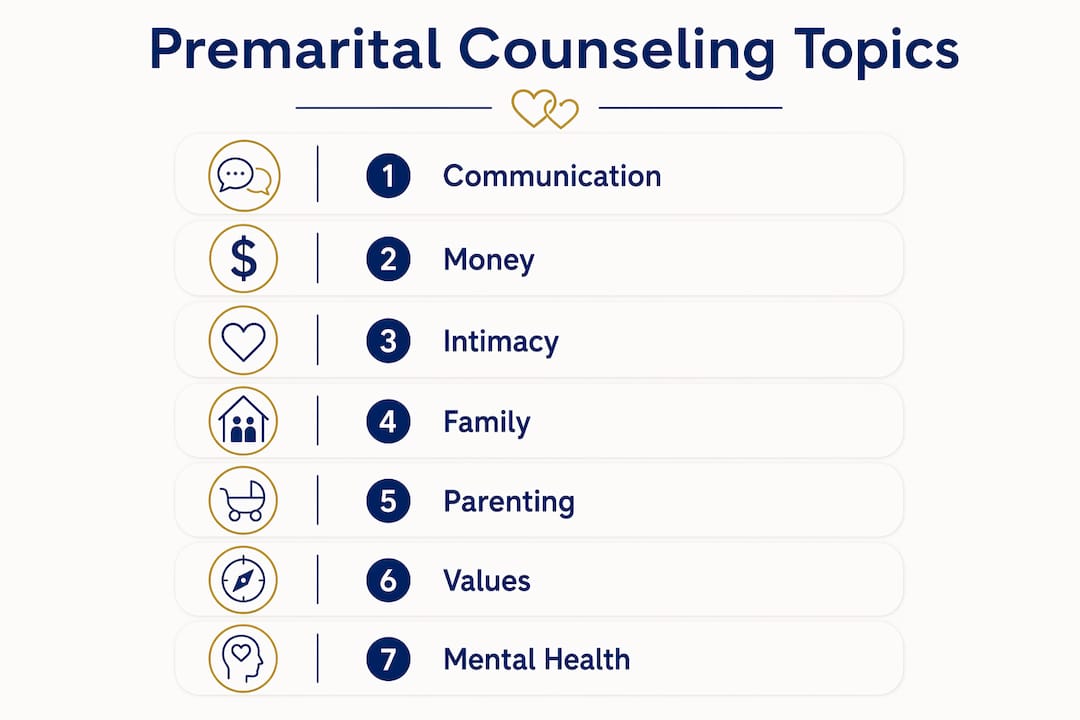
Premarital counseling covers communication and conflict styles, money and debt, sex and intimacy, parenting plans, family history and in-law boundaries, shared values and roles, mental health and trauma, and the logistics of building a life together. Most couples walk into a first session expecting an awkward interrogation and leave surprised: sessions are structured but warm, goal-oriented rather than judgmental, and built around your specific relationship rather than a generic checklist.
Core topics you can expect to cover:
- Communication patterns and how you handle conflict
- Finances: accounts, debt, spending styles, and financial goals
- Sex, intimacy, and physical expectations
- Parenting: whether, when, and how
- Family of origin, in-laws, and boundary-setting
- Values, religion, roles, and long-term life plans
Table of Contents
- How premarital counseling works and when to start
- 1. What do you talk about in premarital counseling: communication and conflict
- 2. Money and finances: what to put on the table
- 3. Sex, intimacy, and physical expectations
- 4. Family background, childhood history, and in-laws
- 5. Parenting and plans for children
- 6. Values, roles, religion, and long-term goals
- 7. Mental health, trauma, addiction, and when to get individual help
- 8. What to expect from sessions: format, timeline, and cost
- 9. A practical checklist of questions to bring to your sessions
- What therapists actually track and the red flags they watch for
- Key Takeaways
- What clinicians wish you knew before your first session
- Masteringconflict offers premarital counseling for couples ready to do the work
- Useful sources and further reading
How premarital counseling works and when to start
Premarital counseling helps couples build skills, surface differences before they become crises, and normalize therapy as a resource for future challenges. Clinicians recommend it even for couples without obvious problems because learning communication tools early makes couples far more likely to seek help later when it actually matters.
Formats range widely. Therapist-led individual couple sessions offer the most personalized depth. Online telehealth works well for busy schedules or couples in different cities. Group workshops and church-based programs like Prepare/Enrich can be affordable and community-grounded, though they offer less privacy for sensitive topics.
Most clinicians suggest starting 6–12 months before the wedding. That window gives you enough time to work through real disagreements without the pressure of a looming date collapsing every session into wedding logistics.
Pro Tip: Book your intake before you finalize the venue. Couples who start counseling early have more time to sit with hard conversations instead of rushing through them.
1. What do you talk about in premarital counseling: communication and conflict
Communication is usually the first topic a therapist digs into because it underlies every other issue on the list. Therapists assess how you listen, how you express needs, and what happens in your body when a fight starts. Fight, flight, freeze, and fawn are all conflict responses that show up in couples work, and most people have never named which one they default to.

Structured inventories are often used to surface communication patterns each partner may not recognize in themselves. Results guide which topics get the most session time.
Sample questions to bring:
- “When we argue, what does ‘calming down’ actually look like for each of us?”
- “What’s our repair ritual after a fight — do we have one?”
- “How do we make decisions when we genuinely disagree?”
- “Who tends to shut down first, and what helps them re-engage?”
Therapists also focus on repair attempts, the small repeatable actions that restore connection after conflict. Building a shared repair vocabulary is one of the highest-leverage skills couples can leave counseling with.
2. Money and finances: what to put on the table
Financial conflict is one of the most cited reasons couples struggle in early marriage, so therapists treat it as a core topic rather than an afterthought. The conversation goes well beyond “who pays what.” It covers how each of you was raised around money, what debt each person carries, credit scores, spending styles, and whether you want joint accounts, separate accounts, or both.
Sample questions to raise with your counselor:
- “Should we combine finances fully, partially, or keep them separate?”
- “How do we handle a major purchase one of us wants and the other doesn’t?”
- “What does financial security mean to each of us, and are those definitions compatible?”
- “How do we build an emergency fund, and who manages it?”
Pro Tip: If a prenuptial agreement is on the table, raise it in counseling as a relational conversation, not just a legal one. A therapist can help you discuss it without it feeling like a threat. For the actual document, consult a family law attorney, not your counselor.
3. Sex, intimacy, and physical expectations
Sex is the topic couples are most likely to avoid bringing up themselves, which is exactly why a good premarital counselor raises it directly. The conversation covers frequency expectations, preferences, boundaries, consent as an ongoing practice (not a one-time agreement), sexual health history, and what happens when desire is mismatched.
Topics to address in session:
- Frequency expectations and how to handle differences without resentment
- How each partner communicates about physical needs and limits
- Sexual health, including STI history and fertility concerns
- How past experiences or trauma affect intimacy now
If either partner has a history of sexual trauma, persistent pain, or a significant mismatch in desire that feels stuck, ask your counselor for a referral. A licensed sex therapist or a pelvic health specialist handles those concerns at a depth that falls outside standard premarital work.
4. Family background, childhood history, and in-laws
Where you came from shapes how you show up in a relationship, often in ways you haven’t consciously examined. Therapists ask about family of origin because attachment patterns, emotional regulation habits, and expectations about roles are largely learned at home. Two people can love each other deeply and still carry completely incompatible blueprints for what “family” looks like.

In-law topics that come up most often: holiday logistics, how much access extended family expects, caregiving responsibilities for aging parents, and what “too involved” actually means to each partner. These conversations are easier to have in a therapist’s office before they become arguments at Thanksgiving.
Pro Tip: Before your session on family, each of you write down one thing your family did well and one thing you’d do differently. Sharing those lists in session gives the therapist a fast read on where your blueprints align and where they don’t.
A short scenario worth raising: “If your mother calls every day and expects to be included in our decisions, how do we handle that together?” Naming a specific pattern is more productive than a vague conversation about “boundaries.”
5. Parenting and plans for children
Few topics carry more weight than whether and when to have children. Therapists treat this as a decision-making conversation, not a values debate, which means the goal is clarity and alignment rather than convincing anyone of anything.
Questions to work through together:
- Do we both want children? Is that a firm yes, a firm no, or a “maybe someday”?
- If yes, when? What’s our timeline, and what would shift it?
- What are our fertility concerns, and have we discussed what we’d do if conception is difficult?
- How do we each define good parenting, and where did that definition come from?
- Who handles childcare, and what does that look like if both of us work full-time?
- What’s our approach to discipline, schooling, and religious upbringing?
Mark each answer as tentative or decided. A counselor can help you build a framework for revisiting tentative items as circumstances change. If partners genuinely disagree on whether to have children at all, that’s a fundamental incompatibility that deserves more than one session.
6. Values, roles, religion, and long-term goals
Shared values don’t mean identical beliefs. They mean you’ve talked honestly about what each of you holds as non-negotiable and found enough common ground to build on. Therapists help couples surface the assumptions they’ve never said out loud: who earns, who manages the household, whether faith is central to daily life, and what “success” looks like in 20 years.
Specific areas to cover: household labor division, career ambitions and what happens if one partner’s career requires relocation, religious practice and how to raise children if you differ, and retirement expectations.
Pro Tip: Try this scenario question in session: “If one of us got a career opportunity that required moving across the country, how would we decide?” The answer reveals decision-making style, whose career gets priority, and whether you’ve actually talked about that.
Document agreements in writing, even informally. Revisiting a written note two years into marriage is far easier than reconstructing a conversation you both remember differently.
7. Mental health, trauma, addiction, and when to get individual help
Premarital counseling is joint work, but it regularly surfaces individual needs. Therapists ask about mental health diagnoses, current medications, past trauma, substance use, and what support systems each partner already has. This isn’t intrusive; it’s how a clinician figures out whether the couple work can proceed productively or whether individual therapy needs to run alongside it.
Signs that individual therapy or specialized care belongs in the plan:
- Active or recently treated substance use disorder
- Unresolved trauma that significantly affects daily functioning or intimacy
- A mental health diagnosis that isn’t currently managed
- A history of abuse in past relationships
- Suicidal ideation or self-harm history
Some therapists will schedule individual sessions alongside joint ones so each partner can speak more openly about personal history. Those conversations stay separate from the couple work unless both partners agree otherwise. If a clinician identifies a concern that falls outside their scope, they refer out rather than try to handle everything themselves.
8. What to expect from sessions: format, timeline, and cost
A typical premarital counseling sequence runs: initial intake and goal-setting, an optional assessment or inventory, core topic sessions, and a closing session with a written plan. Many counselors also recommend a post-wedding check-in 6–12 months after marriage to address the realities of living together that differ from engagement expectations.
| Element | Typical Range / Detail |
|---|---|
| Number of sessions | 6–10 sessions for most couples |
| Session length | 50 minutes |
| Cost per session (U.S.) | Varies by region and provider type |
| Insurance coverage | Some plans cover it; verify with your insurer before booking |
| Sliding-scale options | Available through many community mental health centers |
| Confidentiality | Standard HIPAA protections apply; exceptions include imminent harm and mandatory reporting |
One study cited by GoodTherapy found that couples who received premarital counseling showed a 31% lower likelihood of divorce. That figure comes from survey-based research and should be read as directional rather than predictive, but the direction is consistent across multiple studies.
Choosing the right clinician matters. Look for an LMFT (Licensed Marriage and Family Therapist), LPC (Licensed Professional Counselor), or a psychologist with specific couples training. For more on selecting the right therapist, credentials and specialization in couples work are the two factors that matter most.
9. A practical checklist of questions to bring to your sessions
Before your first session, each partner fills this out independently, then compare answers. Mark the items that feel urgent with a star, pick your top three to start, and agree on one concrete next step per topic.
Communication
- How do I show love, and how do I feel most loved in return?
- What’s my conflict style, and what triggers me most?
- What does a good repair look like after we fight?
Money
4. What debt am I bringing into this marriage?
5. What does financial security mean to me?
6. How should we handle a major purchase we disagree on?
Intimacy
7. What are my expectations around frequency and physical affection?
8. How do I communicate when something isn’t working for me physically?
Family and in-laws
9. How much involvement do I expect from my family of origin?
10. How do we handle holidays when our families have competing expectations?
Parenting
11. Do I want children? If yes, when, and what’s my parenting philosophy?
12. How do we divide childcare if both of us work?
Values and goals
13. Where do I see us living in 10 years?
14. How important is religious practice in our daily life?
Mental health
15. Is there anything in my personal history my partner should understand to support me better?
Share this list with your counselor before the first session when possible. It saves 20 minutes of warm-up and gets you into the real work faster. For more sample counseling questions, Masteringconflict has a dedicated resource worth reading before your intake.
What therapists actually track and the red flags they watch for
Clinicians aren’t just facilitating conversation. In early sessions, they’re assessing safety, power dynamics, repair attempts, and whether both partners are engaging voluntarily. A couple that looks fine on paper can show concerning patterns within the first two sessions.
Red flags that typically trigger referrals or a change in approach:
- One partner controls, dismisses, or speaks for the other consistently
- Indicators of active substance use or addiction
- Disclosure of current or past domestic violence
- Unmanaged mental health symptoms affecting daily function
- Coercive or threatening behavior in or outside sessions
Assessments like the Prepare/Enrich inventory are widely used because they give both partners a structured way to see their own patterns. Results aren’t diagnostic; they’re a map. Therapists use them to prioritize which topics need the most time and to give couples a shared language for differences they’ve sensed but never named.
Key Takeaways
Premarital counseling works best when couples arrive prepared: knowing the core topics, bringing honest questions, and committing to the homework between sessions.
| Point | Details |
|---|---|
| Start 6–12 months early | Beginning before wedding pressure peaks gives you time to work through real disagreements. |
| Bring a question list | Prioritize your top three topics before the first session to use time well. |
| Homework drives results | Couples who complete assigned exercises report stronger communication gains than those who skip it. |
| Plan a post-wedding check-in | A session 6–12 months after marriage addresses the realities of living together that engagement doesn’t reveal. |
| Masteringconflict offers couples counseling | Premarital-focused sessions are available online and in-person, with licensed clinicians trained in evidence-based couples work. |
What clinicians wish you knew before your first session
Most couples come in thinking the counselor will tell them whether they’re ready to get married. That’s not what happens. The counselor’s job is to help you see each other more clearly and give you tools to handle what’s coming, not to issue a verdict.
The single biggest predictor of whether counseling helps is honesty in the room. Couples who perform well for the therapist, who smooth over real disagreements to seem compatible, get very little out of the process. The couples who say the uncomfortable thing, who let the therapist see the actual dynamic, those are the ones who leave with something real.
Homework matters more than most couples expect. A 50-minute session moves fast. The conversation prompts and worksheets assigned between sessions are where the actual integration happens. Skipping them is like going to physical therapy once a week and doing nothing in between.
One more thing worth saying plainly: premarital counseling isn’t a sign that something is wrong. Clinicians who work with couples consistently recommend it for everyone, including couples who feel solid, because the skills you build now are the ones you’ll draw on during the hard years. And there will be hard years.
Masteringconflict offers premarital counseling for couples ready to do the work
Premarital counseling is one of the most concrete investments a couple can make before marriage, and Masteringconflict provides exactly that: licensed clinicians with specific training in couples work, available for in-person sessions in North Carolina, South Carolina, and Florida, and online for couples anywhere.
Sessions cover the full range of premarital topics covered in this guide, from communication and conflict resolution to finances, intimacy, and family planning. Online telehealth appointments make it easy to fit sessions into a busy engagement schedule without commuting. Sliding-scale options and insurance verification support are available for couples watching their budget.
The next step is straightforward: visit Masteringconflict’s clinical services page to review options and request an intake appointment. If you’re unsure whether counseling or coaching fits your situation better, the coaching vs. therapy guide on the site explains the difference clearly.
Useful sources and further reading
- Premarital Counseling: How It Works, Benefits, and Challenges — GoodTherapy overview of goals, formats, and research on outcomes
- What to Expect in Premarital Counseling: Session-by-Session Guide — Practical breakdown of session structure, assessments, and homework
- Premarital Counseling: Types, Benefits, and Purpose — PsychCentral summary of format options and cost context
- Marriage & Family: Building Relationships of Mercy & Tranquility — Faith-based perspective on premarital preparation and family values
- Top premarital counseling benefits for couples — Masteringconflict research-backed summary of mental health and relationship outcomes
- Conflict resolution for couples — Practical exercises and frameworks for building resilient communication
- Marriage counseling before marriage — Timing guidance and reasons to start counseling early
This article is general information, not professional advice. Consult a licensed mental health clinician for guidance specific to your relationship and circumstances.
Recommended
- Premarital Counseling: Everything You Need to Know – Mastering Conflict
- Marriage Counseling Before Marriage: Strengthening Relationships Early – Mastering Conflict
- Common Marriage Counseling Questions That Transform Relationships – Mastering Conflict
- Top premarital counseling benefits for couples in 2026 – Mastering Conflict