
Stress vs. Worry: How They Differ and When It’s Anxiety

Stress and worry are related, but they are not the same thing. Stress is your body and mind reacting to an external demand, such as a deadline, an illness or a conflict at home. Worry is the thinking part: a repeating loop of “what if” thoughts about something that might happen. When either one lasts, grows or starts running your day, it can shade into anxiety.
This guide explains each one in plain terms, shows where they overlap, and tells you what to do about them and when to talk to a professional.
TL;DR
- Stress is a response to an external cause. It usually eases when the situation is resolved.
- Worry happens in the mind: repeated thoughts about what could go wrong. It can be useful, until you get stuck in it.
- Anxiety is persistent apprehension that can continue even when there is no current threat, and it can interfere with work, sleep and relationships.
- Worry that lasts six months or more and disrupts daily life is a reason to seek an evaluation. In a crisis, call or text 988.
Table of Contents
- Is worry and stress the same thing?
- What stress is and what it does to you
- What worry is and when it helps
- Stress vs. worry vs. anxiety at a glance
- Stress vs. anxiety: where they overlap
- Can stress or worry turn into anxiety?
- How to manage stress and worry day to day
- When to get professional help
- Our perspective
- Get support from Mastering Conflict
- FAQ
- Sources
Is worry and stress the same thing?
No, though people use the words interchangeably because they often show up together. A useful way to separate them is to ask where the problem lives.
According to psychologist Dr. Melanie Greenberg, stress is a physiological response, the body reacting to an external event, while worry happens only in the mind. Stress involves an active fight-or-flight response to something happening now. Worry is the cognitive side: you replay a conversation, rehearse a worst case, or try to solve a problem that has not happened yet.
A quick test:
- If you can point to the thing pressing on you (a bill, a presentation, a sick relative), you are probably dealing with stress.
- If the pressure is mostly a thought that keeps returning (“What if I lose my job next year?”), that is worry.
- If both are present and your body feels wound up for no clear reason, you may be moving toward anxiety.
What stress is and what it does to you
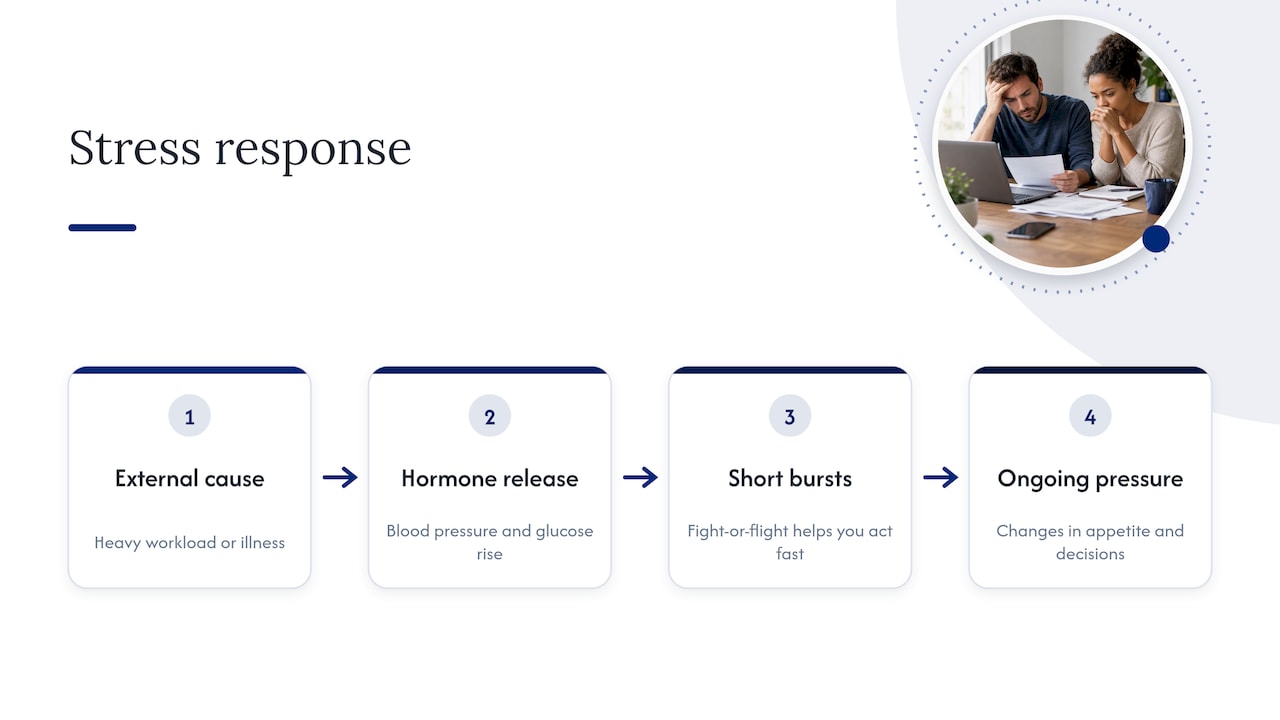
The National Institute of Mental Health describes stress as the physical or mental response to an external cause, such as a heavy workload or an illness. It can be short-term, or it can recur over a long period.
The body’s side of this is well documented. When you are stressed, your body releases hormones that can raise blood pressure, heart rate and blood glucose. This is often called the fight-or-flight response. It is built to help you act fast, and it works well for short bursts.
The trouble comes when the pressure does not let up. The CDC lists common signs of stress that include changes in appetite, trouble making decisions, physical reactions such as skin rashes or stomach problems, and increased use of substances.
One point from MedlinePlus deserves attention: people can get used to stress symptoms and not realize there is a problem. If you have been tense, short-tempered or sleeping badly for months, that may be your new normal rather than a sign that you are fine. Our guide to the early signs of stress can help you spot the pattern sooner.
What worry is and when it helps
Worry gets a bad reputation, but it has a job. Harvard Medical School’s Luana Marques explains that worry can be functional, helping you problem-solve and stay safe. Checking the weather before a hike or double-checking a tax form is worry doing useful work.
It becomes a problem when you get stuck. Useful worry leads to a step: you make a call, write a list, fix something. Unhelpful worry has no next step. It just repeats, and each pass leaves you more tired and no closer to a solution.
Signs that worry has stopped being useful:
- You think about the same issue repeatedly without reaching a decision.
- You seek reassurance again and again, and it does not last.
- You lose sleep replaying what might happen.
- Your mind jumps to worst-case outcomes for ordinary events.
Stress vs. worry vs. anxiety at a glance
| Stress | Worry | Anxiety | |
|---|---|---|---|
| Where it lives | Body and mind | Mainly the mind | Mind and body |
| Usual trigger | An external demand | A feared future event | Can occur with no clear trigger |
| Typical duration | Often fades when the situation is resolved | Comes and goes, can loop | Can linger, often long-lasting |
| Can it be useful? | Yes, in short bursts | Yes, if it leads to action | Occasional anxiety is normal, but persistent anxiety is not helpful |
| Common signs | Tension, headaches, appetite changes | Racing thoughts, “what ifs” | Persistent dread, restlessness, poor sleep, avoidance |
The rows blur in real life. That is normal, and it is why the next section matters.
Stress vs. anxiety: where they overlap
Many people searching this topic really want to know about stress and anxiety, and the two do overlap heavily.
The NIMH explains that stress is generally a response to an external cause and goes away once the situation is resolved, while anxiety is usually internal and can persist without an immediate threat. It also describes anxiety as a persistent feeling of apprehension or dread that does not go away and interferes with how you live.
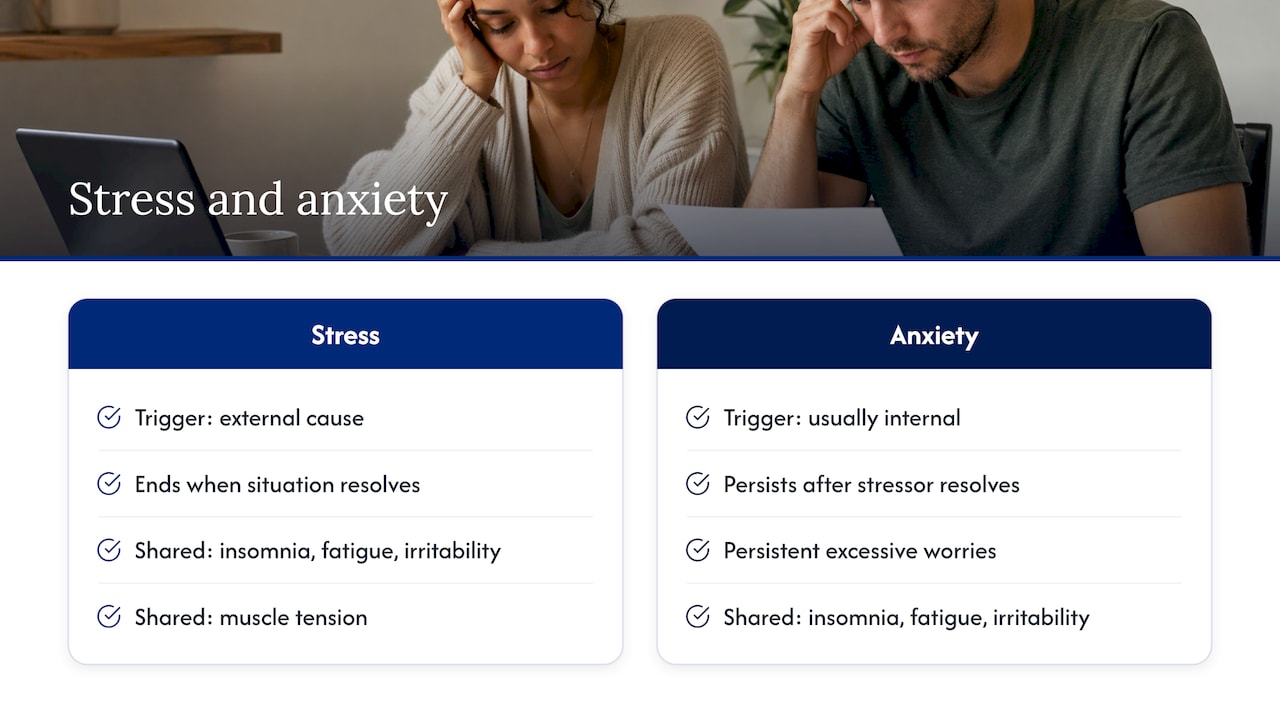
The American Psychological Association puts the dividing line in the worries themselves: anxiety is defined by persistent, excessive worries that do not go away even when the original stressor is removed.
The symptoms are almost the same, which is why it is hard to tell them apart from the inside. The APA notes that both can bring insomnia, fatigue, muscle tension, difficulty concentrating and irritability. The NIMH adds excessive worry, uneasiness, headaches or body pain and high blood pressure to the shared list.
A practical way to think about it: stress is the pressure, worry is the mental rehearsal, and anxiety is what remains when the alarm keeps ringing after the pressure is gone. That is also why a popular shortcut, “stress plus worry equals anxiety,” is a decent memory aid but not a diagnosis. Only a licensed professional can tell you whether you have an anxiety disorder.
If you also wonder whether low mood is part of the picture, see our comparison of stress and depression.
Can stress or worry turn into anxiety?
Yes. The NIMH says unmanaged stress may put someone at risk for an anxiety disorder when its symptoms interfere with daily life, cause you to avoid things, or seem to be always present.
For worry, the CDC gives a concrete marker: worry becomes a potential anxiety disorder when it lasts at least six months and interferes with daily life, such as work or relationships.
Here is how that can look in practice:
- A manager faces a hard quarter at work. That is stress, and it has a cause.
- She starts lying awake rehearsing what might go wrong. That is worry.
- The quarter ends, but she still cannot switch off, avoids meetings she used to handle easily, and her shoulders ache all day. That pattern, with no current threat, is what clinicians look at when they consider anxiety.
Stress and worry also strain relationships. Short tempers, withdrawal and constant tension are often the first thing a partner or child notices, long before you name it yourself.
How to manage stress and worry day to day
The NIMH lists several steps with good support: keeping a journal, practicing mindfulness, exercising, eating healthy regular meals, keeping a sleep routine, avoiding excess caffeine, and reaching out to supportive friends or family. Here is how to put them to work, matched to what you are dealing with.
When the problem is stress
Stress responds best to changing the load or helping your body come down from it.
- Reduce or reschedule what you can. Write down the demands on you and mark which are truly urgent.
- Move your body. Even a 15-minute walk gives the stress response somewhere to go.
- Protect sleep. Keep a regular bedtime, and limit late caffeine.
- Take short resets. Slow breathing for a minute or two between tasks helps. Our pieces on managing stress naturally and stress management for professionals go deeper, and there are versions for students and teens.
If your day depends on mental clarity, a guide to practical stress strategies for focus can add ideas to your routine, alongside sleep, food and movement.
When the problem is worry
Worry responds best to turning thoughts into decisions.
- Set a worry window. Give yourself 15 minutes a day to worry on paper. Outside that window, jot the thought down and return to what you were doing.
- Ask one question: “Is there a step I can take today?” If yes, schedule it. If no, practice letting the thought pass.
- Write it out. Journaling, which the NIMH recommends, moves the loop out of your head and makes it easier to see.
- Talk to someone. Saying a worry aloud to a trusted person often shrinks it.
For more, see our tips for managing anxiety naturally and our broader guide to managing anxiety, depression and stress.
When to get professional help
Self-help is a good start, and it has limits. The NIMH says that if you are struggling to cope or your symptoms will not go away, it may be time to talk to a professional. The CDC advises seeking help if you have physical symptoms of anxiety, such as muscle tension or trouble sleeping, along with persistent worry that is hard to control.
Consider booking an appointment with a licensed therapist, psychologist or your primary care provider if:
- Worry has lasted months and you cannot stop it.
- You are avoiding work, social events or conversations because of how you feel.
- Sleep, appetite or concentration have changed and stayed changed.
- You are relying on alcohol or other substances to cope.
- Tension is damaging your marriage, your parenting or your friendships.
If you are in immediate distress or thinking about hurting yourself, call or text 988, or chat at 988lifeline.org. The line is free and available in the US.
What treatment looks like
The NIMH says psychotherapy and medication are the two main treatments for anxiety, and many people benefit from a combination. Cognitive behavioral therapy (CBT) is a research-supported therapy that helps people identify and question inaccurate or unhelpful thoughts and is commonly used for generalized anxiety disorder. The same page notes that finding the best treatment may take some trial and error with a mental health professional. Medication questions belong with a prescriber. For a plain-language overview, read our guide to therapy for anxiety and our clinical guide to treatment.
Our perspective
Most people come to us calling it “stress,” and it is rarely just stress. Under the label there is usually a pressure at work or at home, a mind that will not stop rehearsing it, and a body that has been on alert for too long. Treating all three as one blur is why so many people try a quick fix and end up back where they started.
In our work, the pressure point is often a relationship: a tense marriage, a struggling teen, a conflict that never resolves. When that is the source, breathing exercises alone do not go far. We pair practical, skills-based tools with clinical rigor, so that you learn to calm the body, challenge the repeating thought, and change the conversation that keeps setting everything off.
Our approach is designed to meet you where you are, whether that means individual counseling, couples work, or support through teletherapy. You do not have to wait until it is severe. The earlier you look at it, the more options you have.
Carlos
Get support from Mastering Conflict
If stress or worry is affecting your sleep, your mood or your closest relationships, we can help you sort out what is going on and build a plan. Our licensed team offers individual counseling for men, women and teens, couples counseling, and online sessions for people in North Carolina, South Carolina and Florida.

Explore our counseling and clinical services, or, if tension at home is the main source, see our couples packages, which include couples sessions at $175 per hour. Prefer to meet from home? Learn about teletherapy counseling. If you are a professional who carries a heavy load, our Women In Balance coaching program supports burnout recovery for women leaders. Not sure which fits? Our page on coaching vs. therapy explains the difference.
FAQ
Is stress and worry the same thing?
No. Stress is a reaction to an external demand and involves the body’s fight-or-flight response. Worry is the repetitive thinking about what might go wrong. They often occur together, which is why they feel like one thing, but they respond to different tools.
What is the difference between stress and anxiety?
Stress usually has a clear cause and fades once the situation is resolved. Anxiety is persistent apprehension that can continue without an immediate threat and interfere with daily life. Their symptoms, such as poor sleep, tension and irritability, are very similar, so a professional evaluation is the reliable way to tell them apart.
How long can worry last before it is a problem?
The CDC says worry may point to an anxiety disorder when it lasts at least six months and disrupts work or relationships. You do not have to wait that long to get support, though. If worry is hard to control or is affecting your sleep and body now, talk to a professional.
Can stress cause physical symptoms?
Yes. Stress hormones can raise blood pressure, heart rate and blood glucose, and the CDC lists stomach problems, skin reactions and appetite changes among the signs. If physical symptoms persist, see your doctor to rule out other causes.
Can I manage worry and stress on my own?
Often you can start by yourself with exercise, regular sleep, mindfulness, journaling and talking with people you trust. If those steps are not enough, or symptoms keep getting in the way of daily life, therapy such as CBT is a well-supported next step.
Sources
- The Difference Between Worry, Stress and Anxiety, The New York Times
- I’m So Stressed Out! Fact Sheet, National Institute of Mental Health
- Generalized Anxiety Disorder: What You Need to Know, National Institute of Mental Health
- Stress, MedlinePlus
- Managing Stress, Centers for Disease Control and Prevention
- Worry and Anxiety, How Right Now, Centers for Disease Control and Prevention
- What’s the difference between stress and anxiety?, American Psychological Association
- 988 Suicide & Crisis Lifeline