
Approaches of Conflict Resolution: A Clinician’s Guide

The main approaches of conflict resolution used in clinical and therapeutic settings are collaborative/interest-based negotiation, mediation, psychotherapy-based methods (including CBT and emotion-focused therapy), restorative practices, and formal alternative dispute resolution (ADR) when legal stakes are involved. For most relationship-preserving conflicts, start with collaborative therapy or facilitated mediation. Reserve ADR or arbitration for disputes where legal rights or formal outcomes matter more than the ongoing relationship.
- Collaborative/interest-based negotiation: Best first step for couples, families, and individuals who want to preserve the relationship
- Mediation: Add a neutral third party when direct conversation has broken down
- Psychotherapy-based approaches: CBT, emotion-focused therapy, or couples/family therapy when emotional patterns are driving the conflict
- Restorative practices: Useful in family, school, or community settings to repair harm and rebuild trust
- Formal ADR (arbitration/settlement): For disputes involving housing, custody, or workplace rights
The Program on Negotiation at Harvard Law School frames negotiation and mediation as flexible, relationship-preserving methods, while arbitration and litigation are more formal and outcome-driven. Masteringconflict, founded by Dr. Carlos Todd, a licensed clinical mental health counselor, applies these evidence-based frameworks in individual, couples, and family therapy.
Pro Tip: If you are unsure which approach fits your situation, write a one-paragraph description of the conflict before your first session. Clinicians use this to identify whether the core issue is a communication pattern, a values difference, or a structural problem, and that distinction shapes which method they recommend.
Table of Contents
- What are the main approaches of conflict resolution in clinical settings?
- How do you choose the right conflict resolution strategy for your situation?
- What steps do clinicians use in therapeutic conflict resolution?
- When should you involve a neutral third party or clinician?
- How do you choose a conflict resolution provider?
- When does a conflict resolution approach become unsafe or ineffective?
- Key Takeaways
- Why collaboration is the clinical default, not just the idealistic one
- Masteringconflict offers clinical support when self-help is not enough
- Useful sources and further reading
What are the main approaches of conflict resolution in clinical settings?
Conflict is not inherently a sign of failure. Reframed clinically, it is often the point where unspoken needs finally surface. The goal is not to eliminate disagreement but to work through it in a way that leaves the relationship, and the people in it, intact.
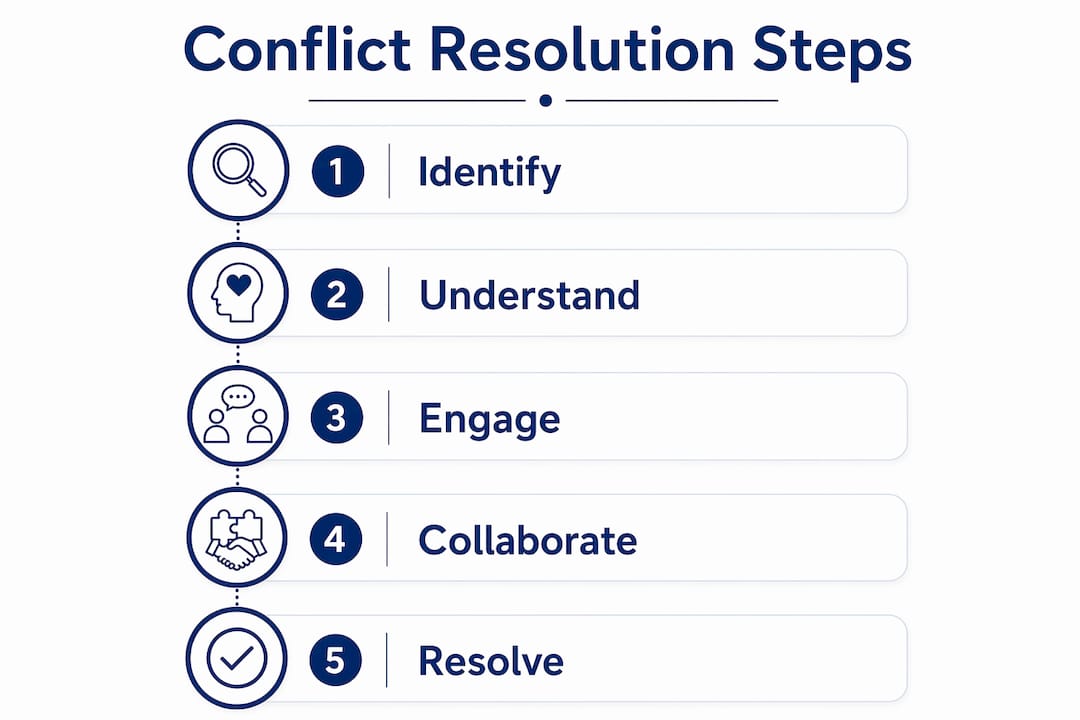
The five primary conflict-management styles identified by Thomas and Kilmann are competing, avoiding, accommodating, compromising, and collaborating. No single style fits every situation, but collaboration tends to produce the most durable outcomes in therapeutic contexts.
Here is how the main clinical approaches break down:
- Collaborative/interest-based negotiation: Parties focus on underlying needs rather than fixed positions. A couples therapist might guide partners to articulate what they actually need from a disagreement about finances, rather than debating who is “right.”
- Mediation: A neutral third party facilitates dialogue without imposing a decision. Particularly effective when direct conversation has become unproductive or emotionally charged.
- Psychotherapy-based conflict work: CBT helps clients identify distorted thinking patterns that escalate conflict. Emotion-focused therapy (EFT) targets the attachment injuries underneath recurring arguments. Family therapy addresses systemic patterns across generations.
- Restorative practices: Structured circles or conferences where affected parties speak directly, often used in family conflict and school settings to repair harm rather than assign blame.
- Arbitration/ADR: A neutral decision-maker issues a binding or non-binding outcome. Appropriate for custody disputes, workplace grievances, or contract disagreements where a formal resolution is needed.
- De-escalation/avoidance (temporary): Sometimes stepping back from a conflict briefly reduces physiological arousal enough to make productive conversation possible. This is a tactic, not a strategy.
“The more you bring standards of fairness, efficiency, or scientific merit to bear on your particular problem, the more likely you are to produce a final package that is wise and fair.” — Roger Fisher, William Ury, and Bruce Patton, Getting to Yes
Research links collaborative problem-solving approaches with lower stress markers and better long-term health outcomes, which is one reason clinicians consistently favor them over competitive or avoidant styles.
How do you choose the right conflict resolution strategy for your situation?
| Approach | Best for | Formality level | Who facilitates | Goal emphasis | Evidence base |
|---|---|---|---|---|---|
| Collaborative negotiation | Couples, coworkers, family members | Informal | Self or clinician | Preserve relationship, meet interests | Strong clinical support |
| Mediation | Broken-down communication, high emotion | Facilitated | Certified mediator | Preserve relationship, explore interests | Strong (PON, clinical) |
| Psychotherapy-based | Recurring patterns, trauma, attachment issues | Clinical | Licensed therapist | Emotional repair, skill-building | Peer-reviewed |
| Restorative practices | Family, school, community harm | Facilitated | Trained facilitator | Repair harm, rebuild trust | Growing evidence base |
| Arbitration/ADR | Custody, workplace, legal disputes | Formal/legal | Arbitrator or ADR professional | Determine rights, formal outcome | Legal/procedural |
If/then decision guide:
- If the relationship matters long-term → start with collaborative therapy or mediation
- If safety is a concern (threats, abuse, coercion) → do not use mediation alone; involve a clinician and, if needed, legal counsel
- If communication has completely broken down → a neutral third party is more effective than direct negotiation
- If legal rights are at stake (custody, housing, employment) → ADR or legal counsel is appropriate alongside therapy
- If the conflict is primarily internal (shame, fear, anger) → individual psychotherapy before any joint process
Negotiation research from PON shows that complementary style pairs, where one person leads and the other listens, often unlock better outcomes than two people using identical approaches.
Pro Tip: Ask yourself: “Do I want to win this argument, or do I want to keep this relationship?” Your honest answer usually points directly to the right method.
What steps do clinicians use in therapeutic conflict resolution?
Clinical guidance from NCBI recommends establishing clear ground rules before any productive resolution can happen. Skipping this step is the most common reason early conflict conversations collapse.
- Set ground rules: No interruptions, no name-calling, one person speaks at a time
- Write the conflict: Each party writes a brief, factual description of the problem without blame language
- Active listening: The listener reflects back what they heard before responding
- Use I-messages: “I feel dismissed when…” rather than “You always…”
- Restate the other person’s position: Accurately, even if you disagree with it
- Identify underlying interests: What does each person actually need from this situation?
- Brainstorm options together: Generate possibilities without evaluating them first
- Evaluate and agree: Discuss pros and cons, then write a shared agreement
Therapeutic conflict work, as PON’s conflict resolution strategies confirm, prioritizes emotional regulation and interest articulation over winning. That shift alone changes the entire dynamic of a conversation.
Pro Tip: Before a difficult conversation, try box breathing: inhale for four counts, hold for four, exhale for four, hold for four. Clinicians use this to lower cortisol and reduce the physiological reactivity that turns a disagreement into a fight.

Building conflict resolution skills takes practice, but even one or two of these steps, applied consistently, can interrupt a pattern that has been running for years.
When should you involve a neutral third party or clinician?
Some conflicts genuinely cannot be resolved without outside help, and recognizing that point early saves significant emotional cost.
Seek professional help when:
- The same conflict repeats without resolution despite multiple attempts
- One or both parties feel unsafe, threatened, or coerced
- Mental health symptoms (anxiety, depression, rage) are worsening
- The dispute involves child custody, housing, or employment
- Communication has become contemptuous or has stopped entirely
- One party holds significantly more power than the other
| Professional role | Who they are | Typical structure | Confidentiality |
|---|---|---|---|
| Licensed therapist | LCSW, LPC, licensed psychologist | sessions, ongoing | Protected with legal limits |
| Certified mediator | Trained neutral, may have legal background | 1–3 sessions, structured | Generally confidential |
| ADR professional | Arbitrator or dispute resolution specialist | Formal hearings, binding/non-binding | Varies by agreement |
Community mediation centers across the United States often offer sliding-scale or free services. Private therapy typically runs on a fee-for-service or insurance basis. Court-connected ADR programs are available in most states for family and civil disputes.
Trust signals to look for: Program on Negotiation references in a provider’s training, state licensure for therapists, and mediation certification from a recognized body. Collaborative leadership in clinical settings is also linked to better outcomes, so ask about a provider’s approach to power dynamics in the room.
How do you choose a conflict resolution provider?
Work through this checklist before committing to a provider or process:
- Does preserving the relationship matter more than the outcome? (Yes → therapy or mediation; No → ADR)
- Is anyone’s safety at risk? (Yes → involve a clinician and possibly legal counsel first)
- What is your timeline? (Urgent → mediation or crisis counseling; Long-term → ongoing therapy)
- What is your budget? (Limited → community mediation, sliding-scale therapy, or insurance-covered sessions)
- Do you need a legally binding outcome? (Yes → ADR or attorney-assisted negotiation)
Questions to ask any provider:
- Are you licensed or certified, and by which body?
- Do you have experience with trauma-informed conflict work?
- How many sessions does your typical process involve?
- What are your confidentiality limits?
- Do you offer sliding-scale fees or accept insurance?
Red flags: A mediator who pushes for settlement without first exploring safety concerns. A therapist who avoids setting boundaries when one party dominates the session. Any provider who guarantees a specific outcome.
Knowing your BATNA (best alternative to a negotiated agreement) before entering any process gives you a realistic floor. Review it with your clinician so emotional pressure does not push you into an agreement that does not serve you. For guidance on whether you need therapy or coaching, the coaching vs. therapy comparison at Masteringconflict is a useful starting point.
Pro Tip: Ask a potential therapist: “How do you handle it when one partner is more dominant in session?” Their answer tells you more about their clinical skill than their credentials do.
When does a conflict resolution approach become unsafe or ineffective?
Not every method works in every situation. Using the wrong approach can make things worse.
- Mediation is contraindicated when there is a history of domestic violence, coercive control, or significant power imbalance. The neutral format can inadvertently favor the more dominant party.
- Collaborative negotiation breaks down when one party is unwilling to acknowledge the other’s interests or when trauma responses (freeze, flight, fawn) prevent genuine engagement.
- Therapy alone is insufficient for disputes with legal dimensions. A therapist can help you process the emotional weight of a custody battle; they cannot replace a family law attorney.
- Avoidance, used long-term, allows resentment to compound. What starts as a minor disagreement can calcify into contempt.
When conflict involves threats, physical harm, or coercion, the priority is safety, not resolution. No conflict resolution method should be used as a substitute for protective action.
Safety checklist:
- Are threats (verbal or physical) present? → Contact a crisis line or law enforcement
- Is one party controlling the other’s access to money, housing, or children? → Legal counsel first
- Are mental health symptoms (suicidal ideation, severe dissociation) present? → Clinical crisis intervention before conflict work
Dealing with difficult or unsafe dynamics requires de-escalation skills and boundary-setting that go beyond standard conflict resolution. Workplace stress and chronic conflict also carry physical consequences, including tension-related postural problems that clinicians increasingly recognize as part of the stress picture.
This article is general information, not professional advice. Confirm the right approach for your situation with a licensed clinician or qualified professional.
Key Takeaways
The most effective approach to conflict resolution in clinical settings is the one that matches the relationship stakes, safety level, and emotional readiness of everyone involved.
| Point | Details |
|---|---|
| Start collaborative | For relationship-preserving conflicts, collaborative therapy or mediation is the evidence-based first step. |
| Safety changes everything | Mediation is contraindicated when abuse or coercion is present; involve a clinician or legal counsel first. |
| Ground rules come first | Setting active listening rules and writing the conflict before talking reduces escalation significantly. |
| Know your BATNA | Clarifying your best alternative before any negotiation protects you from agreements made under emotional pressure. |
| Masteringconflict | Dr. Carlos Todd’s clinical services offer couples therapy, anger assessment, and family counseling for individuals ready for professional support. |
Why collaboration is the clinical default, not just the idealistic one
Most people come to conflict resolution wanting to be heard more than they want to win. That is not weakness. It is actually the data talking. Interest-based approaches consistently outperform positional bargaining in clinical and negotiation research alike, including the foundational work behind the Program on Negotiation at Harvard Law School.
What gets underestimated is how much the framing of a conflict shapes its outcome before a single word is exchanged. When a clinician reframes a dispute from “who is right” to “what do we each need,” the physiological response in the room changes. People breathe differently. They stop rehearsing their next argument and start actually listening.
Competitive approaches are not always wrong. There are situations where someone needs to hold a firm boundary, where accommodation would be harmful, or where a legal outcome is the only path forward. The skill is knowing which situation you are actually in, not which one feels most familiar. That is what strategic flexibility means in practice, and it is what separates a clinician-guided process from a conversation that just goes in circles.
Masteringconflict offers clinical support when self-help is not enough
When conflict has moved past what a conversation or a self-help article can address, professional clinical support makes a measurable difference. Masteringconflict provides clinical services including couples therapy, family counseling, individual therapy, and anger management, all grounded in evidence-based conflict resolution frameworks. For those dealing with anger-driven conflict, the anger assessment is a structured starting point that helps identify what is driving escalation and what clinical approach fits.
Sessions are available online, making care accessible beyond the immediate Charlotte, NC area. Sliding-scale options and insurance-based care vary by service. To get started, visit the clinical services page and book an intake session directly. The first step is simply describing what is happening. A clinician takes it from there.
Useful sources and further reading
The sources below back the clinical claims in this article and offer deeper reading for anyone who wants the evidence or provider guidance.
- Program on Negotiation, Harvard Law School: What Is Conflict Resolution? — Covers the full spectrum from negotiation to arbitration, with clear guidance on when each method fits.
- PON: Conflict-Management Styles, Pitfalls and Best Practices — Explains the five Thomas-Kilmann styles and when to shift between them.
- PON: 5 Conflict Resolution Strategies That Actually Work — Practical, evidence-based tactics including perception-taking and interest-based problem solving.
- PON: Principled Negotiation — The Getting to Yes framework for using objective criteria instead of positional argument.
- NCBI: Conflict Management — Clinical steps for setting ground rules, active listening, and structured resolution in healthcare and interpersonal contexts.
- Masteringconflict: What Is Conflict Resolution? — Foundational overview with clinical framing for individuals and families.
- Masteringconflict: Conflict Resolution Steps for Couples, Families, and Professionals — Step-by-step clinical procedures adapted for relationship and family contexts.
Recommended
- Conflict Management Method: Enhancing Therapy Outcomes – Mastering Conflict
- Effective Conflict Resolution Steps for Couples, Families, and Professionals 2025 – Mastering Conflict
- Conflict Management Skills: Enhancing Therapy Outcomes – Mastering Conflict
- Mastering Empathy in Conflict Resolution: A Step-by-Step Guide – Mastering Conflict