Conflict Management Method: Enhancing Therapy Outcomes

More than 60 percent of American therapy sessions involve managing severe interpersonal conflict. For mental health professionals across North Carolina and South Carolina, learning advanced conflict management techniques is critical as client diversity and emotional complexity grow. This guide explains how evidence-based methods help transform tense moments into real therapeutic progress and reveals proven approaches for supporting clients from all backgrounds through challenging conversations.
Table of Contents
- Defining Conflict Management Methods In Therapy
- Major Types Of Conflict Management Approaches
- How Conflict Management Methods Work
- Clinical Applications For Diverse Clients
- Risks, Limitations, And Practitioner Pitfalls
Key Takeaways
| Point | Details |
|---|---|
| Conflict Management in Therapy | Adopting conflict management methods allows therapists to transform interpersonal tensions into opportunities for growth and improved relationships. |
| Approaches to Conflict | Understanding the five major conflict management styles aids professionals in selecting the best strategy for client interactions. |
| Cultural Competence | Tailoring conflict management techniques to diverse backgrounds enhances therapeutic effectiveness and fosters inclusivity. |
| Risks and Awareness | Awareness of potential pitfalls in conflict management approaches is crucial for maintaining effective client relationships and facilitating emotional growth. |
Defining Conflict Management Methods in Therapy
Conflict management represents a sophisticated approach to understanding and mitigating interpersonal tensions within therapeutic settings. Conflict management refers to the strategic process of addressing and resolving disagreements by employing targeted interventions that reduce dysfunction and enhance group or individual functioning. Mental health professionals recognize that conflict is not inherently negative but rather an opportunity for growth, communication, and deeper understanding.
In therapeutic contexts, conflict management methods involve multiple strategic approaches designed to help individuals navigate emotional challenges. Professionals utilize techniques such as active listening, empathy mapping, emotional regulation strategies, and collaborative problem solving. These methods aim to transform potential confrontational situations into constructive dialogues that promote personal development and improved relationship dynamics.
Key components of effective conflict management in therapy include understanding underlying emotional triggers, developing communication skills, and creating safe spaces for authentic expression. Therapists trained in advanced conflict resolution techniques can support clients in recognizing patterns, reframing perspectives, and developing healthier interaction strategies. This process involves helping clients understand their emotional responses, identify communication barriers, and learn practical skills for managing interpersonal tensions.
Pro tip: Practice active listening by paraphrasing client statements and validating their emotional experiences to create a supportive therapeutic environment.
Major Types of Conflict Management Approaches
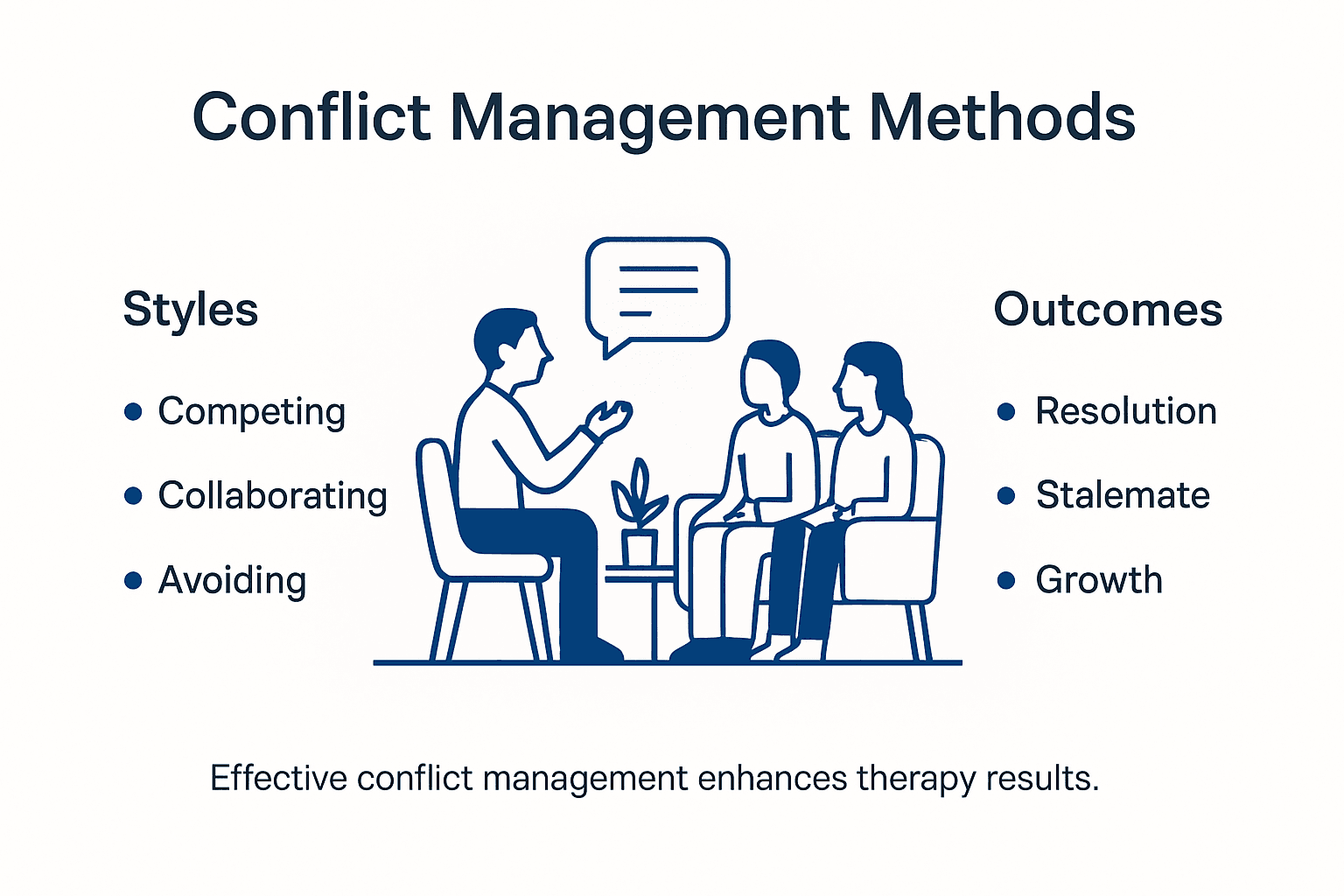
Professional therapists employ diverse conflict management styles tailored to specific therapeutic contexts. Conflict management styles are generally categorized into five fundamental approaches that vary based on assertiveness and cooperativeness: competing, avoiding, accommodating, compromising, and collaborating. Understanding these approaches enables mental health professionals to select the most appropriate strategy for each unique client interaction.

The competing style involves prioritizing one’s own needs and goals, typically resulting in a win-lose scenario where the therapist or client attempts to dominate the discussion. Avoiding represents a strategy where individuals sidestep direct confrontation, potentially suppressing important emotional content. The accommodating approach emphasizes maintaining relationship harmony by yielding to the other party’s preferences, which can sometimes compromise therapeutic progress.
The Thomas-Kilmann Conflict Mode Instrument provides deeper insights into these conflict management strategies, highlighting the nuanced differences between compromising and collaborating approaches. Compromising involves finding middle ground where both parties make partial concessions, while collaborating represents the most constructive approach, focusing on developing mutually beneficial solutions that address underlying emotional needs and promote meaningful therapeutic growth.
The table below summarizes the five major conflict management styles used in therapy and their typical impact on client progress.
| Style | Assertiveness Level | Cooperativeness Level | Typical Client Impact |
|---|---|---|---|
| Competing | High | Low | Can escalate conflicts |
| Avoiding | Low | Low | Issues may remain unresolved |
| Accommodating | Low | High | May suppress client needs |
| Compromising | Medium | Medium | Balanced but may overlook deeper issues |
| Collaborating | High | High | Fosters mutual growth |
Pro tip: Assess your default conflict management style and practice flexibility in adapting your approach to meet each client’s unique emotional landscape and therapeutic requirements.
How Conflict Management Methods Work
Conflict management methods operate through a systematic approach that helps mental health professionals navigate complex interpersonal dynamics. These methods involve a strategic three-stage process: identifying potential conflict sources, comprehensively assessing the situation, and selecting an appropriate resolution technique tailored to the specific therapeutic context. By understanding the underlying dynamics, therapists can proactively address emotional tensions before they escalate.
The core mechanism of conflict management methods centers on several key intervention strategies. Negotiation serves as a foundational technique, enabling both therapist and client to explore differing perspectives and find mutually acceptable solutions. Third-party interventions, such as mediation, provide neutral ground for discussing challenging emotional terrain, allowing clients to express concerns in a structured, supportive environment. These approaches aim to transform potentially destructive conflict interactions into opportunities for personal growth and improved communication.
Conflict management research continually evolves, focusing on innovative approaches for successfully handling interpersonal challenges. Advanced methods now incorporate psychological insights, emotional intelligence techniques, and evidence-based communication strategies. Therapists utilize these sophisticated approaches to help clients develop self-awareness, emotional regulation skills, and more effective communication patterns that extend beyond the therapeutic setting.
Here is a quick reference comparing key intervention strategies in conflict management methods and their business impact in therapeutic settings:
| Intervention Type | Key Benefit | Potential Drawback |
|---|---|---|
| Negotiation | Builds understanding | May require concessions |
| Mediation | Neutral space for dialogue | May slow resolution |
| Collaborative Problem Solving | Encourages ownership | Can be time-consuming |
| Empathy Mapping | Improves emotional safety | May miss practical issues |
Pro tip: Develop a flexible conflict management toolkit that allows you to adapt your intervention strategies dynamically based on each client’s unique emotional landscape and communication style.
Clinical Applications for Diverse Clients
A specific psychotherapeutic strategy called the want/can/must (WCM) strategy demonstrates innovative approaches for addressing conflict across diverse client populations. This method provides mental health professionals with a flexible framework for facilitating information sharing, cognitive restructuring, and minimizing emotional harm. By recognizing the unique communication patterns and emotional landscapes of different cultural backgrounds, therapists can create more inclusive and effective intervention strategies.
Cultural competence plays a critical role in adapting conflict management techniques. Individualized approaches become essential when working with clients from varied racial, ethnic, and socioeconomic backgrounds. Therapists must develop nuanced communication skills that respect cultural differences while maintaining therapeutic effectiveness. This requires active listening, cultural sensitivity, and a willingness to modify traditional therapeutic techniques to meet specific client needs.
Research on culturally adapted group cognitive behavioral therapy demonstrates significant potential for supporting diverse client populations. Successful adaptations involve modifying therapy content, delivery methods, and interpersonal processes to create more inclusive therapeutic environments. These strategies recognize that effective conflict management is not a one-size-fits-all approach but requires thoughtful, personalized interventions that honor each client’s unique cultural context.
Pro tip: Continuously educate yourself about cultural differences and develop a flexible therapeutic approach that can be dynamically adjusted to meet the specific emotional and communication needs of each client.
Risks, Limitations, and Practitioner Pitfalls
Conflict management approaches contain inherent risks that mental health professionals must carefully navigate to prevent unintended therapeutic complications. Each conflict management style presents unique challenges that can potentially undermine therapeutic progress if not implemented with precision and self-awareness. Practitioners must develop a nuanced understanding of these potential pitfalls to maintain effective client relationships and support meaningful emotional growth.
The most significant risks emerge from inappropriate application of conflict management strategies. Competing styles can escalate tensions by creating adversarial dynamics, while avoidant approaches risk allowing critical emotional issues to remain unaddressed. Accommodating strategies might temporarily smooth interactions but can ultimately lead to client resentment and unexpressed underlying conflicts. These potential negative outcomes underscore the critical importance of selecting contextually appropriate intervention techniques.
Clinical judgment becomes paramount in mitigating these risks. Mental health professionals must continuously assess their intervention strategies, remain adaptable, and maintain a balanced approach that honors client autonomy while providing structured guidance. This requires ongoing self-reflection, professional development, and a commitment to understanding the complex emotional landscapes of diverse client populations. Successful practitioners recognize that conflict management is not about winning or losing, but creating spaces for genuine understanding and transformative communication.
Pro tip: Regularly supervise and reflect on your conflict management approaches, seeking peer consultation to identify potential blind spots and refine your therapeutic techniques.
Strengthen Your Therapy Progress with Expert Conflict Management Support
Navigating complex emotional conflicts can stall therapy outcomes and leave clients feeling unheard or stuck. This article highlighted how understanding and applying effective conflict management methods such as collaborating and empathy mapping are vital for fostering growth and healing. If you find yourself challenged by managing conflicts in your personal relationships or professional counseling practice, it is critical to access structured, evidence-based resources tailored to diverse emotional landscapes.
Unlock your potential with comprehensive mental health and conflict resolution services at Mastering Conflict. Whether you seek specialized anger management, couples therapy, or culturally sensitive counseling for yourself or your clients, our expert programs guided by Dr. Carlos Todd empower you with practical tools to transform conflict into connection. Explore our offerings today and take the next step toward meaningful change by booking a session or joining a clinical training program designed to refine your conflict management skills.
Frequently Asked Questions
What are the main conflict management methods used in therapy?
Therapists commonly use methods such as active listening, empathy mapping, emotional regulation strategies, and collaborative problem solving to effectively navigate and resolve interpersonal tensions in therapy.
How do conflict management styles impact therapeutic outcomes?
Conflict management styles, including competing, avoiding, accommodating, compromising, and collaborating, can significantly influence the progress of therapy. Choosing an appropriate style helps to foster mutual growth and improve communication between therapist and client.
What is the role of cultural competence in conflict management in therapy?
Cultural competence is crucial for adapting conflict management techniques to meet the unique emotional landscapes of clients from diverse backgrounds. It ensures that interventions are inclusive, respectful, and effective in addressing individual client needs.
What are some risks associated with conflict management strategies in therapy?
Risks include potentially escalating conflicts with competing styles, allowing issues to remain unaddressed with avoiding approaches, and leading to client resentment with accommodating strategies. Practitioners must carefully navigate these risks through ongoing assessment and adaptability.
Recommended
- Mastering Empathy in Conflict Resolution: A Step-by-Step Guide – Mastering Conflict
- How to Deal With Parenting Conflicts
- Top Couples Therapy Benefits for Families in 2025 – Mastering Conflict
- Effective Conflict Resolution Steps for Couples, Families, and Professionals 2025 – Mastering Conflict
- How to Manage Client Expectations Effectively in 2025