
What You Do in Anger Management Classes: Skills and Exercises

You spend most of an anger management class learning to catch your anger before it takes over, not just talking about being angry. Sessions typically combine identifying your specific triggers, practicing physical calming techniques like deep breathing, challenging distorted thoughts through cognitive restructuring, rehearsing assertive communication, and completing homework between meetings. The American Psychological Association notes that clinician-led programs run about 8 to 10 weeks, built on cognitive behavioral therapy (CBT), the evidence-based framework behind nearly every credible class you’ll find.
A typical class period covers:
- Identifying personal anger triggers and early warning signs
- Practicing relaxation techniques (breathing, progressive muscle relaxation)
- Reframing distorted or catastrophic thoughts
- Rehearsing assertive communication through role-play
- Completing homework logs to track real-world progress
Key Takeaways
Anger management classes work by pairing physiological calming techniques with cognitive restructuring, then rehearsing both through role-play and homework until the response becomes automatic.
| Point | Details |
|---|---|
| Core method is CBT | Classes teach trigger identification, cognitive restructuring, relaxation, and problem-solving as a package. |
| Typical program length | Clinician-led courses commonly run 8 to 10 weeks, per the APA’s guidance. |
| Practice happens in class | Role-play, thought records, and breathing exercises get rehearsed live, then assigned as homework. |
| Communication skills matter | “I” statements, active listening, and boundary-setting are practiced with direct feedback. |
| Masteringconflict offers next steps | Online and in-person classes plus assessments help match you to the right format. |
Table of Contents
- What Does Anger Management Teach as Its Core Techniques?
- What Exercises and Practice Happen During Sessions?
- How Do Classes Teach Communication and Conflict Skills?
- How Are Anger Management Classes Structured?
- Does the Evidence Support Anger Management Classes?
- What Do You Achieve After Finishing Anger Management Classes?
- What Most People Notice Once They Actually Engage
- Where to Get Professional Anger Management Support
- Frequently Asked Questions
- Sources
What Does Anger Management Teach as Its Core Techniques?
Every solid class is built on four CBT pillars: trigger identification, cognitive restructuring, physiological regulation, and problem-solving. You start by mapping the specific situations, people, or thoughts that set you off. That sounds obvious, but most people who struggle with anger have never actually written it down. Once triggers are visible on paper, they lose some of their automatic power.
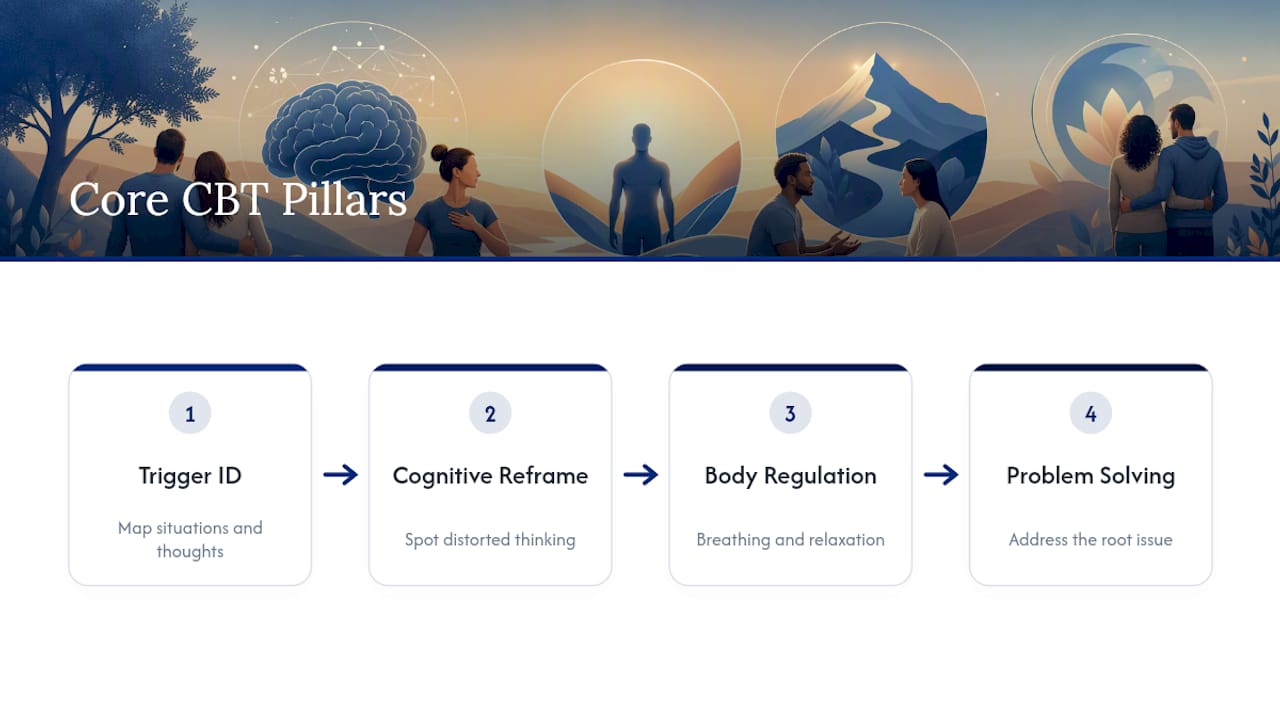
Cognitive restructuring comes next. You learn to spot distorted thinking, catastrophizing, mind-reading, “should” statements, and replace those thoughts with more accurate ones. Verywell Mind reports that this restructuring work sits at the center of most class curricula, alongside relaxation training and communication practice.
Physiological regulation targets the body directly, since anger is a physical event before it’s an emotional one. Problem-solving rounds it out, teaching you to address the actual issue behind the anger instead of just venting about it.
Each technique interrupts a different link in the chain: thought triggers feeling, feeling triggers body response, body response triggers behavior. Break any link and the explosion often doesn’t happen.
Pro Tip: Cognitive distortions tend to show up as absolute language. If you catch yourself thinking “always,” “never,” or “everyone,” pause. That’s usually a distortion talking, not reality.
What Exercises and Practice Happen During Sessions?
Classes are hands-on. You’re not sitting through lectures for two hours; you’re practicing skills the same way you’d practice a golf swing, through repetition until the motion feels less foreign.
Common in-class exercises include:
- Guided deep breathing and progressive muscle relaxation
- Trigger mapping worksheets
- Thought records that track situation, automatic thought, and reframed thought
- Role-play scenarios with a partner or facilitator
- Timeout practice, learning to recognize when to step away
- Homework assignments that mirror the in-class exercise for real situations
A common example: you’ll practice box breathing (four seconds in, hold four, out four, hold four) in class, then get homework to use it the next time you feel your jaw tighten at home or work. Repetition inside a low-stakes classroom setting is what makes the response automatic later, when stakes are high and thinking clearly is hardest.
How Do Classes Teach Communication and Conflict Skills?

Anger management isn’t only about calming yourself down internally. Most curricula devote real time to how you talk to other people once you’re calm enough to talk at all. This is where classes shift from private coping to interpersonal skill, since anger almost always plays out between people.
You’ll practice assertive communication built around “I” statements (“I feel frustrated when plans change last minute” instead of “You always ruin everything”), active listening, and de-escalation phrases like “I need a minute before we keep talking about this.” Boundary-setting gets rehearsed too. Facilitators often use role-play with immediate feedback, so you say the line, get a reaction, and adjust. That feedback loop is what turns a scripted phrase into something you can actually say under pressure.
How Are Anger Management Classes Structured?
Formats vary more than people expect. Some programs run as short weekend workshops. Others meet weekly for a full course. Individual sessions exist too, for people who need one-on-one attention or don’t want a group setting. Online and in-person options both work, though in-person groups add real-time role-play feedback that’s harder to replicate remotely.
By the numbers: The APA notes clinician-led programs commonly run 8 to 10 weeks, though court-ordered programs range from short workshops to multi-week courses depending on jurisdiction and offense.
Typical formats include:
- Weekly group classes (most common for clinician-led programs)
- Individual one-on-one sessions
- Intensive short workshops
- Online self-paced or live virtual courses
Homework between sessions is standard, and most court-ordered programs use SAMHSA or CBT-based curricula that end with a certificate submitted to a probation officer or the court. Programs that fit your schedule and required length matter as much as content. If you’re comparing class duration options, factor in whether you need a court-recognized format.
Does the Evidence Support Anger Management Classes?
The mechanism is straightforward once you see it: reduce physiological arousal through relaxation, change thinking patterns through restructuring, and reactive behavior tends to drop. Cleveland Clinic explains that anger is frequently a secondary response to vulnerability or fear, and effective classes shift attention from the external “instigator” toward your own internal reaction pattern. That shift alone restores a sense of control that pure venting never provides.
The APA’s guidance on anger control is direct on this point: you can’t reliably change behavior by addressing only the body or only the thoughts. Both have to move together.
What classes reliably change:
- Awareness of personal triggers
- Frequency and intensity of angry outbursts
- Communication patterns in conflict
What they don’t automatically fix:
- Underlying trauma
- Active substance use
- Deep relational patterns needing couples or family therapy
What Do You Achieve After Finishing Anger Management Classes?
Most people finish with sharper trigger awareness, better physical control in the moment, and communication that doesn’t escalate as fast. Tracking progress with a simple log, noting frequency and severity of angry episodes, gives you real data instead of a gut feeling about whether it’s working.
If anger is tangled up with trauma, active substance use, or a relationship that’s been damaged for years, classes alone usually aren’t enough. That’s when individual therapy or couples counseling picks up where the class leaves off.
Pro Tip: Ask a partner, friend, or family member to note changes they notice. Self-assessment is useful, but other people often spot progress before you do.
What Most People Notice Once They Actually Engage
Most attendees feel awkward practicing “I” statements out loud for the first few sessions. It passes. The people who treat class as a checkbox for compliance rarely see change; the ones who actually rehearse the skills, even when it feels forced, are the ones who report calmer weeks months later.
Where to Get Professional Anger Management Support
Masteringconflict runs both online and in-person anger management classes built on the same CBT foundation covered above, plus formal assessments for people who aren’t sure whether a class, coaching, or individual therapy fits their situation better. Programs serve individuals, couples navigating conflict, and mental health professionals seeking supervision.
If you’re ready to find out what program fits, start with an anger management assessment to get a clear recommendation instead of guessing between options. Browse the full course catalog for online and in-person formats, or explore clinical services if you suspect deeper issues, like unresolved conflict patterns or relationship strain, need attention alongside anger work. Book an assessment today to get matched with the right program.
Frequently Asked Questions
What do you do in anger management classes?
You identify personal triggers, practice relaxation techniques like deep breathing, challenge distorted thoughts through cognitive restructuring, rehearse assertive communication through role-play, and complete homework between sessions.
What does anger management classes consist of?
Most classes combine CBT-based education, guided relaxation practice, communication skill-building, and behavior tracking, delivered in group, individual, or online formats over roughly 8 to 10 weeks for clinician-led courses.
Are teenager anger management classes different from adult classes?
Yes. Programs for teens typically use age-adapted activities and shorter, more interactive exercises, though the same CBT foundation, trigger identification and relaxation training, still applies. Explore activities designed for kids and teens for specifics.
What are the benefits of anger management classes?
Participants generally report better trigger awareness, calmer physical responses under stress, and clearer communication during conflict, though deeper issues like trauma may need additional therapy beyond the class itself.
How does anger management help if my anger feels justified?
Classes don’t argue that your feelings are wrong. They teach you to separate the feeling from the reaction, so you can still address what’s bothering you without damaging relationships or escalating conflict.
This article is general information, not a substitute for advice from a qualified doctor. Consult a qualified healthcare professional about your own circumstances before acting on anything here.
Sources
- Control anger before it controls you | APA
- Anger Management: What It Is, Skills & Techniques | Cleveland Clinic
- What Happens in Anger Management Class? | Verywell Mind
- Court-Ordered Anger Management Classes: What to Expect | The Foundation of Change