
Clinical Family Mediation in Family Law: A Therapist’s Guide

Clinical family mediation is therapist-led, communication-focused conflict resolution for couples and families that prioritizes relational repair and workable behavioral agreements over legal settlement. When it works, you leave with clearer communication patterns, a co-parenting plan both parties can actually follow, and fewer cycles of destructive conflict pulling children into the middle. Practitioners like Dr. Carlos Todd at Masteringconflict bring licensed clinical training to this process, drawing on evidence from researchers like Robert Emery and the broader COAMFTE-accredited family therapy tradition.
“Therapeutic mediation emphasizes relational prerequisites for fair negotiation and focuses on resolving communication patterns that would otherwise sabotage negotiation outcomes.”
Therapeutic Mediation: An Alternative to Costly Litigation
The phrase “mediation in family law” often gets conflated with court-ordered legal mediation. This article is about something different: a clinician-led process where the goal is not a signed divorce decree but a healthier way for families to communicate, decide, and move forward.
Key Takeaways
Clinical family mediation is therapist-led, communication-focused conflict resolution that produces behavioral agreements, not legal settlements, and is most effective when safety is confirmed and both parties are ready to negotiate.
| Point | Details |
|---|---|
| What it is | Clinician-led mediation focused on communication repair and workable behavioral agreements, not legal outcomes. |
| Who it fits | Separating couples, co-parents in conflict, and families navigating shared decisions where communication has broken down. |
| Safety first | Intimate partner violence, active coercion, or untreated severe mental illness are contraindications requiring referral before mediation begins. |
| Credential check | Look for clinical licensure (LPC, LMHC, LCSW, PhD/PsyD) plus a specific mediation certificate, not licensure alone. |
| Masteringconflict | Dr. Carlos Todd’s clinician-led services include family mediation, couples counseling, and conflict coaching, available online and in Charlotte, NC. |
Table of Contents
- Who benefits from clinical family mediation?
- What actually happens in a clinical mediation session?
- How clinical mediation differs from therapy and conflict coaching
- What the research says about benefits for families
- What qualifications should you look for in a clinical mediator?
- When clinical mediation is not safe or appropriate
- What does clinical mediation cost, and how long does it take?
- How to find and choose a clinical mediator
- A case example: from stuck to workable
- What happens after mediation ends
- A clinician’s perspective on what actually matters
- Masteringconflict offers clinician-led mediation and family counseling
- Sources
Who benefits from clinical family mediation?
Clinical mediation fits a specific set of situations. The people who gain the most from it tend to fall into one of these groups:
- Separating or divorcing couples who want to reduce harm to their children and avoid adversarial proceedings
- Co-parents with ongoing conflict who share custody but cannot get through a school pickup without a fight
- Multigenerational families navigating estate disputes, caregiving decisions, or sibling tensions after a parent’s death
- Adult siblings managing shared property or a parent’s declining health
- Couples considering separation who are not yet sure and want a structured space to make that decision together
The primary goals across all these groups are consistent: restore direct communication, protect children from conflict exposure, create agreements both parties will honor, and build conflict-management skills that outlast the sessions. Family therapists often encounter separating couples before any other professional, which positions them to offer a continuity-of-care alternative to adversarial systems. Clinical mediation is not the right fit when someone needs individual trauma processing, ongoing psychiatric care, or legal representation. Those needs require different services.
What actually happens in a clinical mediation session?
The process moves through five recognizable phases, though a skilled clinician adapts the pace to the family’s readiness.
- Intake and safety screening — the clinician assesses each party individually, screens for contraindications, and establishes ground rules
- Agenda-setting — parties identify the specific decisions or communication patterns they need to resolve
- Present-centered problem solving — the mediator uses therapeutic techniques to interrupt destructive cycles and keep conversation productive
- Drafting agreements — behavioral plans, parenting schedules, or interaction rules are written in plain language both parties understand
- Follow-up — a check-in session confirms agreements are holding and addresses new friction
The clinician-mediator’s role is deliberately different from a therapist’s. Neutrality is the baseline, but the mediator also coaches communication, regulates affect when sessions escalate, and uses structured preparatory steps to move parties from stuck to negotiation-ready. For a practical breakdown of session flow and timing, the step-by-step conflict mediation process for couples and families at Masteringconflict is a useful companion.
| Case complexity | Typical session count | Estimated calendar length |
|---|---|---|
| Low (one focused issue, cooperative parties) | 3–5 sessions | 4–8 weeks |
| Moderate (co-parenting conflict, some resistance) | 6 sessions | 2–4 months |
| High (entrenched patterns, multiple issues) | 10+ sessions | 4 months |
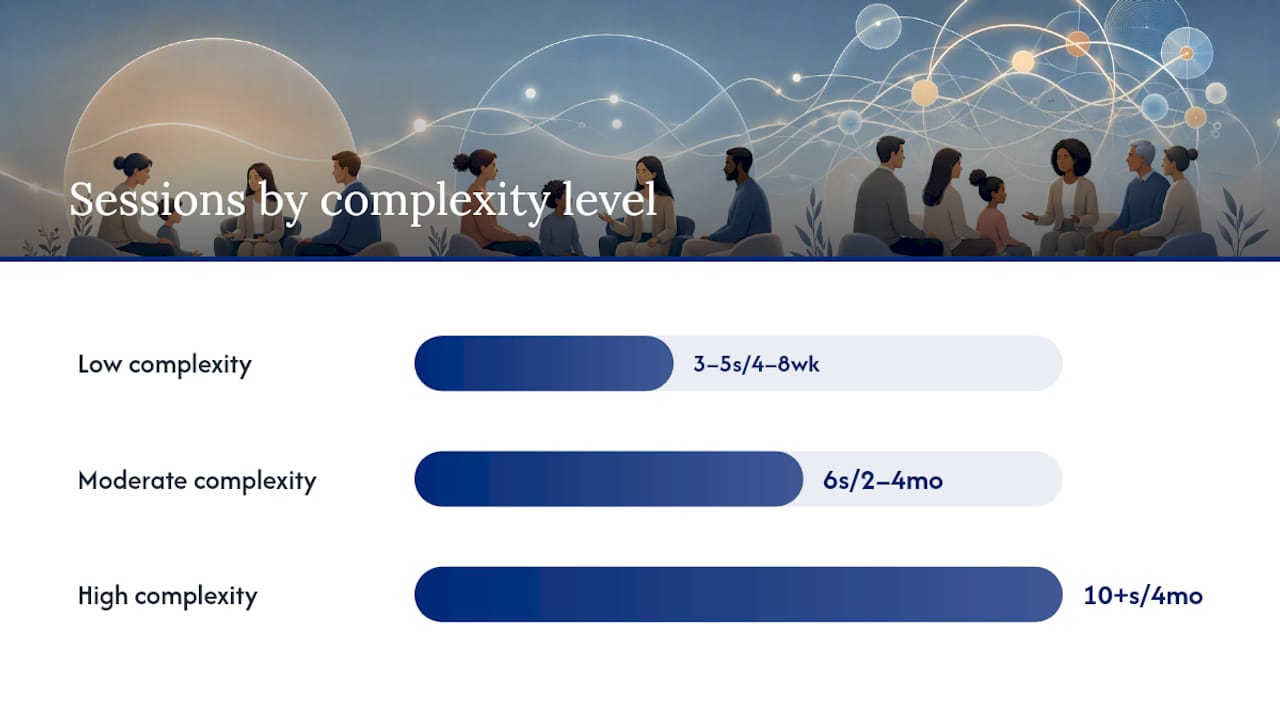
Sessions typically run 60–90 minutes. Most clinicians schedule them every one to two weeks.
Pro Tip: Before your first session, write down three specific behaviors or situations that trigger conflict, not general complaints. “He dismisses everything I say in front of the kids” is workable. “He’s impossible” is not. Concrete examples give the mediator something to actually intervene on.
How clinical mediation differs from therapy and conflict coaching
These three services overlap in feel but differ sharply in purpose.
- Clinical mediation: Goal is a specific, negotiated agreement. The mediator stays neutral. Sessions are time-limited and present-focused. The deliverable is a behavioral plan or memorandum of understanding, not psychological change.
- Ongoing therapy: Goal is psychological insight, healing, or behavior change for the individual or couple. The therapist is an advocate for the client’s wellbeing, not a neutral party. No agreement document is produced.
- Conflict coaching: Goal is skill-building for one person. The coach works with a single client to improve how they handle conflict, not to mediate between two parties.
When to choose which:
- Choose clinical mediation when two or more parties need to reach a specific agreement and communication has broken down.
- Choose therapy when one or both individuals need deeper emotional processing before or after mediation.
- Choose conflict coaching when one person wants to change how they respond to conflict, independent of the other party.
A clinician must stop mediation and refer to therapy or other services when the process surfaces trauma, acute mental health symptoms, or safety concerns that exceed the mediation scope. A well-run clinical mediation balances neutrality with helping skills — the mediator uses therapeutic techniques to make negotiation possible without converting sessions into long-term treatment.
What the research says about benefits for families
The evidence base for clinical and therapeutic mediation is growing, though it carries real limits worth naming.
Decades of research confirm that parental conflict is a strong predictor of impaired child adjustment after divorce. Reducing that conflict is the central target of clinical mediation, and studies on mediated divorce outcomes consistently show fewer returns to court, better co-parenting cooperation, and improved child adjustment when interparental conflict drops.
“Therapeutic mediation combines elements of therapy with mediation’s goal-directed negotiation to produce both emotional repair and concrete agreements.”
Therapeutic Mediation: An Alternative to Costly Litigation
The honest caveat: most studies on therapeutic mediation use small samples, and effect sizes vary. The evidence is promising and coherent, not definitive. What the literature does consistently support is that therapeutic mediation’s additional goal is to facilitate healing and set the stage for healthier post-divorce adaptation, especially for children. That goal is distinct from what legal mediation or standard negotiation produces.
What qualifications should you look for in a clinical mediator?
Licensure alone is not enough. Look for this combination:
| Credential type | What to verify |
|---|---|
| Clinical licensure | LPC, LMHC, LCSW, PhD, or PsyD from an accredited program |
| Mediation-specific training | Completed a recognized mediation certificate program (a common standard) |
| Family therapy background | COAMFTE-accredited training or equivalent supervised family systems experience |
| Supervised clinical hours | Post-licensure supervision in family or couples cases |
| Association membership | Active membership in a professional clinical or mediation association |
Counselors with therapy training can uniquely address intense emotional distress during separation, but mediation training for counselors is uneven. A licensed therapist without specific mediation training is not automatically a qualified clinical mediator. Ask directly about both. For clinicians building these skills, Masteringconflict’s mediation training resources outline what that training path looks like.
When clinical mediation is not safe or appropriate
Some situations require a different response entirely. A clinician should screen for and decline mediation when any of the following are present:
- Current or recent intimate partner violence — mediation cannot be safe or fair when one party fears the other
- Active coercion or severe power imbalance — agreements reached under pressure are not genuine agreements
- Uncontrolled substance use — impaired judgment makes meaningful negotiation impossible
- Untreated severe mental illness — psychosis, active suicidality, or severe dissociation require stabilization first
- Active criminal threats or restraining orders — legal safety must be established before any joint process begins
When these red flags appear, the appropriate referral path is individual therapy, specialized domestic violence services, or legal counsel, depending on the specific risk. Clinicians also carry mandated reporting obligations that do not pause during mediation. For a fuller picture of how counseling ethics apply to referral decisions, Masteringconflict’s ethics resources are worth reviewing.
What does clinical mediation cost, and how long does it take?
Per-session rates for clinician-led mediation in the U.S. typically run in the range that reflects clinical therapy pricing in your region, often comparable to or slightly above standard therapy rates given the specialized training involved. Package pricing is common, with some clinicians bundling a set number of sessions at a reduced per-session rate.
Factors that push cost higher: high conflict, multiple parties, attorney coordination, or the need for written agreement documentation. Factors that reduce cost: sliding-scale availability, telehealth delivery, or bundled packages that include coaching add-ons.
Insurance coverage for clinical mediation is inconsistent. Some clinicians bill under a therapy code when the work qualifies; others charge out-of-pocket only. Ask specifically about sliding scale, payment plans, and whether any sessions can be billed to insurance during intake. Timeline expectations mirror the session-count table above: a focused, cooperative case can resolve in under two months. Entrenched co-parenting conflicts often take four to six months of consistent work.
How to find and choose a clinical mediator
Start with these search sources: clinical directories (Psychology Today, TherapyDen), professional association referral pages, local COAMFTE-accredited training programs, and Masteringconflict’s family conflict resolution resources.
On your first call, ask:
- Are you licensed as a therapist? What is your license type and state?
- Do you have specific mediation training or a certificate? How many hours?
- How many family or co-parenting mediation cases have you handled?
- How do you screen for domestic violence or safety concerns?
- What does a typical session look like, and how do you handle escalation?
- Do you produce a written agreement at the end?
- What are your fees, and do you offer sliding scale or payment plans?
Red flags to watch for: a clinician who cannot name their mediation training, who skips safety screening, who takes sides visibly in early sessions, or who cannot explain what a written agreement from their process looks like.
A case example: from stuck to workable
Marcus and Diane had been co-parenting their two children for 18 months post-separation. Every handoff turned into an argument about schedule changes, and both children had started showing anxiety symptoms at school. Their individual therapists had each recommended clinical mediation.
In the intake session, the mediator identified a core pattern: Marcus experienced Diane’s last-minute schedule requests as disrespect; Diane experienced Marcus’s rigid refusals as control. Neither was communicating the underlying need. The mediator’s first intervention was not negotiation. It was naming that pattern out loud and asking each party to confirm whether it matched their experience.
“Therapeutic mediation is aimed at identifying and resolving communication impasses so post-divorce co-parenting is achievable — it is not the same as psychotherapy but uses therapeutic techniques, selectively.”
Therapeutic Mediation: An Alternative to Costly Litigation
Over six sessions, they built a written parenting communication protocol: all schedule change requests submitted 72 hours in advance via a shared app, a defined response window, and a single monthly check-in call. The children’s anxiety symptoms reduced within two months of consistent implementation. The mediator referred both parents to individual therapy for ongoing support.
Key takeaways from this case: the agreement was behavioral, not emotional. The mediator did not try to repair the relationship. The written protocol gave both parties something concrete to point to when conflict re-emerged.
What happens after mediation ends
A clinical mediation process does not end when the last session closes. Follow-up structure matters.
- Written agreements are documented as a memorandum of understanding or behavioral plan, written in plain language, signed by both parties
- Clinician summaries may be provided to individual therapists or attorneys with client consent
- Booster sessions are available when agreements need adjustment or new conflicts arise
- Referrals are made for individual therapy, parenting classes, or specialty services (substance use treatment, anger assessment) as needed
- Re-engagement is appropriate when a significant life change (new partner, relocation, job loss) disrupts a previously stable agreement
The goal of post-mediation follow-up is not to extend the process indefinitely. It is to make sure the agreements hold under real-life conditions and that each party has the support they need to maintain them.
A clinician’s perspective on what actually matters
The most common mistake families make when entering clinical mediation is expecting the mediator to decide who is right. That is not the job. The job is to create conditions where two people who cannot currently hear each other can make one workable decision together. Safety comes first, always. If a session reveals that one party is afraid of the other, mediation stops and referral happens immediately, regardless of how much progress has been made.
The practical tip I return to most often: before any negotiation begins, ask each party to state what they need the other person to do differently, in one sentence, using only behavior-based language. Not “I need him to respect me.” Instead: “I need him to respond to my texts within 24 hours about the kids.” That shift alone changes the entire texture of what follows.

Professional boundaries are not optional. A clinician who starts providing individual therapy to one party mid-mediation has compromised neutrality and must refer out. Mediation and therapy are different services, even when delivered by the same type of clinician.
Masteringconflict offers clinician-led mediation and family counseling
Masteringconflict, founded by Dr. Carlos Todd (LPC, psychologist), provides clinical services that include clinician-led family mediation, couples counseling, conflict coaching, and family counseling, with online therapy options extending reach beyond the Charlotte, NC home base. The approach is evidence-informed and communication-first: sessions focus on building agreements families can actually live with, not on assigning blame.
If you are ready to move from conflict to clarity, book a consultation to discuss whether clinical mediation, family counseling, or conflict coaching fits your situation best.
Sources
- Therapeutic Mediation: An Alternative to Costly Litigation – THERAPYHELP
- A family therapy perspective on mediation
- Clinical mediation and counselor training (Kutztown research library PDF)
- Mediation in Couple and Family Therapy | Springer Nature Link
- Therapeutic Mediation: An Alternative to Costly Litigation – THERAPYHELP
- Therapeutic family mediation model — Wiley Online Library
This article is general information, not a substitute for advice from a qualified doctor. Consult a qualified healthcare professional about your own circumstances before acting on anything here.
Recommended
- What Is Family Mediation: A Clear Guide for Families – Mastering Conflict
- Family Dispute Resolution Process: A Practical Guide – Mastering Conflict
- Role of Mediation in Families – Building Peaceful Solutions – Mastering Conflict
- Family Conflict Resolution Services: Transforming Relationships – Mastering Conflict