
5 Evidence Based Conflict Resolution Steps for Clinicians and Couples

The techniques with the strongest track record for resolving anger and relationship conflict are CBT-based anger management, the SAMHSA Conflict Resolution Model, Integrative Behavioral Couple Therapy, and Emotionally Focused Therapy. CBT skills work best for individual anger regulation. IBCT and EFT work best for couples stuck in repeating fights. Negotiated timeouts and brief micro-interventions serve as practical add-ons to any of these, and increasingly, all of it can be delivered in person or online.
TL;DR:
- CBT skills, especially relaxation and cognitive restructuring, are most effective for individual anger regulation across diverse populations.
- Structured, rehearsed timeout scripts with a fixed return time are essential for de-escalation and must be practiced beforehand to avoid misinterpretation.
- Effectively treating couples requires sequencing acceptance-based work like IBCT or EFT before introducing communication skills to prevent early disconnection.
- Digital conflict resolution programs like OurRelationship have demonstrated measurable benefits for low-income couples, making them suitable as adjuncts rather than replacements for therapy.
- Recognizing whether conflict is interpersonal, intergroup, or systemic guides the choice of intervention, saving time and improving long-term resolution.
Table of Contents
- Core Evidence-Based Conflict Resolution Techniques in Organizational Behavior
- How to Build an Anger Control Plan and Timeout Protocol
- Sequencing Treatment for Clinicians and Trainees
- Do Web-Based Conflict Resolution Programs Actually Work?
- Types of Conflict Clinicians See in Organizational and Family Settings
- What Actually Causes Most Conflict in Relationships and Families
- Key Techniques for Resolving Conflict in Clinical Practice
- Why Communication Skills Decide Whether Conflict Resolves
- Why Emotional Intelligence Determines Whether Techniques Stick
- Building a Conflict Resolution Framework at Home or in Practice
- The Gap Between What Gets Taught and What Actually Gets Practiced
- How Mastering Conflict Puts These Techniques Into Practice
- Sources
- FAQ
Core Evidence-Based Conflict Resolution Techniques in Organizational Behavior
Clinical conflict resolution isn’t one method. It’s a small toolkit of approaches, each targeting a different failure point in how people handle anger and disagreement, and the strongest clinicians know which tool fits each moment.
Cognitive behavioral therapy remains the backbone of individual anger treatment. The CBT model for anger treats anger less as an emotion to eliminate and more as a signal tied to hostile thinking patterns that need interrupting. Four components do most of the work:
- Relaxation training — controlled breathing and progressive muscle relaxation to lower physiological arousal before it hijacks judgment.
- A-B-C-D cognitive restructuring — mapping the Activating event, Belief, Consequence, and then Disputing the belief that turned a minor slight into a major threat.
- Behavioral rehearsal — practicing calmer responses to known triggers before they happen for real.
- Assertiveness training — replacing passive silence or aggressive outbursts with direct, respectful statements of need.
CBT reviews report moderate to large effect sizes for anger reduction across community samples, veterans, and incarcerated populations, which is a wider range of settings than most therapy models can claim. The mechanism isn’t suppression. It’s changing the hostile self-talk that turns “she’s late again” into “she doesn’t respect my time,” according to CBT perspectives on anger management.
The SAMHSA anger management manual contributes a structured five-step Conflict Resolution Model: identify the specific problem, identify the feelings attached to it, identify its actual impact, decide whether resolving it right now is worth the friction, and if so, set a specific time to address it. That last step matters more than it looks. It stops conflict from becoming a running argument that resurfaces at every unrelated moment.
For couples, two models dominate the evidence base. Integrative Behavioral Couple Therapy starts with a DEEP analysis (differences, emotional sensitivities, external stress, patterns of interaction) and then blends acceptance work with change work. Acceptance interventions like empathic joining and unified detachment help partners see the fight pattern as a shared problem rather than a personal attack, before any skills training gets introduced. Emotionally Focused Therapy takes a different entry point: it hunts for the primary emotion, usually fear or hurt, hiding underneath the secondary emotion of anger, then restructures the interaction cycle so both partners feel safe enough to de-escalate. Both approaches carry solid evidence for reducing destructive conflict cycles in distressed couples, though they get there through different doors.
How to Build an Anger Control Plan and Timeout Protocol
Knowing the theory doesn’t help anyone in the middle of an argument. What helps is a plan built in advance, when both people are calm enough to think clearly.
- Map your triggers. Write down the last five arguments. Note the time of day, what preceded them, and the exact phrase or behavior that flipped the switch. Patterns show up fast.
- List your coping tools by intensity. A quick one might be five slow breaths. A medium one might be a ten-minute walk. A strong one might be calling a friend or writing in a journal before responding to anything.
- Name your social supports. Identify one or two people you can call when a conflict spikes past your ability to self-regulate.
- Draft the timeout script in advance. Agree on an exact phrase either partner can say, like “I need twenty minutes,” that cannot be challenged or ignored in the moment.
- Set the return rule. Decide beforehand how long the break lasts and what happens when time is up (you resume the conversation, not restart the fight).
The research on negotiated timeouts is clear that this only works when it’s rehearsed, not improvised. A timeout announced for the first time during a real fight often reads as stonewalling rather than de-escalation, which can make things worse.
Micro-interventions fill the gap between full therapy sessions. Implementation intentions are simple if-then plans: “If my partner raises their voice, then I will lower mine and name one thing I heard them say.” Attributional reframing prompts a person to generate a second, less hostile explanation for a partner’s behavior before reacting to the first one. Both are brief enough to deliver by computer or through a trained paraprofessional, which makes them useful between sessions or in group formats.
Pro Tip: Practice the timeout phrase during a calm moment, out loud, at least three times. If it feels awkward to say when you’re not angry, it will feel impossible to say when you are.

Before any of this, run a quick safety check. If there’s a history of physical aggression, a pattern of escalating threats, or a fear of imminent harm, timeout scripts and reframing exercises are not the priority. Safety planning is, and it belongs in its own dedicated intervention rather than folded into a communication exercise.
Sequencing Treatment for Clinicians and Trainees
Clinicians who bounce between skills training and emotional processing without a plan tend to lose clients mid-treatment. A workable sequence looks like this: assessment, psychoeducation on the anger cycle or the couple’s interaction pattern, skill acquisition (relaxation, cognitive restructuring, or DEEP analysis depending on the case), rehearsal inside session, then relapse prevention built around the client’s actual triggers.
One sequencing decision matters more than the rest. With highly distressed couples, jumping straight to communication skills training often fails, because the partners are too emotionally flooded to use the skills. Contingency-shaped change, meaning acceptance work that shifts the emotional context of the relationship first, tends to need to happen before rule-governed skills like “use an I-statement” will actually stick.
Measurement keeps the work honest and gives supervisors something concrete to review:
- Anger meter — a 1 to 10 self-rated scale, tracked across sessions.
- Anger awareness records — logs connecting specific triggers to specific responses.
- Session checklists — confirming which CBT or IBCT components were actually delivered, not just planned.
- Brief outcome measures — short relationship satisfaction or conflict-frequency scales given every few sessions.
For clinicians training paraprofessionals or building group curricula, SAMHSA’s session-level workbook structure offers a fidelity-friendly template: cognitive restructuring sessions, assertiveness sessions, and conflict resolution model sessions taught in a fixed order with practice built into each one. Clinicians looking to deepen their own technique base can review evidence-based anger management strategies or study session sequencing approaches for adapting these models across settings. Ongoing aftercare groups, not just discharge, tend to be what maintains treatment gains long term.
Do Web-Based Conflict Resolution Programs Actually Work?
Randomized trial data says yes, within limits. A study of the online OurRelationship program, a web-based intervention built on IBCT principles, found significant improvements in communication, conflict levels, and relationship satisfaction over six months for low-income couples who often can’t access in-person therapy.
That makes digital programs a legitimate option for skills-based work, not a replacement for full therapy. They fit well as a low-cost entry point or a between-session supplement, particularly for couples in areas with few local therapists. They fit poorly where there’s active aggression, severe emotional dysregulation, or heavy comorbid mental health conditions. Those cases need a therapist in the room, not a screen.
Types of Conflict Clinicians See in Organizational and Family Settings
Conflict rarely shows up as one clean disagreement. It tends to split into three recognizable patterns, and naming the type shapes which technique applies.
Interpersonal conflict is the most common presentation: two people, a repeating disagreement, escalating tone. This is the territory of individual anger management and couple-focused approaches like IBCT and EFT.
Intergroup conflict shows up when the fight isn’t really between two individuals but between the roles or camps they represent, a parent versus a teenager acting as “the family’s rebellious one,” or one sibling perceived as always taking another’s side. The content of the argument matters less than the group dynamic underneath it.
Structural or systemic conflict stems from the environment itself: a household with no clear division of responsibilities, a blended family without agreed-upon rules, or a couple whose financial stress recreates the same fight regardless of the actual topic. Treating the surface argument without addressing the structural driver tends to produce short-lived fixes.
Clinicians who correctly diagnose which type they’re facing save significant treatment time. A couple who fights about dishes every week rarely has a dishes problem; they usually have a structural conflict about perceived fairness that keeps finding a new surface to erupt through.
What Actually Causes Most Conflict in Relationships and Families
Most recurring conflict traces back to a handful of root causes, and they repeat across nearly every case that walks into a clinical setting.
Unmet emotional needs sit under a large share of arguments that look like they’re about something else entirely. A fight about chores is frequently a fight about feeling unappreciated.
Communication breakdowns compound the problem. Partners stop translating feelings into words and start translating them into tone, sighs, and silence, which the other person then has to guess at and usually guesses wrong.
Differing expectations, often never explicitly discussed, create conflict that feels sudden but was actually building for months. One partner assumed weekends were for family time; the other assumed weekends were for personal recovery.
External stress, financial pressure, job loss, illness, gets absorbed into the relationship and expressed as irritability toward the person closest at hand, since that person is safer to be angry at than the actual stressor.
Unresolved past conflict that never got a real resolution attempt tends to resurface in unrelated arguments, which is exactly the failure mode the SAMHSA model’s fifth step, setting a specific time to resolve, is designed to prevent. Left unaddressed, old grievances accumulate until a minor disagreement triggers a reaction sized for years of buildup rather than the actual moment.
Key Techniques for Resolving Conflict in Clinical Practice
Several structured techniques recur across effective treatment, each suited to a different intensity of conflict.
Negotiation-style skills training teaches both parties to state needs directly and search for solutions that don’t require one person to lose entirely. This borrows heavily from assertiveness training inside CBT protocols.
Mediation-style facilitation, where the clinician actively structures the conversation rather than letting it run unguided, helps couples or family members who escalate too quickly to negotiate productively on their own. The therapist holds the pace of the conversation until the pair can hold it themselves.
Emotion-focused restructuring, EFT’s core technique, works by exposing the vulnerable emotion driving the hostile behavior. Once a partner hears “I get defensive because I’m scared of losing you” instead of just the defensiveness itself, the fight often loses its charge.
Structured timeout protocols, discussed earlier as a client-facing skill, double as a clinical technique clinicians actively teach and rehearse in session.
Readers interested in complementary communication and negotiation training outside the therapy room can explore the Negotiation Management Professional certification, which covers structured negotiation skills applicable well beyond clinical settings.
Why Communication Skills Decide Whether Conflict Resolves
Almost every therapeutic technique above depends on one underlying skill: the ability to actually hear what the other person said before responding to what you assume they meant.
Active listening means reflecting back content and feeling before offering a counterpoint. “So you felt dismissed when I checked my phone during dinner” lands completely differently than an immediate defense of the phone-checking. Most couples skip this step entirely and go straight to rebuttal, which is exactly what keeps the SAMHSA model’s early steps, identifying the problem and the feelings attached to it, from ever getting a fair hearing.
Assertiveness is the other half. It’s the skill of stating a need clearly without either attacking the other person or swallowing the need to avoid conflict altogether. Passive communication breeds resentment that surfaces later as disproportionate anger; aggressive communication breeds defensiveness that shuts the conversation down before it starts. Assertive communication sits in the narrow middle where actual resolution becomes possible.
Clinicians can find sample scripts and role-play language for building these skills with clients in conflict resolution examples for individuals, couples, and families, which pairs well with the negotiated timeout scripts covered earlier.
Why Emotional Intelligence Determines Whether Techniques Stick
Every technique in this article assumes a baseline skill most people never explicitly learned: recognizing an emotion while it’s happening, not five minutes after the damage is done.
Emotional intelligence in a conflict context breaks into two moving parts. The first is self-awareness, noticing rising heart rate, clenched jaw, or the urge to interrupt before it turns into an actual interruption. The second is accurate labeling, telling the difference between anger and its usual disguises: hurt, embarrassment, fear, or exhaustion. EFT is built almost entirely around this second skill, since it treats anger as a secondary emotion covering something more vulnerable underneath.
Without emotional intelligence, even a well-designed anger control plan fails at the first step. A person who can’t notice their own escalation in real time can’t use a timeout script, no matter how well it’s rehearsed, because by the time they recognize they’re angry, they’ve usually already said the thing they meant to avoid saying.
Building a Conflict Resolution Framework at Home or in Practice
Individuals, couples, and clinicians running group programs all benefit from writing their approach down rather than relying on memory in the heat of an argument.
A workable framework includes a few fixed pieces: an agreed definition of what counts as a conflict worth addressing versus a minor annoyance to let pass, a shared vocabulary for the timeout script and its return rule, a designated time (echoing the SAMHSA model’s fifth step) for addressing anything too heated to resolve immediately, and a short list of coping tools each person commits to using before escalating further.
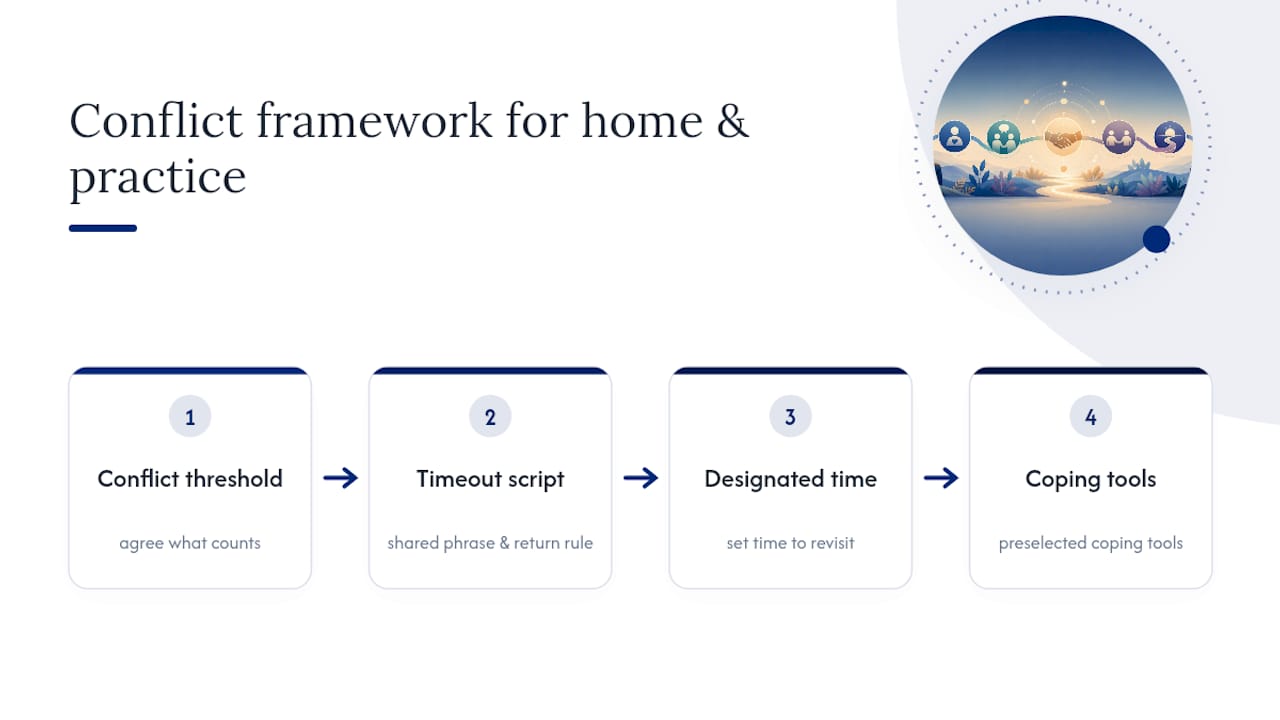
For a household, this might live as a single page taped inside a kitchen cabinet. For a clinical practice or group program, it usually takes more structure: written intake criteria for who’s ready for skills training versus who needs acceptance work first, session checklists to track fidelity, and a clear escalation path when a client discloses aggression or safety concerns. Either version works only if it’s built before conflict hits, not during it. For a fuller step-by-step version of this process, see effective conflict resolution steps for couples, families, and professionals.
The Gap Between What Gets Taught and What Actually Gets Practiced
Most people who seek help for anger or relationship conflict already know the advice. Take a breath. Use an I-statement. Don’t go to bed angry. None of it works reliably, and the reason isn’t that the advice is wrong. It’s that nobody rehearses it until it’s automatic, and generic advice was never specific enough to rehearse in the first place.
That’s the real value of structured models like SAMHSA’s five-step approach or IBCT’s DEEP analysis: they force specificity. A vague plan to “communicate better” collapses the moment someone is actually angry. A rehearsed timeout script with an exact phrase and a fixed return time survives contact with real conflict, because there’s nothing left to improvise under pressure.
The harder truth for couples especially is that skills training without acceptance work often backfires. Teaching two flooded, distrustful partners to use I-statements before they’ve done any acceptance-based work is a bit like teaching vocabulary to someone who hasn’t agreed the conversation is worth having. IBCT gets this right by sequencing empathic joining before change techniques. Clinicians who skip that order because skills training feels more concrete and measurable are often the ones who see clients quietly disengage a few sessions in.
Digital tools have earned a real place in this field, but only as an addition. A web program can teach a couple to fight fewer, smaller fights. It cannot sit across from a client and notice the exact moment their voice drops and their eyes stop making contact, which is often where the actual clinical work begins.
— Carlos
How Mastering Conflict Puts These Techniques Into Practice
The practice runs on an evidence base including CBT skills training, SAMHSA-aligned anger control planning, and IBCT and EFT-informed couples work, delivered by clinicians who treat acceptance and skills as a sequence, not a substitute for each other.
If you’re dealing with anger that keeps outpacing your coping tools, the online anger management classes run from a 1-hour introductory session up to a full 8-hour program, all built around the same relaxation, cognitive restructuring, and assertiveness components covered above. Couples stuck in a repeating cycle can start with a standard couples session or move directly into the 6-Hour Couples Intensive for concentrated IBCT and EFT-informed work in a single sitting. Everything is available through teletherapy, so location isn’t a barrier to starting.
Mental health professionals building their own clinical toolkit can pursue clinical supervision or clinical mentoring directly with Dr. Carlos Todd’s team to build fidelity in these exact methods.
If aggression or imminent harm is present in your situation, prioritize immediate safety resources over any self-guided plan in this article. Once safety is stable, book a session through all-courses to get started.
Sources
- Anger Management for Substance Abuse and Mental Health Clients: A Cognitive Behavioral Therapy Manual (SAMHSA)
- Effectiveness of the online OurRelationship program for underserved couples (APA journal)
- Micro-interventions to reduce coercive conflict (PMC article)
FAQ
What’s the first technique to try for frequent anger outbursts?
Start with CBT-based relaxation training paired with the A-B-C-D cognitive restructuring model, which have the broadest evidence base across different populations for reducing anger intensity.
Is IBCT or EFT better for couples who fight constantly?
Neither is universally better; IBCT tends to fit couples who need both acceptance and skills work, while EFT tends to fit couples where fear and attachment insecurity are driving the hostility, and a therapist can help identify which pattern fits your relationship.
Can a timeout during an argument make things worse?
Yes, if it’s improvised in the moment rather than pre-agreed and rehearsed; an unrehearsed timeout often reads as stonewalling, while a scripted one with a fixed return time tends to reduce escalation.
Do web-based conflict resolution programs really work?
Randomized trial data shows web-based programs like OurRelationship produced real improvements in communication and relationship satisfaction over six months, though they work best as an adjunct or entry point rather than a full replacement for in-person therapy.
Does Mastering Conflict offer both individual and couples options?
Yes, Mastering Conflict offers anger management classes ranging from one hour to a full 8-hour program, plus couples packages including an intensive format, all available through in-person and teletherapy sessions.