
4–8 Week Plan to Strengthen Emotional Regulation for Adults

Emotional regulation is the ability to notice a feeling, understand it, and choose how to respond instead of being run by it. Adults can strengthen this skill through evidence-backed therapies like CBT, DBT, and ACT, along with daily practices such as mindfulness, reappraisal, and grounding. When emotions feel unmanageable on your own, guided self-help or short-term therapy are both well-supported starting points.
TL;DR:
- Emotional regulation techniques like reappraisal and acceptance are more effective long-term than suppression, which impairs memory and understanding.
- Evidence-backed therapies such as CBT, DBT, and ACT show moderate, reliable improvements in adult emotional regulation, especially when tailored to individual needs.
- Practical skills like paced breathing and grounding can reduce intense emotions within minutes, while regular practice over weeks strengthens overall regulation capacity.
- Self-help programs like WHO-recommended modules are effective entry points for adults with moderate distress but may require professional support if reactions are frequent or impairing.
- Age-related increases in regulation are due to practice and experience, but stressors like life transitions can temporarily impair skills regardless of age or background.
Table of Contents
- What emotional regulation actually means
- Why emotional regulation shapes mental health and relationships
- Evidence-based therapies and structured self-help: what research shows works
- Practical skills and exercises you can use right now
- When to seek professional help and what treatment looks like
- Building a 4 to 8 week practice plan and tracking progress
- How emotional regulation changes across adulthood
- Cultural and gender influences on how emotions get expressed
- A clinical perspective on teaching these skills
- How our programs support emotional regulation in daily life
- FAQ
- Sources
What emotional regulation actually means
Emotional regulation is the process of influencing which emotions you have, when you have them, and how you experience or express them. In practice, it looks like pausing before snapping at a partner, naming anxiety instead of letting it spiral, or riding out a wave of frustration without acting on it. It is not the same as suppression, which means pushing a feeling down or hiding it from view.
That distinction matters more than it might seem. Suppression carries a measurable cognitive cost: experimental research has found that people who suppress emotional reactions show worse memory for the emotional events themselves, while cognitive reappraisal does not carry the same cost. Reappraisal, which means reframing how you think about a situation, lets you process an experience fully instead of just muting it.
A few terms come up throughout this guide:
- Reappraisal: changing how you interpret a situation to shift its emotional impact.
- Suppression: hiding or inhibiting an emotional response without changing the underlying feeling.
- Acceptance: allowing an emotion to be present without fighting it or acting on it immediately.
- Dysregulation: a pattern of emotional responses that are too intense, too prolonged, or mismatched to the situation.
Understanding these distinctions is the foundation for everything else: regulation is active and flexible, suppression is passive and costly, and acceptance is often the bridge between the two.
Why emotional regulation shapes mental health and relationships
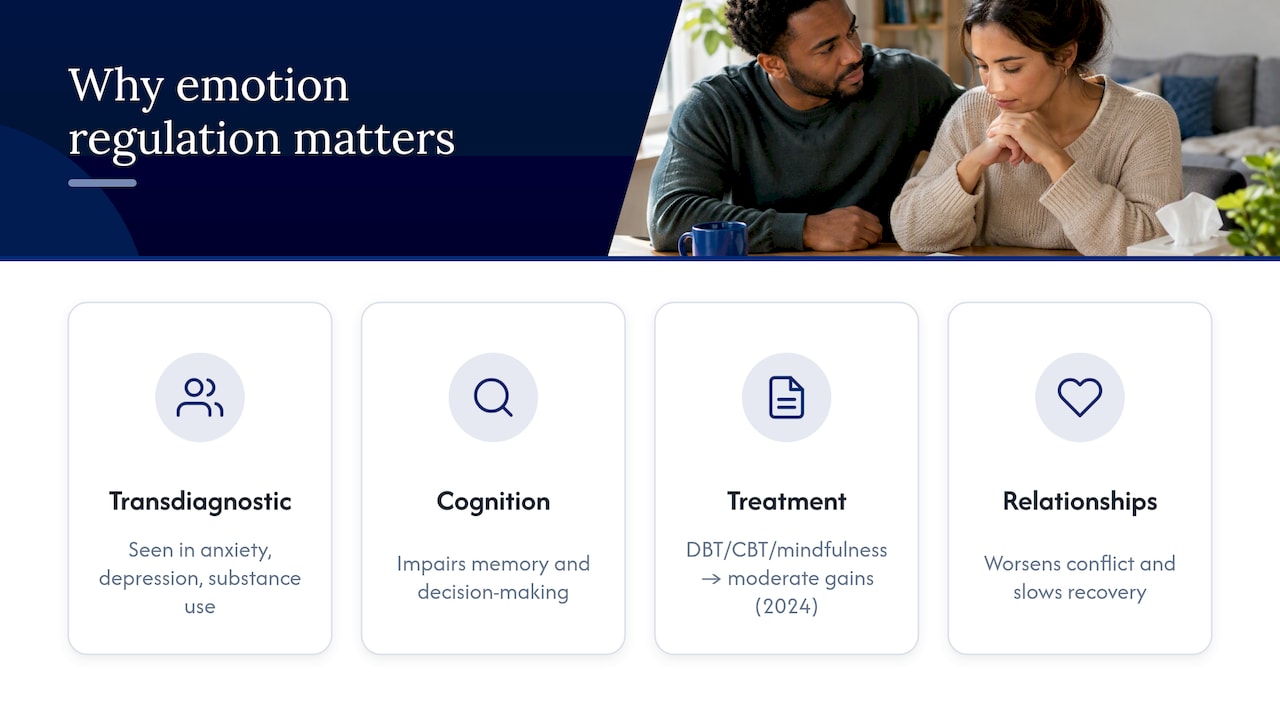
Difficulty regulating emotions shows up across nearly every common mental health condition rather than belonging to just one diagnosis. Anxiety, depression, substance use, and chronic relationship conflict all share emotion regulation difficulties as an underlying feature, which is why clinicians increasingly treat it as a transdiagnostic target rather than a symptom of a single disorder.
The stakes extend beyond mood. How you regulate emotion affects memory, decision-making, and how clearly you think under pressure. Suppressing a reaction in the moment can leave you with a foggier, less accurate memory of what happened, which matters when you are trying to resolve a disagreement with a partner or recall details for work.
A 2024 systematic review and meta-analysis found that psychotherapeutic approaches including DBT, CBT, and mindfulness-based methods produce moderate improvements in emotional regulation among adults in psychiatric populations, a signal that structured treatment reliably moves the needle rather than offering a marginal benefit, according to research published in 2024. Poor regulation does not just make hard days harder. It compounds, straining relationships and making recovery from anxiety or depression slower. For couples specifically, regulation skills often make the difference between a conflict that resolves and one that repeats, a pattern we address in more depth in our piece on how regulation skills affect relationships.
Evidence-based therapies and structured self-help: what research shows works
No single therapy owns emotional regulation, but several approaches have real evidence behind them, and they are not interchangeable. Each suits a different presentation, intensity level, and time commitment.
- Cognitive behavioral therapy (CBT) targets the thoughts that fuel emotional reactions and teaches reappraisal as a core skill; it tends to suit adults dealing with anxiety or depression who want a structured, time-limited approach.
- Dialectical behavior therapy (DBT) groups skills into mindfulness, distress tolerance, interpersonal effectiveness, and emotion regulation, and systematic reviews find it reduces emotional dysregulation across a range of adult clinical populations, making it a strong fit for anyone whose emotional intensity feels frequently overwhelming.
- Acceptance and Commitment Therapy (ACT) emphasizes making room for difficult emotions rather than eliminating them, paired with values-based action, which works well for adults whose avoidance of feelings is getting in the way of living the life they want.
- Mindfulness-based approaches build present-moment awareness and emotional monitoring; a 2024 to 2025 meta-analysis found a small-to-moderate effect for mindfulness components like equanimity and monitoring, useful as a standalone practice or alongside other therapies.
Beyond formal therapy, the World Health Organization recommends structured, individually delivered psychological self-help programs such as Step-by-Step and Doing What Matters as scalable, evidence-based options for adults managing distress. These programs are built to work with minimal support, often around 15 minutes of guidance per week over a few weeks, which makes them a realistic entry point for adults who are not in crisis but want structured help without committing to weekly therapy.
Fit matters more than finding the “best” method. Someone managing frequent, intense anger outbursts may need DBT-style distress tolerance skills before CBT’s cognitive work can land. Someone whose main struggle is chronic worry may do well starting with CBT’s reappraisal techniques. Someone who intellectually understands their patterns but keeps avoiding uncomfortable feelings may benefit most from ACT’s acceptance-based framework. Guided self-help works best for adults whose distress is real but not severe, and whose main barrier is access or cost rather than complexity of need.
Practical skills and exercises you can use right now
Some tools work in under two minutes. Others take longer but build regulation capacity over weeks. Having a few of each gives you options depending on how intense the moment is.
- Paced breathing (30 to 60 seconds): inhale for four counts, exhale for six, repeating until your heart rate settles. Longer exhales activate the body’s calming response faster than even breathing does.
- 5-4-3-2-1 grounding (60 to 90 seconds): name five things you see, four you can touch, three you hear, two you smell, and one you taste, pulling attention out of a spiraling thought and into the present.
- Body scanning (90 to 120 seconds): move attention slowly from your feet to your head, noticing tension without trying to change it yet.
- Labeling the emotion: naming what you feel in one or two words (frustrated, anxious, embarrassed) reduces its intensity by engaging the thinking part of the brain.
- Cognitive reappraisal: ask yourself what else this situation could mean, or how you’d view it if a friend described it to you.
- Defusion: mentally add “I’m having the thought that…” before a harsh self-judgment, creating distance between you and the thought itself.
- Values-based action: when an emotion urges you to avoid or lash out, ask what action would actually align with the kind of partner, colleague, or parent you want to be.
- Activity scheduling: block time for one enjoyable or meaningful activity daily, since behavioral activation supports mood and makes other skills easier to use.
Sleep hygiene and social sharing round out the behavioral side. Poor sleep lowers your threshold for emotional reactivity, while talking through a difficult experience with someone you trust is one of the strategies large-scale daily-life research consistently links to better subsequent mood, alongside acceptance and reappraisal. That same research, drawn from over 161,000 real-world measurement occasions, found rumination and suppression were often ineffective or backfired, reinforcing that the strategy you choose has to match the moment.
For a library of additional exercises you can rotate through, our guide to quick emotional regulation activities covers options suited to home, work, or on the go, and our breakdown of anger-specific exercises pairs movement and mindfulness for adults whose dysregulation shows up primarily as anger.
Pro Tip: When intensity is high, skip the cognitive tools first. Ground your body with paced breathing or temperature change, then move to labeling or reappraisal once your heart rate has settled.

When to seek professional help and what treatment looks like
Self-guided skills work well for everyday stress, but some signs call for professional support rather than more practice on your own.
- You notice a safety risk to yourself or others during emotional episodes.
- Intense emotional reactions are happening frequently and disrupting work, relationships, or daily functioning for weeks at a time.
- You are experiencing thoughts of suicide or self-harm, which warrants immediate professional contact.
- Skills that used to help no longer touch the intensity of what you are feeling.
If any of these apply, the right next step depends on severity. Guided self-help programs suit adults with mild to moderate distress who want structure without weekly sessions. Short-term CBT fits well for anxiety or depression with a clear pattern. DBT skills groups or DBT-informed individual therapy are often recommended when emotional intensity is frequent and severe, since DBT-derived crisis skills like temperature change, intense exercise, and paced breathing are specifically built for high-arousal moments. Couples therapy or anger management classes are worth considering when dysregulation is primarily showing up in a relationship or as anger toward others.
When you reach out to a therapist, it helps to ask what specific approach they use, how they measure progress, and how many sessions they typically recommend before reassessing. Clear answers to those questions are a reasonable signal of a structured, evidence-based practice.
Building a 4 to 8 week practice plan and tracking progress
Skills stick when they are practiced consistently, not just pulled out during a crisis. A realistic plan mixes short daily practices with a longer weekly check-in.
Weeks 1 to 2: practice one quick tool (paced breathing or grounding) twice daily, even when calm, to build familiarity before you need it under stress.
Weeks 3 to 4: add a cognitive tool, such as labeling or reappraisal, during one real triggering moment per day, and log what happened.
Weeks 5 to 6: layer in a values-based or acceptance practice for situations where avoidance has been your default response.
Weeks 7 to 8: review your log, identify which strategies worked in which situations, and drop whatever consistently underperforms.
Three simple measures make this trackable without turning it into a chore: a daily mood rating from one to ten, a brief trigger log noting what happened and which skill you used, and a weekly tally of how often you reached for a skill versus reacting on autopilot.
| Week | Focus | What to track |
|---|---|---|
| 1 to 2 | Quick grounding and breathing tools | Daily mood rating |
| 3 to 4 | Cognitive labeling and reappraisal | Trigger log entries |
| 5 to 6 | Acceptance and values-based action | Skill-use frequency |
| 7 to 8 | Review and adjust strategy mix | Weekly pattern review |
If a skill feels ineffective, the issue is often intensity mismatch rather than the skill itself. Antecedent-focused strategies like reappraisal work best before an emotion peaks, while once you are already flooded, grounding or paced breathing will do more than trying to think your way out. For a broader framework connecting these practices to long-term emotional intelligence, see our guide to self-regulation and emotional intelligence.
How emotional regulation changes across adulthood
Emotional regulation is not static. Many adults report feeling more emotionally steady in their 40s, 50s, and beyond compared to their 20s, partly because repeated practice and life experience build the skill the same way repeated training builds physical fitness. Yale Medicine researchers describe emotion regulation as a learned capacity rather than a fixed trait, which means the gains adults see with age reflect accumulated practice, not just maturity on its own.
That said, age-related shifts are not universally positive. Major life transitions, caregiving responsibilities, health changes, and loss can all strain regulation capacity at any stage of adulthood, regardless of how skilled someone has become. A 35 year old juggling a demanding job and young children may have less bandwidth for regulation in a given week than a 60 year old with more stability, even if the older adult has had more years of practice.
The practical takeaway is that regulation skill is built through use, not simply acquired with age. An adult in their 20s who practices consistently can outpace someone decades older who has never had reason to build the skill. This is also why the same core techniques, reappraisal, grounding, acceptance, apply across the adult lifespan even as the specific stressors triggering dysregulation change from career pressure to caregiving to retirement adjustment.
Cultural and gender influences on how emotions get expressed
How you were raised to express or restrain emotion shapes which regulation strategies feel natural and which feel foreign. Some cultural contexts emphasize emotional restraint and group harmony, which can make suppression feel like the expected default even though it carries the cognitive costs described earlier. Other contexts encourage open emotional expression, which can make acceptance-based practices feel more intuitive but reappraisal’s more internal, cognitive process less familiar.
Gender socialization plays a similar role. Many men are raised with messaging that discourages naming or expressing emotions like sadness or fear, which can push anger forward as the more socially acceptable outlet even when anger is not the primary feeling underneath. Many women face the opposite pressure: encouragement to express emotion paired with judgment for expressing it “too much,” which can complicate the labeling step that research shows is genuinely useful.
None of this means a strategy stops working because of someone’s background. It means the path to using a strategy comfortably may look different. An adult raised to suppress emotion may need more practice with labeling before reappraisal feels accessible. An adult socialized to over-apologize for emotional expression may need explicit permission, often built into ACT-based acceptance work, before values-based action feels possible. Recognizing these patterns in yourself is often the first real step toward choosing a strategy that fits rather than fighting your own instincts.
A clinical perspective on teaching these skills
Working with adults and couples on anger, conflict, and emotional dysregulation makes one thing clear: the skills that research supports are the same ones that hold up in session after session, but the order and pacing matter as much as the technique itself. A client who tries cognitive reappraisal before learning to ground their body first often reports that the “skill didn’t work,” when the real issue was sequencing.
This is the thinking behind how clinical training translates research into teachable steps rather than abstract concepts. An adult working through chronic anger, for example, often needs a body-based skill to lower arousal before any cognitive work can land, a sequence we return to often in both individual and couples work.
— Carlos
How our programs support emotional regulation in daily life
Matching the right support to how intense your patterns are makes a real difference. For adults whose dysregulation shows up mainly as anger, our anger management classes range from a focused 1 Hour Anger Management Class to more in-depth 6 and 8 Hour formats, giving you a structured, one-time entry point without committing to ongoing therapy.

If group learning fits your style better, our 4-Hour and 8-Hour group programs build the same skills alongside others working through similar patterns. When dysregulation is playing out mainly in a relationship, our couples sessions and relationship programs address the interpersonal side that individual skill-building alone cannot reach. For adults who want ongoing one-on-one work, our individual and couples clinical services offer sessions tailored to your specific presentation rather than a fixed curriculum. If you are unsure whether a class or full therapy fits your situation, a good next step is to book a consultation and talk through what you are experiencing before choosing a path.
This article is general information, not a substitute for advice from a qualified doctor. Consult a qualified healthcare professional about your own circumstances before acting on anything here.
FAQ
What causes poor emotional regulation in adults?
Poor emotional regulation often stems from a mix of chronic stress, unresolved trauma, sleep deprivation, and neurodevelopmental differences that affect how the brain processes and responds to emotional triggers. Early environments that modeled suppression or inconsistent emotional support can also make regulation skills harder to develop later in life. In many cases it reflects a skills gap rather than a character flaw, which is why structured practice and therapy are effective.
What are effective strategies for emotional regulation?
Commonly cited effective strategies include cognitive reappraisal, acceptance, grounding techniques, paced breathing, and social sharing, all of which large-sample daily-life research links to better subsequent mood. Rumination and chronic suppression tend to be far less effective and can backfire when relied on repeatedly. The right mix depends on the situation and how intense the emotion is at the moment.
How is emotional regulation different from self-regulation?
Emotional regulation specifically refers to managing emotional states and reactions, while self-regulation is a broader term covering control over behavior, attention, and impulses more generally. Emotional regulation is typically considered one component within the larger category of self-regulation. The terms overlap heavily in everyday use, but emotional regulation focuses narrowly on feelings and their expression.
Can emotional regulation skills really be learned as an adult?
Yes. Research on therapies like CBT, DBT, and mindfulness-based approaches shows moderate improvements in emotional regulation among adults, confirming the skill is trainable rather than fixed. Consistent practice, whether through structured therapy, guided self-help, or daily skill-building, produces measurable gains over weeks rather than years.
When should I consider therapy instead of self-help apps or books?
Guided self-help works well for mild to moderate distress, but therapy becomes the better route when emotional episodes are frequent, intense, affecting your safety, or not improving with self-guided practice. A licensed therapist can also tailor an approach like DBT or CBT to your specific patterns in a way that general self-help materials cannot.
Sources
- Emotional Regulation as a Transdiagnostic Process of Emotional Disorders in Therapy: A Systematic Review and Meta-Analysis – PubMed
- WHO launches new guide to help scale psychological self-help
- A critical test of emotion regulation strategy effectiveness in daily life: Individual differences and situational contexts.
- Mindfulness-based emotion regulation meta-analysis – PubMed