
10 Quick Emotional Regulation Activities for Home, School, and Clinic

The fastest way to calm strong emotions is to match the moment to one of five activity types: physiological (breathing, grounding), attention-based (mindfulness, sensory anchoring), cognitive (reappraisal, labeling), behavioral (movement, creative expression), or social (co-regulation with another person). High arousal generally calls for physiological tools first; milder moments tend to respond better to cognitive reframing. Kids need more modeling and visuals than adults; if outbursts are frequent, intense, or unsafe, a licensed professional should get involved.
TL;DR:
- Physiological tools like breathing and muscle release are most effective during high arousal states such as panic or rage, because they quickly calm the body.
- Attention-based activities like grounding and sensory anchoring work best during moderate moments of distress, redirecting focus away from internal flooding.
- Cognitive strategies such as labeling emotions and reframing thoughts become effective only when emotional intensity drops below moderate levels, allowing for clear thinking.
- Co-regulation by calm adults plays a crucial role in helping children and teens regain control, especially during intense outbursts or meltdowns.
- Self-help activities are usually sufficient for everyday stress, but frequent, intense, or unsafe outbursts may require professional assessment or family counseling.
Table of Contents
- Quick-Start Emotional Regulation Activities You Can Use Today
- Step-by-Step Scripts for Each Emotional Regulation Category
- Teaching Emotional Regulation to Kids and Classrooms
- Matching the Technique to the Moment
- What the Research Actually Says About These Techniques
- Worksheets and Resources to Practice These Skills Further
- Why Most Advice on This Topic Misses the Point
- When Self-Help Activities Aren’t Enough
- Sources
Quick-Start Emotional Regulation Activities You Can Use Today
You don’t need a therapy degree to start managing emotional spikes better today. These ten activities cover the most common emotional moments, and each one takes less than five minutes.
- Box breathing (4-4-4-4). Inhale for four counts, hold for four, exhale for four, hold for four. Repeat four times. Best for adults and teens facing acute anxiety or pre-meeting jitters; works because it slows the heart rate almost immediately.
- 5-4-3-2-1 grounding. Name five things you see, four you can touch, three you hear, two you smell, one you taste. Fits panic, dissociation, or racing thoughts in teens and adults, and this grounding technique redirects attention away from internal flooding toward the present room.
- Affect labeling. Say the emotion out loud, specifically: not “I’m upset” but “I’m humiliated and a little scared.” Works for anyone age seven and up; the specificity itself lowers the emotional charge.
- Opposite action. If the urge is to withdraw when sad, do the opposite: call a friend, go outside, sit up straight. Best for depression-flavored low energy or when avoidance is making things worse.
- Ninety-second movement break. Jog in place, do ten jumping jacks, or walk one flight of stairs. Fits restlessness, anger, or the fidgety energy that builds during a long workday.
- Sensory anchor object. A cold water bottle, a textured stone, a scented lotion. Best for kids and sensory-sensitive teens during overwhelm; the physical input competes with the emotional signal for attention.
- Two-minute expressive writing. Set a timer and write whatever comes, no editing. Fits adults processing anger or grief after a hard conversation, when talking feels too raw yet.
- Co-regulation check-in. A caregiver sits at eye level, keeps their own voice low and slow, and says, “I’m here, we’ll figure this out together.” Best for young children mid-tantrum; their nervous system borrows calm from yours before they can generate their own.
- Progressive muscle release (short version). Clench fists for five seconds, release, notice the difference. Works well for teens and adults holding tension in the shoulders or jaw.
- Distancing question. Ask, “What would I tell a friend in this exact situation?” Fits moderate frustration or self-criticism, once the initial spike has passed enough to think.
Notice the pattern: physiological tools go first when the body is flooded, and cognitive tools only work once someone can actually think. Trying to reason with a screaming toddler, or with yourself mid panic attack, wastes the moment. Calm the body, then talk.
Step-by-Step Scripts for Each Emotional Regulation Category
Knowing the categories helps. Having an exact script ready when your hands are shaking or your kid is mid-meltdown helps more. Here’s how to run each one.
Physiological: breathing and muscle release
The most reliable count for anxiety is 4-4-6: inhale four seconds, hold four, exhale six. The longer exhale activates the vagus nerve and slows heart rate faster than even breathing does. Harvard Health frames a related version of this as part of a broader self-regulation framework called Stop, Breathe, Reflect, Choose: stop the automatic reaction, breathe to calm the body, reflect on what actually triggered you, then choose a response instead of reacting on autopilot.
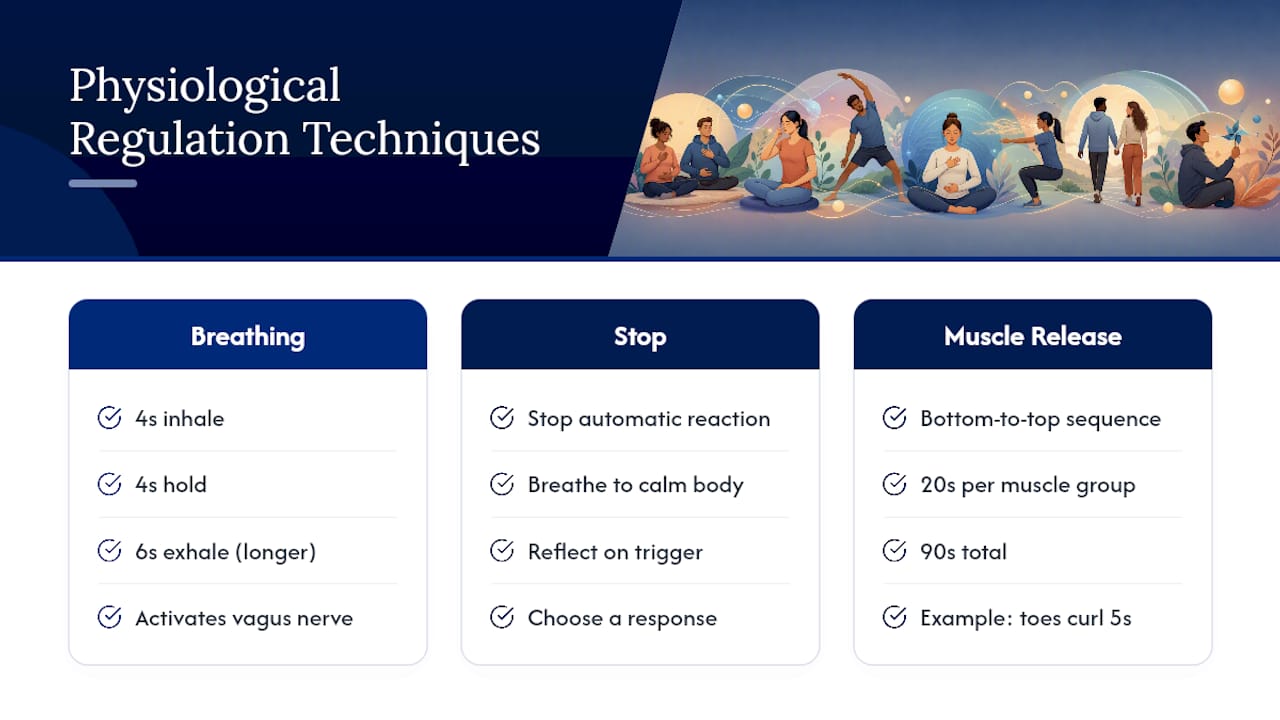
For progressive muscle release, work bottom to top: curl your toes for five seconds and release, tighten your calves and release, clench your thighs, your stomach, your fists, your shoulders, your jaw. Twenty seconds per muscle group, ninety seconds total. Athletes use this before competition; it works just as well before a hard conversation.
Attention and grounding
Run 5-4-3-2-1 out loud if you’re alone, silently if you’re not: “I see the lamp, the door, my hands, the window, that picture. I hear traffic, my own breathing, a clock.” A thirty-second body scan works too. Start at your scalp and mentally travel down, just noticing, not fixing: “Forehead tense. Jaw tight. Shoulders up near my ears.” Naming tension without judging it often loosens it on its own.
Cognitive: labeling and reframing
Affect labeling gets more powerful with precision. “Frustrated” is fine. “Disrespected and rushed” is better, because it points to what actually happened. A three-step reframe: name the automatic thought (“They think I’m incompetent”), question it (“What’s the evidence, actually?”), replace it with something truer (“They’re stressed about the deadline too”). Cognitive reappraisal consistently outperforms suppression in research on emotional outcomes, largely because suppressing a feeling doesn’t remove it, just delays and often intensifies it.
The “fly on the wall” distancing prompt works for rumination: imagine describing the situation as a neutral observer would, with no pronouns like “I” or “me.” It creates just enough psychological space to think clearly.
Behavioral: movement and creative expression
A five-minute movement routine: two minutes of walking, one minute of stretching, two minutes of anything rhythmic (drumming on a table, bouncing a ball). For creative prompts, keep it low-stakes: draw the emotion as a color and shape, no artistic skill required. Expressive writing works best with a real structure: five minutes on what happened, five minutes on how it felt in the body, five minutes on what you need right now.

Social: co-regulation and peer support
For caregivers, the co-regulation script is short on purpose: lower your own voice, slow your own breathing first, then say, “I see this is hard. I’m not going anywhere.” For peer support between teens or adults, a simple opener works better than advice: “That sounds rough. Do you want me to just listen, or help you think it through?”

Pro Tip: Practice every one of these scripts when you’re already calm. A grounding exercise you’ve never tried before a crisis rarely works during one, because the brain can’t learn a new skill and manage a flood of cortisol at the same time.
Teaching Emotional Regulation to Kids and Classrooms
Kids don’t learn regulation from a lecture. They learn it from watching a calm adult do it repeatedly, then trying it themselves with support, then eventually doing it alone. That’s co-regulation, and it happens in four stages.
- Model it. Narrate your own regulation out loud: “I’m feeling frustrated with this traffic, so I’m going to take three slow breaths.”
- Guide practice together. Do the breathing or grounding exercise alongside the child, in the moment, not just in a lesson.
- Fade the prompts. Move from doing it with them to asking “What could you try right now?”
- Let them run it solo. Step back once they can name the feeling and pick a tool without your cue.
Visuals speed this up. A stoplight chart (green: calm, yellow: getting frustrated, red: need a break) gives kids language before they have words. Feelings charts with faces work for younger children; a flip-book of “things I can try” lets them choose their own tool, which builds ownership rather than compliance.
Behavioral skills training, the model many school counselors use, follows the same logic: instruct, model, let the child rehearse, then give specific feedback (“That breath really slowed you down, nice work”). Teach and practice only when the child is calm; a meltdown is not a teaching moment, it’s a co-regulation moment. Trauma-informed language and offering real choices (“Do you want to squeeze the stress ball or take a walk?”) keep the process from feeling like another rule imposed on them, which matters because compliance without buy-in rarely transfers to moments when the adult isn’t watching.
Matching the Technique to the Moment
Not every tool fits every moment, and using the wrong one wastes precious seconds during an actual crisis. The decision comes down to arousal level and timing.
- High arousal (panic, rage, meltdown): go physiological first. Breathing, movement, or a sensory anchor. Cognitive tools don’t work yet because the thinking brain is offline.
- Moderate arousal (frustration, worry, irritability): attention or behavioral tools. Grounding, a short walk, or a creative outlet.
- Low arousal (mild sadness, mulling, low-grade stress): cognitive reappraisal or affect labeling work well here, since there’s enough bandwidth left to think.
- Acceptance-based strategies (letting a feeling exist without fixing it) fit situations you can’t change, like grief or a diagnosis. Change-focused strategies fit situations you can act on, like a solvable conflict.
- Real-time checklist: rate the intensity 1 to 10. Above 7, breathe or move first. 4 to 7, ground or distract. Below 4, reframe or label.
Emotion regulation research backs this order: intervening earlier, before an emotion fully escalates, tends to work better than trying to suppress it once it has peaked.
What the Research Actually Says About These Techniques
Emotion regulation deficits show up across a wide range of psychiatric conditions, and structured skill-building, including reappraisal, acceptance, and self-compassion, measurably reduces symptoms over time.
That finding comes from a comprehensive review of emotion regulation and mental health, and it’s why frameworks like Dialectical Behavior Therapy build entire treatment plans around skills such as opposite action and emotion identification rather than treating them as casual self-help tips. Self-led activities work well for everyday stress, mild anxiety, and the normal friction of parenting or work. They’re not enough when outbursts happen daily, involve any risk to safety, or come with a sense that the person genuinely can’t stop them once they start. That’s the line where a licensed clinician, not a worksheet, becomes the right next step. Clinicians typically use these same activities as homework between sessions, layered on top of deeper work on the trigger itself.
Worksheets and Resources to Practice These Skills Further
A few resources worth bookmarking:
- DBT emotion regulation worksheets covering opposite action, TIP skills, and emotion identification for teens and adults.
- The Emotion and Stress Regulation Magic Tool Box, a printable set of classroom visuals and calming activities for kids.
- Mastering Conflict’s classroom emotional regulation guide for teachers building lesson plans around these skills.
- Mastering Conflict’s anger management exercises for adults for readers who need more structure than a quick list provides.
- Mastering Conflict’s teen emotional regulation guide for parents navigating adolescent mood swings.
Why Most Advice on This Topic Misses the Point
Most articles on this subject hand you a long list of activities and stop there, as if regulation is a matter of knowing enough techniques. It isn’t. The actual skill is speed of recognition: noticing you’re at a 7 out of 10 before you’re at a 9, when almost any tool still works. Wait too long, and even the best breathing script won’t reach you.
The other thing conventional advice underplays is co-regulation. Adults are expected to self-regulate solo, and kids are taught tools in isolation from the relationships that actually make those tools stick. In practice, a calm adult’s presence does more of the regulating in the first sixty seconds than any script does. Teach the scripts, yes, but invest more in staying calm yourself, because that’s the tool your kid or partner is actually borrowing from.
Start with one category, physiological, since it’s the one that works regardless of age or insight level, and build outward from there.
— Carlos
When Self-Help Activities Aren’t Enough
These activities work well for everyday stress, but some patterns need more than a breathing script can fix. If outbursts happen several times a week, escalate quickly, or leave you or your family walking on eggshells, an anger management assessment gives you a clear clinical picture of what’s actually driving the intensity, not just the symptoms showing up at the surface. Mastering Conflict is the option for readers who’ve tried the worksheets and still feel stuck, offering assessment, individual counseling, and structured classes instead of another list to work through alone.

Families where co-regulation has broken down, where every attempt to calm a child or teen turns into a bigger conflict, often benefit more from family counseling than from another round of solo practice. A session there focuses on rebuilding the relational patterns that make self-regulation possible in the first place. If any of this sounds familiar, book an assessment or a family session and get a plan built around your actual situation, not a generic list.
This article is general information, not a substitute for advice from a qualified doctor. Consult a qualified healthcare professional about your own circumstances before acting on anything here.
Sources
- Emotion regulation and mental health: current evidence and beyond — PMC (NCBI)
- Positivepsychology
- Self-regulation for adults: Strategies for getting a handle on emotions and behavior — Harvard Health
- Emotion and stress regulation magic tool box — University of Maryland (PDF)
One Response