
Clinician Backed Six Step Conflict Resolution With Exact Scripts

The six steps are: set the stage and stop any harm, clarify the real issue, surface interests through active listening, brainstorm options together, agree on responsibilities with a written plan, and acknowledge progress with a scheduled follow-up. This sequence works whether you’re mediating a team dispute, a classroom disagreement, or a conflict with a partner. Below, you’ll find exact phrases to use at each stage and how to adjust them by setting.
TL;DR:
- Active listening to surface underlying interests is crucial, as it helps generate mutually acceptable solutions rather than sticking to fixed demands.
- Writing a clear, specific plan with assigned responsibilities and deadlines significantly increases the likelihood of long-term conflict resolution.
- Looping back to earlier steps like clarifying issues or brainstorming is normal and indicates the process is working, not failing.
- Mediators should be involved when power imbalances, emotional barriers, safety risks, or recurring conflicts prevent effective direct communication.
- Skipping the step of creating a detailed, written action plan often causes agreements to fall apart despite good initial conversations.
Table of Contents
- Working through each of the six steps
- Adapting the six steps to your setting
- Knowing when to call in a mediator or professional
- Common mistakes that stall resolution
- How clinicians put these steps into practice
- What the six steps get right, and where people stop too soon
- Where structured support can help
- FAQ
- Sources
Working through each of the six steps
Each step builds on the one before it, and skipping ahead usually backfires. Here’s what to do and say at each stage.
Stop harm and set the stage. Before anything else, make sure the conversation is safe and both people agree to participate. State a ground rule out loud: “Let’s agree we won’t interrupt each other, and we can pause if either of us needs a break.” This step matters most in hierarchical settings, where one person may feel pressure to go along with things. The StatPearls clinical framework recommends setting ground rules explicitly before addressing the substance of a disagreement, since structured openings reduce the effect of power differences on what gets said.
Clarify the issue. Name the specific problem without assigning blame. Try: “Here’s what I understand the disagreement to be. Did I get that right?” In healthcare and other high-stakes team settings, practitioners use structured tools like DESC (describe, express, specify, consequences) to separate facts from feelings and keep requests concrete. A manager might say, “When the report came in two days late, I had to delay the client call. Can we talk about what happened?” rather than, “You’re always missing deadlines.”
Surface interests through active listening. This is where most conflicts actually get resolved, or stall. Reflect back what you hear before responding with your own view. Negotiation research from the Program on Negotiation at Harvard Law School stresses focusing on underlying interests rather than fixed positions, since curiosity about what someone actually needs tends to open options that arguing over demands never will. UC Berkeley’s HR guidance identifies reflective listening, repeating someone’s point in your own words before replying, as one of the most important skills in de-escalation. In a personal relationship, this might sound like: “So it sounds like you felt dismissed when I canceled last minute, not just inconvenienced.” For a deeper look at this skill, see our guide to empathy in conflict resolution.
Brainstorm options together. Once both interests are on the table, generate solutions without judging them yet. Ask: “What are two or three ways we could handle this going forward?” This step works best when both people contribute ideas rather than one person proposing a fix for the other to accept or reject.
Agree on responsibilities and a written plan. Vague agreements fall apart. Specify who does what by when: “You’ll send the draft by Wednesday, and I’ll review it within 24 hours.” Clinicians who convert therapy or coaching agreements into measurable goals, naming the action, the owner, and the deadline, see far fewer repeat conflicts than when agreements stay general.
Acknowledge and schedule follow-up. Close the conversation by naming what went well and setting a check-in date. Setting a reasonable timeframe for follow-up helps keep both people accountable.
Useful scripting options across these steps include:
- “Help me understand what matters most to you here.”
- “What would a fair outcome look like from your side?”
- “Can we agree on one small step before our next conversation?”
Adapting the six steps to your setting
The framework stays the same, but the delivery changes depending on who you’re talking to and where.
- Manager and employee: Hold the conversation privately, bring a brief written agenda so the discussion doesn’t drift, and confirm agreed expectations in an email afterward. Our scripts for resolving workplace conflict offer sample language for these exchanges.
- Classroom or education settings: Use age-appropriate language, let the teacher or facilitator stay neutral rather than taking sides, and ask restorative questions like “Who was affected, and what do we need to make it right?”
- Personal relationships: Pick a calm moment rather than the heat of an argument, protect emotional safety by avoiding blame language, use “I” statements such as “I felt hurt when” instead of “You always,” and schedule a short check-in a few days later.
Knowing when to call in a mediator or professional
Not every conflict resolves through a direct conversation, and pushing forward anyway can make things worse. The Community Tool Box from the University of Kansas recommends neutral third-party mediation when a dispute involves power imbalance, repeated emotional blockage, or high stakes, since a mediator can design a fairer process than either party could manage alone.
Watch for these signs that you need outside help:
- The same disagreement keeps resurfacing despite agreed plans.
- One person holds significantly more power or control in the relationship.
- Safety concerns or legal stakes are involved.
- Communication consistently breaks down or one person shuts down entirely.
A trained mediator adds confidentiality, structured process design, and ethical guardrails that a two-person conversation can’t provide. If you reach this point, it’s reasonable to pause, document what’s already been tried, and propose separate meetings before reconvening.
Common mistakes that stall resolution
Most failed attempts at conflict resolution share a handful of patterns, and each has a quick fix.
- Rushing to close: Don’t wrap up until both people explicitly agree to the plan. Build in a checkpoint to confirm it’s working.
- Threats or ultimatums: Replace “or else” language with curiosity questions like “What’s making this hard for you?” and take a short pause if tempers rise.
- Confusing positions with interests: If someone states a demand, ask a reflective question to find out what need sits underneath it.
- Silent compliance: Agreement without real buy-in tends to resurface as the same conflict later. Ask for a verbal confirmation and set a follow-up date to check durability.
Pro Tip: If someone goes quiet and says “fine” without detail, that’s often a sign of silent compliance, ask them directly what would make the plan actually work for them.
How clinicians put these steps into practice
I have built anger management classes and couples programs around this same sequence: set the stage, clarify, listen, brainstorm, commit, follow up. In session work, verbal agreements can be converted into written, measurable goals, specifying who does what by when, and tracked across future sessions. Our synthesis of evidence-based steps for clinicians and couples goes deeper into how we apply this model across different cases.

What the six steps get right, and where people stop too soon
The biggest gap I see isn’t in step one or two, it’s that people treat this as a straight line instead of a loop. Real conflicts rarely resolve on the first pass through all six steps. You clarify the issue, start brainstorming, and realize you misread the other person’s interest back in step three, so you go back. That’s not failure, that’s the process working as intended.
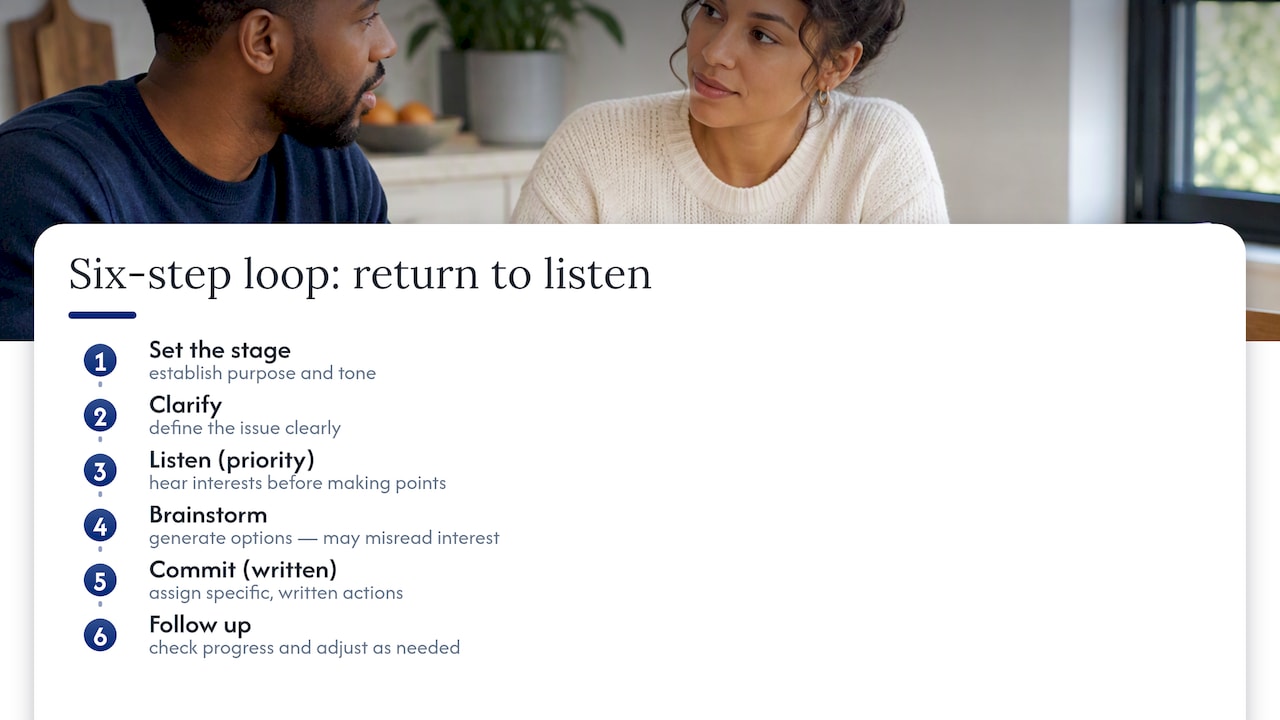
The advice that undersells this the most is “just communicate better.” Communication skills matter, but they’re useless without the structure that keeps a conversation from sliding into blame. The step most people skip is the written plan in step five. A good conversation that ends without a specific, assigned action is just a good conversation, it rarely changes behavior.
If you take one thing from this: prioritize step three. Most people rush past listening to get to their own point, and that’s exactly where resolution attempts break down.
— Carlos
Where structured support can help
When a conflict keeps repeating despite your best conversations, or when emotional reactions escalate faster than either person can manage alone, structured support often moves things forward faster than another unstructured attempt.
We offer a few starting points depending on what’s going on:
- If anger or escalation is the recurring problem, our 1 Hour, 6 Hour, and 8 Hour Anger Management Classes teach these same de-escalation and communication skills in a structured format.
- If the conflict sits inside a relationship, our couples sessions and intensives are built around guided, clinician-led versions of this same process.
- For persistent or complex conflict tied to broader mental health needs, our clinical services offer individual and family counseling.
A short consult is a low-pressure way to find out which option fits your situation.
FAQ
What are the six steps of conflict resolution?
The six steps are setting the stage and stopping harm, clarifying the issue, surfacing interests through active listening, brainstorming options, agreeing on responsibilities with a written plan, and acknowledging progress with a scheduled follow-up. This sequence applies across workplace, classroom, and personal conflicts, though parties often loop back to earlier steps as new information surfaces.
What are the six principles of conflict resolution?
Common principles include separating people from the problem, focusing on interests rather than fixed positions, generating options before deciding, using objective criteria where possible, communicating clearly without blame, and committing to a concrete follow-up. The Program on Negotiation at Harvard Law School frames the shift from positions to interests as central to reaching durable agreements.
What are the six stages of conflict?
Conflict typically escalates through stages such as initial disagreement, personalization, hardening of positions, coalition building, destructive stand-off, and eventually resolution or separation. Recognizing which stage you’re in helps determine whether a direct conversation is still realistic or whether a mediator is needed.
What are the six steps of peaceful conflict resolution?
Peaceful resolution follows the same core sequence: stop any harm, clarify the issue, listen to understand each side’s interests, brainstorm solutions together, agree on specific responsibilities, and follow up to confirm the agreement holds. Keeping the tone non-adversarial at each stage, rather than treating it as a debate to win, is what keeps the process peaceful.
Sources
- Conflict Management in Healthcare – StatPearls (NCBI Bookshelf)
- Section 6. Training for Conflict Resolution – Community Tool Box (University of Kansas)
- Conflict resolution strategies (Program on Negotiation, Harvard Law School)
- Resolving conflicts and managing performance (UC Berkeley HR)