
Clinician Backed Scripts for Managers: Resolving Workplace Conflict

This article gives you real workplace conflict scenarios, the exact resolution steps that address each one, and short scripts you can adapt today. You’ll get an evidence-backed sequence for handling ordinary disputes (facts, impact, needs, options, commitments, follow-up), plus clear rules for when a disagreement needs HR, mediation, or a formal complaint instead of a hallway conversation.
TL;DR:
- Recognize common patterns like personality clashes, communication issues, and workload imbalances, which can often be resolved with simple, direct conversations.
- Use structured six-step resolution methods focused on facts, shared goals, and concrete commitments to prevent escalation and build trust in disputes.
- Escalate conflicts involving power imbalances, repeat issues, or serious misconduct to HR or mediators, rather than relying solely on peer conversations.
- Starting with delay or blame weakens resolution efforts, so acting promptly with clear scripts and documented agreements is essential for lasting change.
- Mastering conflict skills through training and coaching improves long-term workplace harmony and reduces recurring friction.
Table of Contents
- Workplace Conflict Examples and How to Resolve Them Fast
- A Step-by-Step Method for Resolving Everyday Disputes
- When to Escalate: Mediation, HR, and Formal Complaints
- What Practitioners Know That Most Advice Skips
- What Actually Moves the Needle in These Conversations
- How Mastering Conflict Supports Workplace Conflict Skills
- Sources
- FAQ
Workplace Conflict Examples and How to Resolve Them Fast
Most workplace friction falls into a handful of repeatable patterns. Once you recognize which one you’re in, the resolution gets a lot less mysterious. Below are the scenarios that show up most often, each with a script or move you can use the same day.
1. Personality Clashes
Two coworkers grate on each other for reasons neither can fully name. One reads the other’s directness as rudeness; the other reads the first’s caution as passive-aggression.
Resolution: Name the pattern out loud, not the person’s character. Say, “I’ve noticed our meetings get tense when we disagree on timing. Can we agree on how we’ll flag disagreements going forward?” Set one shared ground rule (e.g., raise concerns in the moment, not after) and check back in a week.
2. Poor Communication and Tone Misreads
A Slack message meant as a quick note reads as cold or dismissive to the recipient, who stops responding warmly and starts CC’ing a manager on everything.
Resolution: Address it directly with the reflective script from negotiation research: “Here’s how I understood your message. What were you hoping to convey?” That single question, drawn from the Harvard Program on Negotiation’s “Third Story” method, usually surfaces the gap between intent and impact within one exchange.
3. Unclear Roles and Overlapping Responsibilities
Two team leads both believe they own a client relationship. Each makes commitments the other later has to walk back.
Resolution: Stop debating who’s “right” and build a quick RACI (who’s Responsible, Accountable, Consulted, Informed) for that account. Document it in writing and send it to both parties plus their shared manager the same day.
4. Workload Imbalance
One employee quietly absorbs extra tickets while a teammate leaves on time every day. Resentment builds for weeks before anyone says anything.
Resolution: Bring the imbalance to the manager with specifics, not complaints: “Over the last three weeks I’ve closed 40 tickets to Jordan’s 22. Can we look at how work gets assigned?” Ask for a concrete rebalancing, not a vague promise to “keep an eye on it.”
5. Feedback Gone Wrong
A manager gives critical feedback in front of the team. The employee shuts down and starts avoiding one-on-ones.
Resolution: The manager needs to apologize specifically, not generically. Research on mediation outcomes shows apologies that name what happened, the impact, and the change are far more likely to lead to real resolution than a blanket “sorry if that upset you.” Try: “I gave that feedback publicly and it embarrassed you. Going forward, I’ll raise concerns privately first.”
6. Meeting and Decision Friction
The same two people dominate every meeting while others go quiet, and decisions get made without input from the people who’ll execute them.
Resolution: Set a meeting norm: each major decision gets one round where every attendee speaks before anyone votes. A team lead enforcing this for two weeks usually breaks the pattern without a single difficult conversation.
7. Credit and Recognition Disputes
An employee’s idea gets presented by a colleague to leadership, credit unattributed. The original contributor feels erased and starts withholding ideas.
Resolution: Address it privately with the colleague first: “When you presented the pricing idea, my name wasn’t mentioned. Can we make sure contributions are credited going forward?” If it’s a pattern, loop in the manager with dates and specifics, not accusations.
8. Micromanagement
A manager reviews every email before it’s sent, and the employee starts feeling incapable of independent judgment.
Resolution: The employee proposes a trial period with defined checkpoints instead of blanket oversight: “Can we agree that I’ll flag anything over $500 or client-facing, and you’ll trust the rest for two weeks?” Concrete boundaries work better than asking someone to simply “trust more.”
9. Resistance to Change
A new process rolls out and half the team keeps using the old workaround, quietly undermining the rollout without ever raising an objection.
Resolution: Ask directly what’s driving the resistance instead of assuming stubbornness. “What’s not working about the new process for you?” often reveals a legitimate gap the rollout missed, not just discomfort with change.
10. Resource Scarcity
Two departments need the same designer’s time in the same week, and each assumes the other should wait.
Resolution: Escalate to whoever owns both priorities and ask for an explicit call, in writing, with a deadline. Don’t let two peers negotiate scarce shared resources without a tiebreaker above them.
11. Manager Caused Conflict
A manager plays favorites, assigning the interesting projects to the same two people every quarter while others get repetitive work.
Resolution: This one is hardest to raise directly. Bring specific project assignments over a defined period to HR or the manager’s own supervisor, framed as a pattern, not a single incident. CIPD’s guidance for people managers notes managers often contribute to conflict without realizing it, which is exactly why early, documented feedback matters.
12. Hybrid Work Friction
Remote employees feel decisions get made in the office hallway before the video call even starts. In office employees feel remote colleagues are less responsive and less invested.
Resolution: Make meeting decisions happen only in the meeting, not before it, and require notes shared the same day. A simple rule, “no decisions before the recap is sent,” rebuilds trust on both sides within a few cycles.
13. Harassment or Discrimination
An employee makes repeated comments about a coworker’s appearance or background that cross from awkward into unwelcome.
Resolution: This is not a peer-to-peer fix. The EEOC advises telling the person to stop if it’s safe to do so, then reporting to HR immediately and documenting dates, exact words, and witnesses. This category moves straight to formal channels; skip below for what that involves.
14. Authority and Power Struggles
A senior employee routinely overrides a newer manager’s decisions in front of the team, undermining their authority.
Resolution: The manager needs backing from their own leadership before addressing it, then a direct, private conversation: “When you redirected my instruction in front of the team, it undercut my role. Can we agree to raise disagreements with me first?”
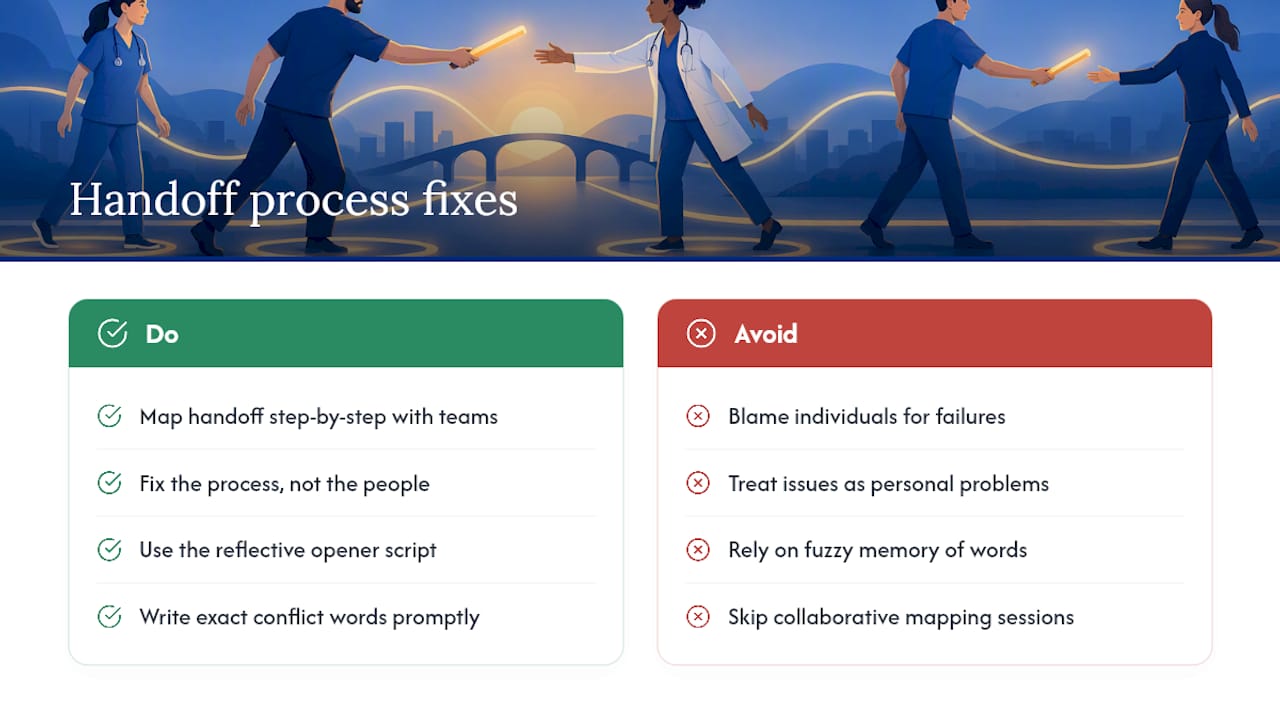
15. Handoff and Process Breakdowns
Work passes from one team to another and details get lost every time, causing repeated rework and finger pointing about whose fault it is.
Resolution: Map the handoff step by step with both teams in the room and fix the process, not the people. Most handoff conflicts are structural, not personal, and treating them as a design problem defuses blame fast.
Three scripts worth memorizing: the reflective opener (“Here’s how I understood this, what were you hoping to convey?”), the Third Story frame (“It seems like we have different priorities here. What would need to be true for both to work?”), and the specific apology (“Here’s what happened, here’s the impact, here’s what I’ll change”).
Pro Tip: Write down the exact words used in a conflict as soon as possible after it happens. Memory softens or sharpens details over time, and specific language is what makes a resolution conversation credible instead of speculative.
A Step-by-Step Method for Resolving Everyday Disputes
Most workplace disputes respond to the same six-step sequence, regardless of the topic. This isn’t a script for dramatic conflicts. It’s the baseline method for the friction that happens every week.
- Pause if emotions are running high. Wait until both people can talk without raised voices or clenched jaws. A conversation held in anger rarely produces a durable agreement.
- Describe the observable issue, not a character judgment. “The report was submitted three hours after the deadline” lands differently than “You don’t respect deadlines.”
- Let each person state impact and needs. Ask, “What was the impact on your side?” and actually wait for the answer before responding.
- Identify shared goals. Even opposing sides usually want the same outcome, like a client kept happy or a deadline hit. Naming that shared goal out loud shifts the tone from combat to problem solving.
- Generate options together. Two or three possible fixes beat one demand. Ask, “What are the ways we could handle this differently next time?”
- Agree on specific commitments, owners, and a follow-up date. Vague resolutions (“we’ll communicate better”) don’t survive a busy week. Concrete ones do.
This sequence closely tracks the structure recommended by the Harvard Program on Negotiation, which built its “Third Story” technique around describing a dispute in neutral terms both sides can accept before anyone assigns blame. Instead of “you’re always late with reports,” the third story version sounds like: “It looks like we have different views of when a report counts as ‘ready.’ What would need to happen for both of our expectations to be met?” That single reframe lowers defensiveness because neither side has to admit fault to keep talking.
Managers running this conversation carry extra responsibility. Open the meeting by naming the ground rules out loud: no interruptions, both sides get equal time, and nothing said becomes ammunition later. Invite the quieter person to speak first; the more dominant personality in most disputes will happily fill silence if given the chance, and that skews the conversation before it starts. Close by writing down what was agreed, who owns each action, and when you’ll check back in.
A single three-hour training session paired with follow-up e-learning was enough to measurably improve psychological safety and reduce reported bullying in one cluster randomized trial, suggesting that structured, brief interventions can shift team dynamics even without a full mediation process. It was a single-site study, so treat it as a promising signal rather than a guarantee, but it backs the idea that a well-run conversation, done consistently, changes behavior over time.
When to Escalate: Mediation, HR, and Formal Complaints
Not every dispute belongs in a peer conversation. Escalate when you notice any of these markers:
- The same conflict has resurfaced two or more times despite an earlier agreement.
- One party holds more power over the other’s job, pay, or schedule (a manager-employee dynamic, for instance).
- The dispute involves more than two people or crosses departments, making a single informal chat unworkable.
- Trust has broken down enough that neither side believes the other will follow through.
- There’s any hint of retaliation, threats, or unwelcome conduct tied to someone’s identity.
At that point, a neutral third party earns its keep. Mediation research shows settlement outcomes improve when the interaction quality between participants is high and when apologies are part of the process; a mediator’s job is largely to protect that interaction quality. An HR investigation is a different tool entirely: it gathers facts, interviews witnesses, and can lead to disciplinary action, which mediation deliberately avoids. If the situation involves harassment or discrimination, the EEOC recommends documenting dates, exact language, and witnesses, reporting through internal channels first, and understanding that retaliation for reporting is itself a separate violation with its own filing deadlines.
What Practitioners Know That Most Advice Skips
Separate the conflict type before choosing a response. A misunderstanding needs clarification; a role dispute needs a decision-rights map; a harassment allegation needs impartial reporting, not a peer chat. Bring dates, messages, and witnessed effects on work rather than character judgments, and make apologies specific: what happened, the impact, what changes. Escalate the moment safety or power imbalance enters the picture. Short conversations fix isolated incidents. Recurring patterns usually need structured training or coaching to actually change.
What Actually Moves the Needle in These Conversations
The biggest mistake I see is delay. People wait weeks hoping a conflict resolves itself, and by the time they act, both sides have built a story where they’re right and the other person is the problem. That’s harder to undo than the original issue ever was.
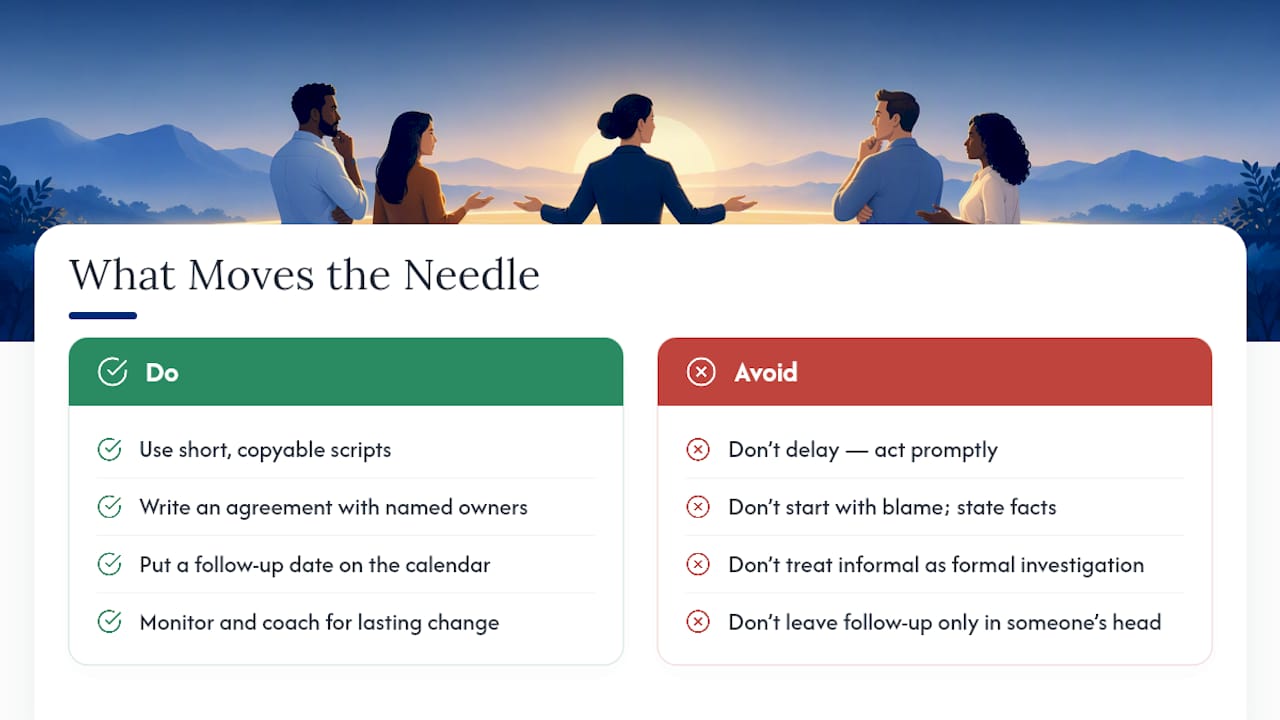
The second mistake is starting with blame instead of facts, which guarantees defensiveness before the conversation even gets going. And the third is treating an informal conversation and a formal investigation as interchangeable. They’re not. One is a chat between colleagues; the other has legal weight and documentation requirements. Confusing them either escalates something small or under-responds to something serious.
What works reliably: copyable scripts, a written agreement with named owners, and a follow-up date on the calendar, not just in someone’s head. Even then, expect that lasting behavior change usually needs more than one good conversation. It needs monitoring, and often coaching.
— Carlos
How Mastering Conflict Supports Workplace Conflict Skills
Reading examples helps, but building the skill takes practice, and that’s where structured classes and coaching come in. Masteringconflict’s 1-hour, 6-hour, and 8-hour anger management classes are built for individuals who recognize their own reactions escalate conflicts rather than resolve them, whether that shows up in a meeting or a one-on-one.
Teams and managers dealing with recurring friction across a department often need more than one person’s skill set to change; Masteringconflict’s group programs are designed for that broader rollout. For conflict that’s spilled into a relationship at home, whether the stress originated at work or not, the couples counseling and packages page covers options from single sessions to intensives. Practitioners who want to build these same skills into their own clinical practice can look at clinical mentoring and supervision. Start with the class or service that fits your conflict context—at work, home, or in clinical practice—and book a session through the website.
Sources
- Telling the third story | Program on Negotiation (Harvard)
- Workplace mediation outcomes study (SAGE Journals)
- Harassment | U.S. Equal Employment Opportunity Commission (EEOC)
- Workplace conflict: a guide for people managers | CIPD
FAQ
What Are the 5 Steps to Resolving Conflict in the Workplace?
The core sequence is: pause if emotions are high, describe the observable issue without blame, let each side state impact and needs, generate options together, then agree on specific commitments with a follow-up date. This structure mirrors the approach outlined by the Harvard Program on Negotiation.
What Is an Example of Conflict Resolution in the Workplace?
A common example is workload imbalance, where one employee handles significantly more tickets than a teammate. The resolution is bringing specific numbers to a manager and requesting a concrete rebalancing of assignments rather than a vague promise to monitor the situation.
How Do You Answer “Give an Example of a Time You Handled Conflict at Work” in an Interview?
Describe a specific scenario using the facts, impact, and resolution structure: what happened, how you addressed it directly with the other person, and what changed afterward. Interviewers want to see that you approached the person directly rather than escalating immediately or avoiding the issue.
What Are the 4 Ways of Dealing With Conflict?
Common approaches include direct informal conversation between the people involved, manager-led intervention, neutral third-party mediation, and formal HR investigation for serious or repeated issues. The right choice depends on severity, power balance, and whether safety or discrimination concerns are present, as outlined by EEOC guidance.
Does Mastering Conflict Offer Training for Handling Workplace Disputes?
Masteringconflict offers anger management classes ranging from one hour to eight hours, along with longer group programs, that build the self-regulation and communication skills that reduce workplace friction. Current pricing and formats are listed on the class page.
2 Responses