
Stress vs. Depression: How to Tell the Difference

Stress is a response to something outside you, such as a deadline, a conflict or a bill, and it usually eases when the pressure does. Depression is a mood condition that lingers, colors almost everything and does not lift just because a hard week ends. The two overlap in fatigue, poor sleep and irritability, which is why so many people cannot tell which one they are dealing with. This guide sets them side by side, adds anxiety to the picture, and tells you when it is time to talk to a professional.
TL;DR
- Stress is a physical or mental response to an external cause. Depression is a condition with its own pattern of mood, thinking and body symptoms, and it can appear even without a clear trigger.
- Depression is more serious and longer lasting than stress. Its symptoms last at least two weeks, and it is not something you can simply “snap out of.”
- Anxiety is the body’s internal reaction to stress and can continue even when no threat is present. Depression and anxiety often occur together.
- Ongoing stress that you cannot manage, or low mood that will not lift, is a reason to see a licensed professional. If you are thinking about hurting yourself, call or text 988 in the U.S.
Table of Contents
- What stress is
- What depression is
- Stress vs. depression, side by side
- Where anxiety fits
- Can stress cause depression?
- Clues that help you sort out what you are feeling
- What to do about each
- When to get professional help
- Our perspective
- Support from Mastering Conflict
- FAQ
- Sources
What stress is
The National Institute of Mental Health defines stress as a physical or mental response to an external cause. It can be short-term, or it can occur repeatedly over a long time. The key word is external: there is usually something you can point to. A work deadline, a family argument, a move, a health scare, a money problem.
Because stress has a source, it often has a shape. It rises, peaks and, when the situation resolves or you get some rest, it comes down. People under stress often say things like “once this project is over, I’ll be fine.” That sentence is a useful clue. When the pressure goes away and you still do not feel fine, something else may be going on.
Stress is not always short. Repeated or constant pressure can wear you down over months. If that sounds familiar, our guides on early signs of stress and chronic stress symptoms walk through what to watch for.
What depression is
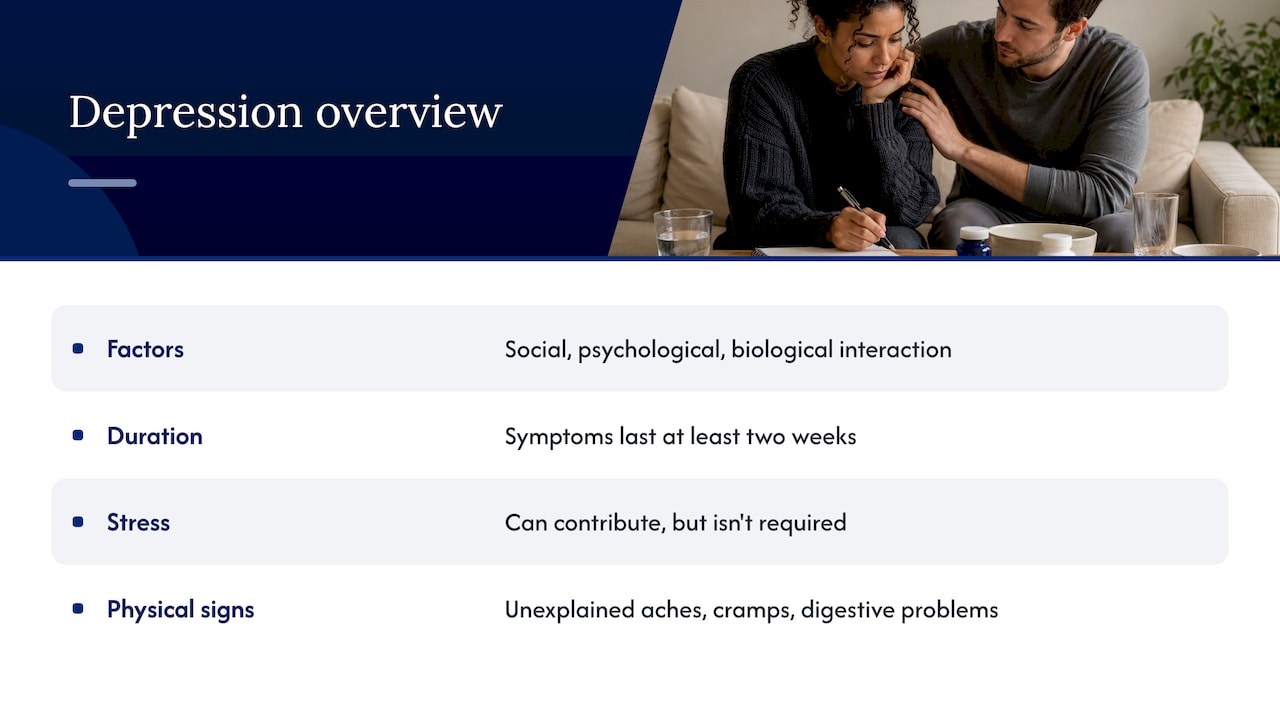
Depression is not just a heavy dose of stress. The World Health Organization describes depression as the result of a complex interaction of social, psychological and biological factors, and says people who have faced adverse life events are more likely to develop it. Stress can be one of those factors, but it is not required.
Mental Health America says depression is more serious and long-lasting than stress, with symptoms that last at least two weeks and can include powerful mood changes such as painful sadness and despair. It also notes that a person with depression cannot simply snap out of it and needs professional help.
Depression also shows up in the body. The National Institute of Mental Health lists physical symptoms such as aches, pains, cramps or digestive problems that have no clear physical cause and do not improve with treatment. Many people go to a primary care doctor for a stomachache or back pain and only later learn that low mood sits underneath.
Stress vs. depression, side by side
No table replaces an evaluation, but this one shows where the two usually diverge.
| Stress | Depression | |
|---|---|---|
| Typical cause | An external demand or pressure | A mix of social, psychological and biological factors; may have no obvious trigger |
| Duration | Often tied to the situation; can be short-term or repeated | Symptoms last at least two weeks and often much longer |
| Core feeling | Overwhelmed, wound up, pressed for time | Persistent sadness, emptiness, hopelessness, loss of interest |
| Effect of relief | Often eases when the pressure lifts | May stay even after circumstances improve |
| Body signs | Fatigue, muscle tension, trouble sleeping | Fatigue and sleep changes, plus aches, cramps or digestive problems with no clear cause |
| Help usually needed | Coping skills, boundaries, rest, sometimes counseling | Professional evaluation and treatment |
The overlap is real. Fatigue and disrupted sleep appear on both sides, and anger and irritability can show up in either. If you notice that short temper is your most visible symptom, our article on depression and anger explains how the two connect.
Where anxiety fits
Many people searching this topic are really weighing three things: stress, depression and anxiety. The National Institute of Mental Health describes anxiety as the body’s internal reaction to stress, one that can occur even when there is no current threat. Put simply, stress is the pressure, anxiety is the lingering alarm inside you.
The American Psychological Association notes that stress and anxiety can produce similar symptoms, including fatigue, muscle tension and difficulty sleeping. That is one reason they get confused. A useful question to ask: is the worry attached to a specific situation, or does it keep going after the situation has passed?
A rough way to sort the three:
- Stress: a reaction to a present demand. The cause is identifiable.
- Anxiety: the alarm stays on, and worry or tension continues without a current threat.
- Depression: the dominant experience is low mood or loss of interest, lasting weeks, often with changes in energy, sleep and appetite.
These are not neat boxes. The Centers for Disease Control and Prevention notes that depression and anxiety can co-occur, with many people experiencing symptoms of both at the same time. You can also be under heavy stress while living with either one.
Can stress cause depression?
It can contribute. Since the World Health Organization lists adverse life events among the factors that raise the likelihood of depression, long periods of stress after a loss, a job change or a damaged relationship can be part of the story. But the relationship is not a straight line. WHO guidance for managing stress-related conditions also makes clear that major disorders like depression can occur independently of identifiable stressful life events.
So two things are true at once. Stress can set the stage, and depression can arrive with no obvious cause. If you are waiting to find a reason before you take your low mood seriously, you do not need to. The absence of a reason is not evidence that nothing is wrong.
Clues that help you sort out what you are feeling
These questions are not a diagnosis. They are a way to organize what you notice before you talk to someone.
Ask about the trigger
Can you name what is pressing on you? Stress usually has a named source. If you cannot find one, or if removing the source does not change how you feel, that points toward something beyond stress.
Ask about time
How long has it lasted? A rough week after a conflict is different from most days for two weeks or more. The two-week mark is the figure Mental Health America gives for depression symptoms.
Ask about interest
Clinical guidance for primary care uses two simple screening questions for depression. The NICE guideline suggests asking whether, in the last month, you have been bothered by feeling down, depressed or hopeless, or by having little interest or pleasure in doing things. If either answer is yes, that is worth raising with a clinician. NICE is an English guideline, but the questions are a handy self-check wherever you live.
Ask about the body
Are you tense and wired, or heavy and flat? Muscle tension and a racing mind lean toward stress or anxiety. Unexplained aches and digestive trouble that do not respond to treatment can accompany depression. Many people have a mix.
Ask what relief does
When you take a day off, sleep well, or resolve the thing that was bothering you, do you feel better? Stress tends to respond to relief. Depression tends to persist through it.
What to do about each
The U.S. Department of Veterans Affairs states that stress, depression and anxiety are all treatable. That is the most important sentence in this section. What you do depends on which you are facing.
For everyday stress
Start with the basics that lower the load: sleep, movement, clear limits on your time, and talking through the problem with someone you trust. Name the specific demand and decide what you can change, delay or hand off. Our guide to managing stress naturally covers practical habits, and the piece on self-care vs. clinical help shows where self-help stops being enough.
If you feel mentally drained rather than sad, a structured plan to recover from mental exhaustion can help you separate burnout-type fatigue from something deeper.
For stress that will not let up
When pressure is constant, skills help: boundary setting, communication, problem solving and ways to calm the body. Counseling is often useful here, particularly when the stress comes from a relationship, a family conflict or work. NICE recommends a stepped-care approach that begins with the least intrusive, most effective intervention and moves up as needed. That is sensible for most people: you do not have to jump to the most intensive option first, and you can step up if the first one does not help.
For depression
Depression calls for a professional evaluation. Therapy, medication or a combination may be recommended depending on severity, and a clinician can also rule out medical causes of your symptoms. Our clinical guide to treating anxiety and depression lays out the main options, and the article on natural approaches is candid about what lifestyle changes can and cannot do on their own.
Mental Health America adds something worth remembering: asking for help with depression is a sign of strength, not weakness, and part of recovery.
When you have both anxiety and depression
If you have symptoms of both without a formal diagnosis, NICE advises that clinicians talk with you about which symptoms to treat first, based on how much each affects your life. In practice, that means telling your provider honestly what hurts most.
When to get professional help
See a professional if you are struggling to cope, or if symptoms of stress or anxiety do not go away. The National Institute of Mental Health gives that advice directly. For depression, do not wait out the two weeks hoping it passes. If your mood has been low for that long, or you have lost interest in things you usually enjoy, book an appointment with a licensed therapist, psychologist or your primary care provider.
Get help sooner if:
- Your sleep, appetite or energy have changed sharply
- Work, school or relationships are slipping
- You are drinking or using substances more to cope
- You feel hopeless or like a burden to others
If you are in immediate distress or thinking about hurting yourself, call or text 988, the Suicide & Crisis Lifeline in the U.S. The National Institute of Mental Health recommends this for anyone in crisis. Outside the U.S., contact your local emergency number or crisis service.
If you are not sure where to start, our guide to finding counseling for depression and anxiety explains what to look for in a provider.
Our perspective
In our work with individuals, couples and families, we rarely meet someone who says, “I have depression” or “I have stress” in clean terms. People say they are snapping at their kids, dreading Mondays, or feeling nothing in a marriage that used to feel alive. Underneath those sentences can be stress, depression, anxiety, or all three, and conflict at home or work is often both a cause and a result.
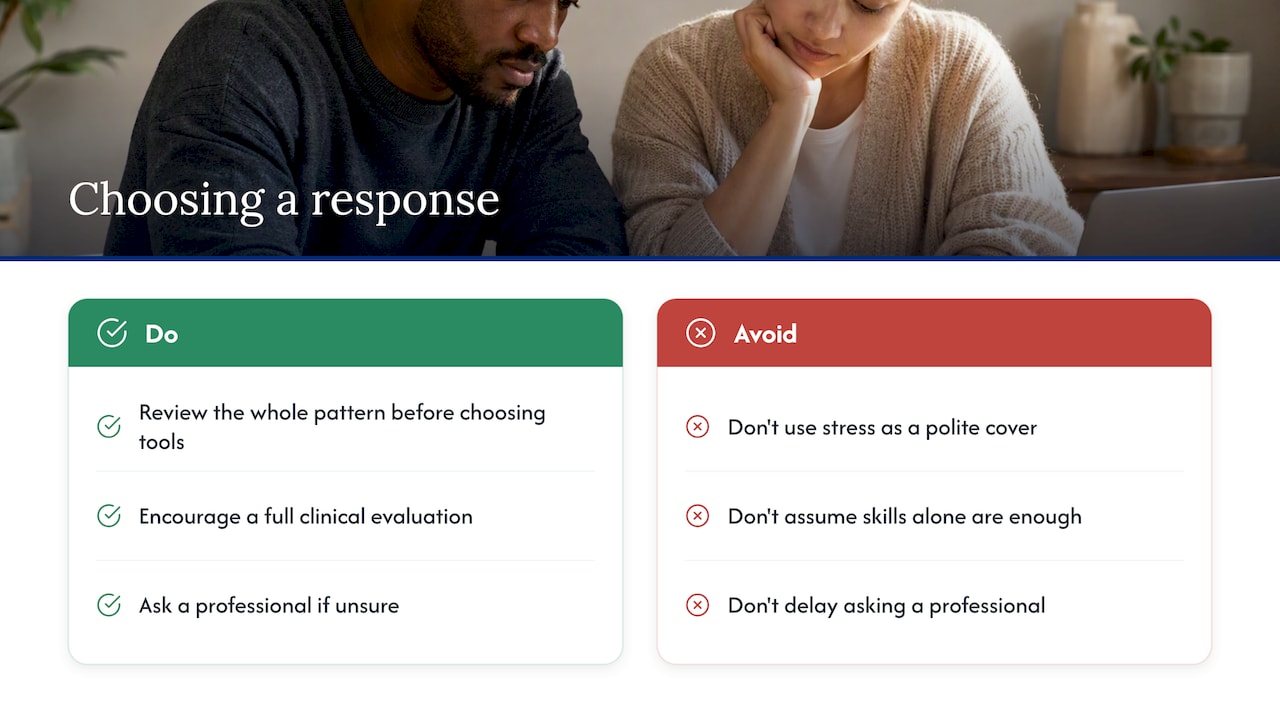
We pay attention to what the person lost, not just what they feel. When someone is losing patience, sleep and interest all at once, we look at the whole pattern before we pick a tool. Anger management skills help when anger is the problem. Couples work helps when the relationship is the pressure. But when low mood has been present for weeks and is not tied to one stressor, skills alone are not the answer, and we say so and encourage a full clinical evaluation.
One caution from experience: do not let the word “stress” become a polite cover for something that deserves a closer look. Stress is common and worth taking seriously, but calling everything stress can delay treatment for depression. If you cannot tell the difference, that is a good reason to ask a professional, not a reason to wait.
— Carlos
Support from Mastering Conflict
If stress is showing up as anger, tension at home or burnout, we can help. We offer anger management classes online, including a 1 hour class at $24.99, a 6 hour class at $79 and an 8 hour class at $85. For relationships under strain, couples sessions are $175 per hour. Individual counseling for men, women, teens and others, along with online options, is listed on our clinical services page. Dr. Carlos Todd, a licensed clinical mental health counselor and psychologist, founded the practice.
FAQ
What is the main difference between stress and depression?
Stress is a response to an outside cause and may be short-term or recurring. Depression is a longer, more serious condition, with symptoms lasting at least two weeks, and it can occur even without an obvious trigger. Stress tends to ease when the pressure does, while depression usually needs professional treatment.
Can stress turn into depression?
Prolonged stress can raise the risk, because adverse life events are among the factors linked to depression. But depression can also develop without any identifiable stressful event. If your low mood lasts two weeks or more, see a professional whatever the cause.
Can you have stress, anxiety and depression at the same time?
Yes. Depression and anxiety often co-occur, and either can exist alongside heavy stress. A clinician can help you work out which symptoms to address first, based on how much each affects your daily life.
Can I just snap out of depression?
No. The National Institute of Mental Health and Mental Health America both describe depression as a condition that cannot be willed away and that calls for professional help. Seeking treatment is a sign of strength, and depression is treatable.
Sources
- I’m So Stressed Out! Fact Sheet, National Institute of Mental Health
- Depressive disorder (depression), World Health Organization
- Depression, National Institute of Mental Health
- Stressed or Depressed? Know the Difference, Mental Health America
- What’s the difference between stress and anxiety?, American Psychological Association
- Mental Health Conditions: Depression and Anxiety, CDC
- Common mental health disorders: identification and pathways to care, NICE
- Guidelines for the Management of Conditions Specifically Related to Stress, WHO
- Take Care of Your Mental Health: Cope with Stress, U.S. Department of Veterans Affairs