
Workplace Conflict Examples: 3 Types, Manager Scripts, Clinician Help

Workplace conflict shows up in three recognizable forms: disagreements over how work gets done (task conflict), friction between personalities (relationship conflict), and clashes over principles or priorities (value conflict). Whatever the type, the first move is almost always the same: a private, documented conversation before anything formal. We built our approach at Mastering Conflict around that same sequence, because it works more often than people expect.
TL;DR:
- For disputes, describe the specific behavior and its impact privately, agree on a concrete adjustment, document it, and follow up within one or two weeks.
- NatCen found that 45% of employees who experienced conflict spoke with a manager and 30% spoke directly with the other person; formal routes were uncommon.
- Report threats, violence, sexual harassment, or discrimination through formal channels immediately; escalate a documented agreement after its second breach instead of repeating the same conversation.
- When conflict keeps returning despite documented agreements, or anger and burnout drive recurring friction, coaching or counseling can address patterns beyond a single dispute.
Table of Contents
- 1. Concrete workplace conflict examples you’ll recognize
- 2. Why conflicts happen: common causes and hidden drivers
- 3. Practical informal resolution steps: a step-by-step playbook
- 4. Manager skills and scripts for resolving team conflicts
- 5. When to escalate: formal processes, harassment, and safety
- 6. Clinical and coaching resources for entrenched workplace conflict
- 7. How people actually resolve conflict: informal versus formal
- 8. Conflict resolution outcomes: what success and failure look like
- 9. How unresolved conflict affects mental health and productivity
- 10. Cultural, generational, and diversity factors in workplace conflict
- Perspective: early intervention matters more than most teams assume
- How Mastering Conflict can help when informal steps aren’t enough
- FAQ
- Sources
1. Concrete workplace conflict examples you’ll recognize
Most disputes at work fall into a short list of recognizable patterns. Naming the type helps you pick the right first move instead of guessing.
- Disagreement over task ownership: Two people believe they own the same deliverable (task conflict). Watch for duplicated work or confused status updates, then ask your manager to clarify ownership in writing within the week.
- Missed deadlines creating tension: A delay from one person pushes everyone else’s timeline (task conflict). Signs include terse messages and visible frustration in meetings; address it by naming the specific delay and asking what support would prevent it next time.
- Work-style clashes: One colleague wants detailed plans, another prefers moving fast and adjusting (relationship conflict). It shows up as repeated friction over process rather than outcomes; a short conversation naming the different styles, not blame, usually defuses it.
- Passive-aggressive emails: Sarcastic “per my last email” messages or cc’ing a manager unnecessarily (relationship conflict). The fix is a direct, private conversation instead of replying in kind over email.
- Credit-stealing or idea theft: Someone presents a colleague’s work as their own in a meeting (relationship conflict, sometimes value conflict if it reflects a pattern). Address it directly and promptly: “In the meeting, I noticed the client idea was presented as yours. Can we talk about how to credit it going forward?”
- Micro-aggressions: Repeated small comments tied to identity, background, or seniority (value conflict). These often go unspoken for months; naming the specific comment and its effect, calmly and privately, is the first step.
- Bullying or harassment: Repeated intimidation, exclusion, or unwanted conduct. This category moves past informal resolution quickly and into formal process, covered later.
- Power struggles between managers: Two leads give conflicting instructions to the same team (task and value conflict). Escalate to whichever manager holds final authority and ask for one aligned message to the team.
- Resistance to change: Pushback on a new process or reorganization (value conflict). Naming the specific worry, not just the resistance, opens a more useful conversation.
- Scheduling conflicts: Competing claims on a meeting room, shared resource, or time-off calendar (task conflict). A quick negotiated trade usually resolves it without anyone needing to “win.”
- Client-triggered incidents: A client’s unreasonable demand creates tension between teammates about who absorbs the cost (task conflict). Clarify shared responsibility before resentment builds.
- Camera and tone disputes in hybrid meetings: Remote and in-office friction over who keeps cameras on, who gets interrupted, and flat-sounding messages that read as cold (relationship conflict). Agree on simple shared norms, cameras on for client calls, a tone check for quick messages, rather than letting assumptions build.
Hybrid and remote settings add a layer most in-person teams do not deal with: tone is easy to misread in text, and camera habits carry social meaning that varies person to person. A short, explicit norm (“let’s default cameras on for stand-ups, off is fine for long working sessions”) prevents weeks of quiet resentment. For more scripted scenarios, our workplace conflict examples and scripts guide walks through additional cases.
2. Why conflicts happen: common causes and hidden drivers
Most visible conflict traces back to a smaller set of root causes. Unclear roles, uneven workload, rushed communication, and compressed deadlines account for a large share of day-to-day friction. These are proximate causes: fix the schedule or clarify the role, and the tension usually drops.
Deeper drivers sit underneath. Status differences change how safe someone feels raising a concern. Mismatched values about fairness, credit, or effort turn a one-off disagreement into a recurring one. Organizational change, a reorg, new leadership, a shift to hybrid work, unsettles norms that used to be unspoken, so people fall back on assumptions that no longer match.
A significant proportion of employees report experiencing conflict at work each year, with many also indicating stress, anxiety, or depression linked to it, according to Acas survey data. That overlap between conflict and mental health strain is a strong argument for treating early signs seriously rather than waiting for them to resolve on their own.
3. Practical informal resolution steps: a step-by-step playbook
Informal resolution works best when it follows a consistent sequence rather than an improvised reaction in the moment.
- Prepare before you talk: Write down the specific behavior and its effect on you or the work, not a general impression.
- Request a private one-on-one: Ask for a short, informal conversation rather than raising it in a group setting or over email.
- Use Third Story framing: Describe the situation as a neutral outside observer would, rather than from either person’s defensive position, which PON’s Third Story technique describes as a way to lower defensiveness and open problem solving.
- Agree on next steps together: Ask the other person what they think a fair adjustment looks like before proposing your own.
- Document and follow up: Send a short written recap of what you agreed, then check in again within one or two weeks.
A neutral opening line matters more than people expect. Try: “I wanted to talk about something that’s been on my mind, not to assign blame, just to figure out a way forward together.” Follow with an impact statement: “When the report came in late, it meant I had to redo the summary overnight.”
Pro Tip: Schedule the conversation for a low-stress time of day, never right after a tense meeting, so both people arrive able to actually listen.
Informal conversations resolve a large share of workplace conflict precisely because they happen early and preserve the relationship, a pattern Acas research on informal resolution ties directly to manager skill and timing. For more tactics you can use the same day, see our practical steps for coping with workplace conflict.
4. Manager skills and scripts for resolving team conflicts
A manager who structures a difficult conversation well prevents most disputes from ever reaching HR. The sequence matters: state the specific issue, provide concrete evidence, explain the impact, invite the other person’s perspective, then agree on a timebound action.
- State the issue plainly: “I’ve noticed the Tuesday reports have been late three weeks running.”
- Give evidence, not impressions: Point to dates, messages, or missed handoffs rather than general complaints.
- Explain the impact: Connect the behavior to a concrete consequence for the team or client.
- Invite their view before proposing a fix: Ask what’s getting in the way before assuming you know.
- Document the agreement: A short written recap protects both people and gives you something to reference at follow-up.
Managers who set clear standards, provide specific evidence of impact, and document agreed ways forward have higher success rates preventing escalation.
Acas, challenging conversations guidance
Bring in HR when a pattern repeats after two documented conversations, when either party requests it, or when the issue touches policy rather than personal style. Our manager’s guide to conflict management covers documentation templates in more depth.
5. When to escalate: formal processes, harassment, and safety
Some situations need formal handling from the start, not a second informal attempt.
- Any threat or act of violence: Report immediately to HR or security; do not attempt informal mediation first.
- Sexual harassment or discrimination: These require formal process under most employment policies, regardless of how minor the first incident seems.
- Repeated conduct after a documented agreement: A second violation of a written agreement is grounds to escalate, not to try the same conversation again.
- Preserve evidence: Save dates, messages, and witnesses before reporting, and keep records confidential.
Violence and harassment at work are treated as structural hazards requiring systematic prevention, with psychological harassment the most commonly reported form, according to the ILO’s guidance on violence and harassment. Legal thresholds and reporting requirements vary by jurisdiction, so confirm specifics with your HR department or a local employment resource before relying on general guidance.
6. Clinical and coaching resources for entrenched workplace conflict
Informal steps and manager scripts resolve most workplace friction. Some situations call for more structured support: conflict that keeps resurfacing despite documented agreements, anger that escalates faster than the situation warrants, or stress patterns that look less like a single dispute and more like chronic burnout.
We offer several routes depending on what’s driving the conflict. Our anger management classes run in formats from one hour to eight hours, online or in person, for people whose frustration is outpacing their usual coping tools. Individual counseling, couples and family counseling, and our coaching program for burnout recovery address the stress and interpersonal patterns that sit underneath repeated workplace friction. For practitioners supporting others through these dynamics, we also provide clinical mentoring and supervision.
7. How people actually resolve conflict: informal versus formal
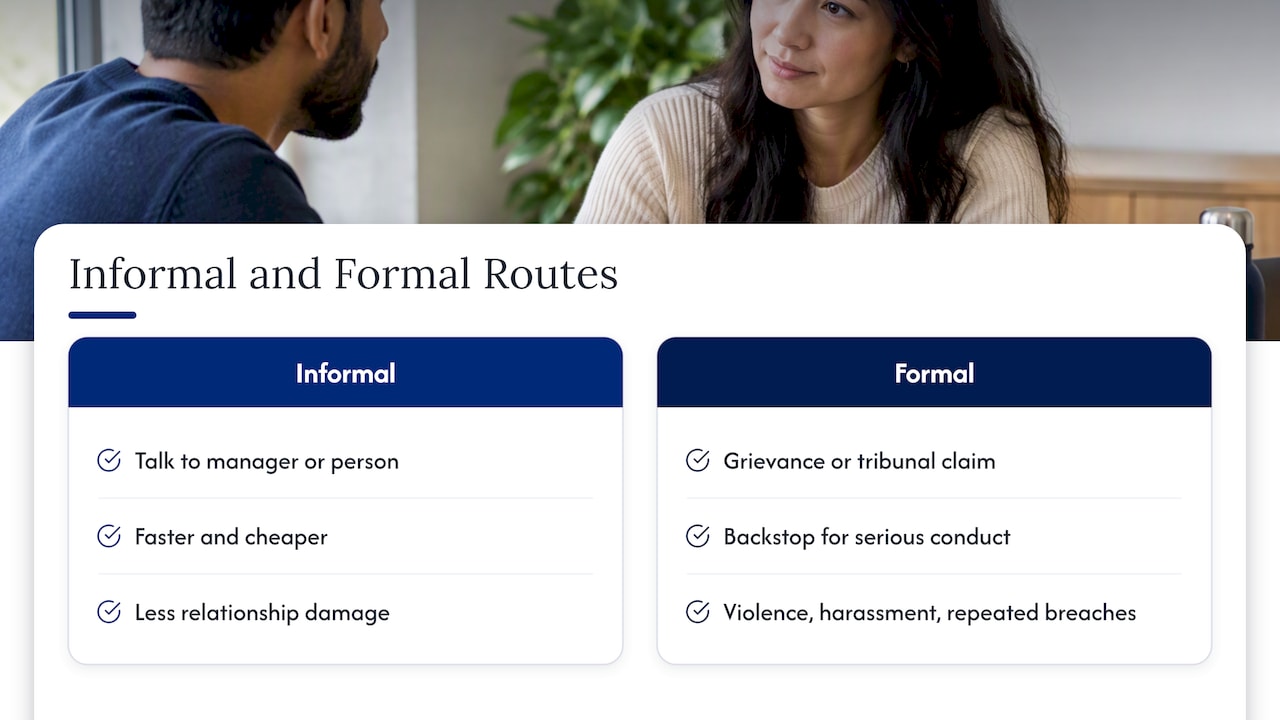
Most workplace conflict never reaches a formal process, and the numbers back that up clearly. Among employees who experienced conflict, nearly half discussed the issue with their line manager and a sizable portion spoke directly with the other person involved, according to NatCen’s research on how UK workers experience and resolve conflict. A smaller fraction used formal grievance procedures, and very few filed employment tribunal claims.
That gap between informal and formal routes is not an accident. Talking to a manager or the other person directly is faster, cheaper, and far less damaging to working relationships than a formal process, which is part of why so few disputes end up there. It also means the skills that matter most day to day are the informal ones: a clear opening line, a specific example, and a willingness to hear the other side.
The low tribunal rate does not mean formal process never matters. It means formal channels work best as a backstop for conduct that informal conversation genuinely cannot fix, violence, harassment, or repeated breaches of agreement, rather than as the default first response to ordinary friction.
8. Conflict resolution outcomes: what success and failure look like
A successful resolution usually looks unremarkable from the outside: two people have a direct conversation, agree on a specific change, and the friction fades within a few weeks. A task-ownership dispute resolved by a manager clarifying who owns which deliverable, documented in writing, rarely resurfaces because the ambiguity that caused it is gone.
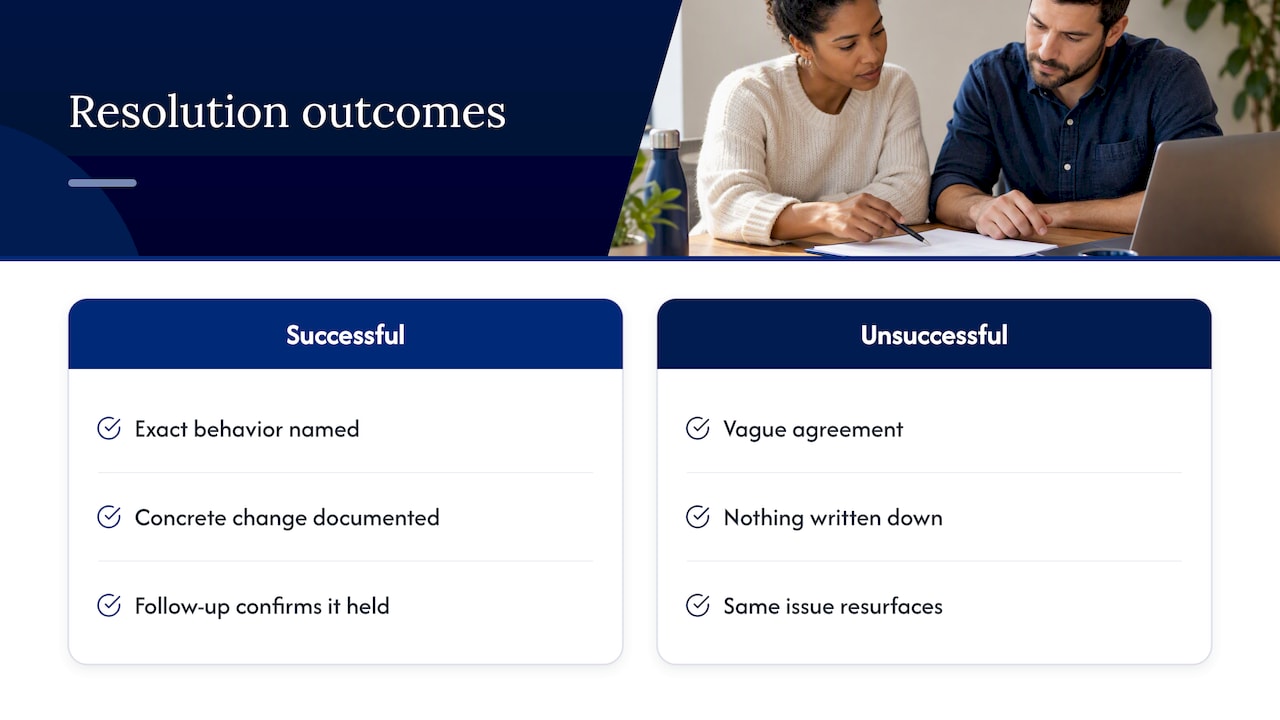
Unsuccessful outcomes share a pattern too. The conversation happens once, nothing gets written down, and both people walk away with a different understanding of what was agreed. Weeks later the same issue resurfaces, often worse, because neither side feels the first conversation actually changed anything. Credit-stealing disputes handled with a vague “let’s be more careful” instead of a specific ask tend to repeat, since nothing concrete changed about how credit gets assigned next time.
The difference between the two outcomes is rarely about communication skill alone. It comes down to specificity: naming the exact behavior, agreeing a concrete next step, and following up to confirm it held. Conversations that stay general (“let’s just communicate better”) resolve less reliably than ones that end with a documented, timebound commitment.
9. How unresolved conflict affects mental health and productivity
Unresolved workplace conflict does not stay contained to the original disagreement. Many employees who reported experiencing conflict also indicated stress, anxiety, or depression connected to it, according to Acas survey findings. That overlap suggests conflict is not just a productivity problem, it is frequently a mental health one as well.
Productivity costs show up in quieter ways than a single missed deadline. People avoid the colleague they’re in conflict with, which slows handoffs and decision-making. Meetings get smaller and less candid when someone is worried about how a comment will be received. Over time, chronic low-grade conflict pushes people toward disengagement or turnover rather than open disagreement, which is often harder to diagnose than an obvious blowup.
Addressing conflict early protects more than the immediate relationship. It protects the person’s capacity to do focused work and, over a longer period, their willingness to stay engaged with the team at all.
10. Cultural, generational, and diversity factors in workplace conflict
Conflict styles are not universal, and assuming everyone handles disagreement the same way is itself a common source of friction. Someone raised in a culture that favors indirect communication may read a blunt, direct style as aggressive, while the direct communicator may read hedging as evasive or unclear. Neither read is wrong, but the mismatch creates recurring misunderstandings that look like personality conflict on the surface.
Generational differences show up in expectations around hierarchy, feedback frequency, and work-life boundaries, which can turn into value conflict when a manager’s default style clashes with a team member’s expectations. Diversity-related micro-aggressions, comments tied to accent, background, age, or gender, often go unaddressed longer than other conflicts because the person affected worries about being dismissed or labeled oversensitive.
Naming these dynamics explicitly, rather than treating every clash as a simple personality mismatch, often reveals what is actually a value conflict in disguise. Our guide to cultural differences and conflict walks through how background shapes conflict style in more depth.
Perspective: early intervention matters more than most teams assume
In my view, the gap between how conflict should be handled and how it actually unfolds is rarely a skills problem. It is a timing problem. Most managers already know how to have a direct conversation; they just wait until the dispute has calcified before trying. Try this week: pick one small, unaddressed friction and schedule a fifteen-minute check-in before it grows into something harder to name.
— Carlos
How Mastering Conflict can help when informal steps aren’t enough
When a workplace conflict keeps resurfacing despite your best documented conversations, or when the underlying issue is anger, stress, or a relationship pattern rather than a single disagreement, structured support closes that gap. We offer various anger management classes, counseling options, and coaching programs aimed at addressing workplace conflict, available online or in person.
If a persistent pattern is driving conflict at work, view our course catalog and find the format that fits, or reach out to schedule a consultation.
FAQ
What are the three main types of workplace conflict?
Workplace conflict generally falls into three categories: task conflict (disagreement over how work gets done), relationship conflict (personality or communication friction), and value conflict (clashing principles or priorities), as described by the Program on Negotiation at Harvard. Task conflict often resolves fastest with structured problem solving, while relationship and value conflicts usually need more patience and rapport building.
How do most people resolve conflict at work?
Most employees resolve conflict informally: 45% talk to their line manager and 30% speak directly with the other person, according to NatCen’s research on workplace conflict. Formal grievance procedures and tribunal claims are used far less often, since direct conversation tends to resolve issues faster and with less damage to the relationship.
What should I say to start a difficult conversation with a coworker?
Open with a neutral statement of intent rather than an accusation, something like naming the behavior you noticed and its effect on you, then invite their perspective before proposing a fix. The Third Story technique suggests framing the issue as a neutral outside observer would, which tends to lower defensiveness on both sides.
When should workplace conflict be escalated to HR?
Escalate immediately for any threat of violence, sexual harassment, or discrimination, since these require formal handling rather than informal conversation. Escalate also when a documented informal agreement has already been broken a second time, which signals that the issue needs a formal process rather than another one-on-one.
Can coaching or counseling help with workplace conflict?
Coaching and counseling can help when workplace conflict is tied to anger, chronic stress, or recurring interpersonal patterns rather than a single disagreement. These services, available both online and in person, are offered to support individuals facing such challenges.
Sources
- How do UK workers experience, respond and resolve conflict in the workplace — NatCen
- Preventing and addressing violence and harassment at work — ILO