
Stop Chronic Accommodation: Clinician Smoothing for Conflict

Smoothing means prioritizing the other person’s concerns over your own to lower tension in a conflict, and it works best as a short-term move, not a habit. Use it when the relationship matters more than the issue and the stakes are low, such as a minor disagreement with a partner or a heated moment with a colleague before a deadline. Reach for something else when the same problem keeps returning, when fairness is at stake, or when your safety is on the line.
TL;DR:
- Smoothing is most effective as a short-term tactic in low-stakes conflicts where maintaining the relationship takes priority over resolving the issue.
- It involves offering validation to lower defensiveness, with concessions that are low-cost to you and valuable to the other person, and should be time-limited with follow-up.
- Repeated use of smoothing without addressing underlying issues signals the need to shift to collaboration or interest-based negotiation, especially if conflicts persist or stakes increase.
- In workplace settings, smoothing functions as an early intervention but should not replace formal action in cases of harassment, discrimination, or ongoing exploitation.
- The tactic is ethically sound when it prevents harm and fosters relationships, but it should be avoided when it obscures important conversations or enables unfairness.
Table of Contents
- What smoothing is and how it maps to the Thomas-Kilmann model
- When to use smoothing: use-cases and red flags
- Step-by-step: how to apply smoothing well
- Benefits and drawbacks of smoothing
- Balancing smoothing with other strategies: when and how to shift
- Applying smoothing at work: manager and employee guidance
- Clinical and training viewpoint from Mastering Conflict
- When smoothing is the smart, ethical move
- How Mastering Conflict can help: relevant classes and counseling
- Sources
- FAQ
What smoothing is and how it maps to the Thomas-Kilmann model
Smoothing, also called accommodating, is one of five conflict-handling modes described in the Thomas-Kilmann Conflict Mode Instrument, a framework that plots behavior on two axes: assertiveness and cooperativeness. Accommodating sits at low assertiveness and high cooperativeness, meaning you set aside your own goals to satisfy the other party’s. The model places four other modes around it, each trading off those same two dimensions differently:
- Collaborating combines high assertiveness with high cooperativeness, seeking a solution that fully satisfies both sides.
- Compromising splits the difference, with moderate assertiveness and moderate cooperativeness.
- Competing is high assertiveness with low cooperativeness, pursuing your own outcome regardless of the other party’s.
- Avoiding is low on both dimensions, sidestepping the conflict altogether.
Psychologically, smoothing works by offering validation: you signal that the other person’s concern is legitimate, which lowers their defensiveness and buys time. The trade-off is that you’re sacrificing your own position, at least temporarily, to get that effect. The distinction that matters most is between smoothing as a deliberate, situational tactic and smoothing as a default personality pattern. One is a tool you pick up when it fits; the other quietly erodes your ability to advocate for yourself, a difference our conflict management skills resource explores in more clinical depth.
When to use smoothing: use-cases and red flags
Smoothing fits situations where the relationship outweighs the immediate issue and the cost of yielding is genuinely low. A few scenarios where it tends to work well:
- A couple disagrees over which restaurant to pick for date night, and one partner lets it go because the choice itself doesn’t matter much.
- A colleague snaps at you the day before a shared deadline, and you let the comment pass rather than escalate in the moment.
- A family member insists on hosting a holiday a certain way, and you accommodate because the tradition matters more to them than to you.
- A teammate pushes back on a minor formatting choice in a shared document, and you defer since the outcome barely affects the final product.
Red flags look different, and they call for a firmer response, not a softer one. Harassment, discrimination, and any pattern where one person consistently gives ground while the other consistently takes it are not situations smoothing should paper over. Repeated exploitation, where the same concession gets asked for again and again, signals that accommodating has stopped working as a tactic and started functioning as a standing policy. For managers, the CIPD’s workplace conflict guidance is direct on this point: informal smoothing has a place in early intervention, but it must never substitute for formal action when harassment, discrimination, or safety concerns are involved.
Step-by-step: how to apply smoothing well
Smoothing done well is deliberate, not reflexive. Here’s a sequence that keeps you in control of the concession instead of just giving in.
- Identify what you can concede and what you must protect. Before the conversation, separate the parts of the issue that don’t matter much to you from the parts that do. Smoothing should only touch the first category.
- Open with active listening. Reflect back what the other person is saying before you respond. A line like “It sounds like the timeline is what’s stressing you out” lowers defensiveness and confirms you’ve actually heard them. Our guide to improving listening skills covers the specific techniques that make this land.
- Validate the concern directly. Skip vague reassurance and name what you’re validating: “I see why this matters to you” works better than “don’t worry about it.”
- Offer a concession that costs you little but matters to them. The goal is asymmetry: the smaller the cost to you and the bigger the value to them, the better the trade.
- Timebox the concession. State explicitly that this is a short-term move, not a permanent shift in how things will go. A revisit clause makes this concrete: “I’ll let this go today, and we’ll revisit next Friday if it’s still unresolved.”
- Record what happened. Note what you conceded, when, and what the follow-up date is. This protects you from the concession quietly becoming the new normal.
- Follow up on schedule. If the issue resurfaces at the agreed date, that’s your signal to shift into a different conflict mode instead of smoothing again.
Pro Tip: Pair every concession with a spoken or written follow-up date. It turns a one-sided yield into a two-sided agreement with an expiration.
This kind of scripted, time-limited approach shows up often in clinical and workplace training because it prevents the single biggest risk of smoothing: letting it slide into a pattern nobody agreed to. Related scripts for couples and family conflict, where smoothing gets used constantly, are laid out in our piece on conflict resolution strategies for couples and families.
Benefits and drawbacks of smoothing
Smoothing earns its place in a conflict toolkit because it does a few things well. It de-escalates fast, which matters when tempers are running hot and a pause is more valuable than a resolution. It preserves the relationship in the moment, signaling that the connection matters more than winning the specific point. And it buys time, giving both people room to regroup before tackling the harder underlying issue.
- Benefit: immediate de-escalation defuses a tense moment before it spirals.
- Benefit: relationship repair happens faster when one side visibly yields on something small.
- Benefit: time to regroup lets both parties approach the real issue with a clearer head later.
- Drawback: unresolved issues tend to resurface, often in a worse form.
- Drawback: the conceding party can start to feel unfairly treated, especially if the pattern repeats.
- Drawback: boundaries erode gradually when smoothing becomes the default response rather than a choice.
Subjective fairness is a documented blind spot in conflict: behavioral research on negotiation shows people tend to judge fairness in ways that favor their own position, which means the person smoothing things over may not even notice they’re accumulating resentment until it surfaces elsewhere. Smoothing supports long-term collaboration when the underlying issue truly is minor and both people understand it as a temporary move. It undermines outcomes when it substitutes for the harder work of resolving something that actually needs resolving.
Balancing smoothing with other strategies: when and how to shift
No single conflict style works in every situation, and PON’s guidance on conflict-management styles is built around exactly this point: strategic flexibility, not loyalty to one mode, is what separates people who manage conflict well from people who don’t. Smoothing is meant to be a bridge to something else, not a destination.
A few signals tell you it’s time to shift:
- The same conflict keeps recurring despite your concessions, which means smoothing bought time but never addressed the actual interest at stake.
- Stakes are rising, turning what was once a low-cost issue into something with real consequences.
- Fairness concerns are building, either in you or in how the other person is treating the arrangement.
- The other party stops reciprocating in any way, leaving the relationship one-sided.
When you see these signals, move toward interest-based negotiation: ask open questions about what the other person actually needs, not just what they’re asking for, and look for a trade that works for both of you. If the issue is too charged for a direct conversation, a neutral third party through mediation can reset the dynamic. The checklist is simple: if smoothing hasn’t reduced the underlying tension within your agreed timeframe, it’s time to try collaborating or compromising instead.
Applying smoothing at work: manager and employee guidance
At work, smoothing is most useful as an early, informal move, not a long-term management strategy. The CIPD’s guidance for people managers treats early, informal intervention as a core skill: a quiet conversation that de-escalates a disagreement before it hardens into a grievance. That guidance pairs directly with PON’s advice to actively listen for underlying interests before assuming a concession is even necessary, since probing interests rather than positions often surfaces a trade that makes smoothing unnecessary in the first place.
A few habits keep smoothing from turning into quiet unfairness in a workplace setting:
- Have the conversation privately rather than in front of the team, which keeps the focus on resolution rather than performance.
- Document what was conceded and by whom, along with a follow-up date, so the arrangement doesn’t quietly become permanent.
- Preserve fairness across the team by checking whether the same person is always the one accommodating.
- Escalate to mediation or a formal grievance process when the issue involves harassment, discrimination, or repeated one-sided concessions.
Concrete scripts for these conversations, including how to open an informal check-in and when to loop in HR, are covered in our guide to resolving workplace conflict. The core principle holds either way: informal smoothing is a first step, and formal processes exist for a reason.
Clinical and training viewpoint from Mastering Conflict
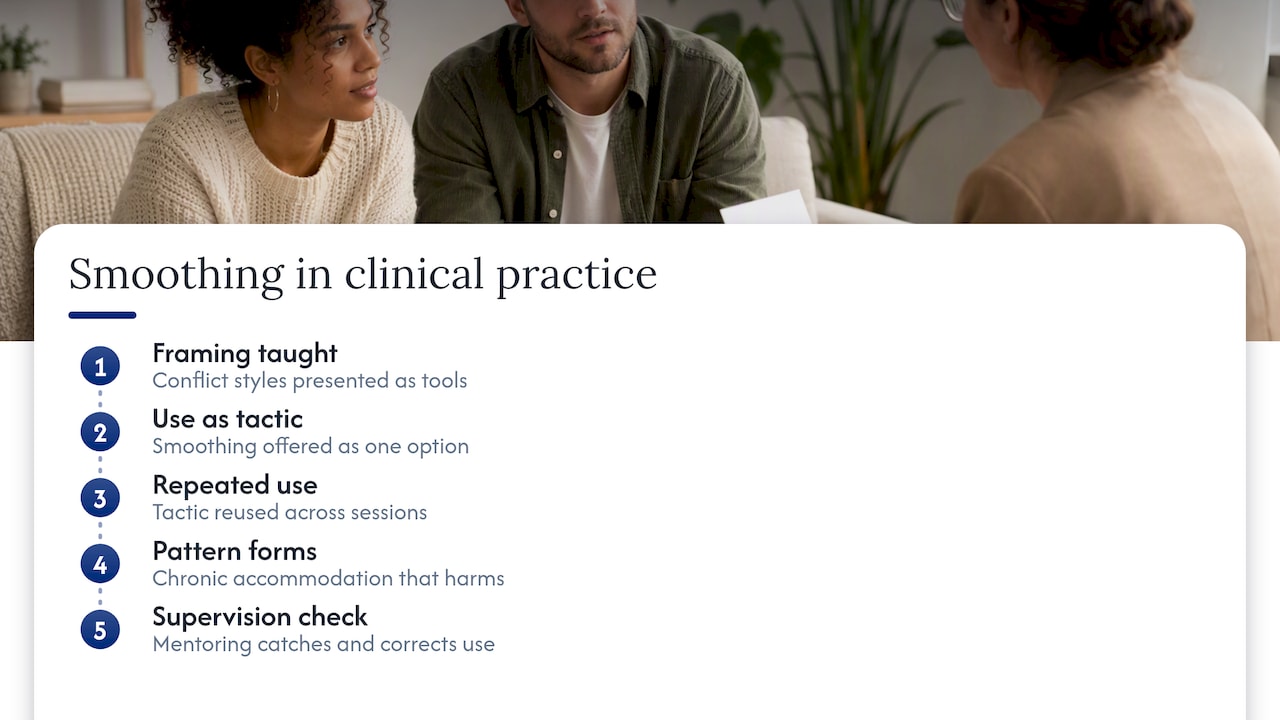
A licensed clinical mental health counselor and psychologist built Mastering Conflict’s approach around treating conflict styles like tools rather than personality traits. That framing shows up across anger management classes, couples therapy sessions, and clinical supervision work, where smoothing gets taught as one option among several rather than a fallback everyone defaults to under stress. In couples therapy, clients often arrive already stuck in a chronic accommodation pattern, one partner smoothing over the same issue repeatedly, and part of the clinical work is helping them recognize when that pattern has stopped protecting the relationship and started harming it. Supervised practice matters here: mentoring and supervision give practitioners a structured space to review how they’re applying tactics like smoothing with clients, catching the moment a temporary tactic quietly becomes a client’s only mode.
When smoothing is the smart, ethical move

Smoothing is a legitimate, sometimes wise, choice when the relationship truly outweighs the issue and both people can move on without resentment building underneath. It stops being smart the moment it starts protecting someone from a conversation they actually need to have, or the moment it becomes the only tool you reach for regardless of the stakes.
The ethical line is safety and fairness: smoothing over a minor preference is fine, smoothing over harm is not. I’d rather see someone build genuine assertiveness alongside their ability to accommodate, because the people who handle conflict best aren’t the ones who always yield or always push. They’re the ones who know which move the moment actually calls for.
— Carlos
How Mastering Conflict can help: relevant classes and counseling
Learning to smooth things over without losing your voice in the process is a skill, and it’s one taught directly rather than left to figure out through trial and error. If assertiveness feels like the missing half of your conflict skills, the 1 Hour Anger Management Class, 6 Hour Anger Management Class, and 8 Hour Anger Management Class build that alongside de-escalation techniques.
For couples caught in a pattern where one partner always smooths things over, the couples counseling packages work through the underlying dynamic rather than just managing the next disagreement.
- Anger management classes teach de-escalation paired with assertive communication.
- Couples packages address recurring accommodation patterns directly.
- Individual counseling through our clinical services fits conflicts tied to deeper mental health concerns.
If a conflict involves your safety or someone else’s, that calls for immediate professional attention, not a self-help tactic. Otherwise, booking an initial session is the fastest way to find out which of these fits your situation.
Sources
- Thomas-Kilmann Conflict Mode Instrument (TKI)
- Conflict resolution strategies – PON
- Mediation factsheet / workplace conflict guidance – CIPD
FAQ
What is smoothing conflict management?
Smoothing is a conflict-handling approach where you prioritize the other person’s concerns over your own to reduce tension, corresponding to the accommodating mode in the Thomas-Kilmann model. It works best as a short-term tactic for low-stakes disagreements where preserving the relationship matters more than winning the specific point.
What are the 5 conflict resolution strategies?
The Thomas-Kilmann model identifies five modes: collaborating, compromising, competing, avoiding, and accommodating, also called smoothing. Each combines different levels of assertiveness and cooperativeness, and effective conflict management means choosing the mode that fits the situation rather than sticking to one by default, according to PON’s guidance on strategic flexibility.
What is smoothing in management?
In a workplace context, smoothing is an informal move managers use for early intervention, calming a tense situation before it escalates into a formal complaint. The CIPD recommends pairing this with documentation and follow-up, and reserving formal mediation or grievance processes for harassment, discrimination, or repeated unresolved issues.
What is an example of smooth it over conflict?
A common example is letting a minor disagreement go, such as accommodating a partner’s restaurant preference or not escalating a colleague’s short temper before a deadline, because the issue itself matters less than keeping the relationship steady. The tactic works best when it’s paired with a plan to revisit the issue if it resurfaces.
When should I stop using smoothing and try something else?
Stop smoothing when the same conflict keeps recurring, when the stakes have risen, or when you notice growing feelings of unfairness on either side. At that point, shifting toward interest-based negotiation or bringing in a neutral mediator tends to address the underlying issue more directly than another round of accommodation.