
The 3 R’s of Trauma-Informed Care: Regulate, Relate, Reason

The 3 R’s of trauma-informed care are Regulate, Relate and Reason. They are a sequence, not a checklist. First you help a child calm a body that is stuck in alarm. Then you connect with them through a safe, attuned relationship. Only then do you ask them to think, reflect, learn or solve a problem. The framework comes from the work of neuroscientist Dr. Bruce Perry, and it is widely used by parents, teachers, foster carers and clinicians.
This guide explains each step in plain terms, why the order matters, what each step looks like on an ordinary Tuesday afternoon, and where the framework stops being enough and a trained clinician should step in.
TL;DR
- The 3 R’s are Regulate, Relate, Reason: calm the stress response, connect, then support thinking and learning.
- The order is the point. A child who is frightened or overwhelmed cannot use reasoning skills, so lectures and consequences delivered first tend to fail.
- Regulation comes through the body (rhythm, movement, sensory comfort, predictable routines), and relating comes through a safe, steady adult.
- Do not confuse these with the “4 R’s” (Realize, Recognize, Respond, Resist), which describe a trauma-informed organization, not a way of responding to one child.
- Persistent, severe or worsening symptoms call for individual professional support, not a framework alone.
Table of Contents
- What the 3 R’s actually say
- Why the order matters
- Step 1: Regulate
- Step 2: Relate
- Step 3: Reason
- How other frameworks map onto the 3 R’s
- Putting the 3 R’s together: an example
- Our perspective
- When the 3 R’s are not enough
- Support from Mastering Conflict
- FAQ
- Sources
What the 3 R’s actually say
The core idea is simple. In the words of one widely shared summary of Perry’s work, a vulnerable child who is to learn, think and reflect needs help in a simple sequence: regulate the fight, flight or freeze response, relate through an attuned and sensitive relationship, then support reflection, learning and remembering.
Here is each step in a sentence:
| Step | What it means | What you are doing |
|---|---|---|
| Regulate | Calm the body’s stress response | Lowering the volume of alarm: safety, rhythm, sensory comfort |
| Relate | Establish connection | Being a steady, attuned presence; showing you understand |
| Reason | Move toward thinking | Telling the story, reflecting, planning, learning |
An Australian Institute of Family Studies article describes the same three steps as a sequence for therapeutic work with children: supporting physical and emotional regulation, establishing connection, and then moving toward reasoning.
Why the order matters
The sequence follows how the brain develops. According to the same Australian source, brain development proceeds from the lower parts of the brain to the middle parts and then to the cortex, and therapeutic interventions should address the parts first affected by trauma. The lower regions handle basic survival and arousal. The cortex handles language, planning and perspective-taking.
When a child is in alarm, the lower brain is running the show. A Scottish education information note describes the logic this way: first calm the psychological stress response, then connect, then support learning, remembering and reflection.
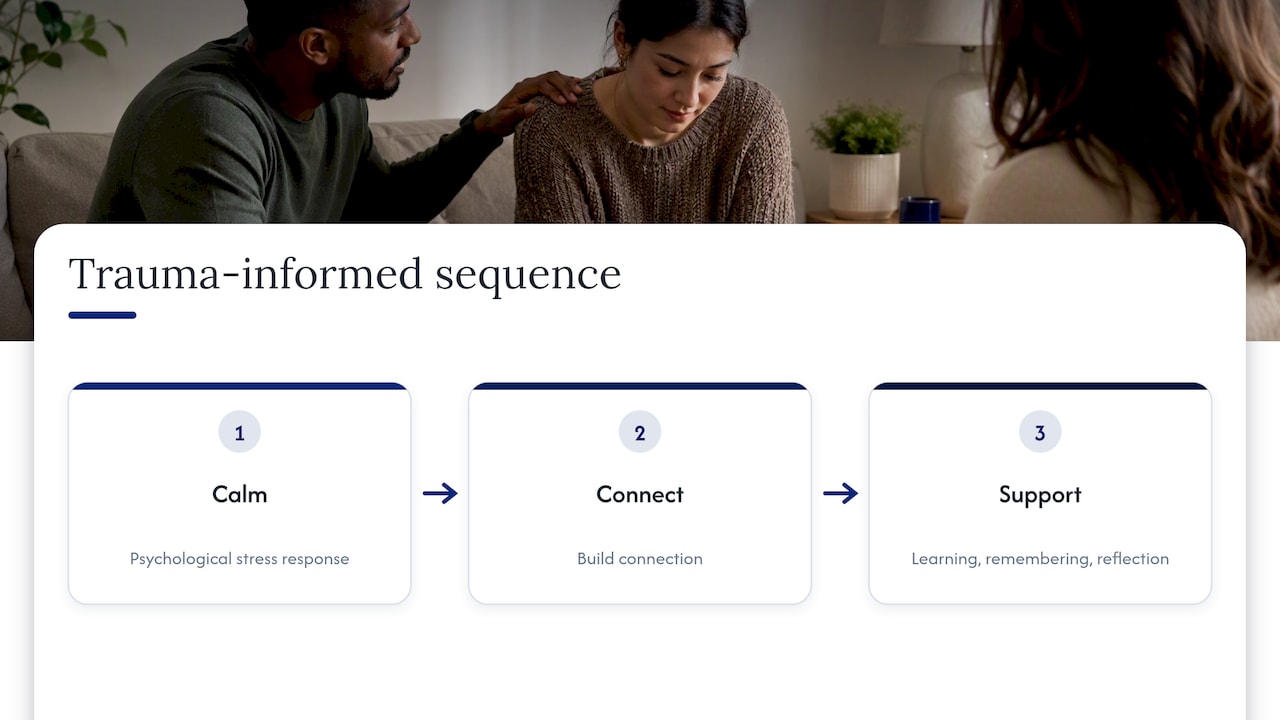
The practical consequence is one every parent and teacher knows from experience. Think:Kids, a program of Massachusetts General Hospital, puts it plainly: children must be regulated or calm enough before they can relate to or appreciate another person’s perspective, and before they can use reasoning skills.
So when you say “Use your words” or “Think about what you did” to a child who is mid-meltdown, you are heading for the part of the brain that is temporarily offline. The same message, delivered twenty minutes later to a calm child who feels safe with you, can land.
A caution about oversimplifying
The model is a map, not the territory. Perry himself describes the Neurosequential Model as an overly simplistic representation of the brain’s complex structures and processes, while still stressing the importance of the Regulate, Relate, Reason sequence, according to Think:Kids. Use it as a practical guide to what to do first, not as a precise anatomy lesson.
Step 1: Regulate
Regulation means helping the body come down from alarm. It is the first step because nothing else works without it.
The Australian Institute of Family Studies article suggests supporting regulation with positive sensory inputs such as weighted blankets, routines, rocking swings and music. The common thread is rhythm and predictability. Research summarized in a university thesis on Perry’s model points the same way, describing repetitive, rhythmic, predictable movement as impactful in retraining the trauma response system.
What this looks like in daily life:
- At home: a predictable bedtime routine, a calm corner with soft lighting, a walk around the block, rocking, slow music, a snack and water.
- In a classroom: a consistent daily schedule, a movement break, a quiet space a child can choose to use, a calm adult voice.
- For you: your own regulation is part of the intervention. A tense, raised voice tells a child’s nervous system that danger is still present.
Two practical points. First, choose the input by watching the child. What soothes one child can overwhelm another, so the Australian article advises careful observation of the child’s needs and consulting an occupational therapist where needed. Second, regulation is not a reward. A child does not have to earn calm. It is the starting condition for everything that follows.
Step 2: Relate
Once the body is calmer, connection is the next job. The Scottish information note describes relating as using an attuned relationship to help a child feel safe and connected, and notes that connection can itself help calm the nervous system. The two steps feed each other.
The Australian article adds that safe, predictable caregivers and shared activities support connection. Notice what is missing from that list: talking about the problem. Relating is often wordless at first. It can be sitting nearby, drawing together, kicking a ball, or simply staying.
What relating sounds like:
- “That was really hard. I’m here.”
- “It looks like you were scared.”
- “I’m not going anywhere. We’ll figure it out when you’re ready.”
What it does not sound like: “Calm down,” “You’re fine,” or “I told you so.” Those statements try to skip ahead to reasoning, or dismiss the feeling the child still has.
Relating when the child is a teen
Teens often resist closeness, so connection tends to be side by side rather than face to face: a car ride, a shared meal, a game. Keep the invitation low-pressure and consistent. The goal is the same: the teen’s nervous system learns that you are a safe person to be near, even when they are at their worst. If anger is what you see most, our guide to children’s anger outbursts walks through how to respond at home.
Step 3: Reason
Reasoning comes last, and it is where the learning happens. Once a child is regulated and connected, their thinking brain can be active, as the Australian article puts it. The Scottish note describes reasoning as telling a story, remembering and reflecting, and exploring ways to manage strong feelings once the child is calm.
In practice, this is the conversation after the storm:
- Name what happened in simple, nonjudgmental words.
- Ask what the child noticed in their body and feelings before things escalated.
- Link feelings to words, building an emotional vocabulary.
- Plan together for next time: what could help, what could you do differently, what can the adults do differently?
Children who have lost someone or lived through upheaval often need extra help finding words for big feelings. Resources on supporting children through grief show how storytelling and remembering can help a child make sense of what they feel once they are ready to reflect.
Reasoning in action: Collaborative Problem Solving
Think:Kids’ Collaborative Problem Solving is one way to put the sequence into practice. It moves through empathy, sharing a perspective or concern, and brainstorming solutions together. Notice that empathy comes first. That is the relating step carried into the problem-solving conversation, so the child is a partner in the solution rather than a target of it.
How other frameworks map onto the 3 R’s
You will see the 3 R’s under other names. They are close cousins, not competitors.
- TBRI (Trust-Based Relational Intervention): a professional handout from a Wisconsin afterschool network maps TBRI’s principles as Empowering to Regulate, Connecting to Relate, and Correcting to Reason.
- Regulate, Relate, Reason and Restore: the Scottish note extends the sequence with a fourth step, restore, aimed at repairing relationships after an incident.
- Reaching the Learning Brain: the title of the Beacon House handout that many parents and teachers meet first. It describes the same three steps, with the learning brain as the destination.
- Rhythm, Repetition, Relationship: a variation on the theme you will find in social media posts about Perry’s work. It puts the emphasis on the ingredients that build regulation and connection: predictable patterns, repeated experiences and safe relationships. It is a way of describing how to regulate and relate, not a different model.
The 3 R’s versus the 4 R’s
This is the most common mix-up. SAMHSA’s four R’s are Realize, Recognize, Respond and Resist (re-traumatization), and they describe what a trauma-informed organization, program or system does. The 3 R’s describe how one adult responds to one child in the moment. A school can adopt the 4 R’s as a policy and teach its staff the 3 R’s as a daily skill. They work at different levels.
Putting the 3 R’s together: an example
Imagine a nine-year-old who throws a book across the room when a worksheet gets hard.
Regulate. The teacher lowers her voice, moves closer without crowding, and offers a few minutes in the quiet corner with headphones. No questions yet.
Relate. Once the child’s breathing slows, the teacher sits nearby and says, “That felt really frustrating. I’m glad you’re okay.” She does not ask why.
Reason. Later, away from classmates, she asks what the worksheet felt like. The child says the numbers looked “like a wall.” Together they agree on a signal for next time and a first step to try.
Notice what changed. The behavior was not ignored, and the book still gets picked up. But the order made the conversation possible.
Our perspective
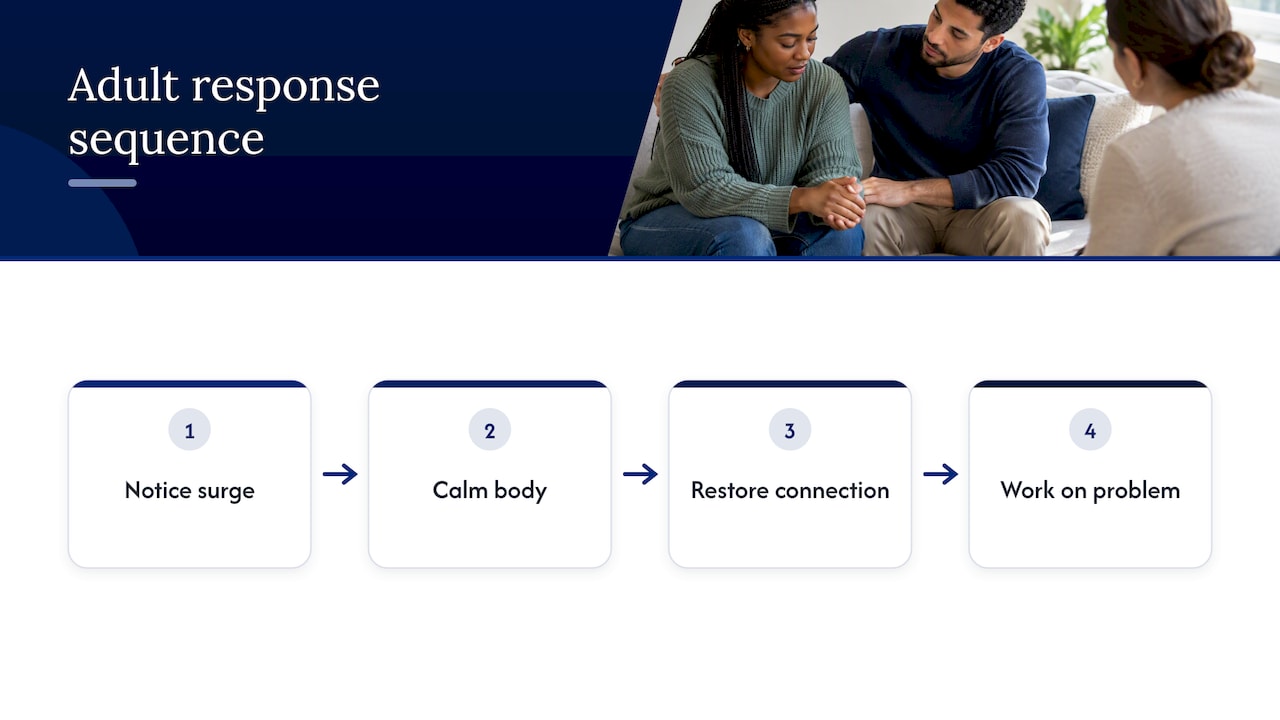
At Mastering Conflict, we spend our days with people whose reactions got ahead of their thinking: angry teens, exhausted parents, couples who can no longer talk without a fight. The 3 R’s matter to us because the same sequence holds for adults. No one reasons well in the middle of a flood of stress. We teach people to notice the surge, calm the body, restore the connection, and only then work on the problem.
Our work is led by Dr. Carlos Todd, a licensed clinical mental health counselor and psychologist, and it rests on evidence-based frameworks paired with tools people can actually use at home. We would add two cautions to the framework. First, regulation looks different for every person, so what works has to be found by observation, not assumption. Second, a framework helps caregivers, but it does not replace individual assessment when trauma symptoms are persistent or severe. If you want a deeper look at how clinicians approach this, see our pieces on trauma-informed counseling and trauma recovery frameworks.
— Carlos
When the 3 R’s are not enough
The 3 R’s are a way to respond well in the moment and to build safety over time. They are not therapy. Consider getting individualized professional help when:
- a child’s reactions are intense, frequent or getting worse despite consistent safe care;
- sleep, eating, school attendance or friendships are suffering;
- the child or teen talks about hurting themselves or others (contact a mental health professional or emergency services right away, and in the US you can call or text 988, the Suicide and Crisis Lifeline);
- you, as the caregiver, find yourself unable to stay calm enough to use the steps.
For specific sensory needs, the Australian guidance points to an occupational therapist. For emotional and behavioral patterns, a licensed counselor or psychologist can assess what is happening and build a plan. Our parent-focused guide to counseling interventions for children explains what to expect from that process.
If conflict at home is part of the picture, our family counseling team can help, and teletherapy makes sessions possible from anywhere.
Support from Mastering Conflict
If anger is the hardest part for you or your teen, our online anger management classes teach the same logic of calming first and thinking second. Options run from a 1 Hour class at $24.99 to a 6 Hour class at $79 and an 8 Hour class at $85, and you can see them all on our anger management classes page. For counseling for women, men, teens, couples and families, visit our clinical services page to book.
FAQ
What are the 3 R’s of trauma?
They are Regulate, Relate and Reason, a sequence for responding to a child affected by trauma. You calm the stress response first, connect second, and support thinking and learning third. The order reflects how the brain develops and how it responds under stress.
Who created the 3 R’s?
The sequence is associated with Dr. Bruce Perry and his Neurosequential Model. Perry has described the model as an overly simplistic picture of the brain while stressing the value of the sequence. Many programs, including Collaborative Problem Solving and TBRI, build on it.
What is the difference between the 3 R’s and the 4 R’s?
The 3 R’s guide how an individual adult responds to a child in the moment. SAMHSA’s 4 R’s, Realize, Recognize, Respond and Resist, describe how an entire organization, program or system becomes trauma-informed. The two work together.
Do the 3 R’s work for adults?
The published sources we reviewed describe the framework for work with children. The underlying idea, that calm and connection come before reflection, also makes sense in adult relationships and conflict, and we use it that way in our own work. For adults with trauma symptoms, a licensed clinician can tailor an approach.
Can I use the 3 R’s without a therapist?
Caregivers and teachers can use the steps in daily life. If symptoms persist, escalate or interfere with daily functioning, individualized support from a licensed professional is the right next step.
Sources
- Calming the body before calming the mind: sensory strategies for children affected by trauma (AIFS)
- Regulate, Relate, Reason and Restore (Education Scotland)
- Regulate, Relate, Reason (Think:Kids)
- Regulate, Relate & Reason: Straight Forward (Wisconsin Afterschool Network)
- Trauma Informed Basics (Pennsylvania Department of Human Services)
- The Three Rs: Reaching the Learning Brain (The Decider)
- Neurosequential Model of Therapy thesis (JMU Scholarly Commons)