
Engaged Couples: Research and Clinician Backed Premarital Counseling

Premarital counseling improves communication, reduces conflict, and increases relationship satisfaction, with effects that meta-analyses and randomized trials both support. Couples who complete a structured program tend to fight less destructively and feel closer to their partner afterward, according to a meta-analytic study on marriage and relationship education. The effects are real but modest, so engaged couples and anyone planning a long-term commitment should treat it as useful preparation rather than a guarantee.
TL;DR:
- Premarital counseling improves communication, conflict resolution, and satisfaction, but the effects remain small to moderate and depend on program quality.
- Focus areas include active listening, conflict rules, financial discussions, parenting, and boundary setting, tailored to each couple’s priorities.
- Structured assessments like PREPARE/ENRICH or FOCCUS facilitate behavior change, but therapist interpretation is crucial for lasting impact.
- The typical program lasts three to eight sessions, with options for online or in-person delivery, and should be booked early in engagement for best results.
- Counseling is more effective for high-risk couples or those facing complexity, while ongoing therapy suits couples with active conflicts or past issues.
Table of Contents
- The main benefits of premarital counseling
- What the research says about premarital counseling
- Topics premarital counseling typically covers
- How premarital counseling actually changes behavior
- Who benefits most and when to book
- What to expect: format, timeline, and how to prepare
- Clinical expertise behind this guide
- Potential challenges and limitations to know before you start
- How to find and choose a qualified counselor
- How premarital counseling differs from other couples therapy or workshops
- A clinician’s take on premarital preparation
- Mastering Conflict’s approach to premarital support
- Sources
- FAQ
The main benefits of premarital counseling
Most couples notice change in a handful of concrete areas rather than a vague sense of “getting closer.” Sessions typically target the specific habits that predict long-term relationship health.
- Communication skills: Couples practice active listening and swap accusatory language for “I” statements, which reduces defensiveness during disagreements.
- Conflict resolution: Therapists teach repair strategies and agreed-upon rules of engagement, such as taking a break before a discussion turns into a shouting match.
- Relationship satisfaction: Couples report feeling more emotionally close and understood once they have language for needs they previously struggled to name.
- Alignment on major life decisions: Finances, parenting philosophy, religion, and extended family boundaries get discussed before they become surprises.
- Preventive help-seeking: Couples who go through premarital work are more likely to return for support later when new stress appears, rather than letting problems fester.
Each benefit builds on the others. Better communication makes conflict resolution possible, and resolving conflict well is what actually produces the satisfaction couples are looking for.
What the research says about premarital counseling
The evidence base is stronger than many people assume, though it comes with real limits. Meta-analyses pooling dozens of studies find effect sizes in the small-to-moderate range, not the dramatic transformation sometimes implied by marketing copy.
Meta-analyses have found small-to-moderate effects on relationship quality and communication skills from marriage and relationship education programs, with higher-dose programs producing larger gains, according to a meta-analytic study on marriage and relationship education efficacy. In practical terms, that means a noticeable but not universal shift: most couples improve, some improve substantially, and a portion see little change.
- A randomized clinical trial in the Army found significant gains in communication skills and relationship confidence at one site, though results varied by location, suggesting delivery quality matters as much as the curriculum itself.
- A systematic review of couple relationship education from 2010 to 2019 found positive effects extending beyond relationship quality into coparenting and child well-being, with online delivery proving effective for many couples.
- A meta-analysis of online relationship education programs found improvements in satisfaction, communication, and relationship confidence, along with reduced anxiety and depressive symptoms in some studies.
The research does have gaps. Follow-up periods vary widely across studies, and sample diversity is limited in some trials, so results do not automatically generalize to every population or relationship structure.
Topics premarital counseling typically covers
Sessions are organized around the questions that most often surface after the wedding rather than before it. A good program walks through each area deliberately instead of assuming couples will figure it out on their own.
- Finances: Spending habits, debt, saving goals, and who manages the budget.
- Children: Whether to have them, timing, and parenting philosophy.
- Communication and conflict rules: How to disagree without escalating, and what “fighting fair” looks like for this couple specifically.
- Sex and intimacy: Frequency expectations, emotional needs, and how desire changes over time.
- Extended family and boundaries: In-law dynamics, holiday planning, and how much autonomy the couple maintains.
- Values and life goals: Religion, career ambitions, and where the couple wants to be in ten years.
Couples rarely need equal time on every topic. A complete guide to premarital counseling topics can help identify which areas deserve the most attention before the first session.
How premarital counseling actually changes behavior
The mechanism matters as much as the topic list. Counselors often start with a structured inventory, such as PREPARE/ENRICH or FOCCUS, to surface patterns a couple might not name on their own. The assessment itself is only a prompt: a study on combining assessments with clinician feedback found that clinician-led interpretation, not the questionnaire alone, is what drives lasting behavior change.
From there, sessions focus on teachable skills: active listening, collaborative problem solving, and specific repair moves for when a conversation goes sideways. This strength-based approach tends to produce faster gains than therapy aimed at deeply entrenched patterns, according to APA coverage of premarital counseling, because couples are practicing tools rather than unwinding years of resentment. It also normalizes returning for help later, building a maintenance habit rather than a one-time fix.
Pro Tip: Ask your counselor for one specific phrase to use mid-argument, something like “I need a pause,” so you leave with a tool you can use that same week.
Who benefits most and when to book
Premarital counseling offers preventive value for any engaged couple, but it matters most for people facing added complexity. Booking earlier in the engagement, rather than the month before the wedding, gives skills time to become habits.
- Higher-risk situations benefit more: Couples navigating financial stress, blended families, or significant cultural or identity differences tend to see the largest gains.
- Short programs suit low-conflict couples: A handful of sessions or a weekend workshop often covers what is needed.
- Ongoing therapy suits couples already in conflict: Recurring disagreements or past infidelity call for a longer therapeutic relationship rather than a brief educational format.
- Booster sessions help after major changes: A move, a new baby, or a job loss are good reasons to check back in even after the wedding.
What to expect: format, timeline, and how to prepare
Most premarital counseling runs a set number of sessions rather than continuing indefinitely, which makes it easier to budget both time and money.
- Expect three to eight sessions for a standard program, with intensives or weekend workshops available for couples who prefer a condensed timeline.
- Choose online or in-person based on logistics: online formats have shown measurable benefits in research on digital relationship education, while in-person sessions suit couples who want a slower, more personal pace.
- Prepare by listing your top three concerns before the first session so the counselor can prioritize what matters most to you.
- Ask about assessments in advance: many programs use a relationship inventory in the first or second session.
- Check for lower-cost options: community organizations and some religious institutions offer reduced-fee premarital programs alongside private practice rates.
Clinical expertise behind this guide
Mastering Conflict was founded by Dr. Carlos Todd, a licensed clinical mental health counselor and psychologist who works with couples on communication, conflict resolution, and relationship repair. The practice’s approach blends clinical training with practical tools couples can use the same week they learn them.
Readers preparing for marriage can explore top premarital counseling benefits for couples and practical communication exercises for couples for more detail on specific skills covered in session.
Potential challenges and limitations to know before you start
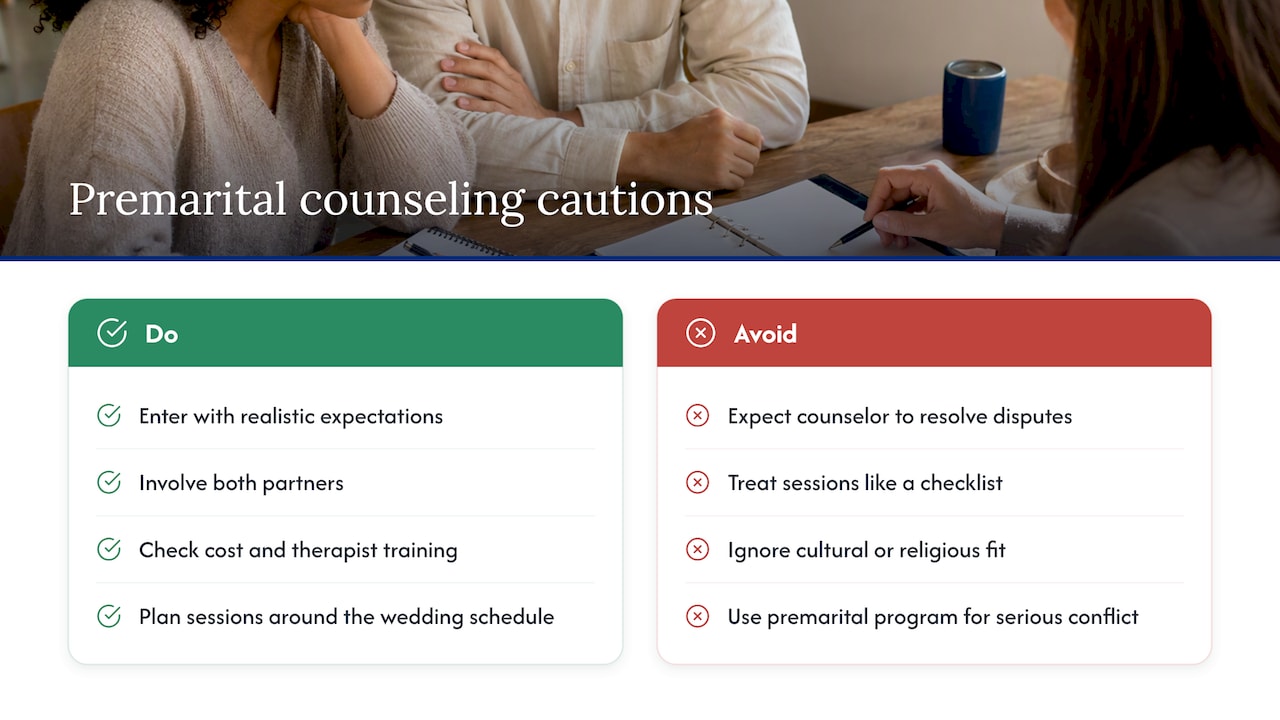
Premarital counseling is not a guarantee, and it is worth entering with realistic expectations. The effect sizes described earlier are small to moderate, which means some couples will see limited change, particularly if only one partner is engaged in the process.
Cost and access are real barriers. Private-practice sessions can add up over several weeks, and not every community has a therapist trained in relationship education specifically, as opposed to general couples therapy. Scheduling can also be difficult during the busiest stretch of wedding planning, which is exactly when couples are most likely to skip sessions or treat them as a checklist item.
Some couples arrive expecting the counselor to resolve a disagreement for them rather than teach them to resolve it themselves, which sets up disappointment when the counselor instead facilitates rather than referees. Cultural or religious mismatches between counselor and couple can also limit how useful sessions feel, particularly around topics like family roles or religious practice.
Finally, premarital counseling works best as prevention. Couples already in serious, ongoing conflict, or dealing with infidelity or safety concerns, typically need a different level of care than a short educational program can provide, and a counselor should redirect them accordingly rather than force-fitting a standard curriculum.
How to find and choose a qualified counselor
Credentials matter more than marketing when choosing a premarital counselor. Look for a licensed clinical mental health counselor, licensed marriage and family therapist, or psychologist with specific training in couples work, not just general individual therapy experience.
Ask direct questions before booking: what assessment tools they use, how many sessions they typically recommend, and whether they have experience with your specific situation, whether that is a blended family, a major cultural difference, or a long-distance engagement. A counselor who cannot answer clearly is worth reconsidering.
Format matters too. Some counselors specialize in structured, time-limited programs using tools like PREPARE/ENRICH, while others offer more open-ended sessions. Religious officiants sometimes provide premarital counseling as part of the wedding process, which can be valuable for couples wanting a faith-based approach, though it is worth confirming the officiant has actual clinical training if deeper issues arise.
Referrals from a primary care provider, a trusted friend’s recommendation, or a professional directory are reasonable starting points. Common questions couples ask before booking can help you know what to ask during an initial consultation call.
How premarital counseling differs from other couples therapy or workshops
Premarital counseling is preventive by design. It targets couples who are not yet in crisis, focusing on building skills before problems take root rather than repairing damage that has already occurred. General couples therapy, by contrast, often begins after a specific rupture, such as an affair, a trust breakdown, or years of accumulated resentment, and tends to run longer with less predictable structure.
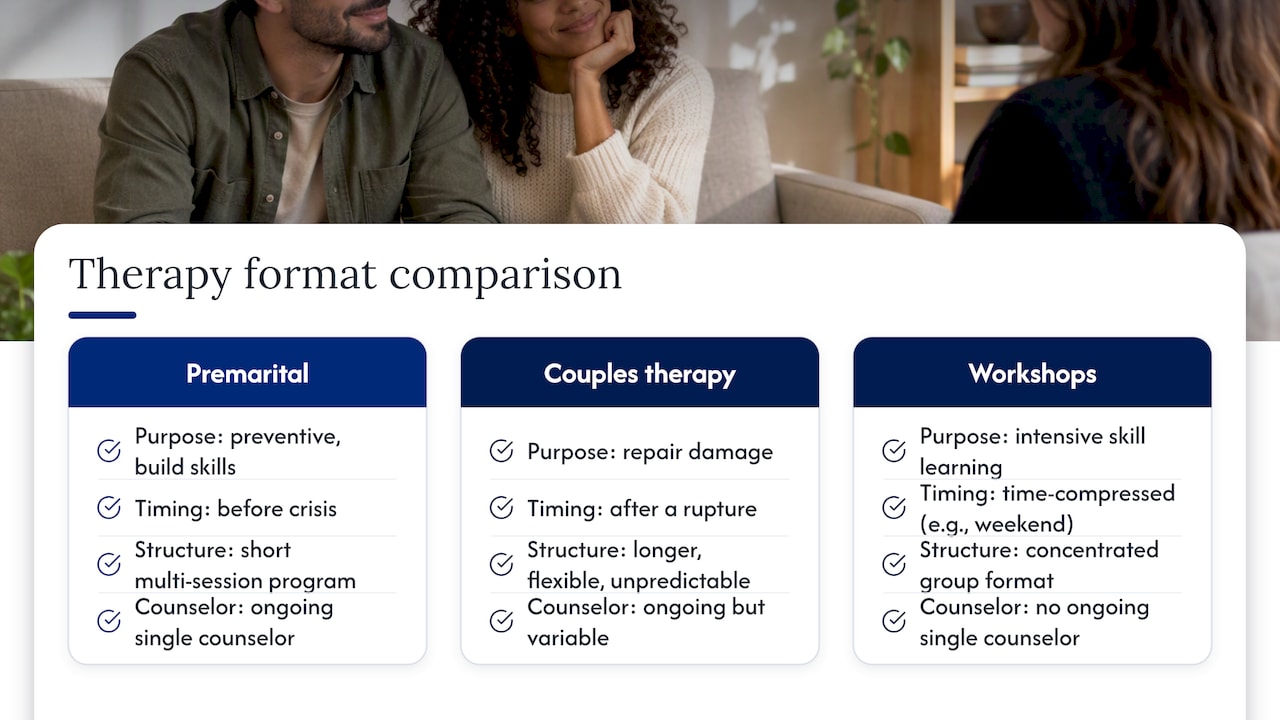
Workshops and retreats offer a third format: intensive, time-compressed learning, often over a weekend, covering similar ground to a multi-session program but without the ongoing relationship with a single counselor. They suit couples who want a concentrated experience and are comfortable learning in a group or seminar setting rather than one-on-one.
The choice between formats depends on where a couple stands. Engaged couples with no major unresolved conflict are well served by a short premarital program. Couples with active conflict or a past betrayal usually need the longer, more flexible structure of ongoing couples therapy. A guide to marriage counseling before marriage breaks down how the preventive and repair-focused models diverge in practice.
A clinician’s take on premarital preparation
The couples who do best are not the ones with the fewest disagreements. They are the ones who learned to have hard conversations early, while goodwill was still high, according to practitioner commentary on premarital counseling’s timing. Try a ten-minute weekly check-in now, before your first session: what went well this week, what felt hard. Treat counseling as maintenance, not a repair job.
— Carlos
Mastering Conflict’s approach to premarital support
Waiting until problems calcify costs couples more time and money than addressing them early. Several counseling formats are designed to support couples in this stage of their relationship.
- Couples sessions for couples who want ongoing, flexible support at their own pace.
- 6 Hour Couples Intensive for engaged couples who prefer a concentrated, single block of work.
- Relationship Renewal Starter Program for couples wanting a structured multi-session path before the wedding.
If you are unsure which format fits, ask about session length, format options, and whether a shorter class or a fuller program makes more sense for your situation. You can review options and book a couples package to get started.
Sources
- Meta-analytic study on marriage and relationship education efficacy
- Marriage education in the Army: randomized clinical trial results
- Helping couples achieve relationship success: progress in CRE research and practice (2010–2019)
- Meta-analysis of online relationship education programs
- APA article on premarital counseling
This article is general information, not a substitute for advice from a qualified doctor. Consult a qualified healthcare professional about your own circumstances before acting on anything here.
FAQ
Does premarital counseling actually improve marriages?
Research shows small-to-moderate improvements in communication and relationship quality for couples who complete premarital programs, according to a meta-analytic study on relationship education. It works best as prevention rather than a fix for couples already in serious conflict.
How many sessions does premarital counseling usually take?
Most programs run between three and eight sessions, though intensives and weekend workshops offer a condensed alternative. The right number depends on how many topics a couple needs to work through and whether they choose an ongoing or intensive format.
What assessments do counselors use in premarital counseling?
Many counselors use validated relationship inventories such as PREPARE/ENRICH or FOCCUS to surface patterns for discussion. A study on assessments paired with clinician feedback found that the counselor’s interpretation of results, not the questionnaire alone, drives real change.
Is online premarital counseling as effective as in-person sessions?
A meta-analysis of online relationship education programs found significant improvements in satisfaction, communication, and relationship confidence, comparable in direction to in-person outcomes. The right choice often comes down to logistics and personal preference rather than effectiveness alone.
How is premarital counseling different from marriage counseling?
Premarital counseling is preventive, aimed at couples before serious problems develop, while marriage counseling more often addresses an existing rupture like an affair or long-standing resentment. Mastering Conflict offers formats for both stages, including couples sessions and intensives for couples at different points in their relationship.