
Safety First Conflict Management in Schools for Parents & Clinicians

When people search for a conflict management in schools PDF, they are usually looking for clinical anger-management resources and clinician training materials, not a classroom curriculum. The most useful next step is to download a clinician-authored PDF or book an anger-management class or consultation directly. We provide both paths built on evidence-based frameworks rather than generic advice.
TL;DR:
- Clinical conflict management is essential when school-related stress reveals deep patterns like repeated aggression or unresolved trauma, not for classroom behavior issues alone.
- Evidence-based therapies like CBT, CBCT, and EFCT effectively reduce anger and relationship conflicts, especially when combined with relaxation and social-skills training.
- Safety screening using the WHO’s LIVES framework is crucial before joint therapy to identify violence, substance misuse, or coercive control that could escalate risk.
- The negotiated time-out is a core de-escalation technique, requiring practice during calm moments, with success depending on rehearsal and understanding physiological cues.
- Practical clinical resources include short classes, structured therapy formats, safety plans, and mentoring, helping practitioners and caregivers manage conflicts effectively.
Table of Contents
- When does clinical conflict management apply to school-related situations?
- What evidence-based therapies treat anger and relationship conflict?
- How should clinicians screen for safety before couples or family work?
- What de-escalation techniques do clinicians actually teach?
- How do you access clinical resources, classes, and clinician training?
- How we think about clinical priorities and resource design
- Get a clinical PDF, a class, or clinician training from us
- FAQ
- Sources
When does clinical conflict management apply to school-related situations?
A classroom behavior chart will not help a father who loses his temper every time his son’s teacher calls home, or a couple whose arguments over a child’s suspension are spilling into shouting matches at the dinner table. Clinical conflict management steps in when school-linked stress exposes deeper patterns: repeated aggression at home, unresolved trauma surfacing as outbursts, or caregivers who simply never learned how to argue without escalating.
This kind of support serves three overlapping groups:
- Parents and caregivers whose reactions to school incidents are harming their relationship with a child or partner.
- Couples and families where disagreements about discipline, school transitions, or a child’s diagnosis have become chronic conflict.
- Mental health clinicians who need structured tools, screening checklists, and referral protocols to handle these cases safely.
A clinician-authored PDF earns its place here because it compresses years of training into a usable reference: a screening checklist to flag risk, emergency steps for acute escalation, and clear guidance on when to refer out rather than attempt therapy alone.
What evidence-based therapies treat anger and relationship conflict?
Two modalities dominate the clinical literature for conflict and anger work. Cognitive-behavioral therapy (CBT) and its couple-focused variant, cognitive-behavioral couple therapy (CBCT), target the thought patterns and behavioral triggers that drive escalation, often pairing cognitive restructuring with relaxation training and social-skills practice. Emotionally focused couple therapy (EFCT) takes a different route, working with the attachment fears underneath anger rather than the anger itself, and tends to suit couples whose conflict is rooted in disconnection rather than impulse control.
Systematic reviews of cognitive-behavioral couple therapies report consistent empirical support for reducing relationship distress and improving both individual and relational outcomes. Separately, a systematic review of CBT for anger found that most randomized controlled trials report statistically significant outcomes, though variation in study design affects how confidently those results generalize.
One finding stands out for treatment planning: meta-analyses of anger and aggression treatments show medium to large effects for approaches that combine cognitive techniques with relaxation and social-skills training, compared to narrower interventions.
- Individual CBT often comes first when one person’s reactivity is the primary driver.
- Couple or family formats add value once both partners contribute to the escalation pattern.
- Relaxation and social-skills components boost outcomes beyond cognitive work alone.
How should clinicians screen for safety before couples or family work?
Not every conflict case is safe for joint sessions. Before any conjoint therapy begins, a clinician needs a screening process that catches active violence, substance misuse, or coercive control, because conjoint work can escalate risk in those situations rather than resolve it.
The World Health Organization’s clinical guidance recommends a first-line response summarized as LIVES:
- Listen closely and without judgment to the person’s account.
- Inquire about needs, concerns, and immediate safety.
- Validate their experience and reduce self-blame.
- Enhance safety by discussing risk and protective options.
- Support through referral to appropriate services.
Red flags that rule out conjoint sessions include disclosed physical violence, active substance abuse affecting judgment, or any indication that one partner fears the other. When these appear, documentation matters as much as the clinical decision itself: a written safety plan, a clear referral pathway, and strict confidentiality protect the person at risk and the clinician’s own practice.
What de-escalation techniques do clinicians actually teach?
Most clinical PDFs on this topic lean on a small set of techniques that are simple enough to rehearse and specific enough to work under stress. The negotiated time-out is the anchor: partners or family members agree in advance on a signal, a fixed duration, and a re-entry step, so a pause never turns into stonewalling. Clinical protocols describe this tool as a low-tech way to prevent escalation to harm while longer-term therapy gets organized.
Alongside the time-out, clinicians teach:
- Recognizing physiological cues (racing heart, clenched jaw, heat in the face) as the signal to initiate a pause.
- Short grounding scripts, often four to six slow breaths paired with a simple counting cue.
- Adapted versions for family settings, where a child or teen also learns the signal.
Pro Tip: Practice the time-out signal during a calm moment at least once a week; a skill rehearsed only during conflict rarely holds up under real stress.
How do you access clinical resources, classes, and clinician training?
Short classes and multi-session therapy serve different goals. A one-hour or six-hour anger-management class builds awareness and basic tools quickly, while multi-session couples or family therapy addresses entrenched patterns that a single class cannot touch.
A quality clinician-training PDF should include:
- A screening tool for violence, substance use, and safety risk.
- A written safety plan template clinicians can adapt per case.
- A session outline showing how psychoeducation, skills practice, and conjoint work sequence together.
Clinicians looking to sharpen this work can pursue structured clinical mentoring rather than learning it solely through trial and error, and parents can start with a single class before deciding whether couples or family therapy is the better fit.
How we think about clinical priorities and resource design
Anger rarely shows up alone. It usually sits on top of fear, grief, or exhaustion, and a resource that only teaches someone to count to ten misses the actual work. Effective treatment pairs emotion activation, naming what the anger is covering, with concrete skills like the negotiated time-out, because skills without insight fade fast under real pressure.
Every PDF and class we build keeps safety screening first, stays culturally responsive to the families we serve, and favors steps a person can actually use in the moment rather than abstract theory. Clinicians interested in supervision or mentoring are welcome to reach out and build on this approach in their own practice.
— Carlos
Get a clinical PDF, a class, or clinician training from us
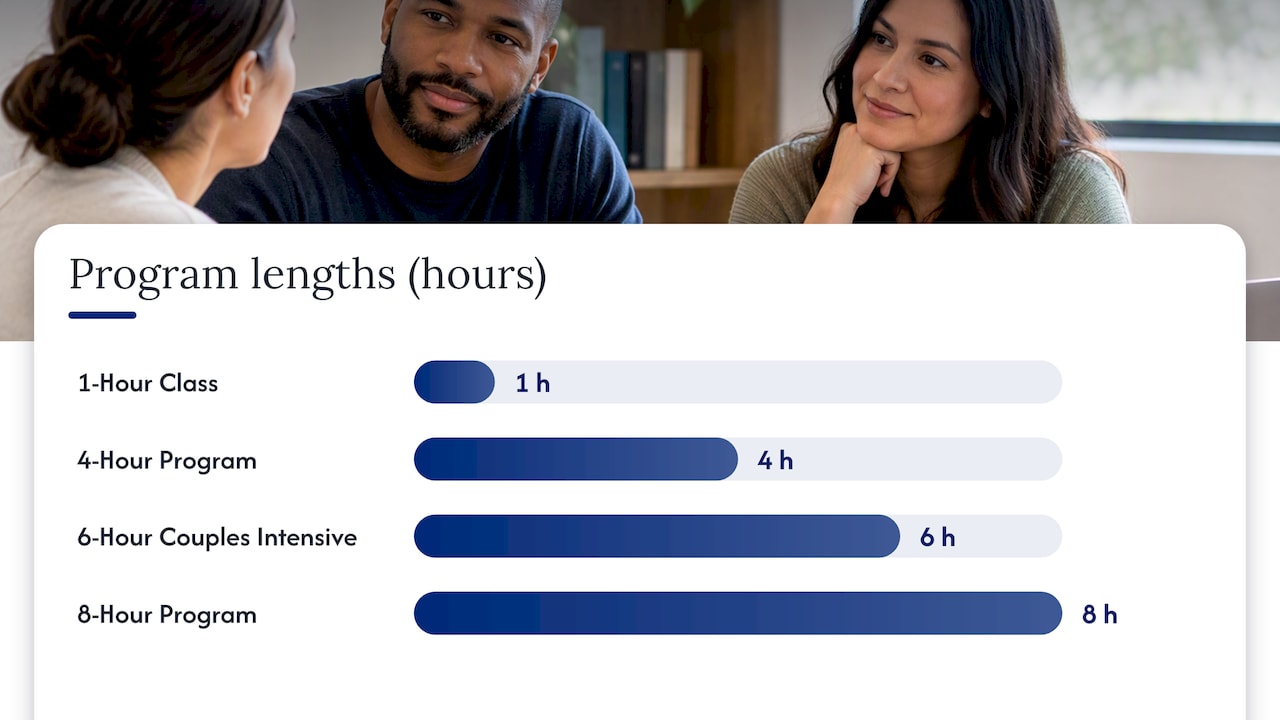
If what you need right now is a usable resource rather than another search result, resources are available to shortcut the process. We offer anger-management classes from a 1 Hour Anger Management Class up through 4-Hour and 8-Hour Programs, couples packages including the 6 Hour Couples Intensive, and clinical supervision for practitioners who want structured oversight rather than guesswork.
- Enroll in a short class if you need practical tools within days, not months.
- Book a couples or family session when the conflict pattern involves more than one person.
- Apply for clinical mentoring if you are a practitioner building this skill set in your own caseload.
Visit our clinical services page to see current formats and book a session directly.
This article is general information, not a substitute for advice from a qualified doctor. Consult a qualified healthcare professional about your own circumstances before acting on anything here.
FAQ
What does “conflict management in schools” mean in a clinical context?
In clinical practice, it refers to anger-management classes, couples or family therapy, and clinician training aimed at adults whose conflict patterns are connected to school-related stress, not a classroom behavior program. The resources involved are screening tools, safety plans, and therapy formats rather than teacher lesson plans.
Is couples therapy safe when there has been violence at home?
Not always: clinical guidance recommends screening for active violence, substance misuse, and coercive control before offering joint sessions, since conjoint therapy can increase risk in those cases. The WHO’s LIVES framework calls for prioritizing safety and individual support first.
What is a negotiated time-out and does it actually work?
A negotiated time-out is a pre-agreed pause with a signal, a set duration, and a re-entry step, designed to stop escalation before it turns into harm. Clinical protocols describe it as a practical, low-tech tool that is often rehearsed individually before couples practice it together.
Which therapy works best for anger linked to family or school stress?
Cognitive-behavioral therapy, including its couple-focused form CBCT, has the broadest evidence base, with meta-analyses showing medium to large effects when combined with relaxation and social-skills training. The right fit also depends on whether one person or the whole relationship is driving the conflict pattern.
How much does an anger-management class cost?
Our 1 Hour Anger Management Class is $24.99, the 6 Hour class is $79, and the 8 Hour class is $85, all one-time fees through our course catalog. Longer group programs, the 4-Hour and 8-Hour Programs, are priced at $149 and $249 respectively.
Sources
- Responding to intimate partner violence and sexual violence against women: WHO clinical and policy guidelines
- Cognitive-Behavioral Couple Therapies: Review of the Evidence for the Treatment of Relationship Distress, Psychopathology, and Chronic Health Conditions
- 21st Century Cognitive Behavioural Therapy for Anger: A Systematic Review of Research Design, Methodology and Outcome
- Anger and aggression treatments: a review of meta-analyses