6 Step WCM For Clinicians: Conflict Management In Schools

Evidence-based conflict management for school-related conflicts relies on CBT-based skill training, brief micro-interventions, and structured mediation such as WCM (want/can/must) that reduce coercive conflict and anger-related distress. This guide is built for clinicians, supervisors, and coaches applying therapeutic protocols to school-aged clients, not for teachers building classroom slide decks.
TL;DR:
- Combined cognitive-behavioral therapy programs outperform single techniques for sustained anger control and conflict resolution in youth.
- Micro-interventions like implementation intentions and attributional reframing offer quick, low-cost tools for lower-severity cases and resource-limited settings.
- Teaching relaxation, cognitive restructuring, problem-solving, and assertive communication addresses different points of conflict handling failure effectively.
- The WCM (want/can/must) protocol provides a structured, feasible framework for mediating conflicts within school time constraints.
- Successful implementation requires targeted clinician training, regular supervision, and adaptation to school and family contexts.
Table of Contents
- What the Research Says About Anger Management and Micro-Interventions
- Core Therapeutic Techniques Every Clinician Should Teach
- Clinical Protocols You Can Actually Replicate
- Adapting These Methods for Students, Families, and Schools
- Training and Supervision for Clinicians Delivering These Programs
- Why Clinical Rigor Beats Generic Conflict Advice
- Getting Started With Mastering Conflict’s Clinical Services
- Sources
What the Research Says About Anger Management and Micro-Interventions
The clinical literature on youth anger is more settled than most practitioners assume. Combined CBT interventions, meaning programs that stack relaxation training, cognitive restructuring, problem-solving, and communication skills rather than relying on one technique alone, consistently outperform single-component approaches.
A school-based trial involving 120 adolescents found significant pre/post gains in anger control, problem-solving skill, communication skill, and general adjustment after a structured group program. That is a large sample for school mental health research, and the multi-domain improvement matters more than any single outcome. Anger rarely travels alone. It shows up tangled with weak communication and poor problem-solving, so a protocol that only teaches breathing exercises tends to underperform one that also builds skill in negotiation and self-talk.
A separate strand of research looks at something smaller: brief, lab-based micro-interventions like implementation intentions (“if X happens, I will do Y”), attributional reframing, and evaluative conditioning. Trials testing these tools in couples and parent-child dyads found they reduced at least one measured index of coercive conflict, and they are cheap enough to deliver by computer or through a trained paraprofessional. For clinicians working in under-resourced schools, that scalability is often more valuable than another 12-week manual nobody has time to run.
None of this evidence is unlimited. Common weaknesses across the research base include:
- Short follow-up windows, often weeks rather than years, so durability past the school term is unclear
- Attendance and access barriers that shrink effective sample sizes in real-world delivery
- Heterogeneous outcome measures, making cross-study comparison harder than it looks in a summary table
- Limited data on how findings generalize across different cultural and socioeconomic contexts
The takeaway for practice: combined CBT programs carry the strongest support for sustained change, while micro-interventions earn their place as fast, low-cost tools for lower-severity or access-limited cases.
Core Therapeutic Techniques Every Clinician Should Teach
Four components do most of the work in anger-focused therapy, and each targets a different failure point in how a young person handles conflict.
Relaxation training interrupts the physiological spike, the racing heart and tight chest, before it hijacks judgment. Progressive muscle relaxation and paced breathing are the standard entry points because they are teachable in a single session and usable anywhere, including a hallway or a car ride home.

Cognitive restructuring targets the interpretation layer. A student who reads a classmate’s neutral comment as an insult reacts to the insult, not the comment. Teaching clients to catch and test those automatic interpretations before reacting is the single highest-leverage skill in the CBT anger toolkit.
Social and problem-solving training builds the behavioral alternative to the outburst. Once a client can name the trigger and slow the reaction, they still need a next move. Structured problem-solving, defining the issue, generating options, weighing consequences, gives them one.
Assertive communication training rounds it out by replacing aggressive or passive responses with a direct, respectful alternative. This is the piece most programs shortchange, and it is often the piece parents notice first when a teen’s conflict pattern actually shifts.
Micro-interventions slot in around these four as adjuncts rather than replacements:
- Implementation intentions script an automatic response to a known trigger before it happens
- Attributional reframing challenges hostile assumptions about another person’s intent
- Evaluative conditioning pairs a conflict cue with a calmer association over repeated trials
Adapt the mix by developmental stage. Younger children respond better to shorter relaxation drills paired with concrete problem-solving steps; adolescents benefit more from cognitive restructuring and communication work, since their conflicts increasingly involve peer status and identity rather than simple frustration.
Pro Tip: Sequence relaxation before cognitive work in every session, even a brief one. A dysregulated nervous system cannot do reframing exercises. Calm the body first, then challenge the thought.
Clinical Protocols You Can Actually Replicate
A protocol only helps if it survives contact with a 45-minute school period and a caseload. Start every case with a front-end assessment that screens for four things: intermittent explosive disorder or other conduct-level concerns, safety risk to self or others, transference from prior relationships that could distort the mediation, and whether conflict itself, rather than a broader diagnosis, is the appropriate treatment target. Provider guidance on managing angry patients stresses that unexamined transference and interpersonal history frequently drive resistance to mediation, so validate the client’s anger source before asking them to change anything.
The WCM (want/can/must) protocol offers a structured, replicable framework once assessment clears the case for mediation:
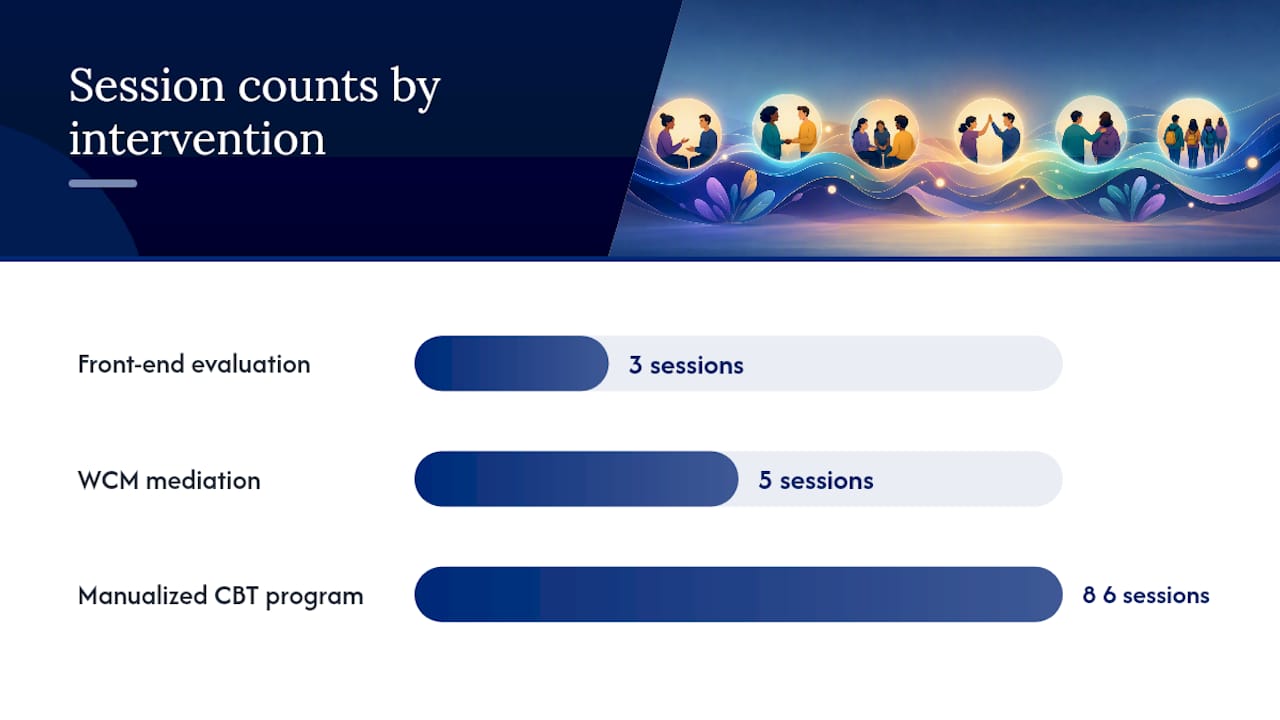
- Complete 3 front-end evaluation sessions establishing history, triggers, and readiness
- In session, help the client articulate what they want from the conflict
- Test that want against what they realistically can achieve given constraints
- Identify what they must do regardless of preference, the non-negotiable behavior
- Apply this framework across 5 mediation sessions, adjusting as new information surfaces
- Monitor perceived stress and conflict frequency at each session to track progress
The clinical summary on WCM reports the model is feasible in adults and reduced perceived stress, with realistic goals centered on better decisions rather than sweeping symptom change.
For briefer contact, a micro-intervention script works in 5 to 15 minutes: name the trigger, apply one implementation intention, and check in. For group work, manualized CBT programs typically run 8 to 12 sessions covering relaxation, cognitive skills, communication, role play, and take-home practice between meetings.
Adapting These Methods for Students, Families, and Schools
School settings add constraints that a private-practice manual does not anticipate: shared consent requirements, staff schedules, and a much lower tolerance for missed sessions. The core elements that transfer well are group discussion, role play, anger and thought diaries, and periodic parent sessions. Evidence reviews of group-format programs show they often produce more durable communication and conflict-management gains than individual formats, with downstream benefits for family and child adjustment that persist for years in some samples.
Before building a school-based track, work through these practical steps:
- Secure written consent that clearly separates what stays confidential from what triggers mandatory disclosure
- Set a referral threshold in advance, so staff know exactly when a case escalates past what a brief protocol can handle
- Loop in parents at defined checkpoints rather than only at intake or discharge
- Trim full protocols into short modules or online components when session access is limited
- Track cultural and family context before assuming a technique will land the same way across every household
Clinicians adapting these methods should also review approaches to conflict resolution for adolescents when family dynamics are part of the presenting problem, since school conflict and home conflict rarely stay separate for long.
Training and Supervision for Clinicians Delivering These Programs
A protocol is only as good as the clinician running it, which puts training design at the center of any program that wants to scale past one practitioner’s caseload.
Build competency training around four pillars: intake assessment (screening for conduct issues, safety, and transference), WCM facilitation, micro-intervention delivery, and outcome measurement for anger and coercive-conflict indices. Supervision works best on a biweekly cadence with recorded role play and a fidelity checklist tied to each protocol step, not a general “how did it go” conversation.
Scaling access matters as much as clinical skill. Web-based relationship programs have shown meaningful improvement in communication outcomes for underserved couples, evidence that brief online modules and paraprofessional-delivered micro-interventions can extend reach without diluting results. Clinicians building out a supervision track should also look at how conflict management skills translate into measurable therapy outcomes over time.
Pro Tip: Score fidelity against a checklist, not memory. A supervisor who only reviews notes after the fact misses the moments where a clinician drifted from the protocol under pressure.
Why Clinical Rigor Beats Generic Conflict Advice
Most conflict resolution content aimed at schools treats anger as a behavior problem to manage rather than a clinical presentation to treat. That distinction changes everything about how a session should run. A behavior-management lens reaches for consequences and rules. A clinical lens asks what the anger is protecting, what belief is driving the reaction, and whether the client has ever been taught an alternative response.
The programs and protocols outlined here work because they treat conflict as something learnable, not something to suppress. The clinic’s anger management and supervision offerings are built around that same premise: skill-building over punishment, structured mediation over vague talk therapy. One brief supervision sequence involving a paraprofessional trained in a 15-minute micro-intervention script showed a marked drop in reported household coercive conflict within weeks, illustrating how far a small, well-taught tool can travel when the delivery is consistent.
— Carlos
Getting Started With Mastering Conflict’s Clinical Services
This service is designed for the work this article describes: applied clinical conflict management, not generic slide-based training. If a student or family case needs a formal starting point, an anger management assessment establishes severity, triggers, and readiness before any protocol begins, which mirrors the front-end evaluation every serious WCM or CBT program requires.
When school conflict has spilled into the household, or the household conflict is driving what shows up at school, family counseling addresses both sides of that loop rather than treating them as separate problems. For practitioners building or refining their own practice, clinical mentoring and supervision grounded in combined-CBT and WCM frameworks can be offered, focusing on practical session-by-session delivery rather than abstract theory.
If you are a parent, adult client, or clinician ready to move past reading about these protocols, consider booking an assessment or reaching out to discuss supervision options through appropriate clinical providers.
This article is general information, not a substitute for advice from a qualified doctor. Consult a qualified healthcare professional about your own circumstances before acting on anything here.
Sources
- Effectiveness of anger management program on anger level, problem solving skills, communication skills, and adjustment among school-going adolescents
- Anger Management for Substance Use Disorder and Mental Health Clients (SAMHSA manual)
One Response