
Clinician Backed 6 Week Plan to Beat Imposter Syndrome

Imposter feelings are common, and they respond well to specific, evidence-based practices: naming the thought pattern, unhooking from it through Acceptance and Commitment Therapy techniques, practicing self-compassion instead of self-attack, and telling a trusted peer what’s actually going on in your head. None of this requires waiting until you feel confident. Start today by writing down one self-doubting thought and asking whether obeying it would move you closer to the work and relationships you actually care about.
TL;DR:
- Naming and unhooking from self-doubting thoughts through acceptance and commitment therapy techniques directly reduces imposter feelings.
- Keeping an achievement log with specific evidence and disclosing doubts to trusted peers weaken internal narratives of fraudulence.
- The six-week plan emphasizes tracking attribution patterns and acting according to core values even when doubts persist, fostering long-term change.
- Structural workplace issues, such as lack of credit or underrepresentation, require environmental interventions alongside personal strategies.
- Professional therapy or coaching can effectively address persistent imposter feelings, especially when linked to anxiety or workplace burnout.
Table of Contents
- Quick Toolkit: Strategies for Imposter Syndrome You Can Use Today
- What Imposter Syndrome Actually Is, and What Drives It
- A 6-Week Plan for Overcoming Imposter Syndrome
- Is Your Workplace Fueling the Problem?
- When to Seek Therapy or Coaching, and What Helps
- A Clinical Perspective on Overcoming Imposter Feelings
- The Part Most Advice Skips
- How Mastering Conflict Can Support Your Next Step
- Sources
Quick Toolkit: Strategies for Imposter Syndrome You Can Use Today
Some of these tactics work the moment you try them. Others need repetition before you notice a shift. Both kinds belong in your rotation.
- Name the thought. Say silently, “I’m having the thought that I don’t belong here.” This single move creates distance between you and the belief. Immediate.
- Unhook and act anyway. Once you’ve named it, ask what a person with your values would do next, regardless of the doubt. Acceptance and commitment therapy calls this “unhooking,” and it works better than trying to argue the thought away. Immediate.
- Run a short self-compassion script. Try: “This is hard. Other capable people feel this too. What do I need right now?” Practice.
- Keep an achievement log. Write down one thing you did well each day, along with the actual evidence, not the vague feeling. Practice.
- Disclose to one trusted peer or mentor. Say the actual sentence: “I sometimes feel like I’m faking it.” Peer disclosure tends to reduce shame and often surfaces feedback that contradicts the imposter story, according to guidance from NYU’s career resources. Immediate.
- Loosen your grip on perfectionism. Set a “good enough” threshold for one task this week and stop there on purpose. Practice.
- Try a controlled failure experiment. Deliberately attempt something slightly beyond your comfort zone where the stakes are low, an approach Stanford’s teaching center recommends to break the avoidance cycle that perfectionism creates. Practice.
Pro Tip: Don’t run these in isolation. Pair the achievement log with the self-compassion script each night: read what you documented, then say the compassion phrase out loud. The combination works better than either tactic alone, because logic without warmth rarely dents a shame-based belief.
What Imposter Syndrome Actually Is, and What Drives It
Imposter syndrome, also called the impostor phenomenon, is a persistent belief that your success is due to luck, timing, or deception rather than competence, paired with a fear that others will eventually “find out.” The defining cognitive glitch is attribution asymmetry: you credit external factors for wins and internal flaws for losses. Land a promotion? Lucky timing. Miss a deadline? Proof you’re a fraud. This asymmetry is not a personality flaw. It’s a learned pattern, and learned patterns can be unlearned.
Several forces feed it. Early family messages that tied love or approval tightly to achievement teach kids that worth is conditional, and that belief often survives into adulthood unchanged. Perfectionism compounds it by setting standards so high that any outcome short of flawless gets read as failure. Workplace exclusion plays a bigger role than most people admit. When credit for group work consistently goes to someone else, or when your ideas get restated by a colleague and suddenly taken seriously, the problem isn’t your confidence. It’s the room.
Underrepresentation adds another layer. When you’re one of few people who share your background, gender, or race in a given room, ordinary uncertainty gets amplified because there’s no built-in cohort quietly reassuring you that this is normal. Researchers studying the impostor phenomenon in medical professionals note there’s no single diagnostic gold standard for it, but they consistently link it to burnout, emotional exhaustion, and measurable career effects, and they find that mentorship and structured institutional support meaningfully reduce its grip, according to a 2025 review in PMC. The takeaway isn’t that you’re broken. It’s that a specific set of thought habits, shaped by real environmental pressure, is doing measurable damage, and both halves need addressing.
A 6-Week Plan for Overcoming Imposter Syndrome
This plan mirrors how clinicians actually sequence the work. It starts with awareness, moves through cognitive and acceptance-based skills, and ends with integration so the gains outlast the program itself.
- Week 1, awareness and baseline. Keep a daily thought log: note the trigger, the automatic thought, and your emotional intensity on a 0 to 10 scale. Separately, write a short values list, three or four things that matter to you regardless of outcome (curiosity, honesty, craftsmanship). This becomes your compass for later weeks.
- Week 2, attribution practice. Each time you catch a success getting dismissed as luck, write the specific skill or effort that actually produced it. Do the same in reverse for failures: list the external factors you’re ignoring. This is core CBT work, and it’s the step most people skip because it feels tedious. Do it anyway; repetition is what rewires the pattern.
- Week 3, unhooking and values-driven action. When a self-doubting thought shows up, name it out loud or in writing, then ask what action your values list points toward. Take that action even while the thought is still present. This is the heart of the ACT approach, and it matters more than feeling ready.
- Week 4, self-compassion and small failure experiments. Add the self-compassion script from the toolkit above to your nightly routine. Pair it with one small, low-stakes failure experiment, volunteer an imperfect idea in a meeting, submit work before it feels “done.” Cleveland Clinic notes that self-compassion tends to produce steadier motivation than self-criticism, which is exactly why this week focuses on kindness before exposure.
- Week 5, disclosure and peer support. Pick one person, a mentor, colleague, or friend, and tell them plainly what you’ve been working on. Set a standing 15 minute check-in every week or two to talk through wins and doubts together. This isn’t venting; it’s structured accountability.
- Week 6, integration and relapse prevention. Review your thought log from Week 1 against your current one. Identify your top two triggers and write a one-line response plan for each (“When I get skipped in a meeting, I will name the thought and ask my mentor for feedback within 48 hours”). Set a monthly reminder to repeat the achievement log for one week, indefinitely.
Track progress with something concrete rather than a vague sense of “feeling better.” Rate your average daily intensity score weekly; a downward trend across six weeks, even a modest one, tells you the plan is working. Also track behavior, not just mood: how many disclosure conversations you had, how many failure experiments you ran, whether you took action while the doubt was still present. If your intensity score plateaus by Week 4, add a second weekly check-in rather than abandoning the plan. This structure roughly follows the clinical workflow used at Mastering Conflict, where assessment of attribution patterns and environmental contributors comes first, followed by alternating CBT and ACT work across several sessions.
Is Your Workplace Fueling the Problem?
Not every imposter feeling starts inside your head. Some of it is a rational response to a genuinely unfair environment, and no amount of self-compassion fixes a structural problem.
Start with an honest audit. Ask three questions: Does credit for shared work consistently land on the same people, and is it ever you? Is feedback specific and actionable, or vague and inconsistent depending on who’s giving it? Do people who share your background or identity hold visible senior roles, or are you one of very few?
If the audit reveals real patterns, act on the environment, not just your mindset:
- Document specific examples, dates, contributions, outcomes, so you have facts rather than impressions when a conversation is needed.
- Ask for credit directly in the moment it’s due, not after the fact when it’s harder to correct.
- Set boundaries around unpaid emotional labor, like being the default person who reassures everyone else.
- Seek out allies and mentors who share your background or have navigated similar exclusion.
Internal strategies like unhooking and self-compassion work well when the doubt is disproportionate to reality. But when representation is genuinely thin or credit is genuinely withheld, organizational and mentorship-based interventions matter more than any individual coping skill. Sometimes the right move isn’t a new mindset. It’s a new manager, team, or role.
When to Seek Therapy or Coaching, and What Helps
Self-help strategies handle a lot of ground. But if imposter feelings are persistent, paired with anxiety or depression, or interfering with your work and relationships, professional support tends to move faster than solo effort.
Cognitive Behavioral Therapy targets the attribution asymmetry directly, teaching you to catch and restructure the “luck versus skill” distortion in real time. ACT focuses less on changing thoughts and more on changing your relationship to them, useful if you’ve tried to think your way out of doubt and found it doesn’t stick. Self-compassion-focused therapy addresses the punitive inner voice underneath both patterns. Group programs add something individual therapy can’t: hearing several other capable people describe the identical fear. Coaching, meanwhile, fits best when the issue is more about performance confidence and less about diagnosable anxiety or depression, a distinction covered in more depth in this comparison of coaching and counseling.
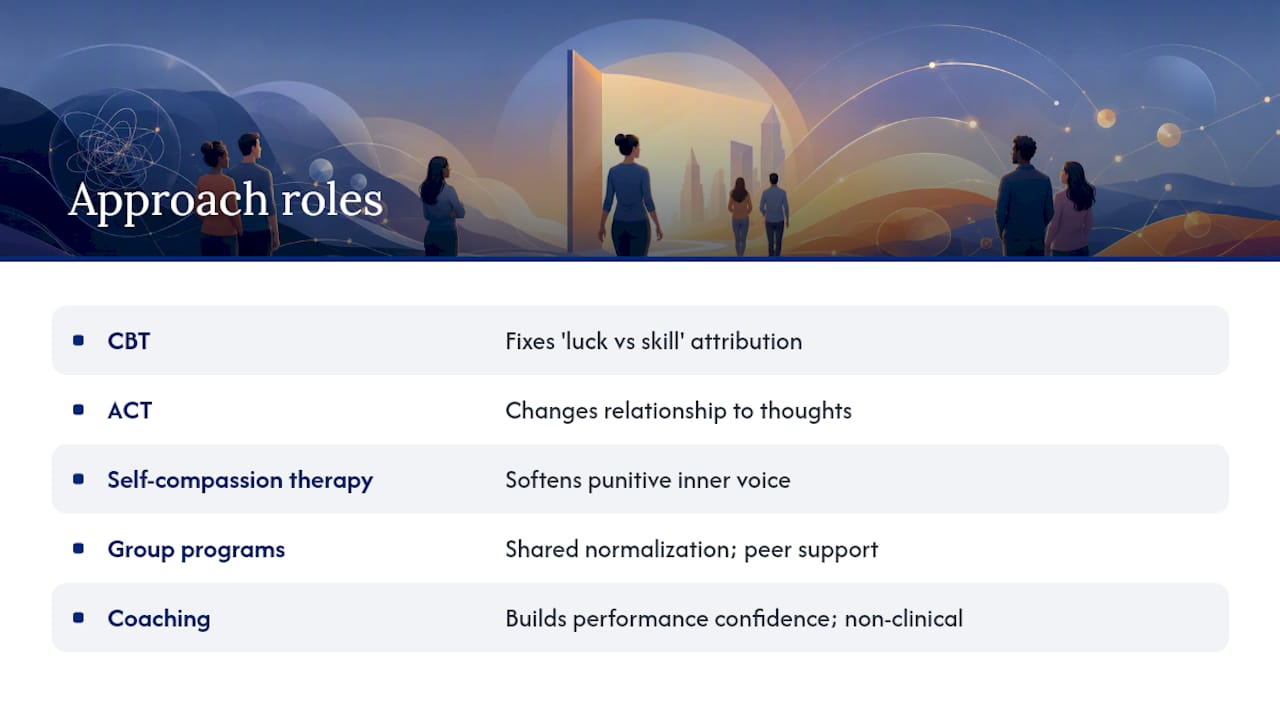
CBT and related behavioral approaches have the strongest evidence base when imposter feelings co-occur with burnout or clinical anxiety, so that overlap is worth naming honestly with any clinician you consult.
When choosing a therapist or coach, ask directly whether they have experience with impostor-phenomenon work specifically, what modality they lean on, and whether sessions are available by teletherapy if your schedule is tight. Group formats and individual sessions both have a place; the right choice depends on whether you need shared normalization or focused one-on-one attribution work, a question explored further in this overview of individual therapy techniques.
A Clinical Perspective on Overcoming Imposter Feelings
Mastering Conflict was founded by Dr. Carlos Todd, a licensed clinical mental health counselor and psychologist whose practice integrates cognitive, acceptance-based, and coaching frameworks rather than treating them as competing schools. In clinical work on imposter feelings, that integration matters: CBT does the precision work of catching distorted attributions, ACT does the harder work of acting despite the doubt staying present, and coaching adds accountability structure when the goal is workplace performance rather than symptom relief.
A clinician-guided version of the “unhook and act” exercise works like this: name the thought aloud in session, rate its intensity, then have the client identify one values-aligned action they’ve been avoiding because of it, and commit to attempting it before the next session. This paired script turns an abstract concept into a testable behavior. Cultural responsiveness matters here too. A clinician working with clients from underrepresented backgrounds needs to distinguish disproportionate self-doubt from an accurate read of a genuinely exclusionary environment, since treating a structural problem as a personal cognitive distortion does real harm.

The Part Most Advice Skips
Most articles on this topic treat imposter syndrome as a pure mindset problem, fixable with enough affirmations and confidence tricks. That framing is incomplete, and it can be quietly harmful when the real issue is an unfair workplace dressed up as a personal failing. The research actually supports a split approach: cognitive and acceptance-based tools for the internal distortion, environmental audits and boundary-setting for the external contributors.
Where conventional advice falls shortest is sequencing. People jump straight to confidence-building before they’ve done the unglamorous work of tracking attribution patterns for a few weeks. Skip that step and you’re building self-compassion on top of a distortion you haven’t even named yet.
If you do one thing first, make it the thought log. Everything else in this plan, unhooking, self-compassion, disclosure, works better once you can see your own pattern in writing rather than just feeling it.
— Carlos
How Mastering Conflict Can Support Your Next Step
If your imposter feelings are tangled up with anxiety, burnout, or a workplace that’s genuinely making things harder, a structured plan works better with a clinician guiding it rather than a checklist alone. Individual therapy can be built around the CBT and ACT integration described above, plus coaching for readers whose main issue is performance confidence rather than clinical symptoms, and clinical mentoring for practitioners who want supervision on how to handle impostor-phenomenon cases in their own caseload.
A first appointment typically starts with an intake conversation focused on your specific triggers, whether they’re rooted in attribution patterns, workplace dynamics, or both, followed by a tailored plan that draws on the same six-week structure outlined earlier. Sessions are available through teletherapy if a flexible schedule matters more to you than an in-person office visit. If you’re not sure whether coaching or therapy fits your situation better, this breakdown of coaching versus therapy walks through the distinction in plain terms. Book an initial consultation through Clinical Services to get a plan built around your actual pattern instead of a generic one.
Sources
- Acceptance and commitment therapy (ACT) principles and clinical applications — PMC
- Impostor phenomenon in medical professionals: techniques and institutional recommendations — PMC (2025)
- What’s imposter syndrome and why does it happen? — Cleveland Clinic
This article is general information, not a substitute for advice from a qualified doctor. Consult a qualified healthcare professional about your own circumstances before acting on anything here.
One Response