
Talk About Emotions: Scripts and Steps That Work

Start here: “When you said [specific thing], I felt [feeling word], and what I need is [specific need].” That one sentence, drawn from the I-statement framework and Nonviolent Communication (NVC) developed by Marshall Rosenberg, is the foundation of almost every effective emotional conversation. Affect labeling research backs it up too: simply naming a feeling reduces its intensity before you even finish the sentence. Your next step is small. Write that script with a real situation in mind, say it aloud once, and you’re already practicing.
Pro Tip: If you’re flooded, shaking, or in the wrong place, it’s okay to pause. Say: “This is hard to talk about right now. Can we revisit this later tonight or tomorrow?” That’s not avoidance. That’s protecting the conversation.
Table of Contents
- Why talking about feelings is so hard for most people
- How do you actually identify what you’re feeling?
- How to grow your emotion vocabulary
- How to structure what you say about your feelings
- Habits that make sharing emotions feel safer
- Conversation starters and sample phrases you can copy right now
- Therapist-backed exercises to build real skill
- When should you seek professional help?
- Key Takeaways
- What actually changes when you learn to name your feelings
- Useful sources and next steps
Why talking about feelings is so hard for most people
The difficulty is real, and it’s not a character flaw. Several forces work against emotional disclosure at once.
- Socialization and shame: Many people, especially men, are taught early that expressing feelings is weakness or drama.
- Fear of judgment or conflict: Sharing a feeling makes you vulnerable. If past attempts ended in dismissal or argument, the brain files “emotional sharing” under “threat.”
- Limited vocabulary: Without words for what you feel, you can’t report it accurately. Vague language (“I’m fine,” “I’m stressed”) keeps the real feeling hidden.
- Alexithymia: A genuine difficulty identifying and describing internal emotional states, affecting a meaningful portion of the population. It’s not stubbornness; it’s a processing gap.
- Past invalidation: If someone once responded to your feelings with “you’re overreacting,” you learned to keep them private.
Here’s what the research shows: affect labeling — the act of putting a feeling into words — measurably reduces emotional distress. Naming the emotion engages the prefrontal cortex and dials down the amygdala’s alarm response. You feel less overwhelmed the moment you say the word out loud.
Defensive reactions from listeners compound the problem. When someone responds to “I’m hurt” with “You’re always so sensitive,” the speaker learns silence is safer. That cycle is breakable, but it starts with the speaker having a structure to work from.
Pro Tip: Practice discussing feelings in low-stakes moments first. Comment on how a movie scene made you feel, or text a friend “that made me anxious.” Small reps build the habit before the high-stakes conversation arrives.
How do you actually identify what you’re feeling?
Most people skip this step and go straight to talking, which is why conversations stall. You can’t communicate an emotion you haven’t named yet.
A simple detection routine
Pause. Take one slow breath. Run a quick body scan: Where do you feel tension? Chest tight? Jaw clenched? Stomach hollow? Pick one physical cue, then match it to one feeling word. Rate the intensity on a scale of 1–10. That’s the whole routine, and it takes under 60 seconds.
Two journaling prompts to surface the feeling
- “Right now, my body feels ____, and the emotion closest to that is ____.”
- “If I could say anything without consequences, I would say I feel ____ because ____.”
Writing bypasses the internal editor that shuts down honest naming. Creative outlets like journaling are clinician-recommended entry points when verbal sharing feels impossible.
Feelings reference table
| Category | Common feeling words |
|---|---|
| Sad | Grief-stricken, disappointed, lonely, hopeless, melancholy |
| Angry | Annoyed, frustrated, resentful, furious, irritated |
| Afraid | Anxious, nervous, panicked, uneasy, terrified |
| Happy | Grateful, content, excited, relieved, proud |
| Confused | Overwhelmed, uncertain, conflicted, lost, surprised |
| Ashamed | Embarrassed, guilty, humiliated, exposed, regretful |
24-hour practice exercise
Observe: Notice a moment when your mood shifts.
Name: Pick one word from the table above.
Note intensity: Rate it 1–10 and write it down.
Do this three times in the next day. You’re not trying to fix anything yet. You’re just building the habit of noticing.
How to grow your emotion vocabulary
The difference between “annoyed,” “angry,” and “resentful” is not semantic. Annoyed is a surface irritation that passes. Resentful is accumulated, unaddressed hurt that poisons a relationship over time. Calling resentment “annoyance” means the real problem never gets addressed.
Finer distinctions produce more accurate conversations. When you say “I’m resentful,” your partner hears something different than “I’m annoyed,” and they should. The word itself carries the history.
Feeling words by category
- Sad: heartbroken, dejected, discouraged, empty, wistful
- Angry: indignant, seething, exasperated, bitter, contemptuous
- Afraid: dread, apprehensive, insecure, vulnerable, alarmed
- Happy: elated, hopeful, appreciative, serene, enthusiastic
- Ashamed: mortified, remorseful, self-conscious, disgraced
- Surprised: stunned, bewildered, caught off guard, astonished
The 2-minute daily labeling drill
Once a day, pick one emotion you felt and replace the vague word with a specific one. “Stressed” becomes “overwhelmed by competing demands.” “Fine” becomes “quietly relieved but still guarded.” This is the drill that shifts your vocabulary from a handful of words to a full toolkit.
The “I feel vs. I think” test
NVC guidance draws a hard line between feelings and thoughts. Try this: swap “feel” for “think” in your sentence. “I feel like you don’t care” still works with “think,” which means it’s an interpretation, not a feeling. “I feel hurt” doesn’t work with “think,” which means it’s a genuine emotion. Stick to the ones that fail the swap test.
Pro Tip: Keep a small feelings list on your phone. When you’re in a conversation and reach for a word, glance at it. You’re not cheating; you’re using a tool.
How to structure what you say about your feelings
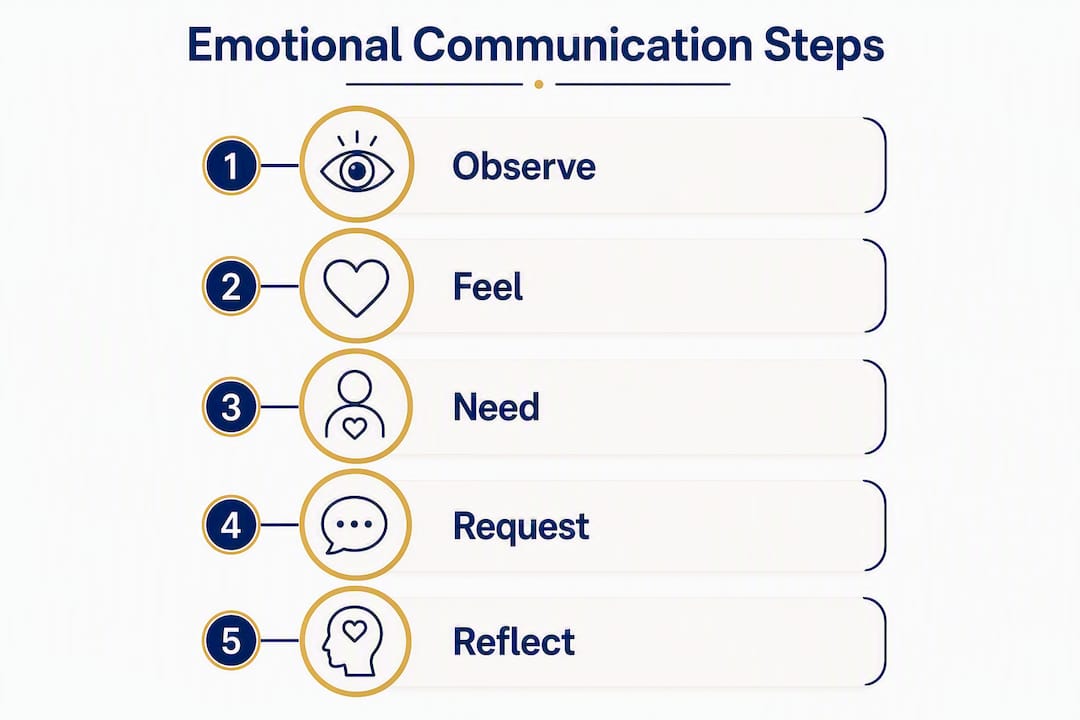
One framework covers most situations: the four-part structure from NVC and I-statement practice. Treating emotions as data rather than accusations changes how listeners receive them.
The structure:
- Observation: What specifically happened (no evaluation, just fact)
- Feeling: One emotion word
- Need or impact: What you need, or how it affected you
- Request: One concrete, doable ask
Compare that to the you-statement version: “You always run meetings over and it’s disrespectful.” The listener immediately defends themselves. The I-statement version gives them something to respond to without feeling attacked.
Scripts for three common contexts
Partner: “When you check your phone during dinner, I feel disconnected. I need some time where we’re both present. Can we try phones-away for 20 minutes?”

Friend: “When you canceled last minute, I felt let down. I was really looking forward to it. Can we reschedule and maybe confirm the day before?”
Coworker: “When feedback on my work comes through a third person, I feel uncertain about where I stand. I’d work better with direct input. Would you be open to a quick check-in?”
Pro Tip: Therapists call it “soft startup.” Lower your voice slightly, slow your pace, and lead with the observation before the feeling. A raised voice or rushed delivery signals threat before the words land. Tone carries the message before the sentence does.
Habits that make sharing emotions feel safer
Comfort with emotional expression doesn’t arrive fully formed. It’s built through small, repeated choices about when, where, and with whom you practice.
- Start in low-stakes moments. Tell a cashier “that made my day” or text a friend “I’m nervous about tomorrow.” These micro-disclosures train the nervous system that sharing is survivable.
- Prepare and rehearse. Write the I-statement before the conversation. Say it aloud in the car. Hearing your own voice say it once removes a layer of fear.
- Pick the right time and place. A tired, hungry, or distracted listener is not a good audience. Timing matters: a calm, private setting with enough time to finish the conversation is worth waiting for.
- Open with appreciation or a neutral observation. “I appreciate that you always listen” before “I want to share something hard” lowers the listener’s defenses before you get to the difficult part.
Choosing the right listener
Not everyone is equipped to hold your emotions well. A good listener for emotional conversations stays curious, doesn’t immediately problem-solve, and doesn’t make your feeling about them. You’re allowed to be selective. Sharing with someone who consistently dismisses or escalates is not practice; it’s punishment.
When you need to set a boundary mid-conversation, use this: “I want to keep talking about this, but I need a few minutes to collect my thoughts.” That keeps the door open without forcing you through it while flooded.
Small daily practices that lower reactivity
Three things that work: a four-count breath before responding, naming the emotion silently before speaking it, and one minute of journaling after a hard interaction. Pausing before responding is one of the most consistently recommended clinician practices for reducing reactive outbursts.

Pro Tip: If speaking feels impossible, text it first. “I have something I want to talk about when you have a few minutes” is a legitimate bridge. Writing gives you time to choose words carefully, and it signals to the other person that this matters without ambushing them.
Conversation starters and sample phrases you can copy right now
The hardest part of any emotional conversation is the first sentence. These are ready to use.
Openers by context
Partner (one-line): “I want to share something I’ve been sitting with.”
Partner (two-line): “I’ve been feeling [word] about [situation]. I’m not looking for a fix, just to be heard.”
Friend (one-line): “Can I tell you something that’s been on my mind?”
Friend (two-line): “I felt [word] when [thing happened]. I wanted to say it out loud to someone I trust.”
Coworker (one-line): “I’d like to share some feedback about how a recent situation landed for me.”
Coworker (two-line): “When [specific event] happened, I felt [word]. I want to figure out how we handle it differently going forward.”
Starting with “I want to share something” rather than “We need to talk” changes the emotional temperature of the room before a single feeling is named. “We need to talk” triggers threat; “I want to share” signals connection.
Text message templates
| Situation | Template |
|---|---|
| Initiating a hard conversation | “Hey, I have something I want to talk about when you have time. Nothing urgent, just important to me.” |
| After a conflict | “I’ve been thinking about what happened. I want to understand your side and share mine. Can we talk soon?” |
| Feeling disconnected | “I’ve been feeling a little distant lately and I miss you. Can we catch up this week?” |
| Needing support | “I’m having a hard time and could use someone to talk to. Are you available?” |
Adapt the formality to the relationship. With a close friend, “I’m struggling and need you” is enough. With a coworker, keep it professional and specific to the work context. The principle stays the same: name the need, make the ask, keep it short.
Therapist-backed exercises to build real skill
Reading about emotional communication helps. Practicing it is what changes behavior. These drills are designed to be done, not just read.
The worksheet template
Copy this and fill it in before any significant emotional conversation:
- Situation: What specifically happened? (One sentence, no adjectives.)
- Body cue: Where did you feel it physically?
- Feeling word: One precise emotion from your vocabulary list.
- Need or impact: What do you need, or how did it affect you?
- Request: One concrete, specific ask.
Run through it in writing first. The act of writing forces clarity that thinking alone doesn’t produce.
Role-play steps with a trusted person
| Round | Duration | Focus | Feedback prompt |
|---|---|---|---|
| 1 | 3 minutes | Speaker delivers I-statement; listener reflects back | “What did you hear me say I felt?” |
| 2 | 3 minutes | Switch roles | “What felt natural? What felt hard?” |
| 3 | 3 minutes | Repeat with a harder scenario | “What would you change?” |
Three rounds, nine minutes total. Do this with a friend, a partner, or a therapist. The Cleveland Clinic and other clinician sources consistently point to repeated, structured practice as the mechanism that lowers the barrier to harder disclosures over time.
Journaling reflection prompts
After any emotional conversation, write three sentences:
- “What I said that worked: ____.”
- “What felt hard: ____.”
- “Next time, I would try: ____.”
That’s the whole debrief. It closes the loop and builds on each attempt.
A clinician note on safety
If a conversation escalates to the point where you feel unsafe, stop it. “I need to pause this conversation” is a complete sentence. Pushing through a flooded, dysregulated state doesn’t produce understanding; it produces damage. Circle back when both people are regulated. Dealing with difficult emotions requires knowing when to stop, not just how to start.
When should you seek professional help?
Practice and self-help carry most people a long way. But some situations call for a clinician, not just a better script.
Seek therapy when:
- Emotional overwhelm is frequent enough to impair work, relationships, or daily function
- You consistently can’t identify what you feel, even after trying the exercises above
- Emotional flooding leads to aggression, self-harm, or complete shutdown
- You’ve tried to practice and the distress doesn’t reduce over weeks
Seek a support group or short-term coaching when the issue is skill-based rather than clinical: you understand your emotions but struggle to communicate them in specific relationships. Masteringconflict offers individual therapy and conflict coaching for exactly this range, from skill-building to deeper clinical work.
For immediate support, contact the 988 Suicide and Crisis Lifeline (call or text 988) or the Crisis Text Line (text HOME to 741741). The Jed Foundation (jedfoundation.org) and NAMI (nami.org) both offer guidance on finding ongoing mental health support.
Before your first therapy session, write down three things: what you want to work on, one example of a situation that triggered the problem, and what you’ve already tried. That 90-second preparation makes the first session significantly more productive.
Pro Tip: When calling a therapy practice, you don’t need a polished explanation. Say: “I’m having trouble expressing my emotions and it’s affecting my relationships. I’d like to work on that.” That’s enough. A good clinician will take it from there.
Key Takeaways
Naming a feeling before you speak it is the single most effective first step toward clearer, less reactive emotional conversations.
| Point | Details |
|---|---|
| Use the four-part structure | Observation, feeling, need, and request reduce defensiveness and give listeners something concrete to respond to. |
| Name before you speak | Labeling an emotion reduces its intensity and helps you choose words instead of reacting. |
| Practice in low-stakes moments | Small daily disclosures build the habit before high-stakes conversations demand it. |
| Use writing as a bridge | Texting or journaling a feeling first gives you clarity and reduces the fear of speaking it aloud. |
| Know when to get help | Persistent alexithymia, emotional flooding, or impaired function are signs to seek a therapist, not just more practice. |
What actually changes when you learn to name your feelings
The conventional framing of emotional communication puts all the weight on the speaker: learn the right words, use the right structure, and the conversation will go well. That’s only half true.
What I’ve seen in clinical work is that the bigger shift happens internally, before a word is spoken. When someone moves from “I’m upset” to “I’m scared that I don’t matter to you,” they’ve already done the hard work. The sentence that comes out is almost secondary. The precision of the feeling word changes what the speaker is asking for, which changes what the listener can actually give.
The other thing most articles miss: emotional communication isn’t a performance skill. It’s a regulation skill. People don’t fail at it because they don’t know the right phrases. They fail because they’re too flooded to access the phrases they already know. That’s why the breath pause, the body scan, and the worksheet exist. They’re not therapy homework for its own sake. They’re ways to get the nervous system calm enough that the prefrontal cortex can do its job.
Start with the one-line script. Use the worksheet once before a conversation that matters. Notice what shifts. The conflict resolution skills that follow from that foundation build themselves.
Useful sources and next steps
A short list of reliable resources for going deeper:
- Nonviolent Communication (Marshall Rosenberg): The original framework for observation → feeling → need → request. Read Chapter 4 for the feelings and needs distinction.
- Verywell Mind: How to Express Your Feelings: Practical breakdown of affect labeling and the “I feel vs. I think” test. Use it alongside the vocabulary drill.
- Cleveland Clinic: Connecting with Emotions: Clinician-backed guidance on low-stakes practice and building emotional literacy over time.
- Positive Psychology: 12 Ways to Communicate Feelings: Covers creative and nonverbal outlets when words aren’t enough yet.
- Mass.gov: How Do I Talk About the Things I’m Feeling?: A plain-language guide on timing, medium, and what to expect after the conversation.
- Masteringconflict individual therapy and coaching: For readers who want structured clinical support, from emotion-focused individual therapy to couples communication work.
- Masteringconflict couples communication guide: Scripts and exercises specifically for partners working through emotional communication together.

This article is general information, not professional mental health advice. For your specific situation, consult a licensed clinician or contact a qualified mental health professional directly.
Recommended
- Dealing with Difficult Emotions: Mastering Your Reactions – Mastering Conflict
- Mastering Empathy in Conflict Resolution: A Step-by-Step Guide – Mastering Conflict
- 7 Essential Tips for Developing Emotional Intelligence – Mastering Conflict
- Emotional Control: Practical Strategies That Actually Work – Mastering Conflict