
Family Dispute Resolution: What Clinical Therapy Actually Involves

Clinical family dispute resolution is evidence-based family and couples therapy, not court mediation. It uses methods like CBT, EFT, and PCIT to reduce anger, rebuild trust, and repair how a family functions day to day. Clinicians track progress with tools like the STAXI-2 for anger, the CD-RISC for resilience, and the Family Intimacy Questionnaire (FIQ) for relational closeness. Masteringconflict offers this kind of care directly.
If conflict in your home has become a pattern rather than an occasional bad night, here’s where to start:
- Book an initial clinical assessment with a licensed therapist if multiple family members are affected.
- Join an anger-management group first if one person’s temper is the primary issue.
- Seek couples-specific treatment if the conflict is mainly between partners.
Pro Tip: Call ahead and ask whether the clinician measures outcomes with tools like the STAXI-2 or CD-RISC. A provider who tracks numbers is a provider who can tell you, objectively, whether treatment is working.
Key Takeaways
Clinical family dispute resolution works because it pairs proven therapy models like CBT, EFT, and MST with measurable outcomes tracked through tools like the STAXI-2 and CD-RISC.
| Point | Details |
|---|---|
| It’s clinical, not legal | This process means therapy from licensed clinicians, distinct from court-based family mediation. |
| Evidence is real | A 12-week program combining CBT, EFT, and PCIT cut adolescent anger and boosted resilience, sustained at 3 months. |
| Safety comes first | Active violence or coercive control calls for crisis services or legal protection before therapy alone. |
| Progress should be measured | Ask any provider how they use tools like the STAXI-2, CD-RISC, or FIQ to track change. |
| Masteringconflict offers this path | Clinical assessments, couples packages, and anger-management groups built on these same evidence-based models. |
Table of Contents
- What Clinical Family Dispute Resolution Actually Covers
- Who Actually Benefits From This Kind of Therapy
- The Research Behind It: What Actually Improves
- Therapy Models and What a Session Looks Like
- Safety Limits: When Therapy Alone Isn’t Enough
- How to Choose a Clinician or Program
- What Changes in the First 3 Months
- Why This Work Matters More Than People Assume
- Getting Started With Mastering Conflict
- Frequently Asked Questions
- Sources
What Clinical Family Dispute Resolution Actually Covers
When people search “family dispute resolution,” a lot of what comes back online is about legal mediators helping divorcing parents split custody. That’s not this. Clinical family dispute resolution refers to therapy: family counseling, couples therapy, anger-management classes, and conflict coaching delivered by licensed mental-health clinicians, not attorneys or court-appointed mediators.
The work draws from several established models, each covered in more detail later in this article:
- Cognitive Behavioral Therapy (CBT) for reshaping thought patterns that fuel conflict.
- Emotion-Focused Therapy (EFT) for repairing attachment ruptures between partners or family members.
- Parent-Child Interaction Therapy (PCIT) for live-coached parent-child dynamics.
- Structural Family Therapy (SFT) for reworking family roles and boundaries.
- Multisystemic Therapy (MST) for high-risk adolescent behavior.
- Solution-Focused Brief Therapy (SFBT) and family problem-solving models for shorter, goal-driven work.
The goals are concrete: lower anger scores on the STAXI-2, improved resilience on the CD-RISC, stronger connection on the FIQ.
| Point | Details |
|---|---|
| Clinical, not legal | This process is therapy delivered by licensed clinicians, separate from court-based family mediation. |
| Multiple modalities | CBT, EFT, PCIT, SFT, MST, and SFBT each target different conflict patterns. |
| Measurable goals | Progress gets tracked through the STAXI-2, CD-RISC, and FIQ rather than left to guesswork. |
Who Actually Benefits From This Kind of Therapy
Not every disagreement needs a clinician. But certain patterns are strong signals this path fits: recurring angry blowups that follow the same script, escalating conflict between siblings or generations, a teenager acting out at school and at home, communication that keeps breaking down no matter how many times you “talk it out,” or family stress layered on top of an existing mental-health diagnosis. Parents managing conflict resolution for adolescents often recognize several of these at once.
Some situations call for a different route entirely. If the dispute is really about legal custody terms, that belongs with a mediator or attorney, not a therapist. If there’s an active safety emergency, that calls for crisis services first, therapy second.
- Recurring anger episodes with no clear resolution
- Adolescent behavior escalating at home or school
- Repeated communication breakdowns across the family
- Conflict layered with anxiety, depression, or trauma symptoms
Pro Tip: Reluctant family members respond better to an invitation than a demand. Try: “I’d like us to sit down with someone who can help us actually hear each other, just for one session, no pressure to keep going.”
The Research Behind It: What Actually Improves
The evidence for systemic family therapy is stronger than most people assume. A quasi-experimental study of 80 adolescents found that a 12-week family-centered emotion regulation program combining CBT, EFT, and PCIT produced significant reductions in adolescent anger, plus real gains in resilience and family intimacy, with the improvements holding at 3-month follow-up.
Broader reviews back this up. A systematic review of systemic interventions for child-focused problems found a substantial evidence base across issues ranging from externalizing behavior to recovery from abuse, though the most intensive models, Multisystemic Therapy among them, only work as intended when clinicians carry low caseloads and follow strict fidelity to the model. On the adult side, couple and family therapy shows effectiveness across relationship distress, mood disorders, anxiety, and alcohol problems.
The pattern across these studies: family-based treatment reliably moves the needle on measurable outcomes, not just subjective feelings.
- Anger reduction tracked via the STAXI-2
- Resilience gains tracked via the CD-RISC
- Family closeness tracked via the FIQ
- Gains that hold up at follow-up, not just at discharge
Where the evidence thins out is long-term data past a year or two, and outcomes for less common family structures. That’s a gap worth asking a prospective clinician about directly.
Therapy Models and What a Session Looks Like
Different models solve different problems. CBT works well for identifying the thought loops that spark repeated arguments. EFT targets the underlying attachment wounds behind couples conflict, often producing strong results for distressed partners. PCIT puts a therapist behind a one-way mirror coaching a parent through live interactions with a young child. SFT reworks family structure, using techniques like enactment and reframing to shift who holds power and how boundaries get drawn, an approach detailed in research on structural family therapy. MST wraps around high-risk teens with intensive, multi-setting support. SFBT and family problem-solving models, supported by multiple controlled trials, aim for faster, goal-specific change.
A typical intake looks like this:
- Safety screening and family history intake.
- Baseline measurement using tools like the STAXI-2, CD-RISC, or FIQ.
- Collaborative goal-setting with the family present.
- Weekly or biweekly sessions, often 50 to 90 minutes depending on the model.
- Re-measurement at set intervals to track real progress.
Sessions aren’t just talk therapy. Clinicians frequently interrupt an argument mid-sentence to name the pattern happening in real time, criticism, stonewalling, withdrawal, and coach an alternative response on the spot.
Pro Tip: If your therapist never interrupts a heated exchange to redirect it, ask about their approach. Active, in-session coaching is a hallmark of models like PCIT and SFT, and it’s often where the real change happens.

Safety Limits: When Therapy Alone Isn’t Enough
Family therapy works best when everyone in the room is safe enough to engage honestly. It isn’t built to handle active danger.
- Threats of violence or active intoxication during sessions
- Coercive control or ongoing intimate partner violence
- Safety risk to a child that requires immediate intervention
- Mandated treatment tied to a legal or child-protective process
Licensed clinicians operate under state reporting requirements and often use safety contracts before continuing joint sessions. If any of these apply, therapy alone is not the starting point.
Family therapy addresses communication, roles, and emotional patterns. It is not a substitute for legal protection, a restraining order, or emergency crisis services when safety is at risk.
How to Choose a Clinician or Program
Picking the right provider matters as much as picking the right model. Start with these credential checks:
- Confirm the clinician is licensed (LCSW, LMFT, or psychologist) in your state.
- Ask about specific training in EFT, Gottman methods, MST, or PCIT if that’s the presenting issue.
- Ask whether they receive ongoing clinical supervision, especially for intensive models where fidelity to the model affects outcomes.
- Ask how they measure progress and how often.
On a first consult call, it’s fair to ask directly:
- “What outcome measures do you use, and how often do we retest?”
- “What’s your typical program length for a case like ours?”
- “Do you offer telehealth, and how does that affect the work?”
- “What’s your cancellation, refund, or transfer policy?”
- “How do you handle cultural or language differences in the family?”
For group-based anger management, also ask about group size. Smaller groups tend to allow more individualized coaching. Readers weighing telehealth versus in-person care can find more detail in this guide to teletherapy for families.
What Changes in the First 3 Months
Most structured programs follow a similar arc: an intake session, then 8 to 12 individual or family sessions, or a comparable run of weekly group classes for anger-focused work.
- Weeks 1 to 2: Intake, baseline STAXI-2, CD-RISC, and FIQ scores, and a shared treatment plan.
- Weeks 3 to 8: Skill-building sessions, targeted at whichever model fits, plus early re-measurement.
- Weeks 9 to 12: Consolidation, a second round of outcome measures, and a decision point on next steps.
The 12-week intervention study referenced earlier showed measurable anger reduction and resilience gains on this same rough timeline, with results holding three months out. If scores haven’t moved by week 8, that’s the moment to reassess, whether that means adjusting the model, adding individual therapy, or reviewing whether medication support could help.
Why This Work Matters More Than People Assume
Most families wait far too long before getting help, usually because they picture therapy as something for crises, not for the slow grind of everyday friction. That’s backwards. The families who do best are the ones who show up before the pattern calcifies, while there’s still enough goodwill in the room to make the coaching land.
What I’d push back on is the idea that talking things out on your own should work eventually. Structural patterns, who holds power, who withdraws, who escalates, don’t shift just because everyone wants them to. They shift when someone trained to interrupt the pattern does exactly that, session after session, and measures whether it’s sticking.
The evidence summarized above isn’t abstract. It’s the same framework behind the assessments and programs Masteringconflict runs every week.
Getting Started With Mastering Conflict
Masteringconflict is the direct route to the kind of clinical care this article describes: licensed clinicians, named outcome measures, and models with real evidence behind them, without the runaround of finding a general therapist who happens to also do family work.
A few starting points depending on what’s going on in your household:
- Clinical Services covers assessments and individual, couples, or family therapy for readers ready to book an intake.
- Couples Packages offer structured, prepaid programs for partners who want a defined arc rather than open-ended sessions.
- Anger Management Groups work well when one person’s temper is driving most of the household conflict, and group settings help families share responsibility for change.
If you’re not sure which fits, start with a short consult call and ask the questions outlined earlier in this article. Booking a clinical assessment is the fastest way to find out where you actually stand.
Frequently Asked Questions
Is family dispute resolution the same as family mediation?
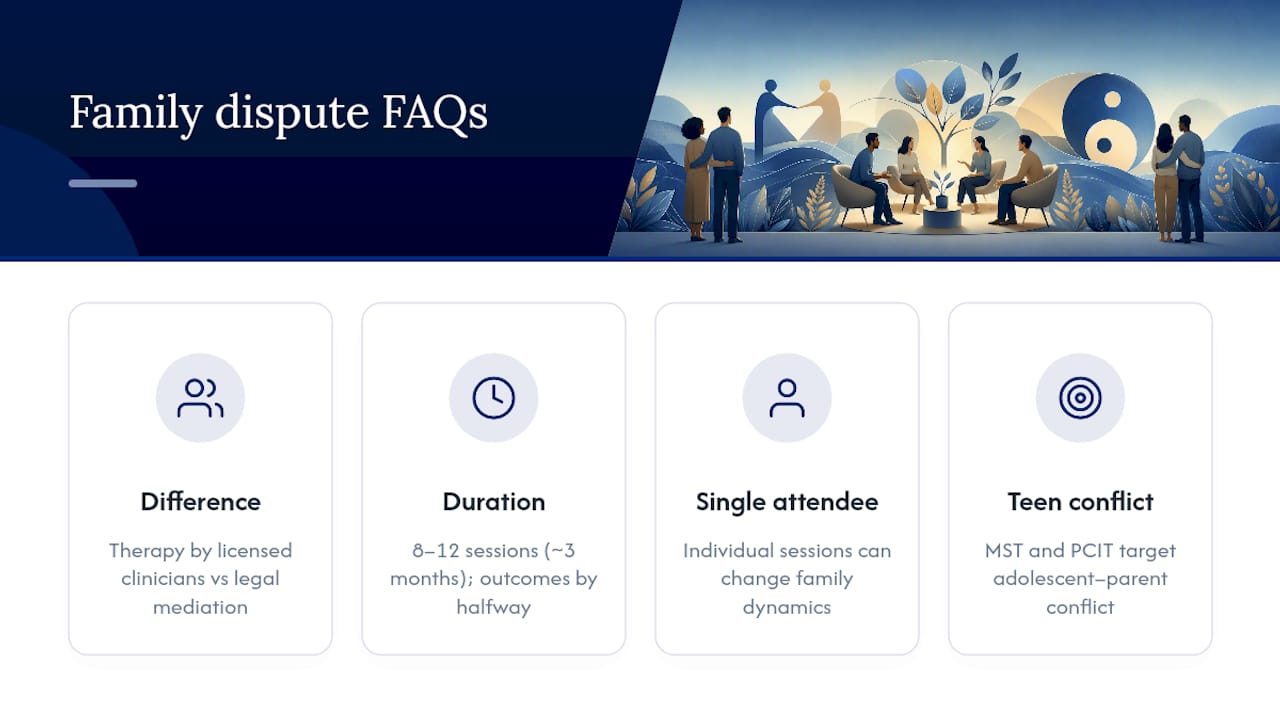
No. Clinical family dispute resolution refers to therapy delivered by licensed mental-health clinicians, focused on repairing relationships and reducing conflict. Family mediation is a legal process for resolving custody or divorce terms.
How long does family therapy usually take to show results?
Many structured programs run 8 to 12 sessions over about 3 months, with outcome measures like the STAXI-2 and CD-RISC often showing movement by the halfway point.
What if only one family member is willing to attend?
Individual sessions, including anger-management coaching, can still create change that shifts family dynamics, and reluctant members often join once they see a difference.
Does insurance cover this type of therapy?
Coverage varies by plan and provider. Ask directly during a consult call about accepted insurance, session costs, and any package options.
Can this help if a teenager is the main source of conflict?
Yes. Models like MST and PCIT are specifically built for adolescent and parent-child conflict, and strategies for teen conflict often complement formal sessions.
Sources
- Effectiveness of a Family-Centered Emotion Regulation Intervention on Adolescent Anger, Psychological Resilience, and Family Intimacy | International Journal of Body, Mind and Culture
- Family therapy and systemic interventions for child‐focused problems: The evidence base
- Effectiveness of couple and family therapy and systemic interventions for adult-focused problems
- Multi-family anger management: a solution-focused approach
Recommended
- Family Dispute Resolution Process: A Practical Guide – Mastering Conflict
- Clinical Family Mediation in Family Law: A Therapist’s Guide – Mastering Conflict
- Family Conflict Resolution Services: Transforming Relationships – Mastering Conflict
- Conflict Management Techniques for Couples, Families & Clinicians – Mastering Conflict