
Conflict Management Techniques in Project Management

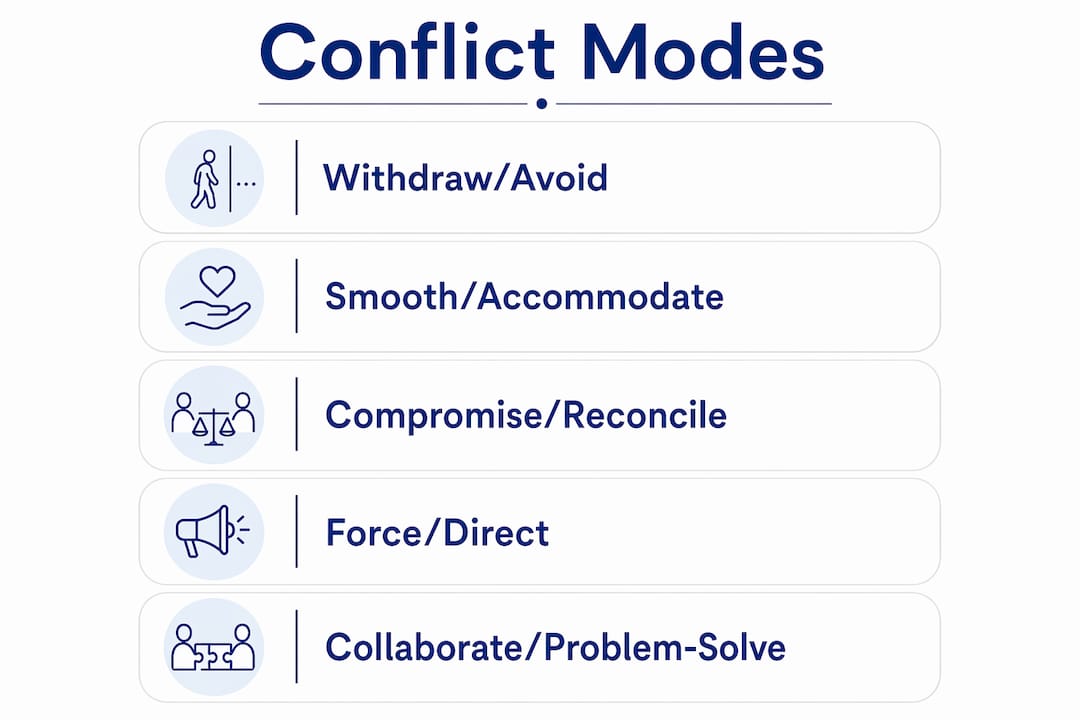
The PMBOK Guide (Project Management Institute) organizes project conflict resolution around five techniques drawn from the Thomas–Kilmann Conflict Mode Instrument (TKI): Withdraw/Avoid, Smooth/Accommodate, Compromise/Reconcile, Force/Direct, and Collaborate/Problem-Solve. Each mode has a specific use case — picking the wrong one for the situation is one of the most common reasons conflicts escalate instead of resolve.
Here is when each technique fits:
- Withdraw/Avoid — Use when the issue is trivial, emotions are running too hot to negotiate productively, or you need time to gather facts. Not a long-term fix.
- Smooth/Accommodate — Use to preserve a relationship when the other party’s need outweighs yours on this issue, or to de-escalate tension quickly. Overuse signals weakness.
- Compromise/Reconcile — Use when both sides have legitimate but opposing needs and a partial win for each is acceptable. Good for time-pressured, moderate-stakes disputes.
- Force/Direct — Use for urgent safety or compliance decisions where delay is dangerous. Damages relationships if used routinely.
- Collaborate/Problem-Solve — Use when stakes are high, the relationship matters long-term, and both parties have time and trust to work through root causes together. The Harvard Program on Negotiation identifies this as the most durable approach, though it requires the most skill and time.
These five modes, the PMBOK framework, and the clinical perspective of Dr. Carlos Todd (licensed clinical mental health counselor at Masteringconflict) form the backbone of this guide.
Table of Contents
- What do the five TKI techniques actually look like in practice?
- How do you choose the right technique for your situation?
- How to run a conflict-resolution meeting step by step
- What are the most common pitfalls managers fall into?
- How long does conflict resolution take, and when should you escalate?
- How do these techniques translate to family and clinical settings?
- How can you detect and prevent conflict before it erupts?
- Why emotional intelligence matters more than technique
- How do you tailor your approach to different stakeholders and cultures?
- Key Takeaways
- When PM tools meet clinical responsibility
- Masteringconflict offers clinical support when conflict goes deeper
- Useful sources and further reading
What do the five TKI techniques actually look like in practice?
Each mode is a tool, not a personality trait. The goal is knowing which one to pick up.

Withdraw/Avoid means stepping back from the conflict without resolution. In a project context, a PM might table a heated scope debate until the team has clearer requirements. The risk: unresolved issues compound. Use it as a pause, not a permanent strategy.
Smooth/Accommodate means prioritizing the other party’s position over your own. A project manager might defer to a senior stakeholder’s preference on a low-impact design choice to protect a critical relationship. The danger is chronic accommodation — it trains others to push harder next time.
Compromise/Reconcile splits the difference. Two departments both want the same developer for their sprint? Each gets three days. Nobody wins completely, but the project moves. Collaboration is often more effective for durable agreements, but compromise is the pragmatic choice when time is short.
Force/Direct means using authority to impose a decision. A safety violation on a construction project requires immediate action — there is no time to workshop a consensus. Used outside urgent situations, it breeds resentment and disengagement.
Collaborate/Problem-Solve takes the most effort and pays the biggest dividend. Two team leads disagree on architecture? Sit down, map each person’s underlying concerns, and build a solution neither had considered alone. This is the mode principled negotiation (Fisher, Ury, and Patton) was designed for: separate the people from the problem, focus on interests rather than positions, and use objective criteria to evaluate options.
Pro Tip: Collaboration is not the universal answer. It is time-consuming and requires trust. For low-impact or time-pressured issues, compromise or accommodation is often the smarter call.
How do you choose the right technique for your situation?
Start with four questions before you pick a mode.
- How urgent is this? Urgent safety or compliance issues point to Force. Everything else allows more deliberate choices.
- How much does the relationship matter long-term? High-value relationships favor Collaborate or Accommodate over Force.
- What are the stakes? High-impact decisions warrant Collaboration. Low-impact ones can absorb Compromise or Avoid.
- How much time is available? Collaboration takes hours or days. Compromise takes minutes. Avoid buys time but resolves nothing.
| Condition | Withdraw/Avoid | Smooth/Accommodate | Compromise | Force/Direct | Collaborate |
|---|---|---|---|---|---|
| High urgency | Short pause only | No | Possible | Yes | No |
| Relationship matters | No | Yes (short-term) | Yes | No | Yes (best) |
| High stakes | No | No | Partial | Safety/compliance only | Yes |
| Limited time | Yes (pause) | Yes | Yes | Yes | No |
| Trust present | No | Partial | Yes | No | Yes |
| Authority gap | No | Yes | Yes | Yes | Requires parity |
A quick pre-conflict checklist: confirm the conflict type (task, process, or interpersonal), identify who holds decision authority, check whether structural issues (unclear roles, missing RACI) are driving the dispute, and note the project phase. Many surface interpersonal disputes are structural issues in disguise — fixing the role clarity often dissolves the argument.
How to run a conflict-resolution meeting step by step
PMI guidance stresses that project managers must diagnose root causes, choose appropriate strategies, facilitate communication, and monitor post-resolution impact. Here is a replicable sequence.
- Prepare. Gather facts, identify each party’s stated position, and hypothesize their underlying interests. Confirm who needs to be in the room.
- Open with ground rules. State the agenda: one person speaks at a time, focus on the issue not the person, and the goal is a workable agreement, not a verdict.
- Separate positions from interests. Ask each party: “What outcome do you need, and why does that matter to you?” This is the core move in principled negotiation.
- Explore options using objective criteria. Bring in data, project requirements, or agreed standards. Remove personal fairness claims from the center of the discussion.
- Agree on actions. Write down who does what by when. Vague agreements dissolve within 48 hours.
- Follow up. Schedule a 15-minute check-in within one week. Unmonitored agreements rarely hold.
Sample facilitator script (condensed):
- Opening: “We’re here to resolve [specific issue]. Each of you will have uninterrupted time to speak. Our goal is an agreement we can both live with.”
- Interests phase: “Tell me what you need from this situation — and what’s driving that need.”
- Options phase: “Looking at the project requirements, what options meet both sets of needs?”
- Agreement: “Let’s write down exactly what we’ve agreed to and who owns each action.”
Pro Tip: Schedule the follow-up check-in before the meeting ends. If you leave without a date on the calendar, follow-through drops sharply. Use a practical conflict resolution template to document agreements on the spot.
What are the most common pitfalls managers fall into?
Three traps catch even experienced project managers.
The peacemaker trap. Trying to keep everyone happy feels like good management. It is not. Dr. Vittal Anantatmula’s PMI commentary puts it plainly: the manager’s job is choosing the right resolution strategy, not minimizing visible conflict. Avoiding hard conversations trades short-term harmony for long-term dysfunction.
Fairness/egocentrism bias. Research by Carnegie Mellon professors Linda Babcock and George Loewenstein shows that our sense of fairness is heavily shaped by egocentrism — we genuinely struggle to see the situation from the other side. The fix is to anchor discussions on objective criteria (project specs, agreed timelines, documented requirements) rather than competing claims about who is right.
Style rigidity. Most managers default to one or two preferred modes regardless of context. Practitioners who default to a single conflict mode consistently produce worse outcomes than those who match mode to situation. Build your range deliberately: practice Collaborate in low-stakes situations so it is available when stakes are high.
Pro Tip: After each resolved conflict, spend five minutes asking: “Did I pick the right mode, or the comfortable one?” That single habit builds strategic flexibility faster than any training course.
How long does conflict resolution take, and when should you escalate?
| Conflict type | Typical resolution time | People involved | Common cost types | Escalation trigger |
|---|---|---|---|---|
| Minor (task/process) | 1–3 days | 2–3 team members | Time, brief productivity dip | Stalled after one follow-up |
| Moderate (interpersonal) | 1–3 weeks | Team + PM | Time, morale, delivery risk | Stalled after two follow-ups |
| Complex (entrenched/safety) | Weeks to months | PM + HR + leadership | Delivery delay, legal/HR cost | Safety issue, misconduct, retraumatization |
Escalation is not a failure — it is a responsible step when team-level resolution has stalled. Escalate to HR or mediation when: the conflict involves a safety or compliance issue, two follow-up check-ins have produced no movement, or one party reports feeling unsafe.
Quick documentation checklist: date of conflict onset, parties involved, mode(s) attempted, agreements reached, follow-up dates, and outcome. This record protects everyone and helps identify patterns across the project.
How do these techniques translate to family and clinical settings?
The TKI modes map directly to therapeutic and family contexts, with one critical difference: emotional safety and informed consent come before any technique.
- Avoid/Withdraw can create space for de-escalation in a heated family argument. Used too long, it becomes stonewalling.
- Accommodate works briefly to lower a partner’s defensiveness in couples therapy, but a therapist should flag when one person is chronically accommodating.
- Collaborate is the goal in most couples and family therapy when safety allows — it mirrors the conflict management skills that support lasting therapy outcomes.
A clinician working with a family might use the interests-vs-positions frame this way: instead of asking “What do you want your partner to do?” ask “What do you need to feel secure in this relationship?” That single reframe shifts the conversation from demands to underlying needs, which is where durable agreements live. Personality-based conflict approaches can further help clinicians tailor the mode to each family member’s natural style.
When conflicts require clinical escalation: If a conflict involves domestic violence, active suicidal ideation, or severe retraumatization, standard negotiation techniques are contraindicated. These situations require trained clinical intervention. Contact Masteringconflict’s clinical services or call 988 (Suicide and Crisis Lifeline) immediately.
How can you detect and prevent conflict before it erupts?
Early detection is an active skill, not passive observation. Subtle signals — meeting silence, shifted participation patterns, indirect feedback — often precede open conflict by days or weeks. In remote and hybrid teams, quieting of communication and changes in meeting dynamics are the clearest early warnings.
Structural prevention works better than interpersonal firefighting. Clear RACI matrices, documented acceptance criteria, and explicit decision-authority rules remove the ambiguity that generates most task and process conflicts. Schedule brief retrospectives at each project phase gate — not to surface grievances, but to catch role confusion before it becomes resentment.
For communication, two habits matter most: normalize disagreement early (“We expect different views — here is how we handle them”) and create a low-stakes channel for raising concerns before they become conflicts. A weekly 10-minute team pulse check costs almost nothing and catches problems while they are still easy to fix.
Why emotional intelligence matters more than technique
Technique without emotional intelligence is a script without a speaker. A project manager who knows all five TKI modes but cannot read the emotional temperature of a room will misapply them consistently.
The four components that matter most in conflict settings are self-awareness (knowing your own default mode and triggers), self-regulation (not reacting when provoked), empathy (accurately reading the other party’s emotional state), and social skill (adjusting your approach in real time). Active listening sits at the center of all four. Reflecting back what you heard (“What I’m hearing is that you’re concerned about the timeline, not the technical approach — is that right?”) slows the conversation down enough for both parties to think rather than react.
Conflict resolution skills built on emotional intelligence tend to hold up under pressure in ways that purely procedural approaches do not.
How do you tailor your approach to different stakeholders and cultures?
A sponsor, a frontline developer, and an external vendor all experience conflict differently and respond to different modes. Sponsors typically respond to data and business impact framing. Developers often need acknowledgment of technical constraints before they can engage in problem-solving. Vendors operate under contractual constraints that limit how much collaborative flexibility they can offer.
Cultural background shapes conflict expectations just as much as role does. In higher-context cultures (common across East Asia, Latin America, and parts of the Middle East), direct confrontation can feel disrespectful even when the intent is collaborative. Indirect approaches, face-saving language, and relationship-building before problem-solving are not avoidance — they are the culturally appropriate path to the same goal. Adapting conflict strategies for small teams with diverse backgrounds requires reading both role and cultural context before choosing a mode.
The practical rule: ask before you assume. A brief pre-meeting conversation (“How do you prefer to handle disagreements when they come up?”) surfaces preferences that save hours of misread signals later.
Key Takeaways
Matching the right conflict mode to the specific situation, relationship, and stakes is the single most important skill in effective project conflict management.
| Point | Details |
|---|---|
| Five PMBOK/TKI modes | Withdraw, Accommodate, Compromise, Force, and Collaborate each fit specific conditions — context determines the right choice. |
| Separate positions from interests | Ask “what do you need and why?” before proposing solutions; this is the core move in principled negotiation. |
| Document and follow up | Write agreements down immediately and schedule a follow-up check-in before the meeting ends. |
| Escalate when stalled | After two failed follow-ups, or any safety/compliance issue, escalate to HR, mediation, or clinical services. |
| Masteringconflict for clinical support | When interpersonal conflict involves emotional safety, trauma, or relationship repair, Masteringconflict’s clinical services provide evidence-based support. |
When PM tools meet clinical responsibility
These frameworks are powerful, and they have limits. In my work as a licensed clinical mental health counselor, the first question I ask before applying any conflict technique is not “which mode fits?” — it is “is this environment safe enough for honest dialogue?” Informed consent, emotional safety, and the therapeutic relationship come before any structured process. Project managers adapting these tools for family or interpersonal contexts should hold the same standard: technique serves the relationship, not the other way around. If a conflict has crossed into territory involving trauma, chronic power imbalance, or mental health crisis, the right move is a referral, not a facilitation script. Persistent interpersonal conflict that does not respond to structured approaches is often a clinical issue wearing a communication problem’s clothes.
Masteringconflict offers clinical support when conflict goes deeper
Some conflicts need more than a framework. When anger, relationship breakdown, or unresolved trauma is driving the dispute, Masteringconflict provides clinical assessments, couples counseling, family therapy, and individual coaching grounded in the same evidence-based principles covered in this guide. Start with an anger management assessment if emotional dysregulation is part of the picture, or go directly to clinical services to book an initial consultation. Telehealth options are available, and the team works with many insurance plans. Confidentiality is standard. The first step is a conversation, not a commitment.
Useful sources and further reading
- PMBOK Conflict Model Overview — Explains how the PMBOK Guide maps the five TKI-derived techniques to project management practice.
- Harvard Program on Negotiation: Conflict-Management Styles — Covers pitfalls and best practices across all five modes with research backing.
- Harvard PON: Principled Negotiation — The Fisher, Ury, and Patton framework for separating positions from interests and using objective criteria.
- PMI: Managing Conflict in the Project Environment — PMI practitioner guidance on diagnosing root causes and selecting resolution strategies.
- DOI Study: Conflict Management Strategies in Project Teams — Research on conflict type prevalence and the productivity benefits of collaborative handling for task conflicts.
- Harvard PON: What Is Conflict Resolution? — Broad overview of negotiation, mediation, arbitration, and litigation as resolution methods.
Recommended
- Conflict Management Skills: Enhancing Therapy Outcomes – Mastering Conflict
- Conflict Management Method: Enhancing Therapy Outcomes – Mastering Conflict
- Conflict Management Techniques PDF: Your Practical Guide – Mastering Conflict
- Conflict Management Training Courses: Skills for Real Life – Mastering Conflict