
Why Do Couples Argue: Real Causes and Real Fixes

TL;DR:
- Couples argue because of emotional wounds, resentments, and communication patterns that prioritize winning.
- Recurring conflicts often stem from unresolved emotional issues rather than surface disagreements or misunderstandings.
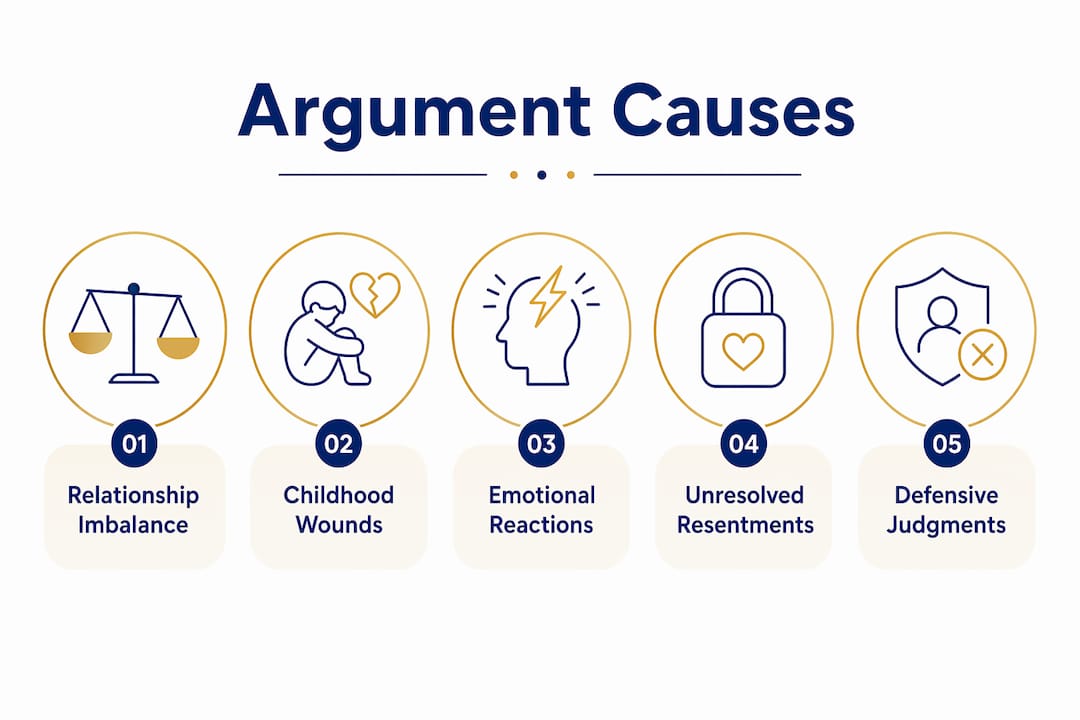
Couples argue because of emotional imbalances, unresolved pain, and communication breakdowns that compound over time. These are not random flare-ups. Relationship psychologists identify five core drivers behind chronic couple arguments: relationship imbalance, childhood emotional wounds, uncontrolled emotional reactions, unresolved resentments, and defensive judgment patterns. Understanding these causes is not just reassuring. It is the first step toward changing them.
Why do couples argue? The five root causes
Relationship psychologists have identified five primary drivers of chronic arguments: relationship imbalance, childhood emotional wounds, uncontrolled emotions, unresolved resentments, and defensive judgment reactions. Each one operates beneath the surface of whatever topic the couple is actually fighting about.
Relationship imbalance
One partner carries more emotional labor, household responsibility, or financial pressure than the other. That gap breeds quiet resentment. Over time, resentment does not stay quiet. It surfaces as irritability, criticism, and arguments that seem to be about small things but are really about fairness.

Childhood emotional wounds
Partners bring their entire histories into a relationship. A person who grew up in a home where conflict meant abandonment will react very differently to raised voices than someone who grew up in a calm household. These emotional wounds from childhood shape how partners interpret tone, silence, and even eye contact during disagreements.
Uncontrolled emotional reactions
When emotions spike, the thinking brain goes offline. Partners say things they do not mean, escalate quickly, and lose sight of the original issue. This is not a character flaw. It is a physiological response. The problem is that without self-regulation skills, every argument risks becoming a blowout.
Unresolved resentments
Unresolved longstanding problems cause resentment to fester. Without real compromise, issues accumulate and trigger either explosive fights or chronic low-level complaining. A couple that never resolved a betrayal from three years ago will find that betrayal showing up in arguments about dishes.
Defensive judgment reactions
Partners enter fights already convinced they are right. That posture shuts down listening before it starts. The result is two people talking past each other, each waiting for their turn to prove a point rather than genuinely hearing the other.
Pro Tip: Before your next disagreement, write down one thing your partner did well that week. This small act interrupts the negative-only mental file you build during conflict.
How do perception and memory distortions fuel repeated arguments?
Memory is not a recording. It is reconstructive. Couples often argue about the “record” of what happened, but each partner’s recall is shaped by their emotional state, their expectations, and their personal history. Two people can experience the same conversation and remember it completely differently. Neither is lying. Both are telling their version of the truth.
This creates a trap. Couples spend enormous energy trying to establish facts, when the real issue is the emotional meaning each person attached to those facts. One partner remembers a dismissive tone. The other remembers being calm. Arguing about who is right misses the point entirely.
The table below shows how the same event produces two different conflict experiences.
| What happened | Partner A’s experience | Partner B’s experience |
|---|---|---|
| Partner B arrived home late without calling | Felt ignored and unimportant | Felt overwhelmed and forgot to call |
| Partner A gave short answers at dinner | Felt they were signaling hurt | Felt they were just tired |
| Partner B went to bed without talking | Felt they needed space | Felt abandoned and shut out |
The pattern is consistent. Each partner interprets the other’s behavior through their own emotional lens. Fights focusing on factual accuracy miss the underlying emotional meaning that needs repair for genuine reconciliation. Validating your partner’s feelings, even when you remember things differently, moves the conversation forward. Debating the facts keeps it stuck.
Pro Tip: Replace “That’s not what happened” with “I didn’t realize you felt that way.” You are not conceding the facts. You are opening the door.
Why do couples keep losing the same argument?
Recurring arguments are not a sign that a couple is incompatible. They are a sign that the conflict has not been resolved at the emotional level. Couples enter arguments with their conclusions already formed, treating the fight like a trial where they are simultaneously the prosecutor and the judge. That posture makes genuine listening impossible.
Several patterns drive this cycle:
- Generalized character attacks. “You always do this” and “You never care” shift the fight from a specific behavior to a verdict on who the person is. No one responds well to a character indictment.
- Negative narrative dominance. Couples fail to name their partner’s virtues during calm moments, so the only active mental file is the conflict file. When a fight starts, that negative file is the only reference point available.
- Identity-level threats. Many couples argue because of a perceived attack on their competence, trustworthiness, or identity rather than the explicit issue. When someone feels their character is on trial, they defend rather than listen.
- Winning over understanding. Partners focus on being right rather than being heard. That goal guarantees a loser, and losers do not feel connected.
The fix is not to argue less. It is to argue differently. Building a fuller, more balanced picture of your partner, one that includes their strengths and their struggles, gives you something to hold onto when conflict heats up. Naming positive virtues during calm moments protects against resentment by keeping the relationship narrative balanced. A couple that regularly acknowledges each other’s strengths is less likely to reduce each other to their worst moments during a fight.
What communication strategies actually reduce arguments?
Effective conflict communication is a skill, not a personality trait. Learning to fight well is like building a muscle. It feels awkward at first, but it improves connection and reduces destructive cycles when practiced consistently.
These strategies come directly from couples therapists and current psychological research:
- Pause before you speak. Notice the physical signs that your emotions are spiking: a tight chest, a raised voice, clenched hands. That pause gives your thinking brain a chance to re-engage before you say something that escalates the fight.
- Get curious instead of accusatory. Replace “Why do you always do that?” with “Help me understand what was going on for you.” Curiosity signals safety. Accusations signal threat.
- Express vulnerability, not just frustration. “I felt scared when you didn’t call” lands differently than “You never think about me.” Vulnerability invites empathy. Frustration alone invites defense.
- Take responsibility for your emotional tone. Couples reconnect faster when both partners own their contribution to the emotional climate of the fight, not just the content of what was said.
- Name your partner’s strengths out loud. Do this regularly, not just during conflict. It builds a reserve of goodwill that makes disagreements easier to survive.
For a deeper look at how these techniques work in practice, the communication skills guide at Masteringconflict walks through each one with real couple scenarios.
Pro Tip: After a fight ends, give yourselves 20 minutes before debriefing. Physiological arousal takes time to drop. Trying to “fix it” while still activated usually restarts the argument.
Couples who practice diffusing conflict early report fewer escalations over time. The goal is not a conflict-free relationship. The goal is a relationship where conflict leads somewhere productive. Esther Perel’s work, including The State of Affairs, offers a sharp lens on how unresolved conflict and disconnection quietly erode even strong partnerships.
Key Takeaways
Couples argue primarily because of emotional wounds, unresolved resentments, and communication patterns that prioritize winning over understanding.
| Point | Details |
|---|---|
| Five root causes | Relationship imbalance, childhood wounds, uncontrolled emotions, unresolved resentments, and defensive judgment all drive chronic arguments. |
| Memory is subjective | Partners recall the same event differently; validating feelings matters more than debating facts. |
| Recurring fights signal unresolved emotion | Couples lose the same argument repeatedly because the emotional core of the conflict was never addressed. |
| Naming virtues protects the relationship | Regularly acknowledging your partner’s strengths prevents negative generalizations from dominating the relationship narrative. |
| Communication is a learnable skill | Pausing, using curiosity, and expressing vulnerability reduce escalation and rebuild connection after conflict. |
What I’ve learned after years of working with couples in conflict
After working with hundreds of couples, the pattern I see most often is this: partners are not fighting about what they think they are fighting about. The argument is about dishes. The real issue is feeling unseen. The argument is about money. The real issue is fear of losing control. The surface topic is almost never the actual wound.
What surprises most couples is how much of their conflict is driven by the story they tell about their partner when that partner is not in the room. If the only mental file you have on your partner is the conflict file, every new disagreement confirms the worst. Building a richer, more honest picture of who your partner is, including their strengths, their fears, and their history, changes how you show up in a fight.
The couples I see make the most progress are not the ones who stop arguing. They are the ones who learn to argue with accountability and curiosity instead of judgment and contempt. That shift does not happen overnight. It takes practice, patience, and often a skilled third party to help interrupt the old patterns. If your conflicts feel circular and exhausting, that is not a sign your relationship is broken. It is a sign you need new tools. Reach out before the resentment calcifies.
— Carlos
When professional support makes the difference
Persistent arguments that circle back to the same wounds are a signal that the conflict needs more than good intentions to resolve.

Masteringconflict offers clinical services for couples that go beyond surface-level communication tips. Dr. Carlos Todd and his team work with couples to identify the emotional patterns driving recurring fights, using evidence-based approaches drawn from clinical mental health practice. Whether the issue is unresolved resentment, emotional reactivity, or a breakdown in trust, the work is structured, specific, and grounded in real psychological research. Couples in North Carolina, South Carolina, Florida, and beyond can access support through in-person and online options. If arguments in your relationship feel stuck, family conflict counseling at Masteringconflict is a concrete next step.
FAQ
Why do couples argue about the same things repeatedly?
Recurring arguments signal that the emotional core of the conflict was never resolved. Couples often address the surface topic while leaving the underlying wound untouched, so the same fight resurfaces under a different label.
What is the most common reason partners fight?
Relationship psychologists point to relationship imbalance as one of the most consistent triggers. When one partner carries significantly more emotional or practical load, resentment builds and surfaces as conflict.
Can arguing actually be healthy for a relationship?
Yes, when it is done with accountability and curiosity rather than contempt. Conflict that leads to genuine understanding strengthens connection. Conflict that focuses on winning damages it.
How does childhood affect the way couples argue?
Childhood experiences shape how partners interpret tone, silence, and emotional intensity. A person who associated conflict with abandonment will react more defensively than someone who grew up in a calmer environment, even in low-stakes disagreements.
When should couples seek professional help for arguments?
Couples benefit from professional support when conflicts feel circular, when resentment has built over months or years, or when arguments regularly escalate to contempt or withdrawal. Early intervention produces better outcomes than waiting until the relationship is in crisis.