
Conflict Management and Negotiation Skills: A Practical Guide

What are conflict management and negotiation skills?
Conflict management and negotiation skills are the practical abilities that let you work through disagreements without destroying the relationship or the outcome. They are not the same thing, though they overlap constantly. Conflict management covers how you recognize, respond to, and resolve disputes. Negotiation is the structured process of reaching an agreement when two or more parties have different interests. Together, they form the foundation of every productive workplace conversation, difficult family discussion, and high-stakes business deal.
The Harvard Program on Negotiation frames the core challenge well: most people walk into conflict trying to win the argument rather than understand the other person’s interests. That instinct is almost always counterproductive. Conflict, when managed intentionally, can drive better decisions, stronger relationships, and genuine innovation rather than damage.
The foundational skills you need to build include:
- Active listening: Hearing what is actually being said, not just preparing your rebuttal
- Emotional regulation: Managing your own reactions so they do not hijack the conversation
- Interest articulation: Stating what you actually need, not just defending your position
- Empathy: Understanding the other person’s perspective without necessarily agreeing with it
- Reframing: Shifting how a problem is described to open up new solutions
- Creative problem solving: Generating options that neither party initially considered
- Clear communication: Saying what you mean in a way the other person can actually receive
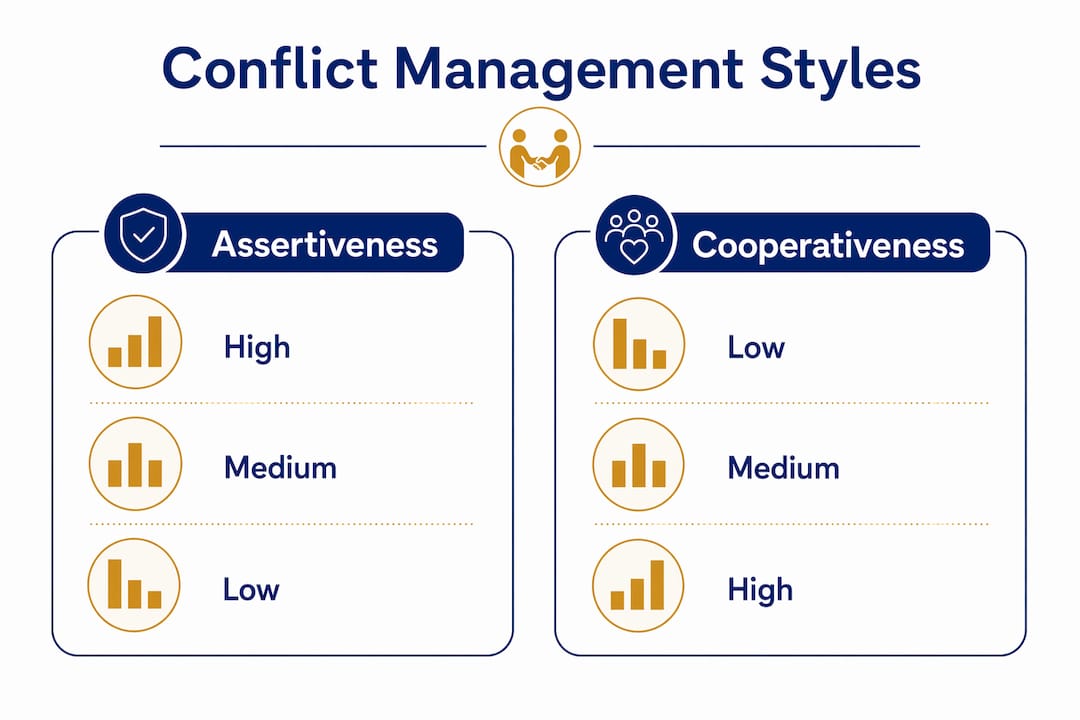
The Thomas-Kilmann Conflict Mode Instrument (TKI), developed in 1974 by Kenneth W. Thomas and Ralph H. Kilmann, remains one of the most widely used frameworks for understanding how people approach conflict. It maps five distinct styles along two dimensions: assertiveness (how much you push for your own needs) and cooperativeness (how much you consider the other person’s needs). Understanding where you naturally land on that map is the first step toward building negotiation skills that actually hold up under pressure.
Common conflict types and the five management styles you need to know
Conflict shows up in predictable patterns. Interpersonal conflict pits two individuals against each other over goals, values, or communication styles. Organizational conflict emerges from competing priorities, unclear roles, or resource scarcity. Cultural conflict arises when different backgrounds produce genuinely different assumptions about what is fair, respectful, or appropriate. Each type calls for a different response, which is exactly why rigid approaches fail.
The Thomas-Kilmann model identifies five styles, and none of them is universally right or wrong:
- Competing: High assertiveness, low cooperativeness. You push for your position and treat the conflict as a win-lose contest. Useful when a quick, decisive call is needed, but it damages relationships when overused.
- Avoiding: Low assertiveness, low cooperativeness. You sidestep the conflict entirely. Sometimes wise when emotions are running dangerously high, but problems left unaddressed tend to harden into resentment.
- Accommodating: Low assertiveness, high cooperativeness. You yield to preserve the relationship. Practical when the issue matters more to the other person, but consistent self-sacrifice leads to burnout and hidden frustration.
- Compromising: Moderate on both dimensions. You split the difference and move forward. Fast and practical for minor issues, though it often produces temporary fixes that ignore deeper interests.
- Collaborating: High assertiveness, high cooperativeness. You dig beneath surface positions to find underlying interests and work toward a solution that genuinely works for both sides. The most effective style for durable agreements.
| Style | Assertiveness | Cooperativeness | Best used when |
|---|---|---|---|
| Competing | High | Low | Urgent decisions, clear authority |
| Avoiding | Low | Low | Emotions are volatile, issue is trivial |
| Accommodating | Low | High | Relationship preservation is the priority |
| Compromising | Moderate | Moderate | Time pressure, minor disputes |
| Collaborating | High | High | Complex issues, long-term relationships |
Strategic flexibility matters more than picking a favorite style. A 2015 study published in Negotiation and Conflict Management Research by Scott Wiltermuth, Larissa Z. Tiedens, and Margaret Neale found that pairs composed of one dominant and one submissive negotiator outperformed pairs with matching styles. The dominant negotiator stated preferences clearly; the submissive negotiator asked clarifying questions. Together, they uncovered more value than either style produced alone.
Essential skills and strategies for effective negotiation and conflict resolution
The gap between people who resolve conflicts well and those who make them worse usually comes down to a handful of specific behaviors, not personality. These are learnable.

Active listening is the single most impactful skill. Active listening improves conflict resolution effectiveness by about 40% through techniques like paraphrasing, reflecting feelings, and asking open-ended questions. The mechanics are simple: repeat back what you heard before you respond, ask questions designed to uncover the other party’s core concerns, and resist the urge to defend yourself while they are still talking.
The 6-second pause is a small technique with a disproportionate effect. Pausing for six seconds before responding to a charged statement reduces emotional reactivity and improves the quality of what you say next. It sounds almost too simple, but the physiological shift it creates is real.
“I feel… I need…” statements replace accusatory language with honest disclosure. Instead of “You never listen to me,” you say “I feel dismissed when I’m interrupted, and I need us to take turns.” The structure keeps the conversation from becoming an attack.
Reciprocity in concessions moves negotiations forward. Making a concession signals good faith and invites the other party to reciprocate, building the trust that makes agreement possible. The key is to make concessions deliberately and name them explicitly rather than quietly giving ground.
Bringing multiple issues to the table unlocks value that single-issue negotiations miss. When you present several proposals you value equally, your counterpart’s reactions reveal what matters most to them. That information lets you trade across dimensions rather than fight over one number.
Key skills to practice deliberately:
- Paraphrasing before responding (“What I’m hearing is…”)
- Naming emotions without blaming (“I notice I’m feeling defensive right now”)
- Separating positions from interests (“You want X, but why do you want X?”)
- Generating options before evaluating them (brainstorm first, judge later)
- Using objective criteria to evaluate proposals (market data, precedent, expert opinion)
Pro Tip: When you feel the urge to counter an offer immediately, treat that urge as a signal to ask one more question instead. The question almost always produces information that improves your next move.
Psychological principles and common pitfalls that derail negotiations
The biggest obstacles in most conflicts are not the facts of the dispute. They are the mental patterns both parties bring to it.
Egocentrism is the most pervasive. Research by Carnegie Mellon professors Linda Babcock and George Loewenstein shows that our sense of fairness is shaped by our own perspective in ways we rarely notice. Egocentrism causes people to believe they are right and the other party is simply being stubborn, which makes genuine resolution nearly impossible until someone steps outside their own viewpoint. Perspective-taking exercises, neutral mediators, and jointly reviewing objective data all help counteract it.
Fixed-pie bias is equally damaging. Negotiators who assume resources are limited and the other party is an adversary stop looking for creative solutions. The Harvard Program on Negotiation consistently finds that separating positions from interests and exploring multiple issues simultaneously produces far more value than treating every negotiation as a zero-sum contest.
Avoidance feels safe but compounds problems. Unaddressed conflicts do not disappear; they accumulate. Misunderstandings harden into resentment, and small grievances become entrenched positions.
Defensiveness shuts down information flow. When someone feels attacked, they stop listening and start protecting. The “I feel… I need…” structure from the previous section directly addresses this by removing the accusatory framing.
Common pitfalls to watch for:
- Treating the other person’s position as their final word rather than a starting point
- Ignoring emotional signals in yourself and the other party
- Over-competing on issues that do not actually matter to you
- Confusing compromise with collaboration (they are not the same)
- Using threats, which almost always escalate rather than resolve
Maintaining empathy and acceptance throughout a conflict, even when you disagree strongly, leads to better outcomes and sustained trust. Empathy does not mean agreement. It means you understand why the other person sees it the way they do.
Statistic to anchor: Active listening improves conflict resolution effectiveness by about 40% through paraphrasing, reflecting feelings, and asking open-ended questions. That single skill shift outperforms most other interventions.
How cultural differences shape conflict and negotiation across contexts
Culture does not just influence communication style. It shapes what people believe conflict means, whether direct confrontation is respectful or rude, and what a fair outcome looks like. Ignoring these differences in a negotiation is one of the fastest ways to create misunderstanding where none was intended.

Cross-cultural negotiation requires awareness of differing communication styles, values, and conflict perceptions to avoid misunderstandings and build rapport. In high-context cultures (common across East Asia, the Middle East, and Latin America), meaning is conveyed through tone, relationship history, and context as much as through words. In low-context cultures (the United States, Germany, Scandinavia), directness is valued and ambiguity is seen as a problem to fix.
Practical considerations for cross-cultural conflict and negotiation:
- Research the communication norms of the other party before the conversation begins
- Avoid interpreting silence as agreement; in many cultures, silence signals discomfort or disagreement
- Build relationship before business; many cultures require trust before substantive negotiation can happen
- Use neutral language and avoid idioms that do not translate well
- Confirm understanding explicitly rather than assuming shared meaning
| Cultural dimension | Low-context cultures | High-context cultures |
|---|---|---|
| Communication style | Direct, explicit | Indirect, implicit |
| Conflict approach | Addressed openly | Managed through relationship |
| Decision-making | Individual, fast | Collective, deliberate |
| Trust building | Task-based | Relationship-based |
Workplace applications extend beyond international settings. A manager mediating between two colleagues from different generational or professional backgrounds faces the same dynamics on a smaller scale. The same principle applies: understand the frame the other person is operating from before you try to change their position. Masteringconflict’s conflict management in the workplace resources address exactly these applied contexts for teams and leaders.
What research and expert practice say about mastering these skills
The most consistent finding across negotiation research is that the shift from confrontational to collaborative thinking is not just a nice idea. It produces measurably better agreements. The Harvard Program on Negotiation frames it as moving from separating positions from interests to generating creative value rather than fighting over a fixed pie.
IMD faculty research adds a practical layer: conflicts addressed openly, what IMD describes as “putting the fish on the table,” produce creative solutions and innovation rather than further antagonism. Avoiding the conversation feels safer, but it forfeits the opportunity to actually solve the problem.
Key expert-backed insights:
- Hiring a neutral mediator overcomes egocentric bias by introducing objectivity that neither party can provide for themselves
- Strategic flexibility across the five Thomas-Kilmann styles produces better outcomes than defaulting to one approach
- Value creation beyond the fixed-pie assumption requires exploring multiple issues simultaneously, not just haggling over one
- Emotional regulation is a prerequisite for effective listening; you cannot hear clearly when you are in fight-or-flight mode
- Successful leaders reframe conflicts as shared puzzles, focusing on collective benefits rather than personal differences
Masteringconflict’s clinical approach, led by Dr. Carlos Todd, a licensed clinical mental health counselor and psychologist, integrates these research-backed principles with therapeutic practice. The clinical services offered through Masteringconflict include anger management, couples counseling, and individual therapy, all grounded in evidence-based conflict resolution frameworks. For professionals seeking structured training, the platform also provides clinical mentoring and supervision for practitioners who want to deepen their conflict management expertise.
How to prepare effectively for a negotiation or conflict resolution session
Preparation is where most people leave value on the table. Walking into a difficult conversation without a clear sense of your own interests, the other party’s likely concerns, and your alternatives is the single most preventable mistake in negotiation.
Start by clarifying your own interests, not just your position. Your position is what you say you want. Your interests are why you want it. Knowing the difference lets you stay flexible on the “how” while holding firm on the “what matters.”
Know your BATNA. Your Best Alternative to a Negotiated Agreement is your real source of leverage. If you do not know what you will do if the negotiation fails, you cannot evaluate whether a proposed agreement is actually good enough to accept.
Research the other party’s interests. What pressures are they under? What outcomes would genuinely work for them? The more you understand their situation, the more options you can generate that work for both sides.
Set the agenda and the tone. Agree in advance on the process: where you will meet, how long you will talk, and what topics are on the table. A shared agenda reduces the chance that one party feels ambushed.
Prepare your opening statement. Not a demand, but a clear articulation of your interests and your commitment to finding a solution that works for both parties. The opening sets the collaborative or adversarial tone for everything that follows.
Anticipate emotional triggers. Know which topics are likely to spike your reactivity, and decide in advance how you will handle them. The 6-second pause technique is most useful when you have already decided to use it before the conversation starts.
How to identify and handle power dynamics during negotiation
Power in negotiation is rarely as fixed as it feels. Perceived power and actual power diverge constantly, and skilled negotiators know how to work with both.
Recognize the tactics. Some negotiators attempt to gain advantage by questioning your competence, citing authority they may or may not have, or creating artificial time pressure. The Harvard Program on Negotiation advises recognizing these power plays for what they are and redirecting the conversation to the substance of the issue rather than reacting emotionally. Staying focused on interests and criteria deprives these tactics of their effectiveness.
Strengthen your BATNA. The most reliable source of power in any negotiation is a strong alternative. When you genuinely do not need this particular agreement, your willingness to walk away becomes credible, and the other party knows it.
Use objective criteria. When power imbalances make direct negotiation feel unfair, shifting the conversation to external standards (market rates, legal precedents, industry benchmarks) depersonalizes the discussion and creates a basis for agreement that neither party can easily dismiss.
Name the dynamic directly. If you feel the conversation has become coercive, saying so calmly and specifically (“I notice we’ve moved away from the substance of the issue”) often resets the tone more effectively than trying to out-maneuver the other party.
Power dynamics in organizational settings often involve hierarchy. A direct report negotiating with a manager faces real constraints that a peer negotiation does not. In those situations, framing your interests in terms of organizational benefit rather than personal preference tends to land better and reduces the risk of the conversation becoming a test of authority.
Post-negotiation strategies that protect the agreement and the relationship
Reaching an agreement is not the end of the process. What happens in the days and weeks after a negotiation often determines whether the agreement holds and whether the relationship survives.
Document the agreement clearly. Ambiguity is the enemy of implementation. Write down what was agreed, who is responsible for what, and by when. Even in informal personal conflicts, a brief summary sent by email prevents the “I thought you said” conversations that reopen disputes.
Follow up deliberately. Check in at agreed milestones to confirm that both parties are meeting their commitments. Early follow-up signals that you take the agreement seriously and catches problems before they become grievances.
Acknowledge the other party’s contribution. People who feel their effort was recognized are more likely to honor the agreement and engage constructively in future conflicts. A simple acknowledgment of what the other person brought to the resolution costs nothing and builds significant goodwill.
Repair the relationship separately from the agreement. The resolution of a specific dispute does not automatically repair the underlying relationship. If the conflict was significant, a separate conversation focused on the relationship rather than the terms of the agreement is often necessary. Maintaining positive relationships through empathy and acceptance after a conflict leads to better collaborative outcomes over time.
Reflect on what worked. Every negotiation is a data point. What preparation paid off? What surprised you? What would you do differently? Professionals who debrief their own negotiations consistently improve faster than those who move straight to the next challenge.
When mediation and third-party intervention make sense
Some conflicts genuinely cannot be resolved by the parties alone. When egocentrism runs deep, when emotions have escalated past the point of productive dialogue, or when the power imbalance is too significant for direct negotiation to feel safe, a neutral third party changes the dynamic in ways that direct conversation cannot.
Mediators do not impose solutions. They facilitate the conversation, help parties articulate their interests, and guide both sides toward options they might not have found on their own. The Harvard Program on Negotiation notes that neutral facilitators help overcome egocentric bias by introducing objectivity that neither party can provide for themselves. In workplace settings, this might be an HR professional, an ombudsperson, or an external mediator. In personal contexts, a therapist or counselor trained in conflict resolution can serve the same function.
Arbitration is a step further: a neutral third party hears both sides and makes a binding decision. It is faster and less expensive than litigation, but it removes the parties’ control over the outcome. Organizations that design dispute resolution systems, a process Harvard Law School professors Frank E. A. Sander and Robert C. Bordone call dispute system design, typically build in mediation as a required step before arbitration to preserve the possibility of a negotiated solution.
When to bring in a third party: persistent stalemates, situations where direct communication has broken down completely, cases involving significant power imbalances, and conflicts where one or both parties cannot regulate their emotions enough to have a productive conversation. Waiting too long to involve a mediator is far more common than involving one too early.
Techniques for de-escalating highly emotional or aggressive conflicts
High-emotion conflicts require a different set of moves than calm disagreements. The goal in the first phase is not resolution. It is de-escalation: reducing the emotional intensity enough that productive conversation becomes possible.
Lower your own arousal first. You cannot de-escalate someone else while you are escalating yourself. The 6-second pause, slow breathing, and physically stepping back (literally, not just metaphorically) all reduce your own physiological activation before you try to influence the other person’s.
Validate before you problem-solve. Telling someone who is angry that they are overreacting, or jumping straight to solutions, almost always intensifies the emotion. Saying “I can see this matters a lot to you” or “That sounds genuinely frustrating” acknowledges the feeling without agreeing with the position. Validation is not capitulation. It is the fastest path to a conversation the other person can actually participate in.
Use a calm, steady tone. Vocal tone is contagious. Raising your voice to match an aggressive person escalates the conflict; dropping your voice slightly and slowing your pace tends to pull the other person’s register down with it.
Name the dynamic without blame. “I notice we’re both getting heated. Can we take a five-minute break and come back to this?” is far more effective than trying to argue your way through the escalation. Naming what is happening without assigning fault gives both parties permission to reset.
Remove the audience. Public conflicts are harder to de-escalate because both parties feel their status is on the line. Moving a heated conversation to a private space removes that pressure and makes it easier for both parties to back down without feeling they have lost face.
Assertive communication, distinct from aggressive communication, is the long-term skill that prevents escalation in the first place. Masteringconflict’s resources on assertive communication skills cover the specific language patterns that let you hold your ground without triggering defensiveness in the other person.
Key Takeaways
Effective conflict management and negotiation skills require strategic flexibility, psychological self-awareness, and a consistent commitment to understanding the other party’s interests rather than simply defending your own position.
| Point | Details |
|---|---|
| Style flexibility beats rigidity | The Thomas-Kilmann model’s five styles each fit different contexts; no single approach works in every situation. |
| Active listening drives outcomes | Active listening improves conflict resolution effectiveness by about 40% through paraphrasing, reflecting feelings, and open-ended questions. |
| Interests beat positions | Separating what you want from why you want it unlocks creative solutions that pure position-bargaining misses. |
| Preparation is leverage | Knowing your BATNA and the other party’s interests before the conversation starts is the most reliable source of negotiating power. |
| Third-party help is a skill, not a failure | Bringing in a neutral mediator overcomes egocentric bias and is often the fastest path to durable resolution. |
Ready to build these skills with professional support?
Reading about conflict management and negotiation skills is a start. Applying them under pressure, in real relationships and real workplaces, is where the actual growth happens. Masteringconflict offers clinical services that integrate evidence-based conflict resolution with therapeutic practice, including anger management, couples counseling, family therapy, and individual sessions. Whether you are navigating a difficult workplace dynamic or a long-standing personal conflict, working with a trained clinician accelerates the process in ways that self-study alone rarely matches. Explore what Masteringconflict offers and take the next step toward resolving the conflicts that are costing you the most.
Recommended
- Conflict Management Skills: Enhancing Therapy Outcomes – Mastering Conflict
- Conflict Management Training Courses: Skills for Real Life – Mastering Conflict
- Master Conflict Resolution Skills for Real-Life Success – Mastering Conflict
- Conflict Management in the Workplace: A Manager’s Guide – Mastering Conflict