
Managing Screen Time for Families: 5 Cs and a Copyable Plan

Managing screen time works best when you stop counting minutes alone and instead protect sleep, relationships, and learning, then use one simple household rule plus device limits to enforce it. Start today with two moves: turn on a daily app or timer limit on the device you use most, and set one phone-free zone or time, like mealtimes or the hour before bed.
TL;DR:
- Across 21 cohort studies, each extra screen hour was linked to 3 to 5 minutes less sleep and a 13.2 minute later bedtime.
- Schoolchildren generally do well with one to two hours of entertainment screen time, while toddlers benefit from brief, shared viewing.
- Adults should track device use for a week before restricting it, then set one measurable target, such as cutting social media by 30 minutes daily.
- Families can reduce daily disputes by agreeing on one to three rules, setting matching device controls, preparing replacement activities, and reviewing the plan weekly.
- Seek professional support when screen use repeatedly disrupts sleep, schoolwork, or relationships, or causes intense anger when access ends instead of simply adding limits.
Table of Contents
- Why manage screen time: what sleep and development research shows
- Practical strategies for adults: daily habits and environmental edits
- Practical strategies for parents: age-aware rules and routines
- Device tools and settings: a quick setup checklist
- A copyable family media plan you can start this week
- Impact of screen time on emotional regulation and anger management
- Balancing screen time with offline social interactions and conflict resolution skills
- Role of screen time in family dynamics and communication patterns beyond children
- Techniques to address screen time during couple and family therapy sessions
- Clinician perspective: translating research into low-conflict habits
- When coaching or therapy can help with screen-related conflict
- FAQ
- Sources
Why manage screen time: what sleep and development research shows
The push to manage screen use is not about guilt. It is about what the hours displace. A large meta-analysis of 21 cohort studies covering 548,338 participants found that more screen time is tied to shorter sleep, with each extra hour linked to roughly 3 to 5 minutes less total sleep and bedtimes pushed back by about 13.2 minutes per hour of use.
More screen time before bed raises the odds of trouble falling asleep, with an odds ratio of 3.05 in that same pooled analysis. Poor sleep, in turn, tends to predict worse mood regulation and attention the next day.
Not all screen time carries equal weight. The American Academy of Pediatrics frames this through its 5 Cs model: Child, Content, Calm, Crowding Out, and Communication, which looks at quality and displacement rather than a flat time budget. Watch for red flags that call for professional support: screen use that routinely delays sleep past a reasonable hour, replaces in-person friendships, or triggers outsized anger when access ends.
Practical strategies for adults: daily habits and environmental edits
Adults often assume screen time problems are a kid issue, but passive scrolling eats into adult sleep and focus the same way. A government digital wellbeing resource recommends starting with measurement before restriction: track your current use, then set one specific, measurable goal rather than a vague intention to “cut back.”
- Check your built-in dashboard (Screen Time on iOS, Digital Wellbeing on Android) for a week before changing anything.
- Pick one measurable goal, such as cutting social media use by 30 minutes a day.
- Turn off nonessential notifications for apps that do not need real-time alerts.
- Switch your display to grayscale during work hours to reduce the pull of color-coded apps.
- Set app limits and downtime so your phone locks noncritical apps at a set hour.
- Block time on your calendar for focused work or family time, free of device checks.
- Leave your phone in another room during meals or family conversations.
- Replace one specific habit (for example, scrolling in bed) with a fixed alternative like reading a few pages.
- Batch communications into two or three windows a day instead of reacting to every ping.
Work and leisure boundaries matter as much as the device settings themselves. Setting calendar-free blocks and batching email checks reduces the constant low-grade stimulation that keeps your nervous system in a reactive mode.
Pro Tip: Pick the single habit that costs you the most sleep or focus and fix that one first; trying to overhaul every screen habit at once rarely sticks.
Practical strategies for parents: age-aware rules and routines
Children’s needs change by age, and the AAP’s 5 Cs give a flexible frame instead of a single number. For infants, the goal is avoiding passive background exposure. Toddlers do better with brief, co-viewed, high-quality content rather than solo use. School-age children generally do well with one to two hours of entertainment screen time plus a family media plan that protects sleep and homework. Teens benefit from gradually expanded autonomy paired with ongoing check-ins rather than blanket restriction.
Parent-focused interventions that emphasize content quality and shared engagement, not just duration, show measurable results: recent meta-analyses found reductions in children’s externalizing and social-emotional problems with an effect size around -0.31 to -0.32 when parents focused on what and how children watched, not only how long.
Household practices that support these rules:
- Keep bedrooms and the dinner table screen-free zones.
- Charge devices overnight in a common area, not the bedroom.
- Apply consequences consistently rather than renegotiating them each time.
- Replace removed screen time with a planned activity, not open-ended boredom.
Transitions cause most meltdowns, so plan ahead. Warn children a few minutes before screen time ends, and avoid negotiating new terms in the middle of a tantrum. A calm, pre-agreed script works better than an on-the-spot deal.
Pro Tip: Announce transitions before they happen (“two more minutes, then dinner”) instead of stopping an activity cold; this alone prevents many power struggles.
Device tools and settings: a quick setup checklist
You do not need to master every feature to get real benefit. Focus on the handful of settings that do most of the work.
- Turn on tracking first. Apple’s Screen Time and Android’s Digital Wellbeing dashboard both show where your time actually goes, which is more revealing than guessing.
- Set app limits and downtime. Both platforms let you cap specific apps and schedule a downtime window where only approved apps stay accessible.
- Mark always-allowed apps. Keep essentials (messaging, maps) available during downtime so the restriction does not feel punitive.
- Use Family Sharing or a linked account to apply limits across a child’s devices from one parent device.
- Turn on bedtime or focus mode so notifications pause automatically in the evening.
- Set router-level time limits for whole-household enforcement when device-by-device settings are not enough.
- Check console parental controls on gaming systems, since kids often spend more unmonitored time there than on phones.
If you only do three things this week: turn on tracking, set a bedtime downtime window, and cap your one worst app.
A copyable family media plan you can start this week
A written plan reduces daily arguments because the rules exist before the conflict does, not during it.
- Map a typical day. Note when screens come out and which moments cause the most friction (usually mornings, after school, and bedtime).
- Pick one to three rules. Keep it short: no screens at meals, devices charge outside bedrooms, and a fixed stop time on school nights. Set the matching device controls (downtime, app limits) to enforce each rule automatically.
- Choose replacement activities. Have two or three ready options (a board game, a walk, reading) so “no screens” does not mean “nothing to do.”
- Schedule a weekly check-in. Ten minutes on Sunday to ask what worked and adjust one rule as needed.
Sample scripts:
- Introducing it: “We’re trying a new plan this week. Screens go off at 8, and we’re going to read or play a game instead.”
- Handling pushback: “I hear that you want more time. The plan stays the same tonight, and we can talk about adjusting it at our Sunday check-in.”
Impact of screen time on emotional regulation and anger management
Screens often double as emotional regulators, especially for children and teens who have not yet built other coping tools. A tablet handed over during a meltdown stops the crying in the moment, but it also teaches the brain that distraction, not self-soothing, is the way out of distress. Over time, that pattern can make it harder to tolerate frustration without a screen nearby.
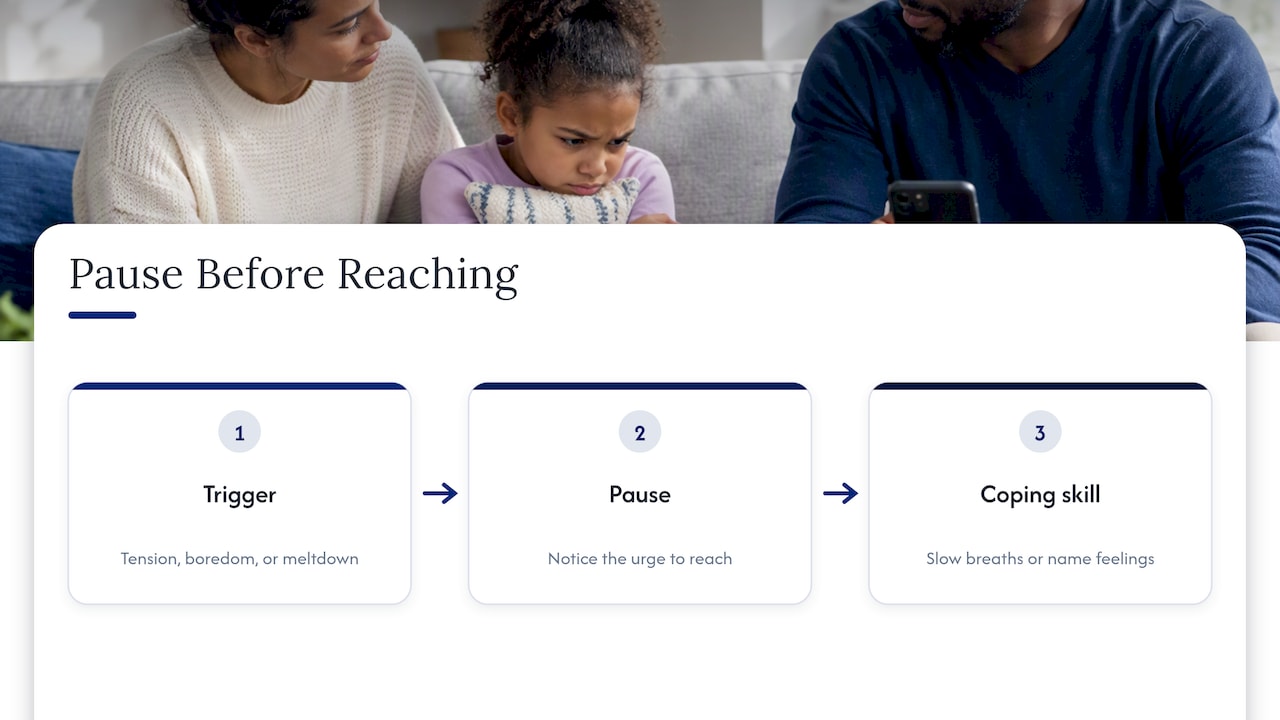
The same dynamic shows up in adults. Reaching for a phone the instant a conversation gets tense or a task feels boring is a learned habit, not a character flaw, and it crowds out the pause that usually defuses anger. Clinicians who work on anger management often ask clients to notice the gap between the triggering moment and the reach for a device, because that gap is where a calming skill, like a few slow breaths, can actually take hold.
Building that gap back in matters more than eliminating screens. Teaching a child to name a feeling before reaching for a tablet, or pausing before sending an angry text, rebuilds the regulation muscle that constant screen access can quietly sideline. Families working through recurring blowups around device use sometimes find it useful to work directly on emotional regulation skills for teens, since the screen conflict is often a symptom of a weaker underlying coping skill rather than the root problem itself.
Balancing screen time with offline social interactions and conflict resolution skills
Face-to-face interaction teaches skills that a screen cannot: reading tone of voice, tolerating an awkward silence, and repairing a disagreement in real time. Kids and adults who spend most of their social energy in text threads or games miss repeated small chances to practice these skills, and conflict resolution is a skill that only improves with practice.
This does not mean treating all screen-based social contact as empty. A video call with a distant grandparent or a group chat that plans a real gathering supports relationships rather than replacing them. The distinction is whether the screen time leads back to in-person connection or substitutes for it entirely.
A practical balance: protect a few in-person touchpoints a week, like a family dinner or a regular outing with friends, and treat those as non-negotiable before any screen privileges. When conflict does arise, whether between siblings or roommates, resist the urge to let a text exchange replace the harder, more valuable in-person conversation. Clinician tools built specifically for teaching teens to pause and choose a response, such as stop-breathe-reflect-choose techniques, give a concrete alternative to hashing things out, or avoiding them, over a screen.
Role of screen time in family dynamics and communication patterns beyond children
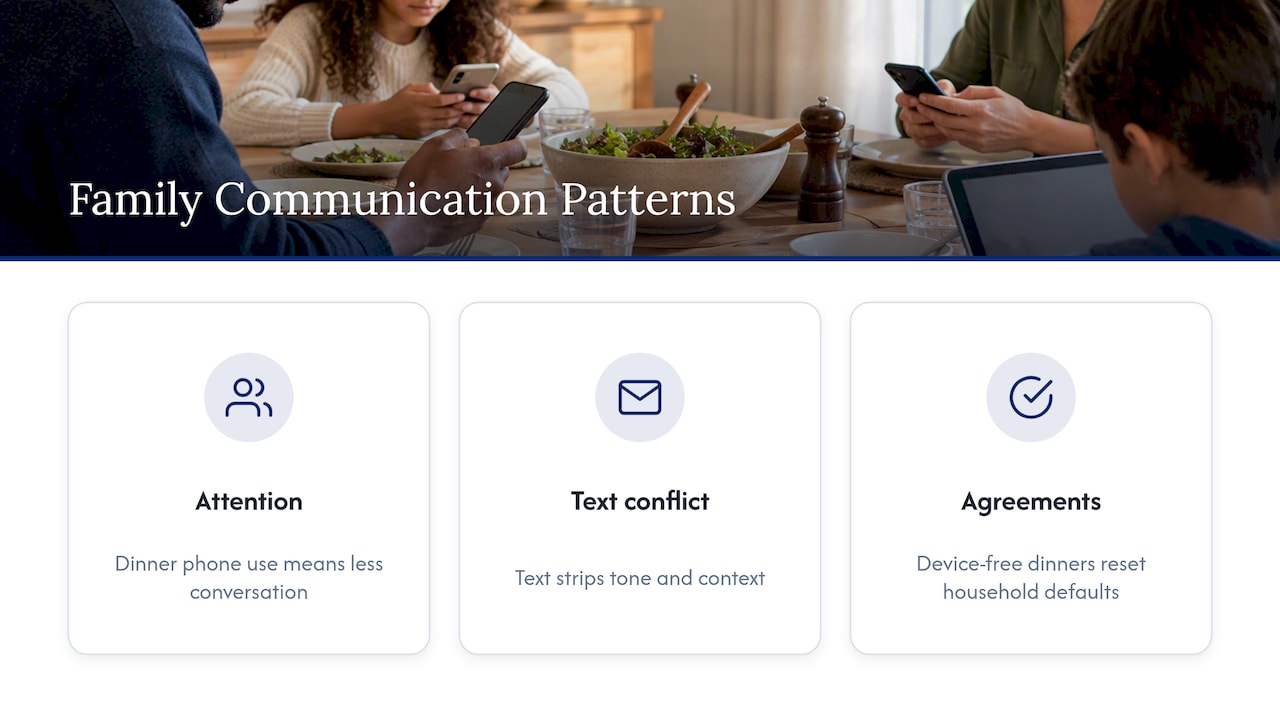
Screen habits shape adult relationships just as much as they shape kids. Parallel phone use during dinner, scrolling instead of debriefing the day, or checking work email during a partner’s story are small moments that add up to a household that talks less than it used to. Couples frequently describe feeling disconnected without being able to name a single incident, and fragmented attention from device use is often a quiet contributor.
Screens also change how conflict gets handled within families. Texting a disagreement instead of raising it in person can feel safer in the moment, but it strips out tone and context, which makes misunderstandings more likely and resolution slower. Some families default to group chats for logistics and never circle back to an actual conversation about the friction those logistics created.
Resetting these patterns usually takes a household agreement, not just an individual one. A shared commitment to device-free dinners, a charging station outside bedrooms, or a no-phones rule during a weekly family meeting resets the default without singling out one person as the problem. Families rebuilding these habits after a period of real strain sometimes benefit from structured support in family conflict resolution tools and teletherapy options, since communication habits formed around screens often need a deliberate, practiced replacement rather than a simple rule.
Techniques to address screen time during couple and family therapy sessions
In therapy, screen time rarely shows up as the primary complaint. It tends to surface as a symptom: a partner who feels ignored, a parent exhausted from nightly battles over a tablet, or a teen who withdraws into a device rather than engage with a difficult conversation. Clinicians typically start by mapping when and why screens enter the picture, rather than treating the device itself as the enemy.
A common technique is separating the behavior from the need it is meeting. A partner scrolling during a tense conversation may be avoiding conflict rather than being dismissive, and naming that distinction changes the conversation from blame to problem-solving. For families, therapists often use the same framing to help parents understand what a child’s device use is replacing, whether that is harder to access friendships, a way to self-soothe, or simply boredom with no obvious alternative.
From there, sessions usually build toward small, specific agreements rather than sweeping bans. One device-free meal, one hour of undistracted evening time, or a shared sign for “I need to finish this conversation before you look at your phone” tends to produce more lasting change than an outright prohibition that nobody can sustain.
Clinician perspective: translating research into low-conflict habits
Modeling works better than lecturing because children, and adults, learn regulation by watching it happen, not by being told about it. When a parent visibly puts a phone away during a hard conversation, that behavior gets absorbed more than any rule.
Clinician guidance consistently points to planning transitions ahead of time and teaching a concrete calming skill, like slow breathing, as a replacement for screen-based soothing, since clinicians report that pre-agreed scripts reduce on-the-spot negotiation. Watch for dependence that interferes with sleep, schoolwork, or relationships. That pattern is a reasonable signal to seek professional support rather than another app limit.
— Carlos
When coaching or therapy can help with screen-related conflict
Screen battles rarely stay confined to a device. When they spill into constant arguments, a child’s rising temper, or a partner who feels unheard, a household rule alone usually is not enough.

Structured support is available for exactly these moments: anger management classes that build the calming skills screens often replace, counseling for parents navigating defiance and meltdowns, and couples counseling when device habits have become a stand-in for a harder conversation. If screen conflict in your home feels bigger than a settings fix, explore our clinical services and schedule a consultation.
This article is general information, not a substitute for advice from a qualified doctor. Consult a qualified healthcare professional about your own circumstances before acting on anything here.
FAQ
What is the best way to manage screen time?
The most effective approach combines one clear household rule, like no screens at meals, with a device-level limit that enforces it automatically. Focusing on protecting sleep, relationships, and activity tends to work better long-term than tracking minutes alone, according to the AAP’s framing of healthy digital ecosystems.
What are the 3 C’s of screen time?
There is no single, universally cited “3 C’s” framework in pediatric guidance; the American Academy of Pediatrics instead uses a five-part model. If you have seen a shorter version referenced elsewhere, it is likely a simplified take on the fuller 5 Cs framework.
What are the 5 C’s of screen time?
The AAP’s 5 Cs are Child, Content, Calm, Crowding Out, and Communication, a framework that asks families to weigh who is using the screen, what they are watching, whether it disrupts calm or sleep, what it displaces, and how it affects family communication. This replaces a single time limit with a more complete picture of screen use.
How much does screen time affect a child’s sleep?
Each additional hour of screen time is linked to roughly 3 to 5 minutes less total sleep and a bedtime delayed by about 13.2 minutes, based on a meta-analysis of 21 cohort studies. The same analysis found screen use before bed more than triples the odds of difficulty falling asleep.
When should screen time concerns lead to professional help?
Consider professional support when screen use consistently disrupts sleep, schoolwork, or relationships, or triggers outsized anger when access ends. Family or individual counseling can address the underlying regulation or communication patterns that often drive these conflicts.
Sources
The American Academy of Pediatrics offers the fullest clinical framework for family screen decisions, while the sleep meta-analysis quantifies the stakes. Apple’s Screen Time and Android’s Digital Wellbeing support pages walk through exact setup steps for the tools mentioned above, and a daily emotional regulation resource offers additional practice exercises for the calming skills discussed here.
- AAP Center of Excellence on Social Media and Youth Mental Health — 5 Cs framework
- Meta-analysis on screen time and sleep (PMC)
- Meta-analyses on parent-focused interventions and child outcomes (PubMed)