
How to Apologize Sincerely: 6 Steps That Work

A sincere apology says you are sorry, names exactly what you did, shows you understand how it hurt, makes no excuses, explains what will change, and offers to repair the damage where you can. Then it stops talking and listens. The words matter, but what matters more is how the other person experiences them.
Below you will find the six steps, examples you can adapt, the phrases that quietly ruin an apology, and guidance on timing, text messages and the workplace. We also cover what to do when an apology isn’t enough on its own.
TL;DR
- Say “I’m sorry,” name the specific thing you did, and own it without “but.”
- Focus on the other person’s experience, not your intentions or your guilt.
- Say what you will do differently, and repair the damage where you can.
- Timing is judged by the listener: not too fast, not too late. Don’t use text for serious hurts.
- If the same conflict keeps coming back, an apology alone won’t fix the pattern. That is when skills practice or counseling helps.
Table of Contents
- What makes an apology sincere
- The six steps, with examples
- A full example, start to finish
- Phrases that ruin an apology
- Timing: not too soon, not too late
- In person, in writing, or by text
- Apologizing at work
- When the other person doesn’t accept it
- Our perspective
- When an apology needs more support
- Quick checklist before you apologize
- FAQ
- Sources
What makes an apology sincere
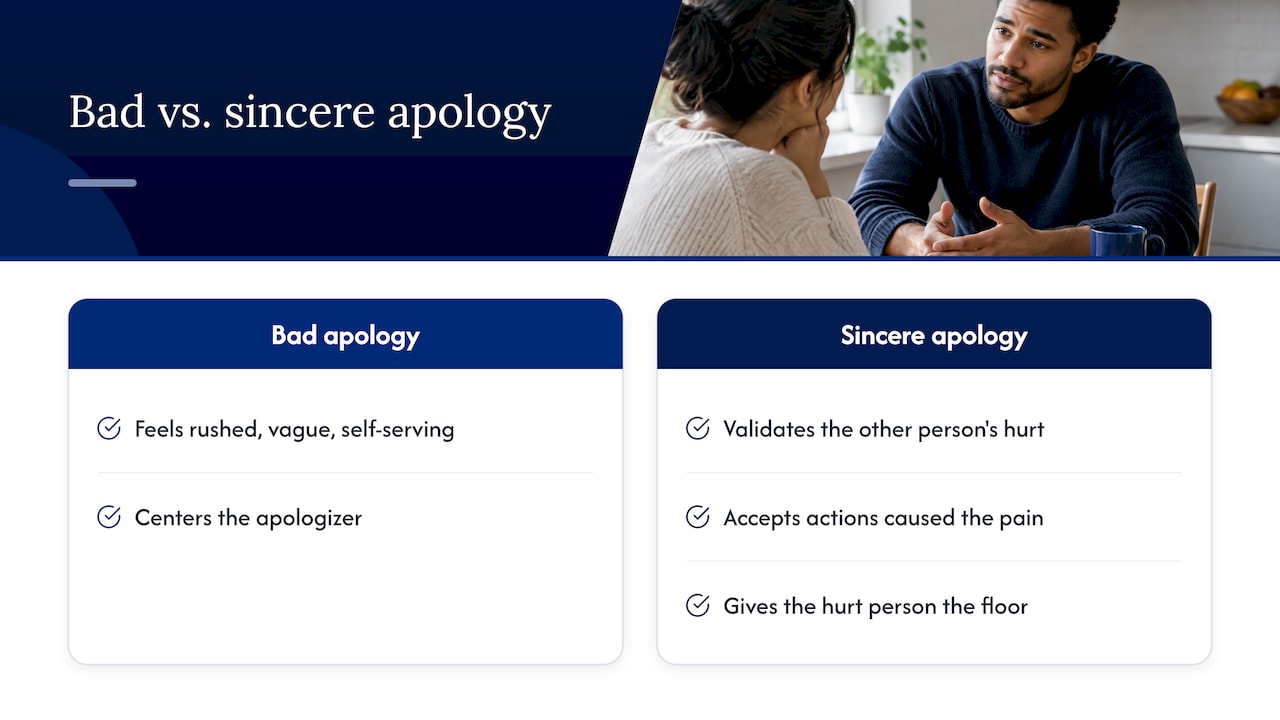
Most people know when they are on the receiving end of a bad apology. It feels rushed, vague or self-serving. A good one feels like being seen.
The Harvard Health overview of heartfelt apologies makes the same point: an apology works when it validates that the other person was hurt and accepts that your actions caused the pain. Researchers and authors Marjorie Ingall and Susan McCarthy go further. The apology is not about you. It is about the person you hurt, and about giving them the floor.
That shift changes everything you say. You stop asking “How do I get forgiven?” and start asking “What does this person need to hear to know I understand?”
The six steps, with examples
The framework below comes from the NPR interview with Ingall, who describes six steps and a “six-and-a-half”: listening. The examples are ours.
1. Say “I’m sorry”
Use the word “sorry.” The researchers advise against swapping in “I regret” or “I apologize,” because those sound formal and distant. Plain wording lands better.
Example: “I’m sorry.”
2. Say exactly what you are sorry for
Vague apologies leave the other person guessing whether you actually know what happened. Name the act, not a general category like “everything” or “how things went.”
Example: “I’m sorry I missed your birthday dinner and didn’t call until the next morning.”
The Love Is Respect guide lists naming what you did as the first step for the same reason: the hurt person needs to hear it as much as you need to say it.
3. Show you understand why it hurt
This is the step most people skip, and it carries the most weight. Describe the impact from the other person’s side. You are not guessing at their feelings. You are showing you have thought about them.
Example: “You’d told me it mattered, and you sat there waiting. I can see that it made you feel like you came second to my work.”
If you aren’t sure how it felt, ask. Our guide to empathy in conflict resolution walks through how to do that without defending yourself.
4. Make no excuses
Explanations have a place, but not inside the apology. “I was stressed” can be true and still sound like a request to be let off the hook. The research summary behind the NPR piece is blunt about it: avoid “but,” because it signals a rationalization.
If the other person asks why it happened, answer briefly and honestly. Otherwise, leave it out.
5. Say what will change
An apology without a plan is just regret. Tell the person what you will do differently, and make it something you can actually do.
Example: “From now on I’m putting your important dates in my calendar with two reminders, and I’m leaving work by six on those days.”
6. Make it right where you can
When there is something concrete to repair, offer to repair it. In the NPR example, the speaker offers to pay for the dry cleaning. In relationships the repair is often less tangible: a rescheduled dinner, a promise honored, time given.
6.5. Listen
After you have said your piece, stop. Don’t ask for a verdict. Let the person respond, even if the response is anger or silence. In the NPR Life Kit piece on apologizing, psychologist Harriet Lerner notes that our default is to listen defensively, hearing what we disagree with so we can correct the facts. Listen instead with the explicit goal of understanding.
A full example, start to finish
Here is how the steps sound together in a real situation. Say you snapped at your partner in front of friends.
“I’m sorry I snapped at you and made that joke about your cooking in front of everyone. It was embarrassing, and I think it made you feel disrespected in your own home. There’s no good excuse. I’m going to stop making you the punchline, and if I’m frustrated about something, I’ll bring it to you privately. If you want, I’ll apologize to our friends too. I’d like to hear how it felt for you.”
It takes about twenty seconds. It uses no “but,” no “if you were upset,” and no request for forgiveness.
Phrases that ruin an apology
These are the most common ways a sorry turns into something else.
| What people say | What the listener hears | Try instead |
|---|---|---|
| “I’m sorry if you were offended.” | Your reaction is the problem. | “I’m sorry I said that. It was disrespectful.” |
| “I’m sorry, but I was tired.” | An excuse. | “I’m sorry I raised my voice.” |
| “Sorry you feel that way.” | Dismissal. | “I’m sorry I hurt you. Tell me more about what it was like.” |
| “I said I’m sorry, what more do you want?” | Pressure to forgive. | “Take the time you need. I’ll be here.” |
| “I’m sorry, you did X too.” | A trade. | Apologize alone; raise your concern later. |
The Irish Ombudsman’s guide to making a meaningful apology is written for public bodies, but its advice holds for anyone: a conditional “sorry if” shifts blame onto the other person’s reaction, and a good apology names the specific action. It also warns against trying to extract an apology in return during your own. If you have a grievance, have that conversation separately, later.
Timing: not too soon, not too late
People ask whether there is a right number of hours or days. There isn’t one. A study from Carleton University found that the apology the recipient perceives as arriving at “just the right time” works best. In those experiments, people who got a “just right” apology rated their willingness to forgive at 6.24 on a 7-point scale, against 4.93 for those who didn’t. They also reported more closeness.
What does that mean in practice?
- Too fast can feel like you are trying to end the discomfort, not understand it. If you apologize before you know what happened, you will get step 3 wrong.
- Too late can feel like you didn’t care, or that the other person had to carry the hurt alone.
- Right usually means after you have calmed down and thought about it, and while the person is still open to hearing it.
If emotions are still high, you can say: “I know I hurt you. I’d like to talk about it properly when you’re ready. Can we set a time?” That is not the full apology, but it shows you take it seriously.
The same study found that feeling heard and understood is what helps an apology work. So if you are unsure about timing, put your effort into step 3 and step 6.5.
In person, in writing, or by text
Face to face
For serious hurts, in person is usually best, or a phone or video call if distance makes that impossible. Tone, eye contact and a chance to respond matter.
Writing a letter or email
Writing helps when the person isn’t ready to talk, or when you want to get the words exactly right. Use the same six steps. Don’t demand a reply. A written apology is also standard in formal settings. Scotland’s duty of candour guidance, for example, says organizations must offer a written apology, which can be by email if that is the person’s preference.
Over text
Text is fine for small things: running late, a forgotten errand. For a real hurt, use it only to open the door (“I owe you a proper apology. Can we talk tonight?”).
There is a reason to be careful. Brigham Young University research found that, for women, using text to apologize or work out differences was linked to lower relationship quality. For men, texting a lot in general was associated with lower quality. The same research found that a sweet or loving text works well for both. Texts are for warmth; the hard conversation needs a voice.
Apologizing at work
The six steps still apply, with a few adjustments:
- Keep it shorter and focus on the specific action and its impact on the work or the person.
- Make step 5 concrete: a process change, a checklist, a deadline.
- If you manage people, apologize to the person first, and to the team only if the team was affected.
- Don’t over-apologize. Repeating “sorry” for small things makes the real ones count for less.
If you are a manager handling a tense situation, our scripts for resolving workplace conflict show how to word difficult conversations, and our piece on assertive communication helps you apologize without grovelling or becoming defensive.
When the other person doesn’t accept it
A sincere apology is not a guarantee of forgiveness. Some hurts take time. Some relationships won’t recover. You can control the quality of the apology, not the response.
- Thank them for listening, without asking for anything more.
- Do what you said you would do. Changed behavior is the strongest part of any apology.
- Don’t repeat the apology over and over. Say it well once, and let your actions say the rest.
- Raise your own concerns later, in a separate conversation.
One caveat from the research: the Carleton paper notes that for some trust violations based on integrity, a highly credible denial can restore trust better than an apology. If you didn’t do the thing you’re accused of, an apology is not the right tool. Say so plainly and calmly instead.
Our perspective
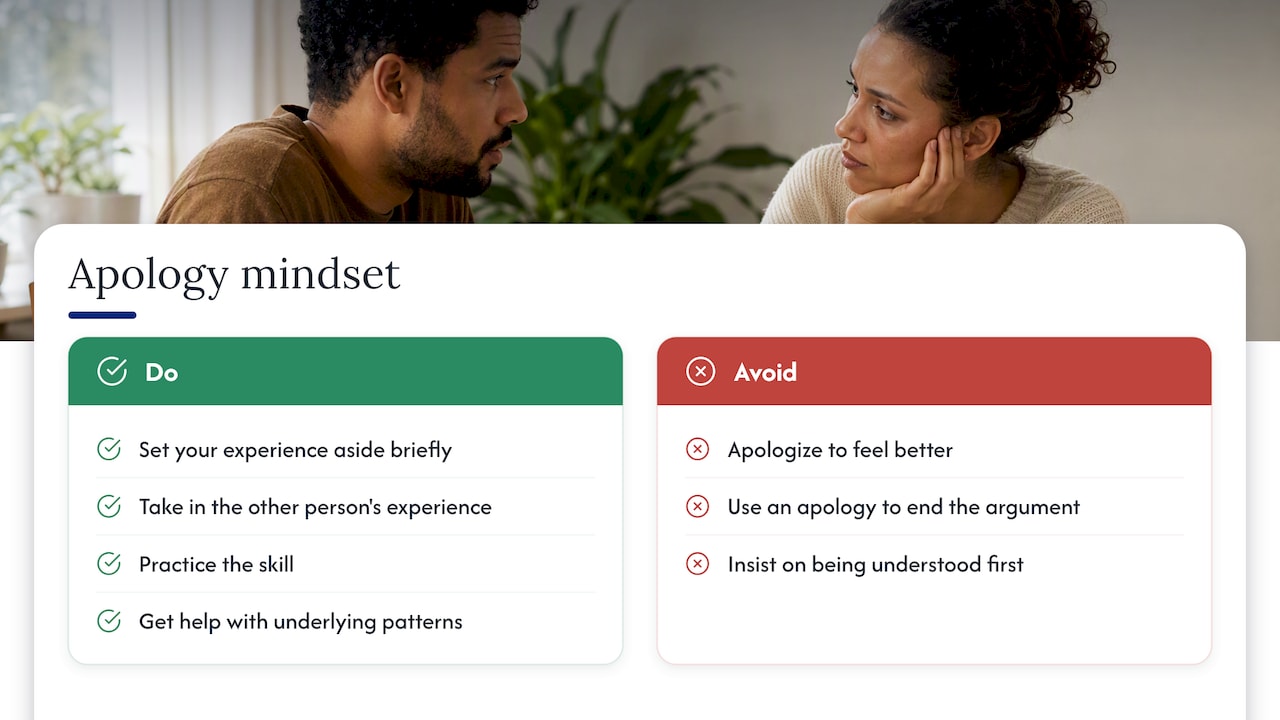
We see apologies go wrong in the same few ways, in couples, families and workplaces. The apology is usually meant well. It fails because the person apologizing is trying to feel better, to end the argument, or to be understood first.
Our work as clinicians begins with a simple idea: conflict is about two experiences that both feel true. A sincere apology doesn’t ask you to give up yours. It asks you to set it aside long enough to take in the other person’s. That is a skill, and like any skill it can be practiced.
If you find yourself apologizing for the same thing again and again, or if every apology turns into a new argument, the apology isn’t the problem. The pattern underneath is. Sometimes that pattern is anger that rises faster than you can manage it. Sometimes it is a communication habit you never learned a better way to replace. Both can change, and you don’t have to figure it out alone.
Our six-step conflict resolution guide gives you exact scripts to practice with, and our post on how to diffuse a conflict with your partner helps you slow things down before the apology is needed.
— Carlos
When an apology needs more support
Sometimes the hurt is bigger than one conversation. Repeated outbursts, broken trust or an affair call for structured help, not just better words.
We offer several options, depending on what you need:
- Anger management classes, online and at your own pace: 1 Hour Anger Management Class for $24.99, 6 Hour for $79, and 8 Hour for $85. They suit people who want to understand and manage the reactions that lead to apologies in the first place.
- Couples sessions at $175 per hour, plus longer programs, including a 6 Hour Couples Intensive at $1,995, listed on our couples packages page.
- Individual, family and teen counseling, including infidelity recovery, on our clinical services page. Teletherapy is available as well.
If you are not sure where to start, our homepage is the best place to look around and book.
If you or someone in your home is in danger, contact local emergency services or the National Domestic Violence Hotline at 1-800-799-7233 first. An apology is not a safety plan.
Quick checklist before you apologize
- Can I name exactly what I did?
- Can I describe how it affected them, in their terms?
- Have I removed every “but,” “if” and “you also”?
- Do I have one concrete change to offer?
- Is there something I can repair?
- Am I ready to listen, including to anger, and to ask for nothing in return?
- Is this the right channel: in person for serious hurts, text only to open the door?
If you can answer yes to most of these, you are ready. If not, take a bit more time. It is better to be a little late and sincere than quick and hollow.
FAQ
What is an example of a sincere apology?
“I’m sorry I forgot to pick you up and left you waiting in the rain for an hour. You must have felt forgotten, and that’s on me. I’ve set an alarm on my phone and I’ll text you when I leave. I’ll also cover your cab fare. How are you feeling about it?” It names the act, shows understanding, offers a change and a repair, and invites a response.
How do you apologize sincerely over text?
Keep texts for small matters, and be specific even then. For a serious hurt, use the text to ask for a conversation, such as “I owe you a real apology. Can we talk tonight?” Research from BYU links using text to work out differences with lower relationship quality for women. Follow up in person or by phone.
How do you apologize sincerely at work?
Be brief and factual. Name what happened, say how it affected the other person or the work, and state the fix. If it was a mistake that affected a team, tell them what process will change. Avoid long emotional explanations, and don’t apologize repeatedly for the same thing.
How long should you wait to apologize?
There is no fixed time. The Carleton study found that what matters is whether the other person feels it came at the right time. Wait until you understand what happened and can listen, but don’t wait so long that they feel you didn’t care.
What if I apologize and they still won’t forgive me?
That is their right, and it doesn’t mean your apology failed. Do what you said you would do, give them space, and don’t ask them to forgive you. If the same conflicts keep returning, couples or individual counseling can help you both change the pattern.
Sources
- NPR: How to say sorry and give a good apology
- NPR Life Kit: 6 Ways To Apologize Like You Mean It
- Harvard Health: The art of a heartfelt apology
- Love Is Respect: How to genuinely apologize
- Ombudsman.ie: The Ombudsman’s Guide to Making a Meaningful Apology
- Carleton University study on apology timing
- BYU News: Too much texting can disconnect couples
- Scottish Government: Organisational Duty of Candour Guidance