
How to Resolve Arguments Effectively and Rebuild Trust

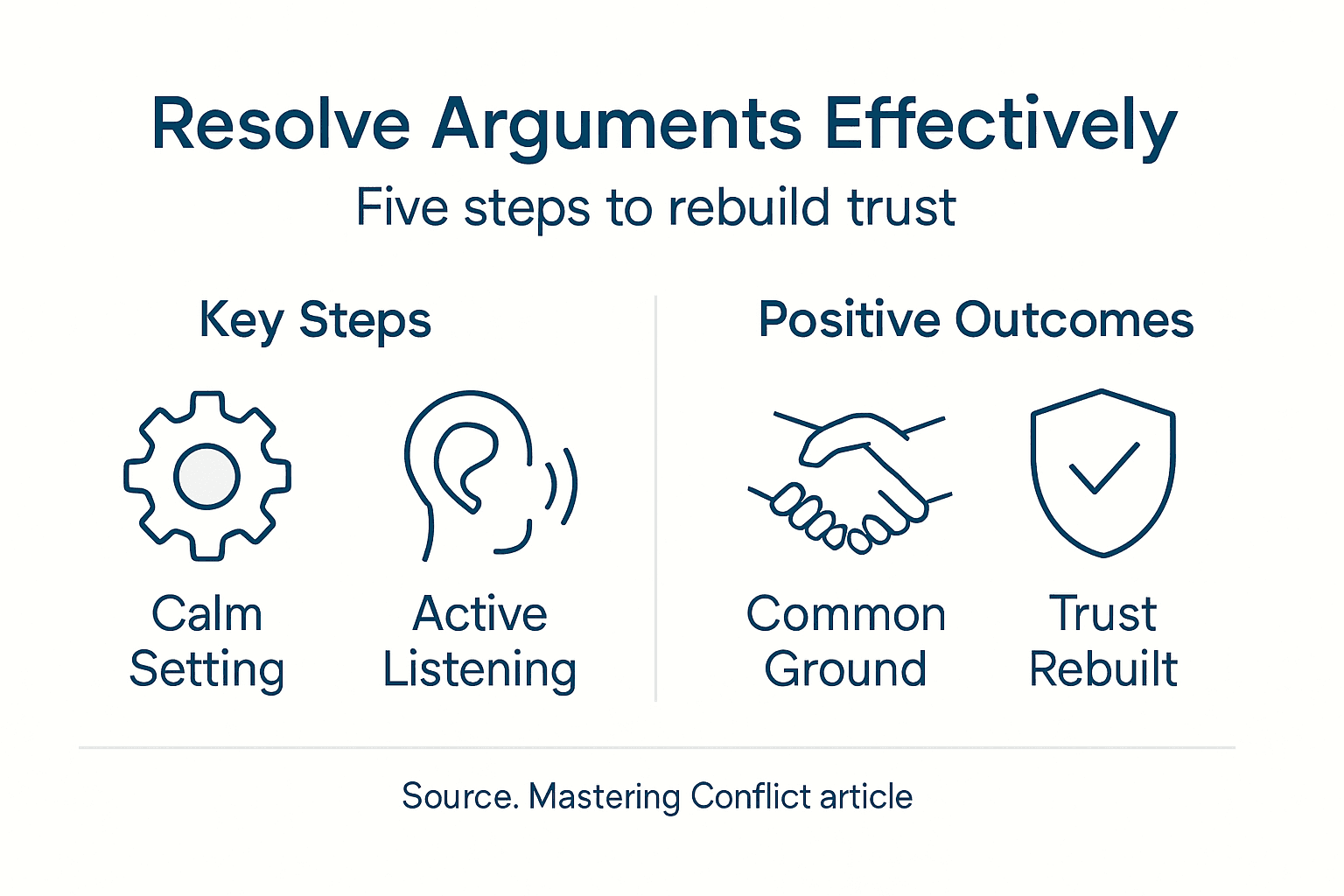
Arguments between couples can quickly spiral when tense words and defensive body language take over. For many in North Carolina and South Carolina, these moments create distance instead of deeper understanding. Building stronger relationships starts when you use calm communication techniques to turn conflict into genuine connection. This guide breaks down practical, therapist-backed steps for couples to communicate openly, listen actively, and find real solutions together—even from the comfort of home with online support.
Table of Contents
- Step 1: Set the Stage for Calm Communication
- Step 2: Listen Actively to Your Partner’s Perspective
- Step 3: Express Your Feelings Without Blaming
- Step 4: Find Common Ground and Agree on Solutions
- Step 5: Reflect on the Outcome and Reconnect
Quick Summary
| Key Takeaway | Explanation |
|---|---|
| 1. Create a Calm Environment | Select a neutral location and time to facilitate comfortable conversation and reduce emotional tension. |
| 2. Practice Active Listening | Give your full attention to your partner without interruptions, ensuring they feel heard and understood. |
| 3. Use “I” Statements | Communicate your feelings using “I” statements to express vulnerability without placing blame on your partner. |
| 4. Collaborate on Solutions | Work together to identify shared goals and brainstorm solutions that honor both partners’ perspectives. |
| 5. Reflect and Connect | After resolving conflicts, discuss the conversation’s effectiveness to reinforce communication patterns and emotional bonds. |
Step 1: Set the Stage for Calm Communication
Resolving arguments effectively starts with creating an environment that promotes understanding and respect. Calm communication techniques transform heated moments into opportunities for genuine connection.
Begin by selecting a neutral location where both people feel comfortable and safe. This might be a quiet room in your home or a calm outdoor space where interruptions are minimal. Choose a time when neither person is exhausted, hungry, or already stressed from other challenges. Physical environment matters immensely in setting the tone for productive dialogue.
Body language plays a crucial role in signaling openness and receptivity. Sit facing each other at a comfortable distance, maintain relaxed postures, and avoid crossing arms or displaying defensive stances. Your nonverbal cues can communicate willingness to listen before a single word is spoken. Keep eye contact gentle and consistent to demonstrate engagement without feeling confrontational.
Pro Tip: Take three deep breaths together before starting your conversation to synchronize your emotional states and create an immediate sense of shared calm.
Step 2: Listen Actively to Your Partner’s Perspective
Active listening transforms conflict from a battleground into an opportunity for mutual understanding. Active listening techniques help partners move beyond surface level disagreements to deeper emotional connections.
To listen actively, start by giving your partner your undivided attention. Put away electronic devices, turn your body toward them, and maintain gentle eye contact. Resist the impulse to interrupt or prepare counterarguments while they speak. Instead, focus completely on understanding their perspective and emotional experience. Use nonverbal cues like nodding and maintaining an open posture to signal you are genuinely hearing them.
Practice reflective listening by periodically summarizing what you have heard. Use phrases like “What I hear you saying is…” or “If I understand correctly…” This demonstrates you are processing their words and creates opportunities for clarification. By showing you truly want to understand their perspective, you create a safe space for honest communication and reduce defensive reactions.
Pro Tip: Pause for at least three seconds after your partner finishes speaking to ensure you have fully absorbed their message before formulating your response.
Step 3: Express Your Feelings Without Blaming
Communicating your emotions effectively requires vulnerability and strategic language choices. Emotional self-regulation skills help you transform potentially defensive conversations into opportunities for genuine understanding.
Start by focusing on your personal experience using “I” statements that describe your feelings without attacking your partner. Instead of saying “You always ignore me,” reframe the sentiment as “I feel disconnected when our communication feels one-sided.” This approach shifts the conversation from accusation to personal vulnerability. Describe your emotions using clear language like “I feel frustrated,” “I feel hurt,” or “I feel misunderstood” without qualifying or blaming your partner for those feelings.

Practice emotional transparency by sharing the underlying emotions driving your reaction. Explain the root of your feelings using specific examples that illuminate your perspective without creating defensiveness. Speak from a place of seeking mutual understanding rather than winning an argument. Your goal is to create a collaborative environment where both partners feel heard and validated.
Pro Tip: Pause and take a deep breath before speaking to ensure your emotions are regulated and your words come from a place of genuine connection.
Step 4: Find Common Ground and Agree on Solutions
Successful conflict resolution depends on discovering shared goals and collaborative problem solving. Calm communication strategies transform arguments from competitive encounters into cooperative opportunities for mutual understanding.
Begin by identifying the underlying needs and values you both share. Look beyond the surface disagreement to recognize your mutual desires for respect, connection, and relationship harmony. Ask clarifying questions like “What matters most to you in this situation?” or “What outcome would make both of us feel heard and respected?” This approach shifts the conversation from winning an argument to finding a solution that honors both partners perspectives.
Draft potential solutions together by brainstorming without judgment. Create a collaborative environment where both partners can suggest ideas freely. Use language that emphasizes teamwork like “How can we solve this together?” or “What compromise might work for both of us?” Be willing to make incremental agreements and remain flexible. Sometimes the solution emerges through open dialogue and mutual willingness to understand each other’s viewpoints.
Pro Tip: Write down potential solutions during your discussion to create a tangible record of your collaborative problem solving.
Step 5: Reflect on the Outcome and Reconnect
The final stage of resolving conflicts is about understanding the journey and reinforcing your relationship’s foundation. Argument reflection strategies help transform challenging moments into opportunities for deeper connection and mutual growth.
After resolving a disagreement, take time to discuss how the conversation went. Acknowledge the efforts you both made to communicate respectfully and understand each other. Share what you learned about yourself and your partner during the process. Recognize the moments where you successfully listened, showed empathy, or chose collaborative language. This reflection helps reinforce positive communication patterns and demonstrates a commitment to continuous relationship improvement.
Physical and emotional reconnection is crucial after navigating a difficult conversation. Consider sharing a meaningful gesture of affection like a hug, holding hands, or planning a shared activity that reminds you of your connection. Express gratitude for your partner’s willingness to work through challenges together. Reaffirm your commitment to ongoing open and honest communication as a team.
Pro Tip: Schedule a brief check-in within 24 hours to ensure you both feel heard and the resolution feels satisfactory.
Use this table to compare healthy vs. unhealthy conflict resolution styles:
| Aspect | Healthy Approach | Unhealthy Approach |
|---|---|---|
| Focus | Mutual understanding | Assigning blame |
| Communication Style | Calm and open | Defensive or hostile |
| Emotional Tone | Respectful and caring | Dismissive or aggressive |
| Outcome | Win-win solutions | Ongoing resentment |
Here’s how each step in resolving arguments contributes to healthier relationships:
| Step | Core Skill Developed | Impact on Relationship | Example Action |
|---|---|---|---|
| Set the Stage | Calm communication | Reduces emotional escalation | Choose a neutral location |
| Listen Actively | Empathetic listening | Increases trust and safety | Summarize partner’s view |
| Express Feelings | Vulnerability | Prevents blame and defensiveness | Use “I feel” statements |
| Find Common Ground | Collaboration | Fosters teamwork and shared solutions | Brainstorm together |
| Reflect and Reconnect | Growth mindset | Strengthens emotional bond | Discuss what worked well |
Transform Arguments Into Growth With Expert Support
Arguments often leave us feeling misunderstood and distant. This article highlights key steps like calm communication and expressing feelings without blame to rebuild trust and reduce tension. Yet, putting these strategies into action can be challenging without guidance. If frustration, repeated conflicts, or emotional disconnect sound familiar, you are not alone. Achieving lasting peace involves developing emotional self-regulation and collaborative problem solving skills backed by professional insight.
Take control of your relationships today by exploring Mastering Conflict for tailored solutions. Whether you seek personalized couples therapy, anger management classes, or support for deeper emotional connection, our expert team, led by Dr. Carlos Todd, provides evidence-based care designed to meet your unique needs. Don’t wait for conflicts to escalate further. Start rebuilding trust and transforming communication patterns now with Mastering Conflict. Your journey toward healthier relationships begins here.
Frequently Asked Questions
How can I create a calm environment for resolving arguments?
To create a calm environment, choose a neutral location where both parties feel comfortable and safe. Ensure that it’s a good time for both of you by avoiding moments when either person is stressed or distracted.
What techniques can I use for active listening during a disagreement?
Use active listening by giving your partner your full attention, maintaining eye contact, and refraining from interrupting. After they speak, summarize their points with phrases like “What I hear you saying is…” to show you understand their perspective.
How can I express my feelings without sounding accusatory?
To express your feelings effectively, use “I” statements that focus on your emotions rather than blaming your partner. For example, say “I feel hurt when communication feels one-sided” instead of placing blame on them.
What steps should I take to find common ground in an argument?
Start by identifying shared goals or values and discussing what both of you need from the situation. Brainstorm potential solutions together to foster collaboration and strengthen your connection.
How can I reinforce trust after resolving a conflict?
After resolving an argument, take time to reflect on the discussion and appreciate each other’s efforts. Schedule a brief check-in within 24 hours to ensure both of you feel heard and the resolution is satisfactory.
Recommended
- How to Deal With Parenting Conflicts
- Rebuilding Trust After Betrayal: A Step-by-Step Process – Mastering Conflict
- 21 Ways to Control Anger in a Relationship
- Effective Conflict Resolution Steps for Couples, Families, and Professionals 2025 – Mastering Conflict
- Capire il trust: significato e importanza nella società • Gio Talente
- The Culture Catalyst: Patrick Lencioni’s Five Behaviors Model – Stratgetic IT Consultants for Accountants