
How to Rebuild Trust in Relationships: 2026 Guide

TL;DR:
- Rebuilding trust involves consistent, transparent behavior paired with emotional and internal transformation from both parties. This process requires months or years of deliberate effort, full disclosure, and managing internal feelings to restore safety and reliability. Success depends on patience, internal growth, open communication, and professional support when needed.
Rebuilding trust is the intentional process of restoring reliability, honesty, and emotional safety between people after a breach has occurred. Whether you are a couple recovering from infidelity, a parent repairing a relationship with a teenager, or a professional working through a conflict at work, the path forward requires the same core ingredients: accountability, consistent behavior, and emotional courage. Knowing how to rebuild trust means understanding that no single conversation or grand gesture does the job. The process unfolds over months, sometimes years, and demands deliberate daily effort from everyone involved.
What are the foundational steps to rebuild trust effectively?
Trust repair begins with full accountability. The person who caused the breach must acknowledge what happened without minimizing, deflecting, or offering premature explanations. A partial admission keeps the injured person in a state of uncertainty, which is the opposite of safety. Accountability is not a one-time statement. It is a posture you maintain throughout the entire repair process.
The next step is what psychologists call the “Glass House” phase. This means voluntary, comprehensive disclosure of relevant information, shared openly and without being asked. The goal is to reduce the cognitive burden on the betrayed person. When they have to search for information or wonder what else they do not know, their nervous system stays on high alert. Willingly offering transparency removes that burden and signals genuine commitment to change.
One critical warning: avoid trickle truth. Repeated partial disclosures reset the healing process every time a new detail surfaces. Full disclosure in one conversation is far more effective than a slow drip of revelations spread over weeks. Each new revelation feels like a fresh betrayal, even when the underlying event is the same.
Consistent small actions outperform dramatic gestures. Psychologists recommend daily 5-minute emotional awareness exercises as a practical starting point. These exercises build self-regulation habits that reduce the likelihood of slipping back into old behaviors. Over time, small reliable actions accumulate into a new track record that the injured person’s brain can actually use to predict safety.
- Acknowledge the breach fully without minimizing or deflecting.
- Enter the Glass House phase by sharing information proactively and willingly.
- Disclose completely in one conversation rather than in fragments over time.
- Practice daily emotional awareness to build self-regulation and prevent relapse.
- Show up consistently through small, reliable actions rather than grand one-time gestures.
Pro Tip: Sharing a moment of personal weakness before a slip happens, not after, builds more transparency than silence or perfection. Proactive honesty signals that you are no longer hiding.
How does internal emotional transformation support rebuilding trust?
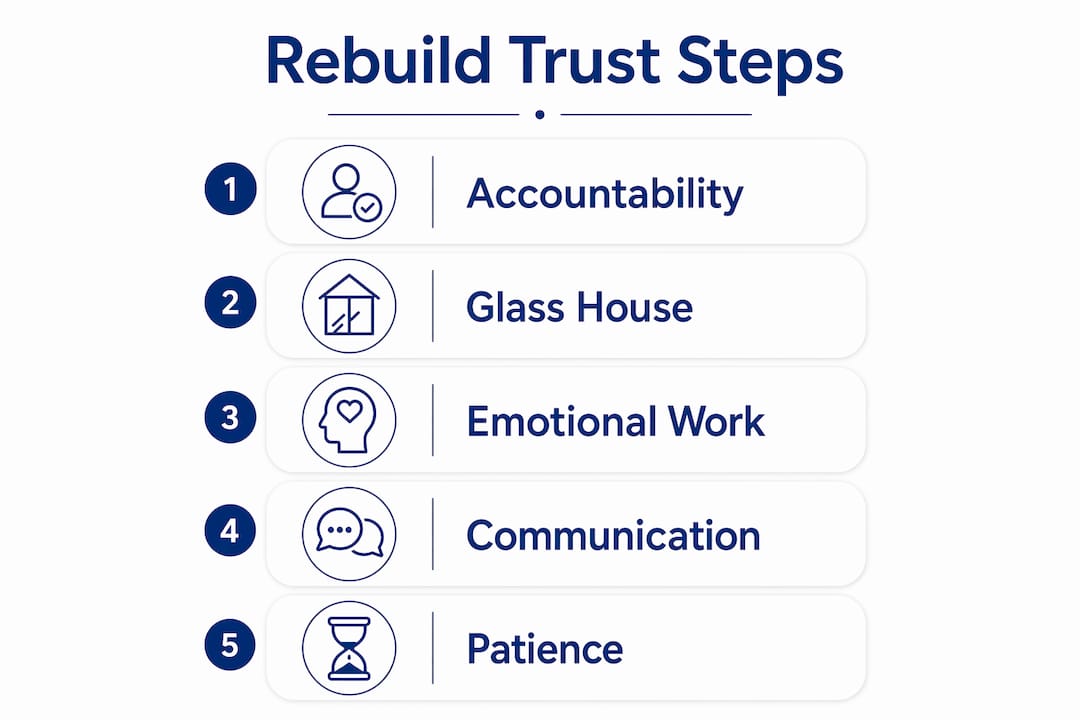
Behavioral change alone does not restore trust. The injured person can observe new behaviors and still feel unsafe if their internal emotional state has not shifted. Both parties need cognitive and emotional transformation alongside the behavioral work. This is one of the most overlooked facts in trust repair.
For the person who caused the breach, the internal work involves managing emotions like shame, defensiveness, and sustained anger. Cognitive reappraisal, a technique where you consciously reframe a situation to change its emotional impact, helps prevent reactive behavior that erodes new trust. Emotional awareness practices improve self-regulation and reduce the risk of returning to old patterns. Anger management resources, including clinical exercises for self-regulation, can support this internal shift directly.
For the injured person, the internal work is equally demanding. It involves managing hypervigilance, processing grief, and eventually moving toward a place where forgiveness becomes possible. Self-forgiveness also plays a role. Many injured people blame themselves for missing warning signs, and that self-blame interferes with healing.
Key internal shifts that support genuine trust restoration:
- Cognitive reappraisal: Actively reframe triggering situations rather than reacting from fear or anger.
- Empathy practice: Both parties work to understand the other’s emotional experience without dismissing their own.
- Self-forgiveness: The injured person releases self-blame; the person who caused harm releases paralyzing shame.
- Positive perception building: Consciously notice and acknowledge new trustworthy behaviors as they appear.
Pro Tip: If you find sustained anger blocking your progress, a structured anger management assessment can identify specific patterns that need clinical attention before they derail the repair process.
What practical communication strategies enhance trust rebuilding?
Open, non-defensive dialogue is the vehicle through which all other trust-building work becomes visible. Validation of pain without excuses is the single most effective communication move the person who caused harm can make. Validation means saying, “What I did caused you real pain, and that pain makes complete sense,” without immediately pivoting to your own feelings or explanations.

Boundary setting is the next communication priority. New boundaries are not punishments. They are agreements that both people create together to define what safety looks like going forward. Collaborative boundary setting gives the injured person agency and gives the person who caused harm a clear structure to operate within. Both outcomes reduce anxiety on both sides.
De-escalation techniques matter when conversations get heated. Agreeing on a time-out signal, returning to the conversation within a set window, and using “I” statements rather than accusations all reduce the chance that a difficult conversation collapses into a fight. Conflict that ends in shutdown or explosion sets back trust repair significantly.
Transparency must be given willingly. Compelled transparency, such as sharing passwords only when pressured, undermines the purpose of the gesture entirely. The injured person needs to feel that openness is chosen, not extracted. When transparency feels forced, it reads as compliance rather than genuine change.
How long does rebuilding trust take, and what challenges might arise?
Trust restoration is a process of retraining the brain. The injured person’s nervous system learned that this relationship is unsafe. Rebuilding trust means generating new, consistent data points that gradually teach the brain to predict safety again. That retraining takes months to years, not weeks.
Healing from betrayal is not linear. Progress and regression spiral together, and a single trigger can temporarily undo weeks of forward movement. The pace of healing is set by the injured partner’s nervous system, not by the timeline the other person finds comfortable.
The table below outlines common challenges and the responses that keep the process moving forward.
| Challenge | What it looks like | Effective response |
|---|---|---|
| Emotional triggers | Sudden fear or anger from a reminder of the breach | Name the trigger, pause, and reconnect without defensiveness |
| Trickle truth | New details emerging after initial disclosure | Commit to full disclosure now; each new detail resets progress |
| Impatience | The person who caused harm pushing for faster forgiveness | Accept that the injured person’s nervous system sets the pace |
| Setbacks | A regression after a period of progress | Treat it as information, not failure; recommit to daily practices |
| Compelled transparency | Sharing information only when asked or pressured | Shift to proactive, voluntary disclosure to restore genuine safety |
Setbacks are not signs that the relationship is beyond repair. They are a normal feature of non-linear healing. The step-by-step process of repairing after infidelity and other major breaches consistently shows that couples and families who persist through setbacks reach genuine restoration more often than those who expect a straight line.
Patience is not passive. It means actively continuing the daily practices, the honest conversations, and the emotional work even when progress feels invisible. The complete guide to rebuilding trust in relationships outlines how sustained effort across all these dimensions compounds over time into real, lasting change.
Key Takeaways
Rebuilding trust requires consistent, transparent behavior paired with genuine internal emotional work from both parties, sustained over months or years.
| Point | Details |
|---|---|
| Accountability comes first | Acknowledge the breach fully and without deflection before any other repair work begins. |
| Glass House phase is critical | Proactive, voluntary disclosure reduces the injured person’s cognitive burden and signals real change. |
| Avoid trickle truth | Partial disclosures reset healing progress; full disclosure in one conversation is far more effective. |
| Internal work is non-negotiable | Cognitive reappraisal, empathy, and self-regulation must accompany behavioral changes for genuine restoration. |
| Healing is non-linear | Setbacks are normal; the injured partner’s nervous system sets the pace, and patience is an active practice. |
What I have learned from years of working through trust repair
After years of working with couples, families, and individuals in clinical settings, the pattern I see most often is this: people focus almost entirely on what they are doing and almost never on what they are feeling. They track behaviors obsessively and neglect the internal emotional shifts that make those behaviors credible.
The trust equation, which balances credibility, reliability, and intimacy against self-orientation, tells you something important. High self-orientation divides the trust score dramatically. When the person who caused harm is primarily focused on their own discomfort, their own timeline, or their own need to be forgiven, the injured person feels it. That self-focus reads as a continuation of the same pattern that caused the breach in the first place.
What actually moves the needle is when the person who caused harm gets genuinely curious about the other person’s experience, not as a strategy, but as a real shift in attention. That shift is what transforms compliance into connection. Prenatal and family contexts add another layer. Parents rebuilding trust with children or co-parents face the added pressure of modeling emotional safety for young people who are watching every move. Resources on prenatal emotional support and family-centered emotional awareness can help parents build the internal capacity they need before they can offer it to others.
The hardest thing I tell clients is that you cannot rush the other person’s healing. You can only control the quality and consistency of your own actions. That is both the most frustrating and the most freeing truth in this entire process.
— Carlos
Professional support for rebuilding trust and relationships
Rebuilding trust on your own is possible, but the process moves faster and more safely with professional guidance. Masteringconflict offers clinical services for individuals, couples, and families working through betrayal, conflict, and trust repair.

For men navigating the specific emotional and relational challenges that come with trust repair, men’s counseling at Masteringconflict provides a focused, evidence-based space to do that work. If distance or scheduling is a barrier, teletherapy options make professional support accessible from anywhere. Masteringconflict serves clients across North Carolina, South Carolina, Florida, and internationally through online sessions. Reaching out is not a sign that you have failed. It is the clearest sign that you are serious about getting this right.
FAQ
What is the first step to rebuild trust after betrayal?
Full accountability is the first step. The person who caused the breach must acknowledge what happened clearly and without deflection before any other repair work can take hold.
How long does it take to regain trust in a relationship?
Trust restoration typically takes months to years, not weeks. The pace is set by the injured person’s nervous system, and healing follows a non-linear path with periods of progress and regression.
What is trickle truth, and why does it matter?
Trickle truth is the pattern of disclosing information in small pieces over time rather than all at once. Each new detail resets the healing process and feels like a fresh betrayal, making full disclosure in one conversation far more effective.
Can trust be fully restored after a major breach?
Yes. Clinical research and practice consistently show that couples and families who commit to consistent behavioral change, internal emotional work, and open communication can reach genuine, lasting trust restoration.
How does communication help with overcoming trust issues?
Validating the injured person’s pain without excuses, setting collaborative boundaries, and practicing non-defensive dialogue all create the emotional safety that trust repair requires.