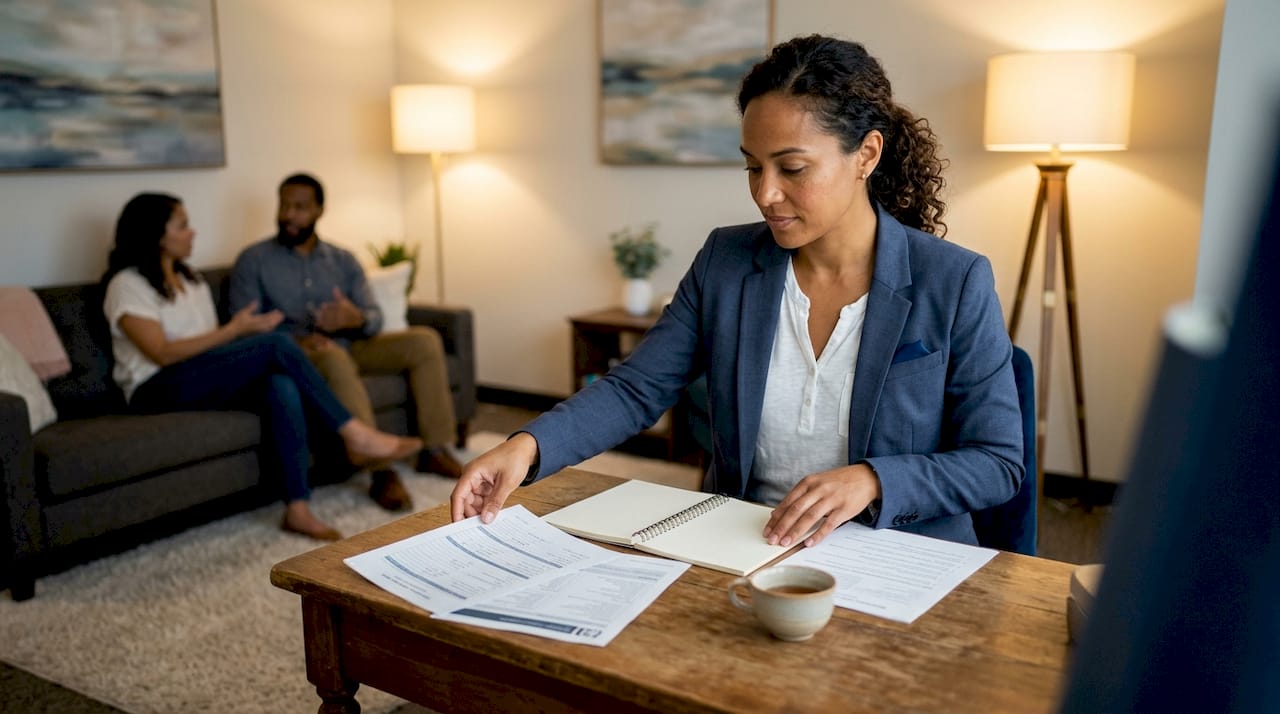
What Type of Therapist Is Best for Marriage Counseling?

TL;DR:
- A licensed marriage and family therapist with specialized couples training offers the best expertise for therapy. Credentials matter less than specific relational training and experience in evidence-based approaches like EFT or the Gottman Method. Early intervention and active participation from both partners significantly improve the chances of successful relationship recovery.
A Licensed Marriage and Family Therapist (LMFT) is the most qualified professional for marriage counseling, because their entire graduate training centers on relational and systemic dynamics between partners. That said, knowing what type of therapist is best for marriage counseling goes beyond a single credential. Licensed Clinical Social Workers (LCSWs), Licensed Professional Counselors (LPCs), and doctoral-level psychologists can all provide effective couples therapy when they hold specialized training in evidence-based approaches like Emotionally Focused Therapy (EFT) or the Gottman Method. The deciding factor is not the degree on the wall. It is the depth of couples-specific training and clinical experience behind it.
What type of therapist is best for marriage counseling?
The short answer is an LMFT with specialized couples training. LMFTs complete graduate degrees focused entirely on systemic and relational frameworks, which means they study how partners interact as a unit rather than treating each person as a separate individual. That systemic lens is exactly what couples therapy requires.
Other licensed professionals can also be strong choices. An LCSW or LPC who has pursued post-graduate training in couples therapy models can be just as effective as an LMFT. A psychologist with a PhD or PsyD brings deep clinical knowledge, but their doctoral training typically focuses on individual assessment and psychopathology rather than relational systems. That gap matters when the core problem is the relationship itself, not one partner’s diagnosis.
The critical point: specialization outweighs degree level in predicting couples therapy outcomes. A master’s-level LMFT who has spent years training in EFT will generally outperform a generalist PhD psychologist who sees couples occasionally. When you evaluate a therapist, ask what percentage of their caseload is couples work. The answer tells you more than their license type.
Pro Tip: Ask any prospective therapist directly: “What percentage of your clients are couples, and which couples therapy model do you primarily use?” A therapist who cannot name a specific model likely lacks the depth of training you need.
What credentials and training matter most for marriage therapists?
Credentials set the floor, but specialized training determines the ceiling. The four most common license types you will encounter are LMFT, LCSW, LPC, and PhD/PsyD psychologist. Each requires a different educational path, and each carries different strengths for couples work.
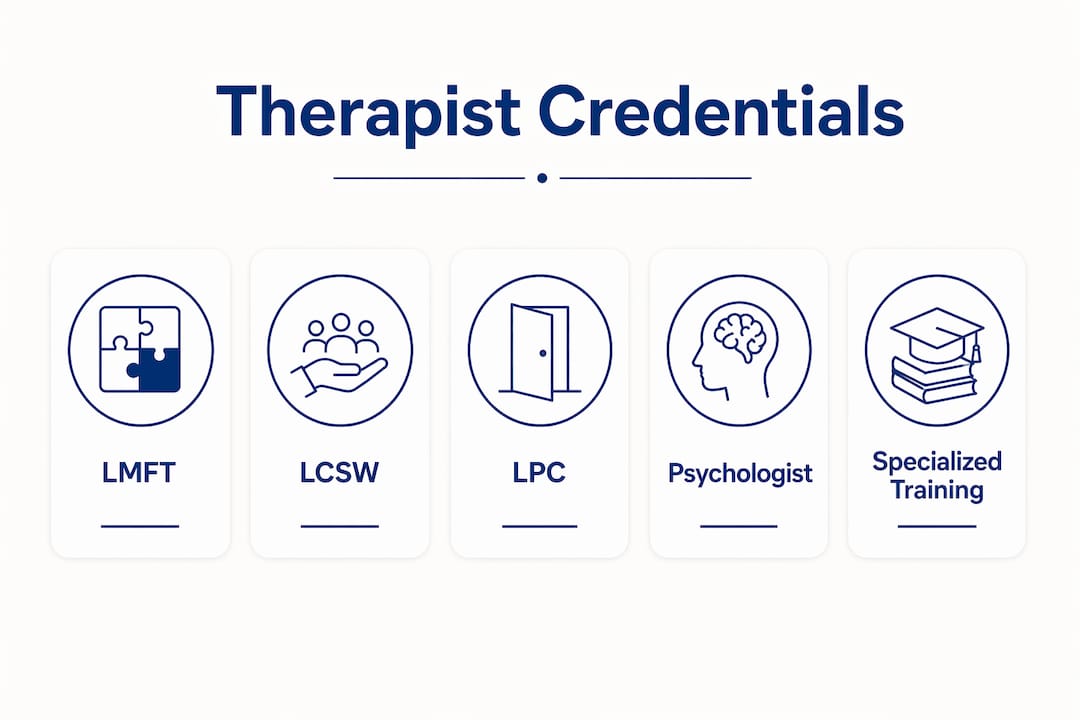
| License | Core Training Focus | Couples Therapy Strength |
|---|---|---|
| LMFT | Relational and family systems theory | Highest by design; built for couples work |
| LCSW | Individual and community mental health | Strong when post-graduate couples training is added |
| LPC | Individual counseling and mental health | Effective with specialized couples certification |
| PhD/PsyD | Individual assessment and psychopathology | Best when complex mental health diagnoses are present |
Cost and accessibility also factor in. Doctoral-level psychologists typically charge higher session rates than master’s-level therapists. If your relationship issues center on communication, conflict patterns, or emotional disconnection rather than a diagnosable mental health condition, a master’s-level LMFT or LPC with couples training delivers strong results at a lower cost per session.
Pro Tip: Check whether your therapist holds certification from a recognized body like the International Centre for Excellence in Emotionally Focused Therapy (ICEEFT) or the Gottman Institute. These certifications require supervised clinical hours in a specific model, which is a reliable signal of genuine expertise.
What are the main evidence-based approaches used in couples therapy?
The best marriage therapists do not improvise. They use structured, research-supported methods. EFT and the Gottman Method are the two most researched approaches in the field, and both have strong evidence behind them.
Here are the four approaches you are most likely to encounter:
- Emotionally Focused Therapy (EFT): Developed by Dr. Sue Johnson, EFT is grounded in attachment theory. It helps partners identify negative interaction cycles and rebuild emotional bonds. Research consistently supports EFT as one of the most effective approaches for couples in distress.
- The Gottman Method: Built on decades of research by Drs. John and Julie Gottman, this approach targets specific behaviors that predict relationship breakdown, including criticism, contempt, defensiveness, and stonewalling. Therapists trained in this method use structured exercises to replace destructive patterns with connection.
- Imago Relationship Therapy: Developed by Dr. Harville Hendrix, Imago focuses on how childhood experiences shape adult relationship patterns. It uses structured dialogue to help partners understand each other’s emotional history.
- Integrative Behavioral Couple Therapy (IBCT): IBCT combines behavior change strategies with acceptance work. It is particularly useful for couples where one or both partners struggle to change entrenched habits.
Therapists certified by ICEEFT or the Gottman Institute have completed supervised clinical hours in their respective models. That certification standard matters because it separates therapists who attended a weekend workshop from those who have practiced under expert supervision.
How to choose the right marriage therapist for your relationship
Choosing a couples therapist works best when you treat it like an interview process. Asking therapists directly about their experience, style, and treatment approach helps you find someone whose method matches your needs. Do not settle for the first name on an insurance list.
Follow these steps to find the right fit:
- Identify your primary concern. Communication breakdown, infidelity, parenting conflict, and emotional disconnection each respond best to different approaches. Knowing your core issue helps you match it to a therapist’s specialty.
- Ask about couples-specific experience. Request the percentage of their caseload that is couples work and the therapy model they use most. A therapist who primarily sees individuals may lack the relational training couples therapy demands.
- Assess chemistry with both partners. Both people in the relationship must feel heard and safe with the therapist. If one partner feels consistently dismissed or sided against, the therapy will stall. A good therapist holds space for both perspectives without taking sides.
- Check logistics. Location, session availability, telehealth options, and insurance coverage all affect whether you will actually attend consistently. Inconsistent attendance undermines even the best therapeutic approach.
- Watch for warning signs. A therapist who takes sides, avoids naming a specific model, or discourages questions about their approach is not a strong fit for couples work.
- Review common counseling questions before your first session. Knowing what to ask and what to expect reduces anxiety and helps you evaluate the therapist more clearly.
Pro Tip: Schedule brief consultations with two or three therapists before committing. Most offer a free 15-minute call. Comparing how each one responds to your questions reveals more than any online profile.
When should couples seek therapy, and does individual therapy help too?
Early intervention produces better outcomes than waiting until a relationship is in crisis. Couples who seek therapy before patterns become entrenched give themselves a genuine advantage. Waiting years to address recurring conflict allows negative cycles to deepen and become harder to shift.
Both partners’ engagement matters more than their starting level of hope. Active commitment from both people correlates with higher success rates, even when one partner enters therapy skeptical. The willingness to show up and participate is what drives progress, not perfect optimism at the outset.
Individual therapy alongside couples counseling is sometimes the right call. Consider it when:
- One partner carries unresolved trauma that directly affects relationship patterns
- A diagnosable mental health condition like depression or anxiety is destabilizing the relationship
- Personal patterns rooted in childhood or past relationships keep surfacing in couples sessions
- One partner needs a private space to process feelings before bringing them into joint sessions
Individual and couples therapy together improve outcomes when the therapists coordinate with each other and with the client’s consent. That coordination prevents conflicting guidance and keeps both tracks aligned. For guidance on when to seek couples counseling, recognizing early warning signs is the first step.
Key Takeaways
The best therapist for marriage counseling is a licensed professional with deep, specialized training in couples therapy models, not simply the highest academic degree.
| Point | Details |
|---|---|
| LMFTs lead in couples training | Their graduate education focuses entirely on relational and systemic dynamics. |
| Specialization beats degree level | A master’s-level LMFT with EFT training often outperforms a generalist PhD in couples work. |
| EFT and Gottman Method are top choices | Both are research-backed and widely used by certified couples therapists. |
| Early intervention matters | Couples who seek therapy sooner experience more positive results than those who wait. |
| Both partners must engage | Active commitment from both people drives therapy success, regardless of starting hope levels. |
What I have learned after years of working with couples
After working with couples for many years, the pattern I see most often is this: couples wait too long. By the time they sit down in a therapy room, they have been cycling through the same argument for years. The damage is real, but it is rarely irreversible. What makes the difference is finding a therapist who actually knows how to work with two people in a room at the same time.
That sounds obvious, but it is not. Many therapists see couples without ever having trained specifically in couples therapy. They apply individual therapy skills to a relational problem, and it does not work the same way. I have seen couples leave those experiences more frustrated than when they started, convinced therapy cannot help them.
My honest advice: prioritize the therapist’s couples-specific training above everything else. Ask about their model. Ask how many couples they currently see. If they hesitate or give vague answers, keep looking. A therapist who is confident in their couples work will answer those questions directly and with specificity.
The other thing I tell couples is to trust their gut about fit. If one partner feels consistently unheard after the first two or three sessions, that is not just discomfort with the process. That is a signal. A skilled couples therapist creates safety for both people. You deserve that, and you should advocate for it without apology.
— Carlos
Clinical support for couples at Masteringconflict
Choosing the right therapist is the first step. Taking that step with a clinician who specializes in couples work makes all the difference.
Masteringconflict offers specialized clinical services for couples and families, grounded in evidence-based approaches to relational conflict and communication. Dr. Carlos Todd brings licensed clinical expertise to every session, working with couples to address the patterns that keep relationships stuck. Whether you are dealing with recurring conflict, emotional distance, or a specific crisis, the work is structured, focused, and built around your relationship’s actual needs. Couples in North Carolina, South Carolina, Florida, and beyond can access services online. Book a consultation through Masteringconflict’s couples therapy page to get started.
FAQ
What is the difference between a therapist and a counselor for marriage?
The terms are often used interchangeably, but licensing differs by state. Both can provide couples therapy when they hold the appropriate license and specialized training in relational approaches.
Is a psychologist good for marriage counseling?
A psychologist can be effective for couples therapy, but only when they have specific training in couples therapy models like EFT or the Gottman Method. Without that training, a master’s-level LMFT with couples specialization is typically the stronger choice.
What should I expect in marriage therapy?
Expect structured sessions where both partners discuss specific patterns, not just surface arguments. A trained therapist will identify recurring cycles and introduce evidence-based tools to shift them over time.
How do I know if a marriage therapist is qualified?
Ask whether they hold certification from a recognized body like ICEEFT or the Gottman Institute, and ask what percentage of their caseload is couples work. Those two questions reveal more than a license type alone.
How soon should couples seek marriage counseling?
Early intervention leads to better outcomes, so seeking help before patterns become entrenched gives couples the best chance of success. Do not wait for a crisis to make the call.
Recommended
- Marriage Counseling Therapist in Charlotte NC – Mastering Conflict
- Marriage Counseling: Transforming Couples’ Communication – Mastering Conflict
- Marriage Counseling Before Marriage: Strengthening Relationships Early – Mastering Conflict
- Common Marriage Counseling Questions That Transform Relationships – Mastering Conflict