Conflict Resolution and Conflict Transformation: A Family Guide

Conflict resolution solves a specific dispute. Conflict transformation changes the relationship or system that keeps producing disputes. Use resolution first when the issue is discrete and time-limited. Move to transformation when the same fight keeps coming back, when power is unequal, or when the conflict touches identity and values. The Program on Negotiation at Harvard and scholar John Paul Lederach both treat these as complementary tools, not competing ones.
Quick next steps by path:
- Resolution path: Name the specific issue, set a 30-minute conversation window, agree on one concrete outcome, and write it down.
- Transformation path: Schedule a consult with a licensed clinician or mediator, map the recurring pattern, and commit to at least 3 months of structured work.
Pro Tip: Resolve the pressing issue first so emotions cool, then schedule the deeper transformation work within the same week. Letting the immediate crisis pass without booking the follow-up is how families end up back at square one.
Table of Contents
- What’s the real difference between conflict resolution and conflict transformation?
- How do the five conflict-management styles affect your family?
- When should you use resolution, transformation, or both?
- Practical steps you can use today
- What do therapy and coaching actually cost, and how long does it take?
- How do you find and vet a qualified practitioner?
- Key Takeaways
- Why I believe most families need transformation, not just resolution
- Masteringconflict can help you take the next step
- Useful sources
What’s the real difference between conflict resolution and conflict transformation?
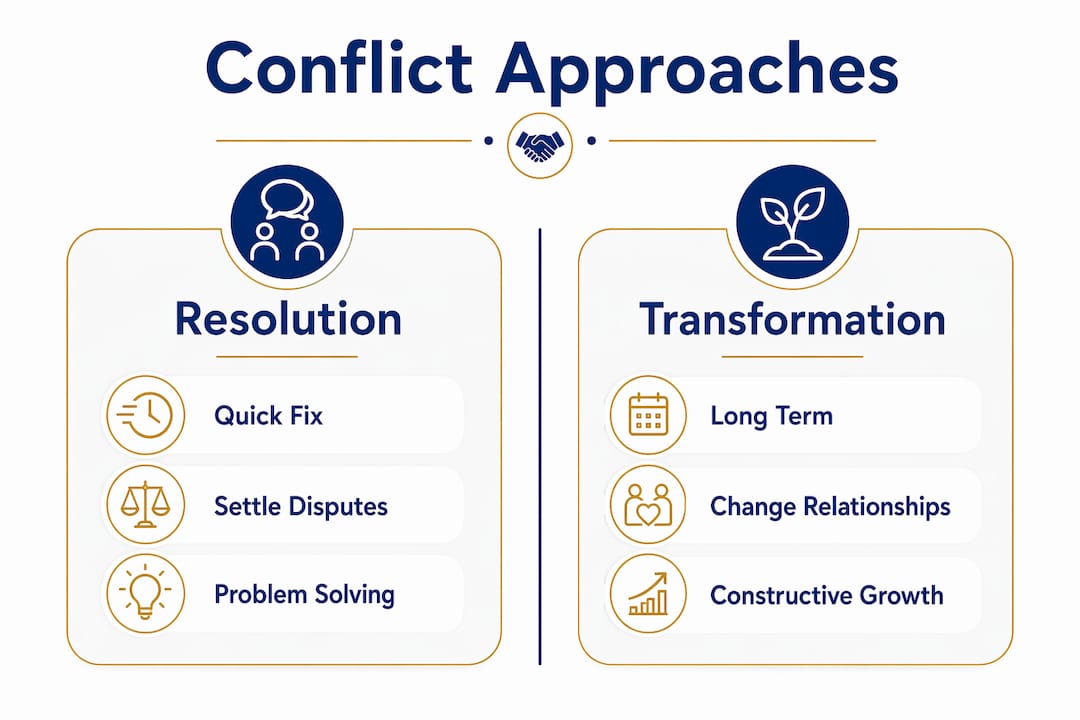
Conflict resolution targets immediate disputes and aims for positive-sum outcomes through problem-solving and negotiation. It is short-term, outcome-focused, and works best when the conflict is bounded. Think: two siblings arguing over screen time, or spouses disagreeing about a vacation budget.
Conflict transformation, as Lederach frames it, views conflict as an opportunity for constructive change. It shifts the images people hold of each other and rebuilds the relational patterns underneath the argument. The goal is not just to settle this fight but to change how the people involved relate to each other going forward.
Beyond Intractability describes transformation as building “adaptive platforms” that address immediate problems while creating processes for longer-term relational and systemic change. That framing matters for families: a single mediation session may stop the bleeding, but it rarely heals the wound.
| Dimension | Conflict Resolution | Conflict Transformation |
|---|---|---|
| Goal | Settle the specific dispute | Change relational or systemic patterns |
| Time horizon | Short-term (days to weeks) | Long-term (months to years) |
| Typical techniques | Negotiation, problem-solving, mediation | Dialogue, restorative practices, therapy |
| Who benefits most | One-off or low-stakes disputes | Recurring, identity-based, or power-imbalanced conflicts |
| When to escalate | When agreement breaks down | When patterns repeat or safety is at risk |
Scholars like Christopher Mitchell urge clarity about what level of change you are targeting: personal, relational, or systemic. Families who skip that question often choose the wrong tool and wonder why nothing sticks.
How do the five conflict-management styles affect your family?
The five styles identified by conflict researchers are Competing, Avoiding, Accommodating, Compromising, and Collaborating. Each reflects a different balance between asserting your own needs and attending to the other person’s.
- Competing: One parent insists on an 8 PM bedtime, no discussion. Fast, but breeds resentment.
- Avoiding: Neither spouse brings up the credit-card debt. Tension builds silently.
- Accommodating: One partner always yields on in-law visits. Works short-term; erodes self-respect over time.
- Compromising: Both parents agree on 9 PM, neither fully satisfied. Efficient, but leaves underlying needs unaddressed.
- Collaborating: The family talks about why bedtime matters (rest, school performance, alone time for parents) and designs a routine that meets everyone’s core needs. Slower, but durable.
Collaborating is the style most likely to produce agreements that hold, because it surfaces the interests beneath the positions. It is also the hardest to sustain under stress, which is exactly why clinical support helps.
Pro Tip: Coach yourself or a family member toward collaborating in low-stakes moments first. Practice on what to cook for dinner before you try it on finances. The skill transfers, but only if you’ve built the muscle.

When should you use resolution, transformation, or both?
Start with resolution when: the issue is single and specific, the timeline is short, power between the parties is roughly equal, and both people want a quick answer. A disagreement about holiday travel plans fits here.
Shift to transformation when you notice any of these:
- The same argument recycles every few weeks or months.
- The conflict involves identity, values, or deeply held beliefs.
- One person consistently holds more power (financial control, parental authority, social status).
- Previous agreements collapsed within days.
- Either party feels unsafe, unheard, or chronically dismissed.
Conflict analysis guidelines from the Danish Refugee Council emphasize mapping root causes, proximate causes, and triggers before designing any intervention. That principle applies at the family level too: a fight about dishes is rarely about dishes.
Safety warning: If there is any domestic violence, active threats, or fear of physical harm, skip negotiation entirely. Contact the National Domestic Violence Hotline (1-800-799-7233) or a licensed clinician before attempting any conflict work at home.
Practical steps you can use today
These techniques are grounded in evidence and used by clinicians at Masteringconflict. Start with de-escalation before anything else.
De-escalation sequence:
- Call a time-out. Say: “I need 20 minutes to calm down. I’m coming back to this.”
- Breathe slowly: 4 counts in, hold 4, out 6. Repeat three times.
- Return to the conversation only when your heart rate has dropped.
- Set one ground rule aloud: “No interrupting while the other person speaks.”
Active listening and I-statements:
- Replace “You never listen” with “I feel dismissed when I’m interrupted.”
- Reflect back: “What I’m hearing is that you feel overwhelmed by the workload. Is that right?”
- Validate without agreeing: accepting another’s perspective is not the same as endorsing it, and that distinction alone can open a conversation that was locked shut.
Restorative questions to go deeper:
- “What happened from your point of view?”
- “Who else was affected, and how?”
- “What do you need right now to feel okay moving forward?”
These questions shift the conversation from blame to accountability. Pair them with assertive communication skills to keep the dialogue productive rather than reactive.
Pro Tip: Practice I-statements during a calm moment, not a heated one. Try them at dinner when something minor comes up. By the time a real conflict hits, the phrasing will come naturally.
What do therapy and coaching actually cost, and how long does it take?
Short-term resolution work, such as a few mediation sessions or structured problem-solving, typically involves multiple sessions. Deeper relational or family transformation work usually lasts several months, sometimes longer when systemic factors like trauma or chronic power imbalances are involved.
Common clinical pathways in the U.S.:
- Individual therapy: Typically 45–50 minutes per session; focuses on personal conflict patterns and communication skills.
- Couples or family therapy: Usually 60–90 minutes; addresses relational dynamics directly.
- Conflict coaching: Goal-focused, often shorter-term; useful for specific skill-building without a clinical diagnosis.
- Anger-management classes: Structured group or individual programs; often 8–26 weeks depending on the provider and any court requirements.
On cost: many therapists charge $100–$250 per session without insurance. Most major insurance plans cover individual and family therapy when a licensed clinician provides it; verify your specific benefits before booking. Sliding-scale options exist through community mental health centers and some private practices. Masteringconflict offers family counseling and teletherapy options; contact the practice directly for current fees and package details, as pricing is not publicly listed.
Practitioners who integrate conflict management skills into therapy tend to produce faster, more durable outcomes than those who treat communication and emotional regulation as separate tracks.
How do you find and vet a qualified practitioner?
Credential checklist:
- Licensed clinical credential: LMFT, LCMHC, LCSW, or licensed psychologist
- Specific mediation or conflict-resolution training (40-hour basic mediation training is a common baseline)
- Experience with families, not just individuals
- Trauma-informed care training, especially if abuse or neglect is part of the history
Questions to ask in an initial consult:
- “How do you handle power imbalances between family members in a session?”
- “How do you measure whether we’re making progress?”
- “What does a typical treatment plan look like for a family in our situation?”
- “Do you have experience with [specific issue: blended families, co-parenting, adolescent conflict]?”
Red flags to watch for:
- No safety protocol for domestic violence disclosures
- Claims that one approach works for every family
- Resistance to discussing measurable outcomes
- Pressure to commit to a long package before an initial session
For teletherapy, confirm the clinician is licensed in your state. Most states require licensure in the client’s state of residence, not the therapist’s. Verify insurance coverage before the first session, not after.
Key Takeaways
Conflict resolution addresses specific disputes quickly; conflict transformation rebuilds the relational patterns that generate recurring conflict, and most families need both at different moments.
| Point | Details |
|---|---|
| Resolution vs. transformation | Use resolution for single, bounded disputes; use transformation when the same conflict keeps recurring. |
| Collaborating style wins long-term | Of the five styles, collaborating surfaces underlying interests and produces the most durable agreements. |
| Pair both approaches | Resolve the immediate issue first, then schedule transformation work within the same week to prevent recurrence. |
| Typical clinical timeline | Short-term resolution takes multiple sessions; relational transformation work usually lasts several months. |
| Masteringconflict next step | Masteringconflict offers family counseling, teletherapy, and conflict coaching for U.S. individuals and families. |
Why I believe most families need transformation, not just resolution
Most people come to conflict work wanting the argument to stop. That’s understandable. But stopping an argument and changing the dynamic that produces it are two different jobs, and conflating them is the most common mistake I see.
Short-term resolution techniques are genuinely useful. They stop escalation, create breathing room, and produce agreements that hold for a while. The problem is that a family with a chronic conflict pattern will cycle back to the same fight within weeks if the underlying relational structure stays intact. Lederach’s insight, that conflict carries energy that can be redirected toward constructive change, is not just poetic. It is clinically accurate.
What I find most overlooked is the role of cognitive bias. PON researchers Linda Babcock and George Loewenstein documented how egocentrism makes it nearly impossible to genuinely see another person’s position without structured support. Scripted techniques like I-statements and reflective listening are not soft skills. They are bias-interruption tools. Families who practice them consistently change the neurological habit of self-referential interpretation, which is the actual engine of most recurring conflict.
The clinical work I find most effective pairs a short-term resolution plan with a longer-term transformation framework from the first session. Families leave with something concrete to do this week and a map of where the deeper work leads.
Masteringconflict can help you take the next step
Families dealing with recurring conflict need more than a checklist. Masteringconflict, founded by Dr. Carlos Todd, a licensed clinical mental health counselor and psychologist, offers a direct path from reading about these techniques to practicing them with clinical support.
Services include family counseling, teletherapy for remote clients across the U.S., conflict coaching, anger-management classes, and clinical training and supervision for practitioners. Dr. Carlos Todd’s approach integrates short-term resolution techniques with transformation-oriented clinical work, so families leave sessions with both immediate tools and a longer-term plan.
To get started, visit the all courses page for structured online programs, or book directly through the family counseling or teletherapy pages. An initial consult typically covers your specific conflict pattern, a preliminary plan, and next steps. Fees and package options are available on request.
Useful sources
- Settlement, Resolution, Management, and Transformation | Beyond Intractability — Anchors the core definitions of resolution vs. transformation; use this first for conceptual grounding.
- Conflict Transformation | Beyond Intractability — Explains transformation as an adaptive platform for both immediate and long-term change.
- Lederach on Transformation | Beyond Intractability — Primary source for Lederach’s framework; essential for understanding transformation rationale.
- Conflict Management Styles | Program on Negotiation, Harvard — Defines and evaluates the five styles; supports the styles section and practitioner guidance.
- Conflict Resolution Strategies | Program on Negotiation, Harvard — Covers egocentrism and perspective-taking; supports practical technique recommendations.
- How to Manage Conflict: Six Essentials | IMD Business School — Grounds the “separate person from problem” principle; useful for practitioners and families alike.
- Beyond Resolution: What Does Conflict Transformation Actually Transform? | Christopher Mitchell — Academic caution about scope and realistic goals; read before committing to a transformation plan.
- Conflict Analysis Guidelines | Danish Refugee Council — Practitioner framework for mapping root causes and power dynamics; informs the decision-flow section.
Recommended
- Family Conflict Resolution Services: Transforming Relationships – Mastering Conflict
- Navigating Family Conflict for Positive Relationships – Mastering Conflict
- Conflict Resolution for Families: Tools, Tips, and Teletherapy 2025 – Mastering Conflict
- Effective Conflict Resolution Steps for Couples, Families, and Professionals 2025 – Mastering Conflict