
Coaching vs Counseling: Choose the Right Path for Growth

TL;DR:
- Coaching focuses on future goals, action planning, and skill development without diagnosing mental health issues. Counseling delves into emotional roots, trauma, and mental health treatment for deeper psychological concerns. The right choice depends on your emotional stability, goals, and whether you need healing or progress-oriented support.
People in conflict often reach a frustrating crossroads: do you need a coach or a counselor? Both sound helpful, both promise change, and both involve sitting with a professional to talk through your challenges. But choosing the wrong one doesn’t just waste money — it can leave you feeling misunderstood, stuck, or worse, like growth is impossible. This guide cuts through the confusion by showing you exactly what separates coaching from counseling, where they overlap, and how to match the right support to what you’re actually going through right now.
Table of Contents
- What is coaching and how does it work?
- What is counseling and when is it the right choice?
- Coaching vs counseling: Key differences and similarities
- Outcomes: What to expect from each approach
- A fresh perspective: More alike (and connected) than you might think
- Find the right support for your transformation
- Frequently asked questions
Key Takeaways
| Point | Details |
|---|---|
| Coaching is action-focused | Coaching helps you set and reach future goals through partnership and accountability. |
| Counseling addresses deeper issues | Counseling provides emotional support, diagnosis, and healing for personal or relationship struggles. |
| Choosing support can be nuanced | Some people benefit from both approaches, and collaboration is often in your best interest. |
| Research supports both methods | Evidence shows coaching and counseling each have proven benefits for different needs. |
What is coaching and how does it work?
Coaching is an active partnership built around where you want to go, not where you’ve been. It does not involve clinical diagnosis, medical treatment, or a focus on mental illness. Instead, a coach works with you to identify goals, remove obstacles, and create concrete action plans.
“Coaching is a partnership with the client using a thought-provoking, creative process to help the client maximize personal and professional potential.” — International Coaching Federation (ICF)
For couples or individuals in conflict, this might mean a coach helping you map out communication strategies, set boundaries, or practice new behaviors between sessions. Imagine a couple that argues constantly about finances. A coach wouldn’t explore the childhood roots of each partner’s money anxiety. Instead, the coach would help both partners create a shared financial plan, assign action steps, and hold each accountable by the following week. That’s the coaching model in action.
Here’s what a typical coaching engagement looks like in practice:
- Action planning: You and your coach define specific, measurable goals together
- Accountability: You check in regularly and report on progress toward commitments
- Brainstorming solutions: Sessions focus on generating options, not analyzing past wounds
- Practicing new skills: You may role-play conversations, rehearse responses, or test new behaviors
- Forward momentum: Every session moves you closer to a defined outcome
A great example of this in the conflict space is conflict coaching explained, which shows how coaching principles apply directly to interpersonal disputes and workplace friction.
Pro Tip: Coaching works best when you already have basic emotional stability. If you can function day-to-day but feel stuck or frustrated, coaching is likely your fastest path forward. If your emotional state feels unmanageable, read on about counseling first.
What is counseling and when is it the right choice?
Counseling, sometimes called therapy, goes deeper into the emotional and psychological roots of what you’re experiencing. A licensed counselor is trained to assess, diagnose, and treat mental health concerns. That’s a meaningful distinction that changes everything about how sessions are structured and what outcomes look like.
Where coaching asks “Where do you want to go?”, counseling asks “What has been getting in your way, emotionally and historically?” If you’ve been stuck in the same conflict patterns in every relationship you’ve had, a counselor will explore why those patterns formed in the first place. This is especially important for people dealing with unprocessed trauma, chronic anxiety, depression, or grief.
Consider a couple where one partner grew up in a home with significant emotional neglect. No amount of action planning will resolve the attachment wounds driving their conflict style until those wounds are acknowledged and treated therapeutically. That’s where counseling ethics and boundaries become central — counselors operate within a licensed, regulated framework specifically designed for this kind of work.
As a clear professional distinction, counseling is oriented toward emotional and psychological problems, often involving clinical work such as diagnosis and treatment, while coaching focuses on future goals and actions without diagnosing or treating mental health conditions.
The benefits of choosing counseling include:
- A safe, structured space to process difficult emotions without judgment
- Unbiased professional feedback grounded in clinical training and ethics
- Emotional regulation skills built through evidence-based techniques
- Crisis support when you’re overwhelmed or unsafe
- Pattern interruption that goes to the source of recurring relational problems
Pro Tip: If your conflict, stress, or emotional pain feels overwhelming, chronic, or tied to events you haven’t fully processed, choose counseling first. You can always add coaching later once you’ve built a stable emotional foundation.
Coaching vs counseling: Key differences and similarities
Now that you understand each approach on its own terms, putting them side by side makes the practical choice much clearer.
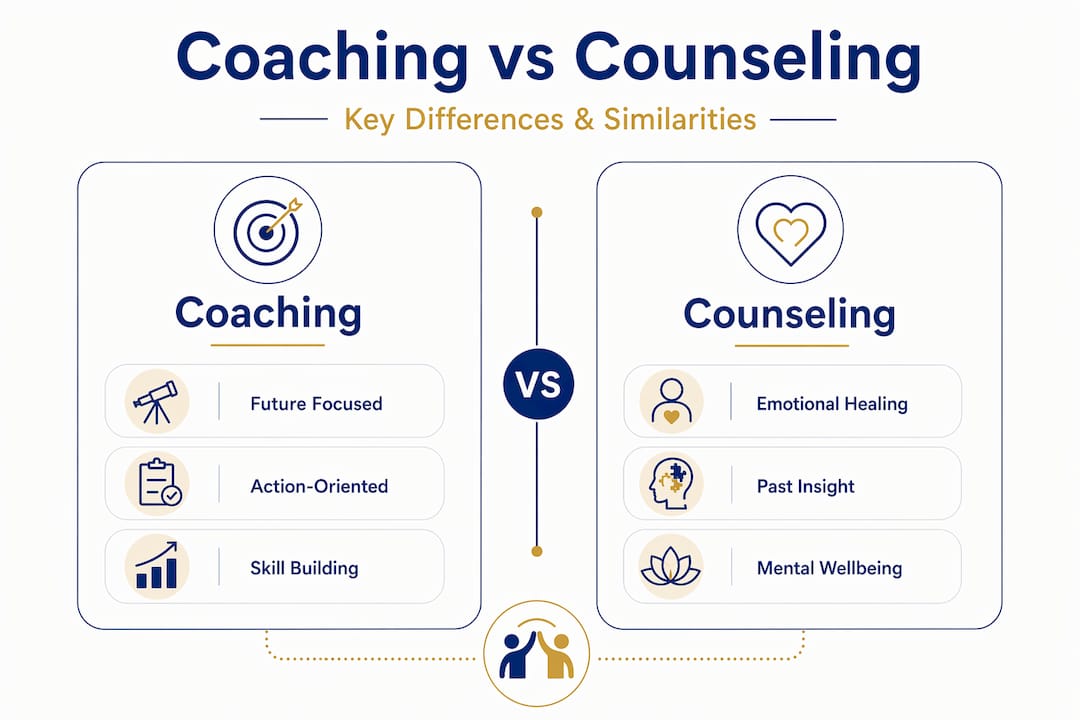
| Factor | Coaching | Counseling |
|---|---|---|
| Primary focus | Future goals and growth | Emotional healing and psychological patterns |
| Session style | Action-oriented, structured | Exploratory, reflective, process-driven |
| Credentials required | Certification (e.g., ICF) | State licensure (LPC, LCSW, MFT, etc.) |
| Diagnosis and treatment | Not provided | May include clinical diagnosis and treatment |
| Typical duration | Short-term, goal-specific | Varies; can be long-term for complex issues |
| Level of emotional challenge handled | Mild to moderate, stable baseline needed | Mild to severe, including crisis situations |
| Regulatory oversight | Professional ethics codes | State and federal licensing laws |
The ICF code of ethics frames coaching boundaries around structured agreements, confidentiality policies, and defined responsibilities rather than clinical diagnosis or treatment. This is very different from the legal and ethical obligations a licensed counselor carries, which include mandatory reporting requirements and clinical supervision.
That said, a coaching vs therapy guide will consistently show you that both fields share a commitment to the client’s growth, rely on a strong working relationship, and use conversation as the primary tool. The difference between coaching and psychotherapy isn’t always obvious in a single session, which is why the decision needs to start with an honest assessment of your situation.
Use this set of questions to find your best fit:
- What am I struggling with most? Is it a specific goal, or a deep emotional wound?
- How long has this been a problem? A new conflict at work calls for different support than a 15-year pattern in relationships.
- Do I need emotional healing or action planning? Both are valid. Only one is the right starting point.
- Am I in crisis or stable? Crisis states require clinical support first.
- Have I already tried one approach without results? That’s useful data that points toward trying the other.
The therapy versus coaching guide for 2025 offers additional scenarios to help you work through this decision with more precision.
Outcomes: What to expect from each approach
Understanding what you’ll realistically gain from each approach helps you stay committed and avoid disappointment. Both coaching and counseling produce real, measurable change. But the type of change differs significantly.

| Outcome Area | Coaching | Counseling |
|---|---|---|
| Goal achievement | High, especially with structured framing | Moderate, embedded in broader healing |
| Emotional relief | Supportive but not the primary focus | Central and clinically prioritized |
| Relationship improvement | Through communication skills and action | Through pattern change and healing |
| Skill-building | Directly taught and practiced | Developed as part of therapeutic work |
| Crisis intervention | Not designed for this | Core competency of licensed professionals |
| Long-term behavior change | Strong when motivation is intact | Strong when emotional drivers are addressed |
Research supports the effectiveness of coaching for goal-related work. One randomized controlled trial found that learning-goal framing predicted significantly higher perceived goal achievement in coaching groups compared to performance-goal framing. This tells us that how you enter coaching — your mindset and intentions — shapes your results as much as the coach’s skill.
On the relationship quality side, you might be surprised to learn that working alliance scores between human coaches and simulated AI coaches showed no statistically significant difference in at least one study (human coaches M=74.50, SD=7.25; AI coaches M=72.73, SD=10.34). What this suggests is that the quality of the relationship and the structure of support matter enormously, regardless of format. Both coaching and counseling benefit from genuine rapport.
For people comparing the roles in detail, the life coach vs therapist breakdown covers how these professionals are trained differently and why that training shapes what results you can expect. Strong client-practitioner relationships in either field consistently outperform mismatched ones, regardless of technical skill.
The most important thing to understand: neither approach works passively. You will be asked to reflect, practice, and show up consistently. The difference is in what you’re doing and why.
A fresh perspective: More alike (and connected) than you might think
Here’s what most guides won’t tell you outright. The sharp line between coaching and counseling is largely a professional boundary issue, not an absolute difference in human experience. In real life, personal growth doesn’t sort itself neatly into “past issues” and “future goals.” People are messier than that. And the best practitioners know it.
We’ve worked with individuals who came in for coaching around relationship communication and quickly revealed trauma histories that needed clinical attention. We’ve also seen people complete counseling and then find they needed a coach to help them use the insight they’d gained. Growth is rarely linear, and it rarely respects professional categories.
One qualitative study makes exactly this point. Collaboration rather than competition between coaching and counseling professionals is recommended, and the research acknowledges that both substantial similarities and real differences exist between the fields. The debate about whether the gap is purely definitional or fundamentally substantive is still alive in professional circles. What’s clear is that the client benefits most when professionals from both fields communicate, refer, and sometimes work in tandem.
The strict division you often see in articles like this one (including this one) is useful for clarity. But don’t let it become a barrier. If you’ve tried counseling and feel you’ve plateaued, adding coaching may be exactly the nudge you need. If coaching feels hollow because deeper issues keep surfacing, that’s your signal to seek clinical support. And if you’re unsure? Find your right path by talking to a professional who can honestly assess what you need rather than just selling you one modality.
The most effective practitioners in conflict resolution don’t defend their turf. They care about your outcome. That’s the standard you should hold anyone you work with to.
Find the right support for your transformation
If this guide has clarified something for you, the obvious next step is connecting with support that matches your actual situation.
At Mastering Conflict, we offer both clinical counseling and structured coaching programs, so you don’t have to guess which one you need or work with two separate providers who don’t communicate. Our services cover anger management, couples therapy, family counseling, individual therapy, and targeted coaching vs therapy programs for conflict resolution and burnout recovery. Dr. Carlos Todd and the Mastering Conflict team are equipped to meet you at the right starting point — whether that’s healing what hurts or building what’s next. Reach out today and let’s match you with the right support for real, lasting change.
Frequently asked questions
How do I know if I need coaching or counseling?
If your challenges are mainly about setting goals and moving forward, coaching may be the right fit. If you have emotional pain, unresolved trauma, or need clinical diagnosis, counseling addresses emotional and psychological concerns in ways coaching is not designed to.
Can I benefit from both coaching and counseling?
Yes, and many people do. The fields can work well in sequence or even alongside each other, and collaboration between professions is widely recommended to serve clients more completely.
Is coaching confidential and ethical?
Certified coaches are bound by formal ethics codes, including confidentiality. However, the ICF code of ethics is a professional standard, not a legal one. Counselors carry additional legal confidentiality protections and mandatory reporting obligations under state licensing laws.
Are coaching results backed by research?
Yes. Studies show that learning-goal framing in coaching significantly predicts higher perceived goal achievement, meaning your mindset and how you frame your goals directly influence your results in coaching.