
Coach vs Therapist: How to Choose the Right Support

TL;DR:
- Therapists are licensed clinicians who diagnose and treat mental health disorders, while coaches focus on goal-oriented growth without clinical intervention. Choosing between them depends on whether you need mental health treatment or personal development support, with clear boundaries and appropriate referrals essential for safety. Both modalities can complement each other when professionals maintain role clarity and communicate transparently.
A therapist is a licensed clinician trained to diagnose and treat mental health disorders, while a coach is a goal-oriented partner focused on personal or professional growth without clinical intervention. That single distinction shapes everything: the credentials required, the problems addressed, the methods used, and the ethical boundaries each professional must respect. Choosing between a coach vs therapist is not a matter of preference. It is a matter of matching the right modality to your actual needs. Masteringconflict works with both populations and sees the confusion play out regularly, which is why this breakdown matters.
What is the core difference between a coach and a therapist?
Psychotherapy is defined by the American Psychological Association as the clinical treatment of emotional and behavioral problems, including diagnosing and addressing mental disorders. Coaching, as defined by the International Coaching Federation (ICF), is a creative, forward-looking partnership designed to maximize personal and professional potential without clinical diagnosis. These are not two versions of the same service. They operate in fundamentally different domains.
Therapy addresses what is broken or causing suffering. Coaching addresses what is possible and how to get there. A therapist treating someone with generalized anxiety disorder uses evidence-based clinical protocols like Cognitive Behavioral Therapy (CBT) or Acceptance and Commitment Therapy (ACT). A coach working with someone who wants to launch a business or improve their leadership presence uses goal-setting frameworks, accountability structures, and motivational strategies.
The overlap that confuses people is real. Both involve a one-on-one relationship, reflective conversation, and personal growth. But the purpose, scope, and professional accountability behind each are entirely different. Understanding that difference protects you as a client.
How do credentials and licensing separate coaches from therapists?
The professional requirements for therapists and coaches are not comparable. Therapists must hold a graduate-level clinical degree, such as a Master of Social Work, a Master of Counseling, or a doctorate in psychology. They must complete supervised clinical hours, pass licensing exams, and maintain licensure through continuing education. In every U.S. state, practicing therapy without a license is illegal.
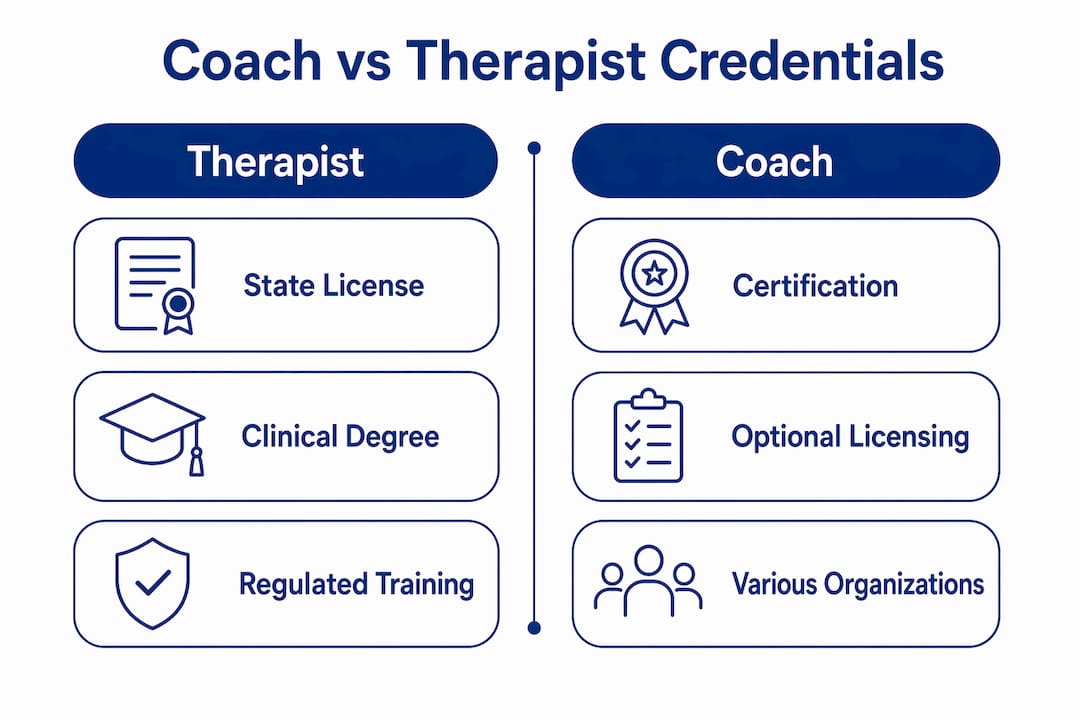
Coaches face no equivalent legal requirement. The ICF offers respected certifications like the Associate Certified Coach (ACC), Professional Certified Coach (PCC), and Master Certified Coach (MCC), and these credentials signal genuine training. But no law prevents someone from calling themselves a life coach without any certification at all. That gap in regulation creates real risk for clients who assume a coach’s credentials match a therapist’s.
Here is what to look for when evaluating a provider:
- Therapists: State licensure (LCSW, LPC, LMFT, PhD, PsyD), graduate clinical degree, supervised hours, board oversight
- Certified coaches: ICF or equivalent certification (ACC, PCC, MCC), coach-specific training hours, adherence to ICF ethics code
- Uncredentialed coaches: No verifiable training, no ethical oversight, no accountability structure
Pro Tip: Always ask a coach for their specific certification and the organization that issued it. Ask a therapist for their license number and verify it through your state’s licensing board website.
The absence of licensing in coaching does not make coaching less valuable. It means you carry more responsibility as a consumer to vet who you hire.
How do therapy and coaching differ in goals, methods, and client issues?
The clearest way to understand therapy vs life coaching is to look at what each is actually designed to do.
| Dimension | Therapy | Coaching |
|---|---|---|
| Primary focus | Diagnosing and treating mental disorders, trauma, emotional distress | Goal-setting, motivation, accountability, performance |
| Time orientation | Past and present (understanding root causes) | Present and future (building toward outcomes) |
| Typical issues | Depression, anxiety, PTSD, grief, relationship dysfunction | Career transitions, leadership development, habit change, burnout recovery |
| Methods used | CBT, EMDR, psychodynamic therapy, DBT | Motivational interviewing, strengths assessments, action planning |
| Licensing required | Yes, by law | No, voluntary certification only |
| Insurance coverage | Often covered | Rarely covered |

Coaching focuses on goals, routines, accountability, and motivation. Therapy requires licensed clinical training to address deeper emotional challenges and psychological disorders. A coach is not a clinical substitute, no matter how skilled or experienced they are.
Where coaching genuinely shines is in the space after clinical work. Someone who has completed trauma therapy and stabilized may work with a coach to rebuild their career, redefine their identity, or set new life goals. The two modalities can complement each other powerfully when used in the right sequence and with clear communication between providers.
Pro Tip: If you are currently in therapy, tell your coach. If you are working with a coach and start experiencing symptoms like persistent low mood, flashbacks, or panic attacks, bring that to a licensed therapist immediately. Both professionals should know about the other.
Emotional distress, trauma, or psychological suffering signals that therapy is the appropriate choice. Coaching is for growth, decision-making, and accountability, not for diagnosing or treating mental illness.
What ethical boundaries must coaches and therapists maintain?
This is where the difference between a life coach and a therapist becomes a safety issue, not just a professional distinction. ICF Standard 3.7 requires coaches to recognize when a client’s needs exceed the scope of coaching and to refer appropriately, including pausing or ending the coaching relationship if clinical concerns arise.
The practical challenge is that 85% of coaches report clients requesting mental well-being support, and 44% have made referrals to therapists because the client’s needs exceeded coaching scope. That means boundary management is not an edge case. It is a routine part of coaching practice. Coaches who ignore this reality put clients at risk.
One of the most documented hazards in coaching is what researchers call “therapeutic language creep.” This occurs when a coach begins using clinical terminology, exploring trauma histories, or processing deep emotional pain without the training to do so safely. Using clinical language or trauma processing in coaching sessions without clinical training can harm clients. Ethical coaching requires explicit scope communication and referral when clinical intervention is indicated.
Specific situations that require immediate referral to a licensed therapist include:
- A client disclosing active suicidal ideation or self-harm
- Panic attacks that are recurring and interfering with daily functioning
- Trauma activation during sessions (flashbacks, dissociation, hyperventilation)
- Symptoms consistent with psychosis, severe depression, or eating disorders
- Disclosures of domestic violence or abuse
“The boundary between coaching and therapy is not only credential-based but fundamentally about client safety and competence, requiring coaches to recognize clinical needs promptly.” — The Coaching Guild
Therapists carry their own ethical obligations in the reverse direction. A therapist who also offers coaching must be transparent about which role they are operating in during any given session. ICF ethics case studies emphasize that professionals holding multiple roles must disclose this clearly and maintain distinct boundaries between them.
How do you decide whether you need a coach or a therapist?
Choosing between a coach and a therapist comes down to whether you need treatment for mental health symptoms or goal-oriented support for growth and accountability. Here is a practical decision framework you can use right now.
- Identify your primary concern. Are you experiencing symptoms like persistent sadness, anxiety that disrupts sleep, intrusive memories, or difficulty functioning at work or in relationships? If yes, start with a licensed therapist.
- Assess your current stability. Are you able to manage daily responsibilities, maintain relationships, and function without significant distress? If yes, coaching may be appropriate.
- Clarify your goal. Do you want to process pain, understand your past, or heal from something? Therapy. Do you want to build something, achieve something, or change a specific behavior? Coaching.
- Consider your history. Unresolved trauma, a history of mental health diagnoses, or current medication for a psychiatric condition all point toward therapy as the primary support.
- Ask about combined support. Both therapists and coaches can serve you simultaneously when your needs span both domains. A therapist handles clinical care and emotional healing. A coach handles goal-setting and ongoing motivation. The key is that both professionals maintain clear boundaries and communicate transparently.
Clients sometimes assume coaching is sufficient because they “function well.” Acute symptoms like panic, trauma activation, or self-harm require licensed therapy to ensure safety, regardless of how well someone appears to be managing on the surface. High functioning and clinical need are not mutually exclusive.
You can also explore mental fitness training as a complementary resource when you are working on resilience and performance alongside either modality.
Key takeaways
The single most important distinction in coaching versus therapy is this: therapy treats mental health conditions through licensed clinical practice, while coaching accelerates growth and goal achievement without clinical diagnosis or treatment.
| Point | Details |
|---|---|
| Credentials define scope | Therapists hold state licenses and clinical degrees; coaches hold voluntary certifications with no legal requirement. |
| Goals determine fit | Choose therapy for mental health symptoms and trauma; choose coaching for growth, goals, and accountability. |
| Ethical referral is mandatory | ICF ethics require coaches to refer clients to therapists when clinical needs arise, including pausing coaching. |
| Therapeutic language creep is dangerous | Coaches using clinical methods without training risk harming clients and violating professional ethics. |
| Combined support is possible | Therapy and coaching can work together when each professional maintains clear, transparent role boundaries. |
Where I stand on the coaching and therapy divide
I have spent years working as a licensed clinical mental health counselor and watching the coaching industry grow rapidly. The growth is genuinely good. More people have access to structured support for their goals, and skilled coaches do transformative work. But I will be direct about what I see in practice.
The most common mistake I encounter is not clients choosing the wrong modality. It is coaches who do not know what they do not know. Someone with strong interpersonal skills and a coaching certification can create a relationship that feels therapeutic, uses language borrowed from therapy, and addresses emotional content that requires clinical training to handle safely. The client feels supported. The coach feels effective. And then something activates, and neither person is equipped for what comes next.
I have also seen the reverse. Therapists who are so cautious about scope that they never help clients build toward a future. Therapy can become a holding pattern if it never transitions into forward momentum. That is where coaching, used correctly, fills a real gap.
The emerging fields of somatic coaching and neuroscience-based coaching are worth watching. They bring genuine insight from nervous system research into coaching practice. But they also carry higher risk of scope creep because they work close to the body and emotional regulation, which are clinical territory. If you are drawn to these modalities, verify that your provider has both coaching credentials and clinical training, or that they work in close collaboration with a licensed clinician.
My honest recommendation: if you are unsure which you need, start with a licensed therapist for an initial assessment. A good therapist will tell you if coaching is more appropriate for your goals. A good coach will tell you if therapy is more appropriate for your symptoms. Trust the professional who refers you out.
— Carlos
Find the right support with Masteringconflict
Masteringconflict offers both licensed clinical therapy and structured coaching programs, so you never have to guess which type of support fits your situation. Dr. Carlos Todd and the Masteringconflict team provide clinical services for individuals dealing with anxiety, trauma, anger, and relationship conflict, alongside coaching programs for burnout recovery, conflict resolution, and personal development. For mental health professionals navigating the coaching and therapy boundary in their own practice, clinical supervision is also available. Start by exploring the full coaching vs therapy resource to clarify which path fits your needs right now.
FAQ
What is the main difference between a life coach and a therapist?
A therapist holds a state license and clinical degree to diagnose and treat mental health disorders. A life coach focuses on goal-setting, motivation, and accountability without clinical training or legal oversight.
Can a coach and a therapist work together for the same client?
Yes. Therapy and coaching can complement each other when each professional maintains clear role boundaries and communicates transparently. Therapy addresses clinical and emotional healing; coaching addresses growth and goal achievement.
When should a coach refer a client to a therapist?
ICF Standard 3.7 requires coaches to refer clients to licensed therapists when clinical needs arise, including symptoms like panic attacks, trauma activation, self-harm, or suicidal ideation.
Is life coaching covered by health insurance?
Life coaching is rarely covered by health insurance because it is not a licensed clinical service. Therapy provided by a licensed clinician is often covered, depending on your plan and diagnosis.
Can someone benefit from both therapy and coaching at the same time?
Yes, provided both professionals are aware of the dual support and maintain distinct, non-overlapping roles. A therapist handles mental health treatment; a coach handles performance and goal-oriented work.