
Not Infusions: IV Therapy as Talk Therapy for Anxiety & Depression

In this article, “IV therapy” refers to psychotherapy and counseling, the evidence-based talk therapies that clinicians recommend as first-line care for anxiety and depression. Approaches like cognitive behavioral therapy (CBT), interpersonal therapy (IPT), and behavioral activation have the strongest research support for reducing symptoms and improving daily functioning. If you or someone you know is in immediate danger, contact emergency services or a crisis hotline right away.
TL;DR:
- CBT targets unhelpful thoughts and behaviors, IPT addresses relationship patterns or life changes, and behavioral activation counters withdrawal through rewarding activities.
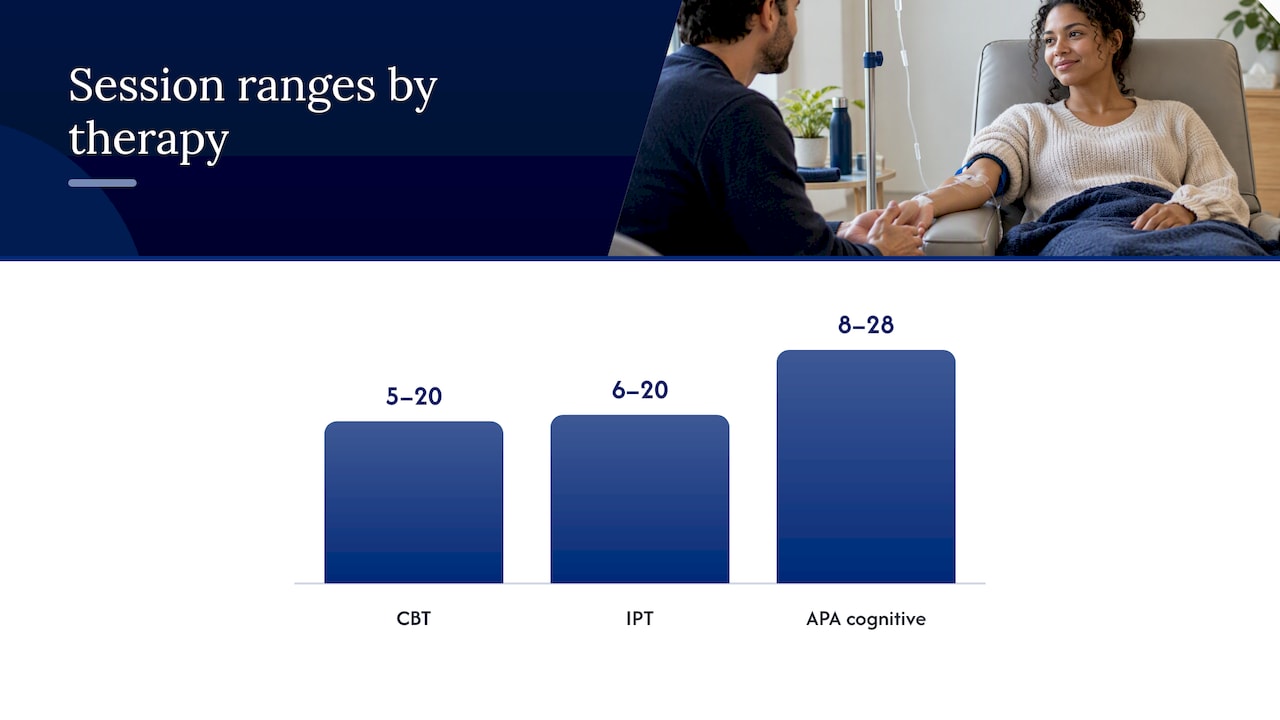
- CBT often runs 5 to 20 sessions, IPT 6 to 20 weekly sessions, while cognitive therapy may reach 28 sessions in complex cases.
- Completing tasks between sessions, such as thought records or scheduled activities, is associated with greater progress; mood tracking can help clinicians adjust treatment.
- Teletherapy is supported when privacy and risk are manageable, but in person care is preferable for severe symptoms, high risk, or inadequate home privacy.
- If someone shows active suicidal intent or has seriously harmed themselves, call emergency services or a crisis hotline and stay nearby until help arrives.
Table of Contents
- Evidence-based psychotherapies that treat anxiety and depression
- What to expect: sessions, program length, goals, and homework
- How to choose a therapist or program: exact questions to ask and red flags
- Teletherapy and delivery formats: online, group, guided self-help, and when each is right
- Urgent situations and safety planning: what to do now if you or someone is at risk
- What is IV therapy and how it is proposed to work for anxiety and depression
- Scientific evidence and clinical studies on effectiveness and safety of IV therapy for anxiety and depression
- Potential risks, side effects, and contraindications of IV therapy
- Comparison of IV therapy with standard treatments for anxiety and depression
- Guidelines and recommendations from medical and psychiatric organizations regarding IV therapy for these conditions
- Typical treatment protocols, duration, and frequency for IV therapy in this context
- Mastering Conflict’s clinical approach and author perspective
- If you want to book therapy with us: services and next steps
- FAQ
- Sources
Evidence-based psychotherapies that treat anxiety and depression
Several talk therapies have solid research behind them, and understanding the differences helps you pick the right fit. CBT works by identifying unhelpful thought patterns and behaviors, then replacing them with more accurate thinking and healthier coping skills; it is structured, often includes homework between sessions, and tends to run a defined number of weeks rather than continuing indefinitely. A plain-language explainer on CBT mechanics walks through how the technique applies in everyday practice.
IPT focuses on relationship patterns and life transitions that fuel depression, while behavioral activation targets withdrawal and avoidance by rebuilding engagement with rewarding activities. Problem-solving therapy teaches structured decision-making for people stuck in cycles of worry, and third-wave approaches such as acceptance and commitment therapy add mindfulness-based skills to the mix. According to the National Institute of Mental Health, psychotherapy reduces symptoms and improves functioning for both depression and anxiety, and treatment should be individualized based on the person’s needs, with medication added when appropriate.
A large network meta-analysis of psychotherapies for depression found that most major psychotherapy types outperform usual care or waitlist controls, with few consistent differences in effectiveness between CBT, IPT, behavioral activation, and other established approaches. That matters because it means the best therapy often depends less on the specific label and more on fit with your goals and your therapist’s skill.
Guideline consensus on first-line therapy options includes:
- CBT, recommended across major guidelines for both anxiety and depression.
- IPT, often used for depression tied to relationship or role transitions.
- Behavioral activation, effective for withdrawal and low motivation.
- Problem-solving therapy, useful for anxiety driven by persistent worry.
Statistic callout: The NICE NG222 guidance recommends brief structured psychological interventions, including CBT, behavioral activation, IPT, and problem-solving therapy, for moderate to severe depression, and advises choosing the delivery format based on available resources and patient preference without specifying exact session counts. That guidance reflects a broader pattern: structured talk therapy, not a single “best” method, is what the evidence consistently supports.
What to expect: sessions, program length, goals, and homework
Weekly sessions are the norm for most structured therapy programs. Session counts vary by method and severity, but ranges are fairly consistent across major approaches.
- CBT programs often run from about 5 to 20 sessions, with structure tightening around specific goals.
- IPT courses commonly span 6 to 20 weekly sessions, adjusted to clinical need.
- APA clinical guidance lists average session ranges for some cognitive therapies, varying based on complexity.
- Progress reviews happen at intervals your clinician sets, deciding whether to continue, intensify, or shift approach.
The Prevention Services Program summary confirms that standard CBT and IPT courses are typically time-limited and tailored to the person rather than open-ended. Homework matters here: a study on therapy outcomes found that patients who complete between-session tasks, like thought records or scheduled activities, tend to make greater progress than those who skip them. When symptoms are severe or persistent, clinicians may recommend combining therapy with medication, a decision the APA clinical practice guideline frames as something to individualize rather than apply universally.
Pro Tip: Keep a simple log of your mood and completed homework each week; it gives your therapist concrete data to adjust your plan instead of relying on memory alone.
How to choose a therapist or program: exact questions to ask and red flags
Picking the right provider shapes how well therapy works, so it helps to go in with a short list of things to verify.
Credentials and fit to confirm:
- Active clinical license and training in CBT, IPT, or behavioral approaches relevant to your concern.
- Direct experience treating anxiety, depression, or the specific issue you are facing (grief, couples conflict, family stress).
- Comfort with your cultural background, language needs, and any accessibility requirements.
- Clear telehealth or in-person options that match your schedule and insurance situation.
Questions worth asking during an intake call:
- What experience do you have treating this specific issue?
- How do you set goals and measure progress over time?
- What is your plan if I’m in crisis between sessions?
- Will you coordinate with my prescriber or primary care provider if needed?
- How often do you expect we’ll meet, and for roughly how long?
The NIMH guidance on finding help recommends starting with primary care for initial screening and preparing questions in advance to evaluate whether a provider is the right match. Watch for red flags: promises of a guaranteed cure, a vague or missing treatment plan, reluctance to coordinate with other providers, or a pattern of canceled sessions. Any of these suggest it may be worth looking elsewhere.
Teletherapy and delivery formats: online, group, guided self-help, and when each is right
Virtual therapy has solid evidence behind it. A 2023 WHO update on psychological interventions notes that teletherapy can be a high-value option for many people, with evidence supporting virtual delivery when privacy and risk are manageable.
Formats worth considering:
- Individual teletherapy, convenient and private for most mild to moderate concerns.
- Group CBT, useful for building skills alongside peers facing similar issues.
- Guided self-help, a lighter-touch option for less severe symptoms.
- Blended care, combining occasional in-person visits with virtual sessions.
In-person care is usually preferable when risk is high, symptoms are severe, or your home does not offer enough privacy for confidential sessions. For teletherapy to work well, find a private space, test your connection beforehand, and treat the session with the same focus you would give an in-person appointment.
Urgent situations and safety planning: what to do now if you or someone is at risk
Active suicidal intent, a specific plan, or serious self-harm are signs that call for immediate action, not a scheduled appointment. The WHO Q&A on suicide recommends contacting emergency services, a crisis hotline, or an emergency medical center right away, and following up with a mental health professional after the crisis passes.
Immediate safety steps:
- Call emergency services or a crisis hotline without delay if danger feels imminent.
- Remove access to means of self-harm where possible.
- Stay with the person, or ensure someone else does, until help arrives.
- Watch for increased substance use, which often signals worsening risk.
Statistic callout: Crisis hotlines operate 24 hours a day, seven days a week, giving anyone in crisis a direct, immediate line to support at any hour.
What is IV therapy and how it is proposed to work for anxiety and depression
As defined for this guide, “IV therapy” is structured talk therapy, the kind delivered in a counseling office or over a secure video call, not an intravenous infusion. The mechanism is psychological and behavioral rather than biological: a trained clinician works with you to identify patterns in thinking, behavior, or relationships that sustain anxiety or depressive symptoms, then applies specific techniques to shift those patterns over time.
CBT, for instance, is proposed to work by helping you notice distorted thoughts (catastrophizing, all-or-nothing thinking) and test them against reality through structured exercises. Behavioral activation works by reversing the withdrawal cycle: as you re-engage with meaningful activities, mood often follows. IPT works by addressing the relationship or role transition, such as grief, conflict, or a major life change, that is fueling depressive symptoms.
These mechanisms are supported by guideline bodies rather than invented claims. The NIMH overview of psychotherapies describes therapy as something that can be delivered in person or virtually, and often used alongside medication when clinically appropriate. The common thread across every evidence-based approach is that change happens through structured conversation, skill-building, and practice, not through a physical substance introduced into the body.
Scientific evidence and clinical studies on effectiveness and safety of IV therapy for anxiety and depression
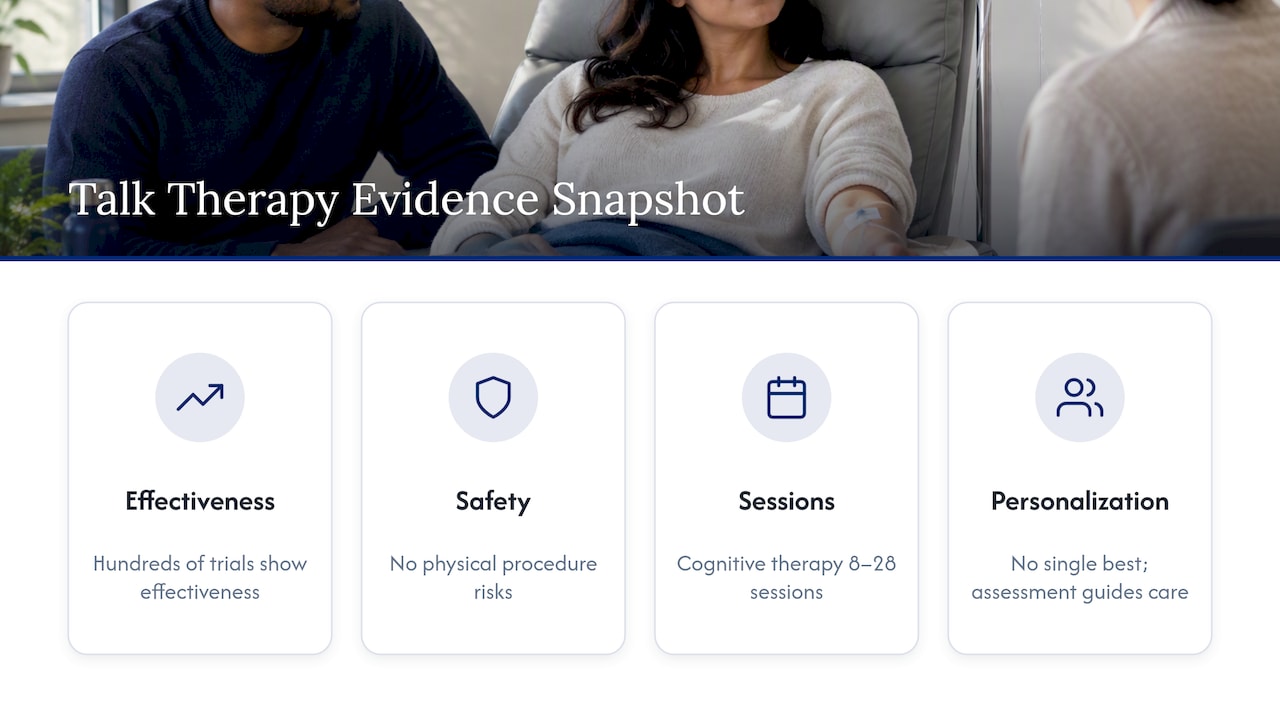
The research base for psychotherapy as defined here (talk therapy) is extensive and consistent. The network meta-analysis of psychotherapies for depression pooled data from hundreds of trials and found that multiple approaches, including CBT, IPT, behavioral activation, problem-solving therapy, and third-wave therapies, are effective compared to usual care or waitlist controls. Differences between these major approaches were inconsistent, suggesting that several well-delivered therapies can achieve similar results.
Safety is also well established for talk therapy: it carries none of the physical risks associated with medical procedures, since it involves conversation and skill practice rather than any substance or device. The APA clinical practice guideline on depression lists multiple psychotherapy interventions as recommended treatments for adults and reports average session ranges for cognitive therapies between 8 and 28 sessions, depending on severity and complexity.
What the evidence does not support is a single “best” therapy for everyone. Guidelines consistently point to individualized care: your symptom severity, personal preference, and access to providers all shape which approach and format (individual, group, in-person, virtual) will serve you best. This is why an initial assessment matters so much, it is the step where a clinician matches the evidence to your specific situation rather than applying a one-size answer.
Potential risks, side effects, and contraindications of IV therapy
Because this guide uses “IV therapy” to mean psychotherapy, the risk profile looks very different from what that phrase might suggest elsewhere. Talk therapy does not carry the physical risks of an infusion, injection, or medical procedure. The real risks are psychological and practical, and they are worth naming clearly.
Some therapies, particularly those that involve revisiting difficult memories or confronting avoided situations (common in CBT for trauma or anxiety), can temporarily increase distress before symptoms improve. A mismatch between therapist and client, or a therapy style that does not fit your needs, can also slow progress or leave you feeling unheard. The therapeutic relationship itself is considered a core active ingredient in successful treatment; when rapport is poor, outcomes tend to suffer regardless of which technique is used.
Contraindications in this context are less about medical restrictions and more about clinical judgment: someone with severe, acute risk (active suicidal intent, psychosis, or a crisis requiring stabilization) typically needs emergency or higher-level care before or alongside outpatient talk therapy. For couples or families, systemic approaches that address relationship patterns may be necessary when interpersonal conflict is a major driver of symptoms, rather than individual therapy alone. The safeguard against most of these risks is open communication: telling your therapist when something feels off, and revisiting the treatment plan together if progress stalls.
Comparison of IV therapy with standard treatments for anxiety and depression
Framed correctly, psychotherapy is a standard, guideline-recommended treatment, not an alternative to one. The comparison that matters most is therapy versus medication versus combined care, and the evidence here is well mapped.
The APA guideline recommends psychotherapy as a frontline option for adult depression and supports combining it with medication when symptoms are more severe or persistent. The NICE guidance takes a stepped approach: less intrusive options, like guided self-help or brief structured therapy, are often tried first for milder cases, with more intensive or combined treatment reserved for moderate to severe presentations.
Medication can work faster for some biological symptoms of depression, such as sleep and appetite disruption, while therapy tends to build skills that reduce relapse risk over the longer term. Neither replaces the other universally, individual response, preference, and access all factor into the decision, which is why guidelines frame this as a conversation between patient and clinician rather than a fixed hierarchy. For couples whose anxiety or depression is tangled up with relationship conflict, couples-focused or family therapy can address dynamics that individual treatment alone might miss.
Guidelines and recommendations from medical and psychiatric organizations regarding IV therapy for these conditions
Every major guideline body referenced in this article points to the same conclusion: structured psychotherapy is a recommended, evidence-based treatment for anxiety and depression, often used alone or alongside medication depending on severity. The NIMH describes CBT and IPT as evidence-based options with treatment chosen based on the individual. The WHO’s 2023 update on psychological interventions supports virtual delivery formats as a legitimate, high-value care option for many people.
The NICE NG222 recommendations specifically name CBT, behavioral activation, IPT, and problem-solving therapy as recommended interventions, while also advising clinicians to weigh resources and patient preference when choosing format. The APA clinical practice guideline echoes this, listing multiple psychotherapy interventions as recommended care and providing session-range benchmarks clinicians can use to plan treatment.
None of these organizations frame psychotherapy as a last resort or a soft alternative. They frame it as one of the primary, well-supported paths to recovery, with the specific modality and format tailored to the person rather than applied uniformly.
Typical treatment protocols, duration, and frequency for IV therapy in this context
Most structured talk therapy protocols follow a predictable rhythm: weekly sessions, a defined number of weeks, and periodic check-ins to measure progress. CBT protocols commonly run 5 to 20 sessions, while IPT often spans 6 to 20 weekly sessions, according to the Prevention Services Program summary. More complex or severe cases may extend toward the higher end of the APA’s reported 8 to 28 session range for cognitive therapies.
A typical protocol starts with an initial assessment that covers diagnostic history, current symptoms, and safety planning, then moves into active treatment with measurable goals set collaboratively. Sessions typically run about 45 to 60 minutes, delivered weekly at first and sometimes tapering to biweekly as symptoms improve. Clinicians reassess periodically, deciding whether to continue the current approach, step up intensity, or shift to a different modality if progress has stalled. For couples or families, protocols often integrate relationship-focused sessions alongside individual work when interpersonal patterns are part of what sustains the symptoms.
Mastering Conflict’s clinical approach and author perspective
Choosing a provider for anxiety or depression is less about finding a perfect method and more about finding someone who will individualize care and stay accountable to your progress. We offer teletherapy alongside in-person counseling for individuals, couples, and families, built around evidence-based methods rather than a single fixed protocol.
Our services span individual counseling, couples therapy, family counseling, and anger management programs, along with coaching for burnout recovery and clinical training for practitioners. We also treat teletherapy as a core delivery option, extending access well beyond our home base.
Whatever provider you choose, including us, run them through the same questions covered earlier in this guide: their experience, how they measure progress, and their crisis plan. That checklist protects you regardless of who ends up on the other side of the screen.
— Carlos
If you want to book therapy with us: services and next steps
If you are ready to move from reading to doing, we offer a direct path. A first step typically starts with an initial assessment, where we review your history and current symptoms, then set measurable goals together before scheduling ongoing sessions.
Relevant services to explore:
- Clinical services covering individual counseling for women, men, and teens, plus anger management and infidelity recovery.
- Couples packages, including structured programs for relationship repair.
- Family counseling for households navigating conflict tied to anxiety or depression.
- Clinical supervision for practitioners seeking mentoring and training.
Before your first session, use the intake questions from earlier in this guide, credentials, experience, goal-setting approach, and crisis planning, to confirm fit. When you are ready, book a session through our clinical services page to get started.
This article is general information, not a substitute for advice from a qualified doctor. Consult a qualified healthcare professional about your own circumstances before acting on anything here.
FAQ
Does IV therapy mean psychotherapy or an infusion treatment?
In this guide, “IV therapy” refers specifically to psychotherapy, talk-based treatments like CBT, IPT, and behavioral activation, not an intravenous infusion. These therapies are recommended by organizations including the NIMH as evidence-based options for anxiety and depression.
How many therapy sessions are typically needed for anxiety or depression?
Standard CBT programs often range from about 5 to 20 sessions, while IPT commonly spans a similar range depending on severity. The APA reports average ranges as high as 8 to 28 sessions for some cognitive therapies in more complex cases.
Is online therapy as effective as in-person sessions?
Evidence reviewed by the WHO supports teletherapy as a high-value option for many people when privacy and risk levels are manageable. In-person care remains preferable for more severe symptoms or higher-risk situations.
What should I do if someone is in immediate crisis?
Contact emergency services or a crisis hotline right away if someone shows active suicidal intent or severe self-harm, then arrange follow-up care with a mental health professional, as recommended by the WHO. Crisis hotlines operate 24 hours a day, seven days a week for exactly these situations.
Does Mastering Conflict offer teletherapy for anxiety and depression?
Yes, we provide teletherapy alongside in-person counseling for individuals, couples, and families through our clinical services. Sessions begin with an initial assessment to set goals before moving into ongoing, evidence-based treatment.
Sources
- Psychotherapies – NIMH
- APA clinical practice guideline on depression
- Network meta-analysis of psychotherapies for depression