
Build Trust First: 7 Habits for Navigating Cultural Differences

Prioritize building trust and staying curious over memorizing etiquette rules. In your next cross-cultural conversation, learn one greeting or thank-you phrase in the other person’s language and ask a genuine clarifying question before assuming intent. Research from HBS Online and the Program on Negotiation backs this approach, and this approach is often effective in couples and family sessions.
TL;DR:
- Learning a simple greeting or thank-you phrase in the other person’s language enhances respect and opens up genuine dialogue, often within five minutes.
- Observing food and gesture norms reveals cultural values more than verbal explanations, helping avoid accidental disrespect.
- Asking curiosity-driven questions and mirroring formality levels foster trust and prevent misunderstandings in both personal and professional settings.
- Avoid stereotyping and over-adapting, and when missteps happen, openly acknowledge confusion with a request for clarification to rebuild rapport.
- Building cultural intelligence through ongoing practice and using tools like the P.A.U.S.E. method improves real-time adjustments and reduces recurring conflicts.
Table of Contents
- Practical Tips for Navigating Cultural Differences Day to Day
- What Frameworks Explain Why These Tactics Work?
- How Do You Apply These Skills in Different Settings?
- What Mistakes Should You Avoid, and How Do You Repair Them?
- How Do Clinicians Use These Strategies in Practice?
- A Clinician’s View on Everyday Cultural Friction
- When to Get Professional Support for Cultural Conflict
- Sources
Practical Tips for Navigating Cultural Differences Day to Day
You don’t need a degree in anthropology to get this right. You need a handful of habits that signal respect before you ever say the wrong thing.
- Start with the basics. A greeting, a “thank you,” or a farewell in someone’s native language costs you five minutes to learn and tells them you prepared. This small gesture shifts dynamics without requiring fluency.
- Learn one phrase beyond hello. Something like “I want to understand this correctly” works across nearly every context and buys you room to ask follow-up questions.
- Watch food and gesture norms before you act. Whether someone eats with their hands, refuses a handshake, or waits for elders to speak first tells you more about the room than any briefing document.
- Ask curiosity questions instead of guessing. Try: “Can you walk me through how this is usually handled where you’re from?” It beats silently assuming you already know.
- Mirror formality levels. If someone uses titles and last names, match that until they signal otherwise. Dropping into first names too fast can read as disrespect in many settings.
- Send a written outline before meetings. A short agenda in advance reduces the chance that mixed-language or mixed-context conversations spiral into confusion, a tactic PON research points to for restarting stalled talks.
- Use small rituals to build rapport. Sharing a meal, asking about family, or exchanging a coffee before business talk isn’t wasted time. It’s often the actual negotiation groundwork.
Pro Tip: If you misstep, don’t over-apologize or go silent. Say plainly, “I may have gotten that wrong. Can you help me understand what I missed?” That one sentence repairs more than a paragraph of nervous explanation.
What Frameworks Explain Why These Tactics Work?
Cultural intelligence, or CQ, is the ongoing capacity to read unfamiliar social cues and adjust your behavior in real time. It isn’t a certificate you earn once. It’s a muscle you keep using, because every new context resets the learning curve.
One compact tool worth knowing is the InterCulturaling™ P.A.U.S.E. method, built for in-the-moment use:
- Pause before reacting to something unfamiliar.
- Assess what’s actually happening versus what you assume is happening.
- Understand the other person’s likely frame of reference.
- Shift your approach if needed.
- Engage with a question or comment that tests your read.
Researchers also describe broad cultural prototypes, dignity, face, and honor cultures, that shape how people handle conflict and negotiation. Someone from a face culture may avoid direct confrontation to preserve group standing, while someone from a dignity culture might value bluntness as a sign of respect. These are tendencies, not rules; the Annual Reviews cross-cultural management analysis warns against treating any nation as a monolith. The strongest negotiators pair advance preparation with live curiosity rather than a fixed script, a dual approach HBS Online identifies as the difference between negotiators who close deals and those who stall out on assumptions.
How Do You Apply These Skills in Different Settings?
The tactics above shift shape depending on where you’re using them.
In personal relationships, open conversations about difference directly rather than tiptoeing around them. Try: “I noticed we handle holidays differently. Can you tell me what matters most to your family?” Avoid assuming your partner’s family traditions are the default, and don’t treat curiosity as an interrogation.
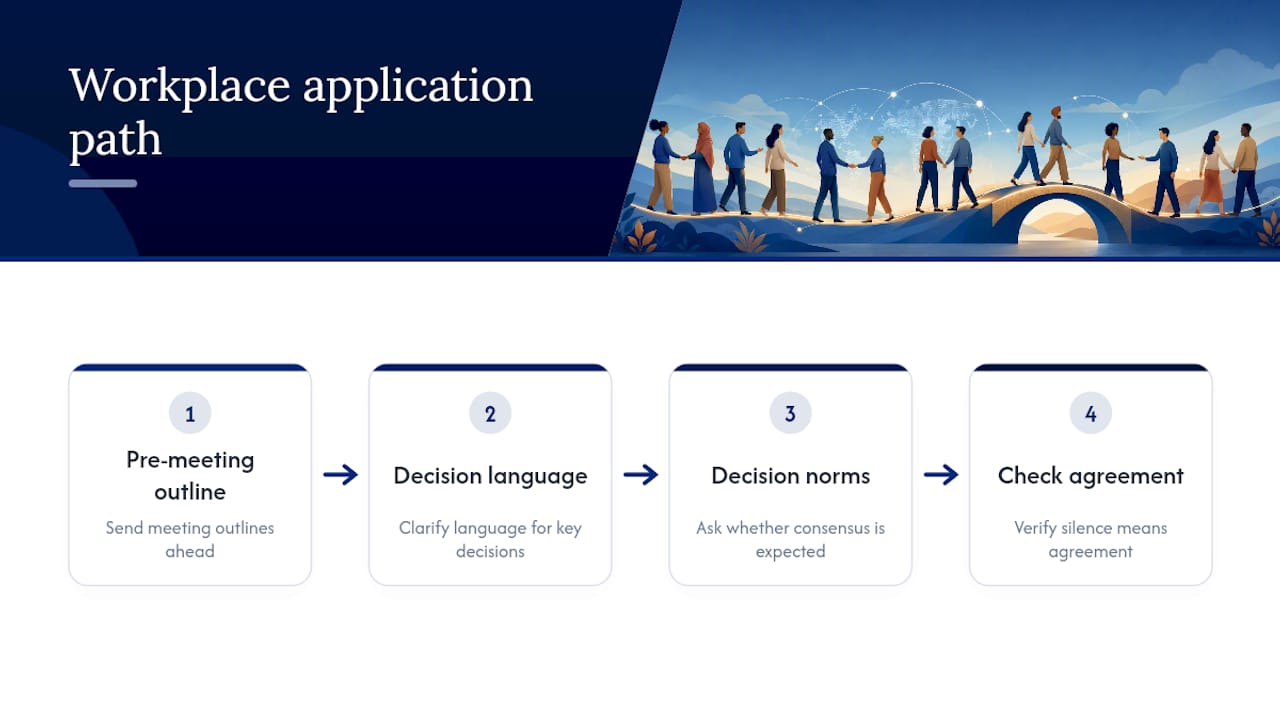
In the workplace, send meeting outlines ahead of time and clarify which language will be used for key decisions if your team is multilingual. Let cultural norms inform how decisions get made, some teams expect consensus, others expect a single voice to decide, and ask rather than guess which applies. Red flags: scheduling around only one time zone’s convenience, and assuming silence in a meeting means agreement.
In leadership and negotiation, build rapport before discussing terms. HBS research is consistent on this: relationships often determine outcomes more than the terms themselves. Adjust your directness based on what the room expects, and save blunt feedback for private settings when you’re unsure. When stakes are high, invest more time in trust before pushing for resolution; when stakes are low, faster tactical adjustments are fine. For more on structuring these conversations, see this guide to conflict management and negotiation skills.
What Mistakes Should You Avoid, and How Do You Repair Them?
Most cross-cultural missteps come from a short list of repeat offenders.
- Stereotyping based on nationality. Treating one person as a stand-in for an entire culture ignores how much individuals vary within any group.
- Over-adapting to the point of losing authenticity. Mimicking accents or mannerisms often reads as mockery, not respect.
- Assuming language competence. Speaking quickly or using idioms with someone still learning your language creates confusion, not connection.
- Forcing humor. Jokes rely on shared context that often doesn’t translate, and a joke that lands flat can derail trust fast.
When you misstep, name it plainly: “I think I misunderstood the situation. Can you help me see what I missed?” If tension keeps recurring across repeated interactions, especially in a relationship or family, that’s usually the signal to bring in a neutral third party rather than keep trying to self-correct.
How Do Clinicians Use These Strategies in Practice?
Therapists assess cultural dynamics from the first intake session, asking how a client’s upbringing shapes their expectations around conflict, authority, and communication style. This isn’t a formality:
- Chronic relational conflict often traces back to unspoken cultural assumptions neither partner named out loud.
- Cultural identity stress, feeling caught between two worlds, shows up frequently in multicultural family work.
- Framing questions like “What did conflict look like in your household growing up?” surface patterns clients rarely connect on their own.
Some clinicians build this cultural lens into couples and family counseling rather than treating it as an afterthought.
A Clinician’s View on Everyday Cultural Friction
Most cultural conflict I see in session isn’t dramatic. It’s a couple arguing about how loudly to celebrate a birthday, or a family split on when adult children should move out. The differences are ordinary. What matters is whether people ask about them or assume they already know the answer.
— Carlos
When to Get Professional Support for Cultural Conflict
Some cultural friction resolves with a better question and a little patience. Other times, it’s layered into deeper patterns, recurring arguments, unspoken resentment, or one partner feeling erased by the other’s traditions, and that calls for more than a conversation tip.
Teletherapy, couples therapy, and anger management assessments can support those navigating cultural differences and blended traditions, especially when misunderstandings escalate. If cultural tension has become a recurring source of strain in your household, family counseling gives you a structured space to name what’s actually happening instead of circling the same argument. Book an initial assessment to find out which service fits your situation.
Sources
- Cross-Cultural Negotiation: Navigating Differences to Find Common Ground — HBS Online
- How to solve intercultural conflict — PON
- Annual Reviews — Cross-cultural management review