
5 Conflict Resolution Approaches That Actually Work in Therapy

Five evidence-based therapeutic approaches are available today for individuals, couples, and families: Communication/Skills Training (try speaker-listener drills first), Cognitive-Behavioral Couple Therapy or Behavioral Couple Therapy (CBCT/BCT, ask for it by name when relationship distress is the primary concern), Emotionally Focused Therapy (EFT, request it when attachment injuries or pursuer-distancer cycles are driving the conflict), Integrative and Systemic approaches including Integrative Behavioral Couple Therapy (IBCT), Gottman Method, and Bowen family-systems work (best for high-conflict or multi-generational patterns), and brief reappraisal and telehealth interventions (a practical starting point for prevention or when in-person access is limited). A narrative review of studies from 2016 through 2025 confirmed that CBT and EFT are the most frequently reported approaches for improving communication, emotional regulation, and marital satisfaction across these categories.
- Communication/Skills Training: Practice one speaker-listener exchange before your next session.
- CBCT/BCT: Ask your clinician whether cognitive restructuring homework is part of the plan.
- EFT: Look for a therapist trained in de-escalation of pursuer-distancer cycles.
- Integrative/Systemic (IBCT, Gottman, Bowen): Useful when acceptance work is as important as behavior change.
- Brief/Digital Reappraisal: Start with a structured reappraisal module if access or time is constrained.
Pro Tip: When calling a therapist for the first time, ask specifically which of these five approaches they use and whether they have received formal training or supervision in it. Vague answers are a red flag.
Key Takeaways
The most effective conflict resolution in therapy matches the approach to the presenting pattern, the clinician’s training, and the client’s safety needs.
| Point | Details |
|---|---|
| Five core approaches | Communication training, CBCT/BCT, EFT, Integrative/Systemic, and brief reappraisal each target different conflict patterns. |
| Alliance predicts outcomes | Therapeutic alliance quality is a stronger predictor of success than strict protocol adherence alone. |
| Safety screening is non-negotiable | Active IPV, acute suicidality, and untreated severe SUD require triage before conjoint skill work begins. |
| Brief interventions work | A 21-minute reappraisal module eliminated Year 2 marital quality decline in a randomized sample of 120 couples. |
| Masteringconflict | Offers couples, family, and individual therapy plus clinician training and supervision across all five approaches, with telehealth available. |
This article is general information, not a substitute for advice from a qualified doctor. Consult a qualified healthcare professional about your own circumstances before acting on anything here.
Table of Contents
- Why conflict in relationships isn’t the problem you think it is
- The 5 evidence-based conflict resolution approaches, compared
- What to expect when you start therapy
- How to choose the right clinician for your situation
- Training and supervision resources for clinicians
- What a clinician actually does with these five approaches
- Masteringconflict offers the clinical path forward
- Sources
Why conflict in relationships isn’t the problem you think it is
Therapy does not aim to eliminate conflict. The goal is to change the pattern around it. Partners who can disagree without one person shutting down and the other escalating have built what clinicians call a relational frame: a shared understanding that the relationship can hold tension without breaking. That shift, not the absence of arguments, is what predicts long-term satisfaction.
The evidence on couple therapy outcomes is clear that EFT and related approaches work by helping partners access primary emotions beneath the conflict cycle, fostering secure attachment bonds that reduce blaming and withdrawal. Conflict becomes less dangerous when both people trust the relationship can survive it.
What predicts success across all five approaches is the therapeutic alliance: the quality of the working relationship between client and clinician. Therapist neutrality, active disruption of harmful in-session cycles, and genuine warmth matter more than strict protocol adherence alone.
- Relational frames let partners disagree without escalation.
- Attachment security reduces the threat value of conflict.
- Alliance quality predicts outcomes across all modalities.
- Safety concerns (active intimate partner violence, acute suicidality) require immediate triage before any skill work begins.
Pro Tip: If a session feels like it is going through the motions, name it. A good clinician will pause the skill work and address the alliance directly. That pivot is often where the real change starts.
The 5 evidence-based conflict resolution approaches, compared
1. Communication and skills training
Structured communication training teaches active listening, I-statements, and the speaker-listener technique, where one partner speaks while the other reflects before responding. It appears as a foundational component in nearly every effective intervention reviewed. Communication skills training improves intimacy and reduces conflict frequency and works as both a low-intensity psychoeducational program and a clinical skill module. Delivery can be individual, couple, group, or self-guided online. Typical programs run multiple sessions. Not appropriate as a standalone approach when active intimate partner violence (IPV) is present.

2. Cognitive-Behavioral Couple Therapy and Behavioral Couple Therapy (CBCT/BCT)
CBCT and BCT target distorted thinking patterns and maladaptive behaviors that maintain relationship distress. Core techniques include cognitive restructuring, behavioral experiments, and communication skill practice. Empirical reviews support BCT and CBCT across multiple trials; effect sizes are somewhat lower in community settings but remain meaningful. Delivered primarily as couple therapy in-person or via telehealth, session counts vary by program and needs. CBCT also has strong evidence for individual disorders (depression, anxiety) when relationship functioning is a maintaining factor. Contraindicated when one partner is unwilling to engage or when active IPV has not been safety-planned.
3. Emotionally Focused Therapy (EFT)
EFT targets the attachment system directly. The therapist tracks the pursuer-distancer cycle, helps each partner access the primary emotion underneath their position (fear, shame, longing), and creates enactments where new emotional experiences replace old defensive ones. The evidence base for EFT shows it de-escalates negative cycles and fosters bonding that reduces blaming and withdrawal. Typically 8–20 sessions for couples; adapted versions exist for families and individuals. EFT is particularly well-suited to attachment injuries (affairs, betrayals, emotional abandonment). Requires a therapist with formal EFT training; not recommended as a first-line approach when severe substance use disorder is untreated.
4. Integrative and systemic approaches (IBCT, Gottman Method, Bowen)
This category covers approaches that blend acceptance with behavior change or address multi-generational and family-system patterns. IBCT adds empathic joining and unified detachment to standard BCT, helping partners accept differences they cannot change while still targeting behaviors that can shift. A pre-pilot IBCT prevention program using five 120-minute sessions showed improvements in acceptance and empathic joining, with some gains maintained at three-year follow-up in a small sample. The Gottman Method uses the Sound Relationship House framework and targets the Four Horsemen (criticism, contempt, defensiveness, stonewalling). Bowen family-systems work addresses triangulation and differentiation across generations. Family counseling approaches emphasize detriangulation, structured recovery contracts, and contingency management to reduce relational conflict. Delivery ranges from couple to family to multi-family group formats, in-person and telehealth. Timelines vary: IBCT and Gottman-based work typically involve multiple sessions adjusted to client needs. Contraindications mirror those for CBCT: active IPV requires specialized safety planning first.
Pro Tip: For high-conflict couples where one or both partners resist “working on the relationship,” IBCT’s acceptance strategies often create more traction than pure behavior-change techniques. Start there.
5. Brief reappraisal and telehealth interventions
A randomized study of 120 couples found that a 21-minute reappraisal module eliminated the Year 2 decline in marital quality seen in the control group, with the effect mediated by reduced conflict-related distress. That is a striking result for something shorter than a typical therapy session. Brief reappraisal exercises ask partners to view a recent conflict from the perspective of a neutral third party and write about it, interrupting the emotional escalation cycle. Digital and telehealth formats extend access to underserved areas, though fidelity monitoring matters. Best suited for prevention, stepped-care entry points, or couples not yet ready for full therapy. Structured Interparental Conflict (IPC) interventions used in U.S. legal and clinical contexts follow a similar brief-structured format and are associated with reduced parental conflict and improved child outcomes.
What to expect when you start therapy
Most sessions follow a recognizable arc: assessment of the presenting pattern, in-session skill practice or enactment, homework assignment, and progress review at the next meeting. That rhythm holds whether you are doing CBCT or EFT, though the content differs.
Common in-session techniques include speaker-listener exchanges, role-play, therapist-guided enactments (where partners practice a new emotional response in real time), and behavioral experiments. Homework typically involves communication logs, structured practice drills between sessions, or shared activities designed to build positive interaction.
Timeline heuristics:
- Brief interventions (reappraisal modules, psychoeducation programs): 1–5 sessions.
- Short-term structured therapy (CBCT, BCT, communication training): 6–12 sessions.
- Longer integrative or attachment-based work (EFT, IBCT, Gottman): 12–26 sessions.
Common outcome measures include the Dyadic Adjustment Scale (DAS), conflict frequency logs, and validated relationship questionnaires administered at intake and periodically through treatment.
Safety and contraindications checklist:
- Screen for active IPV before beginning any conjoint work.
- Assess for acute suicidality and refer for crisis services when indicated.
- Evaluate substance use severity; untreated severe SUD often requires concurrent specialized treatment.
- Court-ordered programs (IPC, co-parenting interventions) follow structured timelines set by the referring court.
Pro Tip: Ask your clinician to use a brief session-feedback tool at the end of each appointment. Routine outcome monitoring catches alliance ruptures and treatment drift early, before they become dropout.
How to choose the right clinician for your situation
Match your clinical goals and safety needs to the approach and the clinician’s actual training. A therapist who says they “use a little of everything” without naming specific models or supervision is not the same as one who completed formal EFT training or a CBCT workshop series.
Credentials and training to ask about:
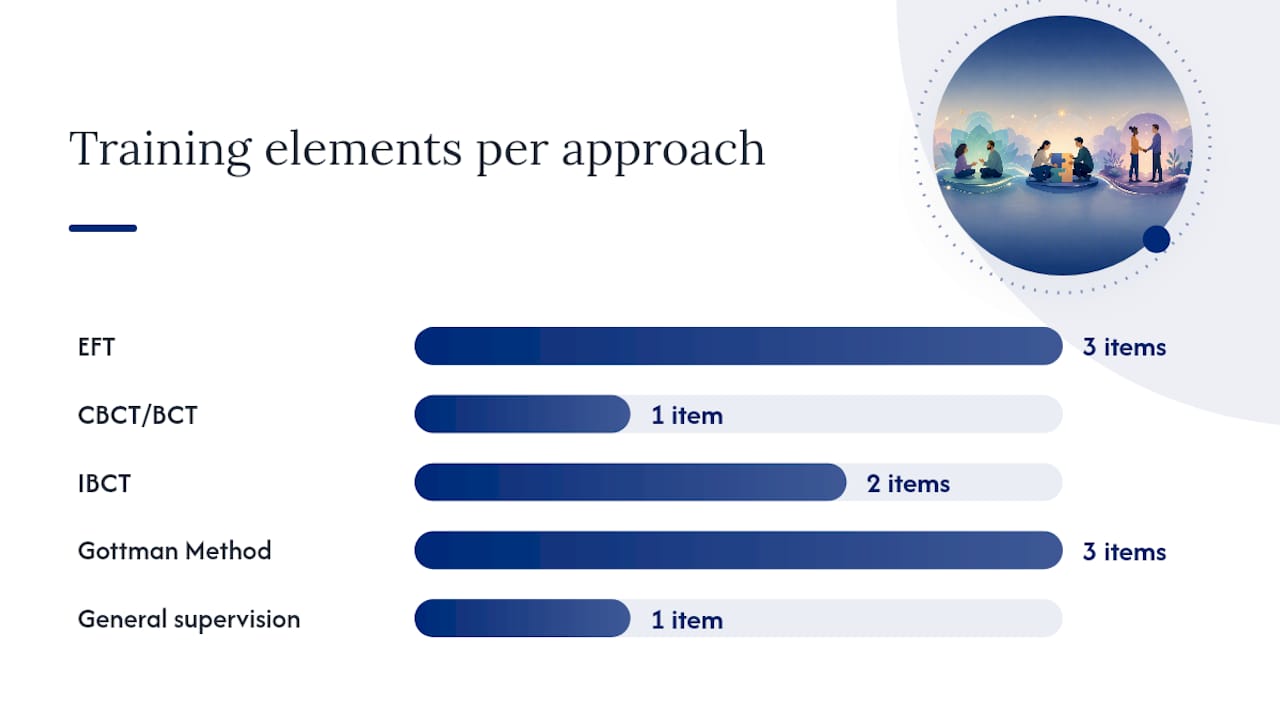
- EFT: Externship, Core Skills training, and Supervisor/Therapist certification through the International Centre for Excellence in Emotionally Focused Therapy (ICEEFT).
- CBCT/BCT: Workshop training through the Association for Behavioral and Cognitive Therapies (ABCT) or equivalent.
- IBCT: Training workshops and supervision with developers or certified trainers.
- Gottman Method: Level 1, 2, and 3 training through the Gottman Institute.
- General: Active clinical supervision or peer consultation group.
Ten questions to ask at intake:
- Which specific approach do you use for couples or family conflict?
- What formal training have you completed in that model?
- How do you track progress across sessions?
- What is your experience with domestic violence screening and safety planning?
- Do you offer telehealth sessions?
- Are you currently receiving supervision or peer consultation?
- What does a typical session look like for a couple like us?
- How many sessions should we expect?
- What happens if we are not making progress after six sessions?
- What are your fees, and do you offer a sliding scale or accept insurance?
Red flags: vague treatment plans with no named model, blame-based language toward one partner in session, no safety screening at intake, and resistance to discussing outcomes or progress measures.
Cost and access: Telehealth significantly expands geographic access. Many clinicians offer sliding-scale fees. Brief structured programs (reappraisal modules, psychoeducation groups) are often lower cost than weekly individual therapy. For culturally adapted approaches and faith-sensitive interventions, ask specifically whether the clinician has training in that area.
Training and supervision resources for clinicians
Fidelity and ongoing supervision predict better client outcomes. The research is consistent on this: alliance quality and active therapist skill matter more than model loyalty alone, but you need a model to practice with fidelity.
Training pathways:
- EFT: ICEEFT Externship (entry), Core Skills, then Supervisor track.
- CBCT/BCT: ABCT workshops, continuing education through university training clinics.
- IBCT: Developer-led workshops; supervision with IBCT-trained consultants.
- Gottman Method: Three-level training sequence; online and in-person formats available.
- Communication/Skills Training: PREP (Prevention and Relationship Enhancement Program) facilitator training for psychoeducation delivery.
- Family/Systemic: Bowen Center training; family therapy CE through AAMFT.
Outcome monitoring tools: Dyadic Adjustment Scale (DAS), Conflict and Communication Assessment, and session-by-session feedback tools such as the Session Rating Scale (SRS) and Outcome Rating Scale (ORS).
Supervision structures that work: weekly case consultation groups, video review of recorded sessions with a supervisor, and co-therapy with a more experienced clinician. For telehealth delivery, add platform-specific fidelity checks.
Cultural adaptation is not optional. The 2016–2025 narrative review identified culturally adapted and spiritually integrated strategies as a distinct, effective category. Seek CE training in cultural humility and adapt assessment tools for the populations you serve. For clinicians seeking a psychotherapy partner resource for referrals or peer consultation, connecting with a licensed colleague in a complementary specialty strengthens your network and your clients’ care.
What a clinician actually does with these five approaches
Start with alliance and safety. Every time. The technique comes second, chosen by the pattern in front of you: a pursuer-distancer cycle points toward EFT; rigid cognitive distortions maintaining distress point toward CBCT; a couple where one partner refuses to label emotions points toward IBCT’s acceptance strategies. Reappraisal exercises work well in prevention groups and stepped-care entry points where full therapy is not yet warranted.
The practical adjustments matter as much as the model. With high-conflict couples, IBCT’s empathic joining often creates more movement than direct behavior-change assignments. With families, detriangulation is frequently the first structural move before any skill work lands. Brief reappraisal is underused in prevention contexts and worth adding to any psychoeducation program.
Refer out when active IPV is present, when suicidality is acute, or when untreated severe substance use disorder is driving the conflict. Those cases need specialized care first. Trying to run couples therapy over an active safety crisis is not integrative; it is harmful.
Masteringconflict offers the clinical path forward
Masteringconflict provides the full clinical range these five approaches require: anger-management classes, couples counseling, family counseling, individual therapy, conflict coaching, and clinical training through mentoring and supervision. For clinicians, the All Courses library covers training in evidence-based conflict resolution approaches with continuing-education options. For families navigating high-conflict patterns, the family counseling service offers structured intake and telehealth access. Online therapy extends reach beyond North and South Carolina and Florida to clients across the U.S.
Book a clinical intake or explore training options at Masteringconflict. The first step is a single conversation with a clinician who knows which approach fits your situation.
Sources
- Couple therapy and systemic interventions for adult‐focused problems: The evidence base
- Family counseling approaches in substance use disorder treatment (Chapter excerpt)
Recommended
- Conflict Resolution Strategies for Couples and Families – Mastering Conflict
- Conflict Resolution for Kids: 5 Strategies Boosting Skills by 50% – Mastering Conflict
- Conflict Resolution for Couples: Practical Strategies for 2025 – Mastering Conflict
- Conflict Management Method: Enhancing Therapy Outcomes – Mastering Conflict