
Anger management classes: Build emotional control that lasts

TL;DR:
- Anger management focuses on building emotional skills rather than quick calming techniques.
- Programs teach cognitive reappraisal, acceptance, mindfulness, social skills, and relaxation.
- Results include better emotion regulation, healthier relationships, and reduced physical stress symptoms.
Most people walk into anger management classes expecting to learn how to “calm down faster.” That expectation is understandable, but it misses the point entirely. Anger management is not about suppression or counting to ten. It is about building a genuine set of emotional skills that change how you process, interpret, and respond to the situations that trigger you. If you live in North Carolina, South Carolina, or Florida and you have been wondering whether these classes are worth your time, this guide will walk you through exactly what they involve, how they work, and what you can realistically expect to gain.
Table of Contents
- What are anger management classes?
- How anger management classes work: Methods and curriculum
- Who should attend anger management classes?
- Real-life outcomes: What can you expect?
- Why quick fixes don’t work—and what does
- Find the right anger management solution for you
- Frequently asked questions
Key Takeaways
| Point | Details |
|---|---|
| Evidence-based methods | Anger management classes use proven emotion regulation strategies like reappraisal and acceptance for lasting results. |
| Assessment is key | Most programs start with standardized assessments to guide and measure progress. |
| Outcomes vary | Results depend on method, participant effort, and consistent practice, but most see real improvement. |
| Local options available | Residents in North and South Carolina and Florida can access clinical, teletherapy, and specialized anger management services. |
What are anger management classes?
Anger management classes are structured programs designed to help people understand their anger, recognize its triggers, and build practical skills for responding in healthier ways. They are not punishment or a sign that something is deeply wrong with you. They are a clinical tool, grounded in research, that helps people live with less conflict and more control.
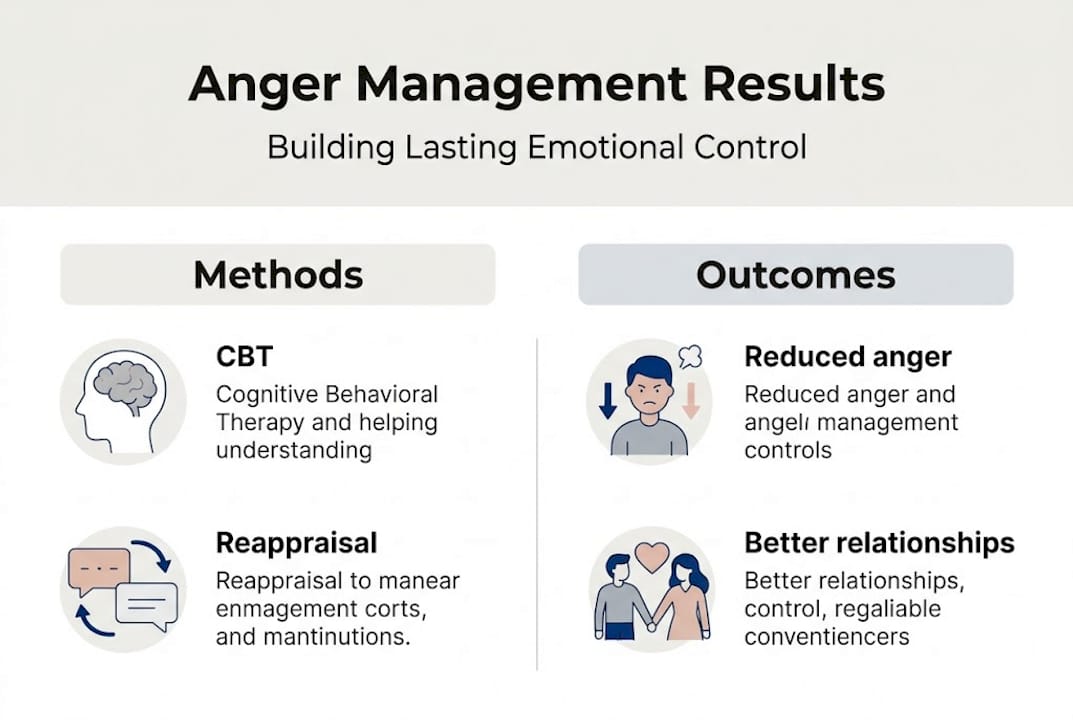
At the core, these classes do two distinct things. First, they work to reduce the internal experience of anger, meaning how intensely and frequently you feel it. Second, they focus on reducing harmful anger expression, which means how that anger comes out in your words and actions. Evidence-based anger treatment commonly uses cognitive and emotion-regulation methods such as reappraisal and acceptance, and these approaches are well-supported in research on emotion regulation interventions for reducing anger.
Common techniques used in anger management classes include:
- Cognitive reappraisal: Changing how you interpret a situation so it feels less threatening or provocative
- Acceptance strategies: Learning to sit with frustration without acting on it impulsively
- Mindfulness: Staying present and aware of physical and emotional cues before they escalate
- Social skills training: Practicing assertive communication so anger does not become the only way to express unmet needs
- Relaxation techniques: Using breathing, grounding, and body-focused methods to lower physiological arousal
The setting matters too. Anger management classes are offered in group formats, individual therapy sessions, and online platforms. Group settings create a shared experience where participants learn from each other’s situations. Individual sessions allow for more personalized work. Online options, which have grown significantly in recent years, make the classes accessible to people across North Carolina, South Carolina, and Florida who cannot attend in person due to work schedules, childcare, or distance.
“Anger management is not about removing anger from your life. It’s about understanding it well enough that you make better choices when it shows up.”
Most programs also begin with a standardized assessment. Before any skills are taught, you complete a structured evaluation of your anger patterns, triggers, and severity. This baseline matters because it personalizes your treatment and gives both you and your counselor a clear starting point. Mindfulness practices for anger are often introduced early in the curriculum because they help clients develop the self-awareness needed for all the other techniques to actually stick.
| Feature | Group format | Individual format | Online format |
|---|---|---|---|
| Cost | Lower | Higher | Varies |
| Personalization | Moderate | High | Moderate to high |
| Peer learning | Yes | No | Sometimes |
| Flexibility | Fixed schedule | Flexible | Highly flexible |
| Accountability | Peer-supported | Clinician-supported | Self and clinician |
Understanding what these classes actually include removes a lot of the anxiety people feel before starting. They are structured, purposeful, and clinically informed, not vague or lecture-based.
How anger management classes work: Methods and curriculum
After understanding what anger management classes are, let’s look at how they function from session to session. The day-to-day experience is more practical and engaging than most people expect.
A typical program follows a predictable rhythm. Assessment comes first, where you identify your specific anger patterns through validated tools. From there, sessions move into psychoeducation, which means learning about what anger actually is, how the brain processes threat, and why some people are more reactive than others. Then the real work begins: practicing specific skills that shift how you experience and express anger.
A typical session-by-session structure looks something like this:
- Check-in and reflection: Review of the previous week, including any situations where anger was triggered and how you responded
- Skill introduction: A new technique is introduced with explanation and examples
- Practice activity: Role-play, journaling, group discussion, or a structured exercise to apply the skill
- Homework assignment: A between-session task to practice the skill in real life
- Wrap-up and goal-setting: Identifying what to focus on before the next session
This structure is intentional. Skill-building only works if it is practiced consistently outside the classroom, not just discussed inside it. Anger management exercises practiced between sessions are often where the biggest breakthroughs happen because real life is the actual proving ground.
One nuance worth knowing: research on emotion-regulation strategies shows they can reduce anger over time, but different strategies may not show a clear advantage over one another in every trial. Results depend on the intervention design, the individual, and how consistently the skills are practiced. This is not a reason for skepticism. It is a reason to commit to the full program rather than expecting overnight results.
Pro Tip: Keep a brief anger journal between sessions. Note the trigger, your physical reaction, your thought, and what you did. This kind of structured reflection dramatically speeds up your learning curve and gives your counselor better material to work with.
Popular anger management approaches compared:
| Approach | Core method | Best suited for | Typical duration |
|---|---|---|---|
| Cognitive Behavioral Therapy (CBT) | Thought restructuring | Adults with reactive anger | 8 to 12 sessions |
| Dialectical Behavior Therapy (DBT) | Distress tolerance and acceptance | Intense emotional dysregulation | 12 to 24 weeks |
| Mindfulness-based methods | Present-moment awareness | Chronic stress-related anger | Ongoing |
| Psychoeducation-focused | Learning about anger mechanics | First-time participants | 4 to 8 sessions |
The role of time is significant. Anger reduction techniques that seem basic in week two often produce powerful results by week eight because the nervous system needs repetition to build new patterns. Do not judge the program by how you feel after the first session.
Who should attend anger management classes?
After seeing how classes operate, it is vital to know who benefits most and how to recognize if you or someone in your family may need them.
Anger management is not reserved for people who have lost control in dramatic ways. Many people who benefit most from these classes appear calm on the surface but struggle with chronic irritability, passive-aggressive communication, or a persistent sense that nothing ever goes their way. These patterns are just as disruptive to relationships and health as more visible outbursts.
Common signs that anger management classes may help:
- Frequent arguments at home or work that feel impossible to de-escalate
- Physical symptoms during conflict: racing heart, clenched jaw, tension headaches
- Saying or doing things in anger that you later deeply regret
- Relationships at home, at work, or socially are suffering because of your reactions
- You find yourself replaying conflicts long after they end, feeding resentment
- People close to you have expressed concern or fear about your temper
- Your children are modeling aggressive or reactive behavior they learned from watching you
Adults are the most common participants, but anger management classes are also adapted for teens and children. Anger management for kids involves age-appropriate activities like storytelling, movement-based exercises, and visual tools that make abstract concepts concrete for younger minds. For parents navigating a child’s explosive behavior, there are also anger techniques for parents that help the whole family system shift together.
For people in North Carolina, South Carolina, and Florida, access to qualified local providers has expanded significantly. Teletherapy platforms now make it possible to connect with a licensed clinician from anywhere in the state, removing one of the biggest barriers to starting.
Programs often use standardized assessments and skill-building elements. A key distinction these assessments track is the difference between reducing how intensely you feel anger internally versus reducing how that anger is expressed through behavior. Both matter, and both can be measured and improved.
Pro Tip: If you are uncertain whether you need anger management or a different form of therapy, start with a clinical assessment. An anger assessment takes the guesswork out of it and gives you a clear clinical picture before you commit to a specific program.
Real-life outcomes: What can you expect?
Understanding who is a good fit, let’s highlight what people actually achieve through anger management classes. Realistic expectations make a significant difference in how fully participants engage with the process.
The most well-documented outcome is improved emotional regulation. Participants consistently report a stronger ability to recognize the early signs of anger before it peaks, which gives them a much wider window to choose how they respond. That window, even if it is only a few extra seconds, changes everything.
Real-life improvements reported by participants in NC, SC, and FL include:
- Fewer explosive arguments at home and calmer resolutions when conflict does arise
- Stronger communication with partners, children, and coworkers
- Reduced physical symptoms of stress, including better sleep and lower blood pressure
- Greater confidence in handling situations that previously felt impossible
- Improved relationships with children and a sense of modeling healthier behavior
One of the most meaningful shifts people describe is moving from feeling controlled by their anger to feeling like they have a genuine choice in the moment. That is not a small thing. It changes the entire texture of daily life.

Statistic callout: Evidence-based anger treatment using cognitive and emotion-regulation methods such as reappraisal and acceptance consistently appears in research showing reductions in both the frequency and intensity of anger responses across diverse adult populations.
Results do vary. The method used, the individual’s level of engagement, the quality of the assessment, and the consistency of between-session practice all influence outcomes. Someone who attends every session but never applies the skills outside the room will progress more slowly than someone who treats each assignment as genuine practice. This is not a passive process.
Exploring the anger management benefits that research points to, the picture is encouraging. Most people who complete a structured program report meaningful improvements in how they handle conflict, not just fewer outbursts, but a fundamentally different relationship with their own emotional responses. For practical strategies to start applying right away, anger management tips grounded in clinical practice can be a useful complement to formal classes.
The honest truth is that the people who see the most dramatic results are often those who were most skeptical walking in. When someone finally experiences that calm, that pause, that moment of choosing differently in a situation that would have previously exploded, the value becomes undeniable.
Why quick fixes don’t work—and what does
Here is the uncomfortable reality that most guides skip: the entire market for “anger management tips” is built on the appeal of instant relief. Breathe deeply. Count to ten. Walk away. These are not useless, but they are not solutions. They are delay tactics.
What actually produces lasting change is the harder work of reappraisal: examining the story you are telling yourself about a situation and questioning whether it is accurate. Controlling anger in relationships requires this kind of cognitive honesty because most relational anger is not really about the incident that triggered it. It is about a pattern of perceived disrespect, unmet need, or accumulated resentment that the incident finally surfaced.
Acceptance is the other piece that changes everything. Not accepting bad behavior from others, but accepting that discomfort is inevitable, that you cannot control every outcome, and that your nervous system’s alarm response is not always accurate. Practitioners in North Carolina, South Carolina, and Florida who work in evidence-based settings consistently emphasize this: the goal is not to stop feeling angry. It is to stop letting anger make your decisions for you. That shift requires practice, not just understanding.
Find the right anger management solution for you
Now that you know what to expect and what actually works, here is how to take practical next steps toward real change.
At Mastering Conflict, we offer a full range of clinical services built on evidence-based methods that address anger management for individuals, couples, children, and teens across North Carolina, South Carolina, and Florida. Whether you prefer face-to-face sessions or flexible access through our teletherapy platform, our licensed clinicians tailor each approach to your specific patterns and goals. Couples dealing with conflict-driven tension can explore our couples packages, which address anger as a relational dynamic rather than an individual problem. Start with a clinical assessment, connect with a specialist, and begin building emotional control that actually holds up in real life.
Frequently asked questions
Do anger management classes really work?
Yes, evidence-based anger management classes using techniques like reappraisal and acceptance can meaningfully reduce anger frequency and intensity and improve emotional control for most participants.
How long does it take to see results?
Most participants notice improvements in emotional regulation after several consistent weeks of practice, though research shows that results depend on the specific strategy used and how consistently it is applied between sessions.
Are anger management classes suitable for children and teens?
Yes, anger management programs are commonly adapted for younger populations with age-appropriate activities, visual tools, and skill-building exercises designed specifically for how children and teens process emotions.
Can I attend anger management classes online?
Yes, many qualified providers now offer fully online anger management classes using the same evidence-based techniques as in-person programs, making them accessible regardless of your location in NC, SC, or FL.
Are standardized assessments part of anger management classes?
Most programs use standardized assessments at the outset to distinguish between reducing internal anger experience and reducing harmful outward expression, which allows clinicians to personalize the intervention effectively.