
Find the Right Therapist in Charlotte, NC: Guide

TL;DR:
- Matching therapy approach and cultural understanding is key to effective treatment in Charlotte.
- Teletherapy offers effective, accessible options alongside in-person for diverse needs.
- Choosing culturally competent, inclusive therapists enhances retention and therapy outcomes.
Most people searching for a therapist in Charlotte, NC start by checking licenses and reading online reviews. That makes sense, but it misses something critical. The therapist who gets results for your neighbor may not be the right fit for you, especially when you’re dealing with something as personal as anger, relationship conflict, or family breakdown. Approach, cultural understanding, and the right therapeutic method all shape whether therapy actually works. This guide walks you through how to choose a therapist in Charlotte who is matched to your specific needs, whether you’re looking for anger management, couples counseling, family therapy, or an inclusive provider who truly gets your background.
Table of Contents
- Understanding your therapy needs in Charlotte, NC
- Evaluating therapy approaches: What matters for results
- The value of culturally competent and inclusive therapists
- Teletherapy and in-person options: Flexibility for every Charlotte resident
- Why cultural fit and approach matter more than credentials in Charlotte therapy
- Explore therapists and tailored support in Charlotte, NC
- Frequently asked questions
Key Takeaways
| Point | Details |
|---|---|
| Therapy fit matters | Choosing a therapist who understands your needs and background is crucial for real progress. |
| Approach impacts outcomes | CBT, family systems, and culturally responsive care all offer different benefits—matching approaches to needs yields better results. |
| Cultural competence boosts retention | Therapists who tailor care to your identity keep clients engaged and are linked to a 35% higher retention rate. |
| Telehealth is effective | Virtual therapy sessions are shown to work just as well as in-person visits for Charlotte residents. |
Understanding your therapy needs in Charlotte, NC
Before you can find the right therapist, you need to know what you’re actually looking for. That sounds obvious, but most people walk into their first session without a clear picture of their goals. Are you trying to control explosive anger at work or at home? Are you and your partner stuck in the same fight on repeat? Is your family struggling to communicate without someone shutting down or walking out? Each of these situations points toward a different type of support.
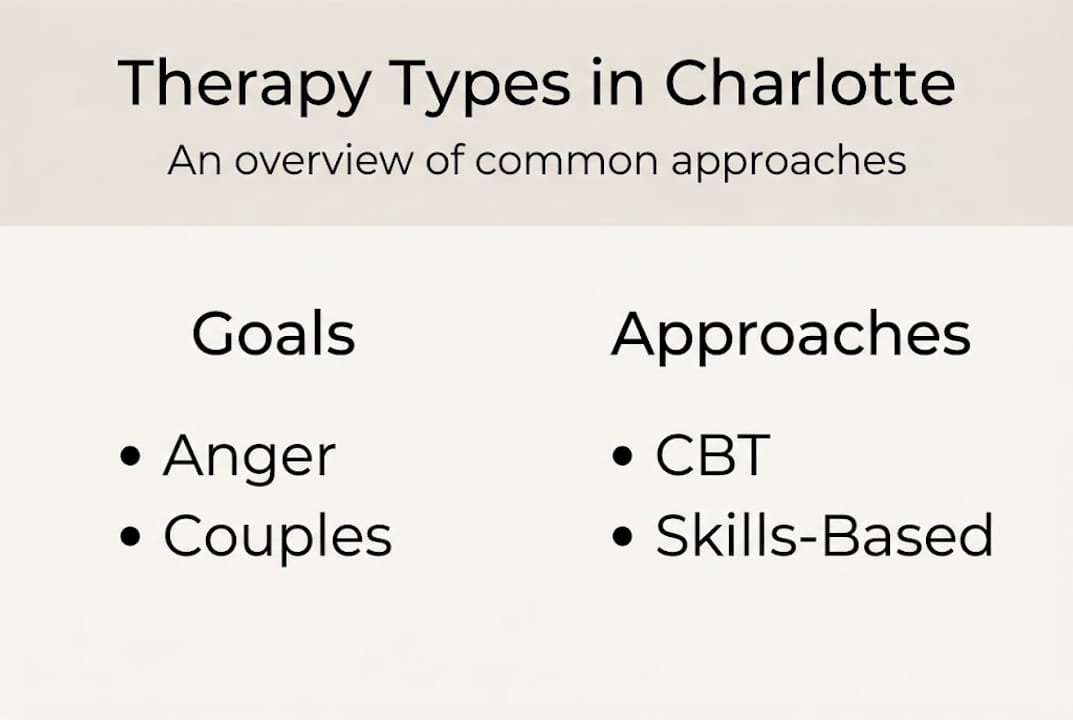
In Charlotte, the most common therapy goals fall into a few clear categories: anger management, couples counseling, and family conflict resolution. For individuals dealing with intense or recurring anger, anger management classes offer structured, skills-based support. Couples often benefit from marriage counseling, which addresses communication patterns, trust, and intimacy. Families navigating tension between parents and kids, or blended family dynamics, often find relief through family therapy options.
Here’s something worth knowing: not all anger management approaches are the same. Some models treat anger as a secondary emotion, meaning something deeper like fear, shame, or grief is driving it. The Anuvia model leans this direction. Others, like Cognitive Behavioral Therapy (CBT), treat anger as a primary skill-building target, focusing on identifying triggers and replacing reactive patterns with healthier responses. Neither is wrong. But the model your therapist uses will shape your entire experience.
Pro Tip: Before your first appointment, write down three things you want to feel or do differently after therapy. This gives your therapist a concrete starting point and helps you measure progress.
Here are some questions to help you clarify your needs before reaching out to a provider:
- What specific situation or feeling is making you seek therapy right now?
- Is this something that affects only you, or does it involve others at home or work?
- Have you tried therapy before? What worked, and what didn’t?
- Are you looking for short-term coping skills or longer-term personal growth?
- Do you have a preference for individual, couples, or group sessions?
Answering these questions honestly before your first call will make a real difference in how quickly you find the right fit.
Evaluating therapy approaches: What matters for results
Once you clarify your needs, the next step is understanding how different therapy approaches can impact your results. Charlotte has no shortage of licensed therapists, but what separates effective care from just filling an hour is the method behind it.
Cognitive Behavioral Therapy is one of the most widely used and researched approaches for issues like anger, anxiety, and relationship conflict. It focuses on practical skill-building and helping clients identify distorted thinking that drives destructive behavior. Family systems therapy takes a broader view, treating the family as a unit where every member influences the others. Culturally responsive care adds another layer, ensuring the therapist understands how race, identity, and lived experience shape a client’s emotional world.
Here’s a quick comparison to make sense of the options:
| Therapy approach | Focus area | Typical issues addressed |
|---|---|---|
| Cognitive Behavioral Therapy (CBT) | Thoughts and behaviors | Anger, anxiety, depression, conflict |
| Family systems therapy | Family relationships and patterns | Family conflict, parenting struggles, disconnection |
| Culturally responsive care | Identity, culture, lived experience | Minority stress, cultural trauma, identity issues |
| Emotionally focused therapy (EFT) | Emotional bonds and attachment | Couples conflict, intimacy issues, trust repair |
Matching the approach to your story matters more than most people realize. A therapist using pure CBT with someone who has experienced generational trauma or cultural displacement may miss the root entirely. That’s why teen counseling that works for one family might fall flat for another.
The most effective therapy is not the most popular technique. It’s the one designed around how you see the world, not how a textbook describes your problem.
Pro Tip: When you call a potential therapist, ask directly: “What modalities do you use, and why do you choose them for someone in my situation?” A good therapist will give you a clear, thoughtful answer, not just a credential list. You can also request an anger assessment before committing to a full program, which helps both you and your therapist understand what’s actually driving the behavior.
The value of culturally competent and inclusive therapists
Alongside methods and modalities, it pays to consider how well your therapist understands your background and identity. Cultural competence is not a buzzword. It’s the difference between a therapist who listens and one who truly hears you.

A culturally competent therapist understands how race, ethnicity, religion, gender identity, and socioeconomic background shape your experience of stress, conflict, and healing. In a city as diverse as Charlotte, this matters enormously. Research shows that culturally tailored therapy boosts retention by 35% for minority clients. That’s not a small number. It means people are far more likely to stay in therapy, do the work, and see results when their therapist actually understands where they’re coming from.
Here’s how that plays out in practice:
| Care type | Retention rate (minority clients) | Session engagement |
|---|---|---|
| Standard therapy | Lower baseline | Moderate |
| Culturally tailored therapy | 35% higher retention | Significantly higher |
Think about what a 35% improvement in staying with therapy actually means. It means fewer people dropping out after two sessions. It means more people reaching real change.
Signs that a therapist is genuinely culturally competent include:
- They ask about your cultural background without making assumptions
- They acknowledge systemic barriers to mental health care
- They don’t pathologize your cultural values or family structure
- They use language that reflects your identity and lived experience
- They show comfort discussing race, racism, and community-specific stress
Charlotte’s growing diversity is reshaping what good therapy looks like here. Providers who specialize in working with Black and African American clients understand how historical trauma, community expectations, and identity intersect with mental health. If you’re looking for a space where you won’t have to explain your world before you can get help, that kind of specialization matters. The counseling environment itself also plays a role, since feeling safe and respected in the physical space helps you open up faster. Whether you’re dealing with personal anger, family conflict therapy, or couples tension, cultural fit is part of the treatment.
Teletherapy and in-person options: Flexibility for every Charlotte resident
Whether you’re seeking convenience or a traditional experience, your choice of therapy format also matters. The good news is that you don’t have to sacrifice quality for flexibility.
Research consistently shows that telehealth is just as effective as in-person therapy for most mental health needs, including anger management and couples counseling. This is not a temporary pandemic workaround. It’s a legitimate, evidence-backed format that expands access for people with busy schedules, transportation limits, or privacy concerns.
That said, each format has its strengths:
When teletherapy works better:
- You have a demanding schedule with limited travel time
- You feel more open talking from the comfort of your own space
- You live in an area of Charlotte with limited nearby providers
- You want access to a specialist regardless of location
- Privacy at home is easier than taking time off work
When in-person makes more sense:
- You’re working through intense trauma or crisis
- You’re doing couples or family sessions where body language matters
- You find it hard to stay focused in a home environment
- You value the ritual of going somewhere dedicated to healing
Exploring teletherapy options in Charlotte gives you access to a wider pool of culturally competent providers without geographic limits. That’s a real advantage in a city where the right cultural fit might not be located in your zip code.
Pro Tip: For teletherapy to work well, use a private room with a closed door, headphones, and a reliable internet connection. Let anyone at home know not to interrupt during your session. Treat it like an in-person appointment, because the work you do is just as real.
Why cultural fit and approach matter more than credentials in Charlotte therapy
Here’s an uncomfortable truth most people don’t want to hear: a therapist with an impressive resume and a wall full of certifications can still fail you completely if they don’t understand your world. After working in Charlotte’s mental health community and seeing what actually moves the needle for clients, the pattern is clear. The therapists who get results are the ones whose clients feel genuinely seen, not just processed.
Credentials tell you someone met the minimum standard. They don’t tell you whether that person understands what it’s like to grow up in your community, carry your family’s expectations, or navigate anger that has roots in something much older than your last argument. Research confirms this: culturally tailored therapy increases retention by 35% among minority clients, meaning people stay and do the work when the relationship feels real.
Choosing inclusive therapists who match your identity and values is not just a preference. It’s a strategic decision that improves your outcomes. A good credential is a starting point, not the destination.
Explore therapists and tailored support in Charlotte, NC
Ready to take action and find a therapist who fits your needs?
Mastering Conflict provides evidence-based, culturally sensitive clinical therapy services in Charlotte, NC, covering anger management, couples counseling, family therapy, and individual care. You can explore anger assessment support to get a clear picture of where you are before you start, or review the differences between therapy vs coaching to find the format that matches your goals. Dr. Carlos Todd and the Mastering Conflict team offer personalized, inclusive consultations designed to meet you where you are. Reach out today to take that first step toward the right fit.
Frequently asked questions
What should I look for in a Charlotte, NC therapist?
Seek someone whose approach, cultural awareness, and experience align with your specific needs. Cultural fit boosts retention by 35% for minority clients, which means it directly affects whether therapy works for you.
Is telehealth as effective as in-person therapy in Charlotte?
Yes. Studies confirm telehealth matches in-person therapy in effectiveness for most mental health needs, including anger management and relationship counseling.
How do I know if a therapist is culturally competent?
Look for therapists with training in culturally responsive care who ask about your background, acknowledge systemic barriers, and avoid assumptions about your identity or values.
What types of therapy are common for anger management in Charlotte?
CBT and skills-based approaches are widely used. Some clinicians view anger as a secondary emotion requiring deeper emotional exploration, while others focus on practical trigger management and response training.
Where can I find a therapist with experience in anger management, couples, or family therapy in Charlotte?
Start with specialized clinical services that list these areas as their focus, and confirm the provider’s experience with your specific situation before booking your first session.