
Effective Anger Management Activities for Teens: A Guide

TL;DR:
- Teen anger often results from feeling misunderstood, overwhelmed, or pressured, not just being difficult.
- Evidence-based techniques like CBT, relaxation training, and group therapy effectively reduce teen anger.
- Parents can support long-term change by modeling emotional regulation, creating routines, and practicing anger management activities at home.
Effective Anger Management Activities for Teens: A Guide
Teen anger is one of the most misunderstood parts of raising an adolescent. Many parents assume it will pass on its own, but dismissing it as “just a phase” can allow unhealthy patterns to take root. The truth is that anger in teens is a signal, not a sentence. With the right activities and consistent parental support, teenagers can learn to recognize, regulate, and express anger in ways that actually strengthen their relationships and confidence. This guide gives you practical, evidence-based tools to help your teen build real emotional regulation skills, starting today.
Table of Contents
- Understanding teen anger: What’s really happening?
- Foundations: Evidence-based approaches that work
- Activity toolkit: Powerful anger management exercises for teens
- Fostering long-term change: Supporting your teen at home and beyond
- A fresh perspective: What most advice misses about teen anger
- Find more support: Next steps for your family
- Frequently asked questions
Key Takeaways
| Point | Details |
|---|---|
| Evidence matters | Proven approaches like CBT and group counseling show real improvements in teen anger control. |
| Home activities work | Simple activities—like journaling and deep breathing—help teens regulate emotions daily. |
| Support is essential | Active parental involvement and knowing when to seek outside help are key to long-term success. |
| Healthy expression beats suppression | Encouraging open, respectful expression helps teens build resilience and self-control. |
Understanding teen anger: What’s really happening?
Before you can help your teen manage anger, you need to understand what is driving it. Anger rarely appears from nowhere. For most teenagers, it is a response to feeling misunderstood, disrespected, overwhelmed, or trapped. The adolescent brain is still developing the prefrontal cortex, which is the part responsible for impulse control and decision-making. That means teens are physiologically more reactive than adults, not because they are being difficult, but because their brains are literally wired that way right now.
Common triggers for teen anger include:
- Peer conflict: Social rejection, bullying, or friendship drama are among the most powerful anger triggers for teens.
- Academic pressure: High expectations, test anxiety, and fear of failure can build into explosive frustration.
- Hormonal changes: Fluctuating hormones during puberty intensify emotional responses across the board.
- Family dynamics: Feeling controlled, misunderstood, or overlooked at home creates chronic low-level anger.
- Unmet needs: Hunger, sleep deprivation, and social isolation can dramatically lower a teen’s anger threshold.
- Digital stress: Social media comparison and online conflict carry emotional weight that spills into daily life.
Here is where a lot of parents get stuck: they think anger is the problem. It is not. Anger is a natural emotion with a biological purpose. The problem is when anger gets expressed in destructive ways, or when it stays bottled up until it explodes. APA strategies on anger make clear that effective anger management for teens focuses on interrupting the anger cycle through physiological calming like breathing and relaxation, cognitive restructuring to reframe unhelpful thoughts, and behavioral outlets that channel energy constructively. These approaches draw from both cognitive behavioral therapy (CBT) and dialectical behavior therapy (DBT).
Expert consensus: Anger in adolescents is not simply a mood problem. It is a regulatory challenge rooted in brain development, environmental stressors, and learned emotional patterns. Addressing it requires a skills-based approach, not just discipline.
Understanding what is happening under the surface is the first step. The second step is knowing that you, as a parent, are not helpless. Research consistently shows that parental support for teen anger plays a major role in whether teens develop healthy or unhealthy anger habits. Your presence, your response, and your modeling of emotional regulation all matter far more than most parents realize.
Foundations: Evidence-based approaches that work
Not all anger management strategies are created equal. Some approaches have solid research behind them. Others are based on folk wisdom that sounds reasonable but does not hold up when tested. As a parent, knowing the difference helps you make smarter decisions about how to support your teen.
The three approaches with the strongest track records for adolescent anger are CBT, group therapy, and relaxation training. Here is how they compare:
| Approach | How it works | Best for | Format |
|---|---|---|---|
| Cognitive behavioral therapy (CBT) | Teaches teens to identify and reframe unhelpful thought patterns that fuel anger | Teens with persistent aggressive or reactive anger | Individual or group |
| Group therapy or counseling | Peers practice skills together, building social and communication competence | Teens who struggle in social situations or with peer conflict | Group/classroom |
| Relaxation training | Targets the body’s stress response using breathing, progressive muscle relaxation, and mindfulness | Any teen; especially effective for physical tension and anxiety-driven anger | Individual, home, or group |
A 6-session anger management program covering anger education, ABC analysis (activating events, beliefs, consequences), relaxation, thought modification, problem-solving, and communication skills significantly reduced anger levels and improved adjustment in teens aged 13 to 16. That is meaningful change from a short, structured program.
On the CBT side, school-based CBT with problem-solving, social skills training, self-instruction, and role-play has shown statistically significant reductions in anger and aggression across multiple meta-analyses. Interestingly, group formats in classroom settings outperformed individual sessions in some studies, which suggests peer interaction itself is part of the healing process.
For parents looking to support evidence-based anger strategies at home, the key takeaway is this: the most effective programs are structured, skills-focused, and combine multiple techniques rather than relying on any single method.
Pro Tip: When choosing outside support for your teen, look for programs or counselors that explicitly use CBT or DBT frameworks and include practice-based components like role-play and journaling. Ask directly: “What specific skills will my teen practice during sessions?” A good program will have a clear answer.
Parents can also reinforce relaxation techniques for anger between sessions by practicing them at home together, which normalizes the tools and reduces the stigma teens sometimes feel about needing help.
Activity toolkit: Powerful anger management exercises for teens
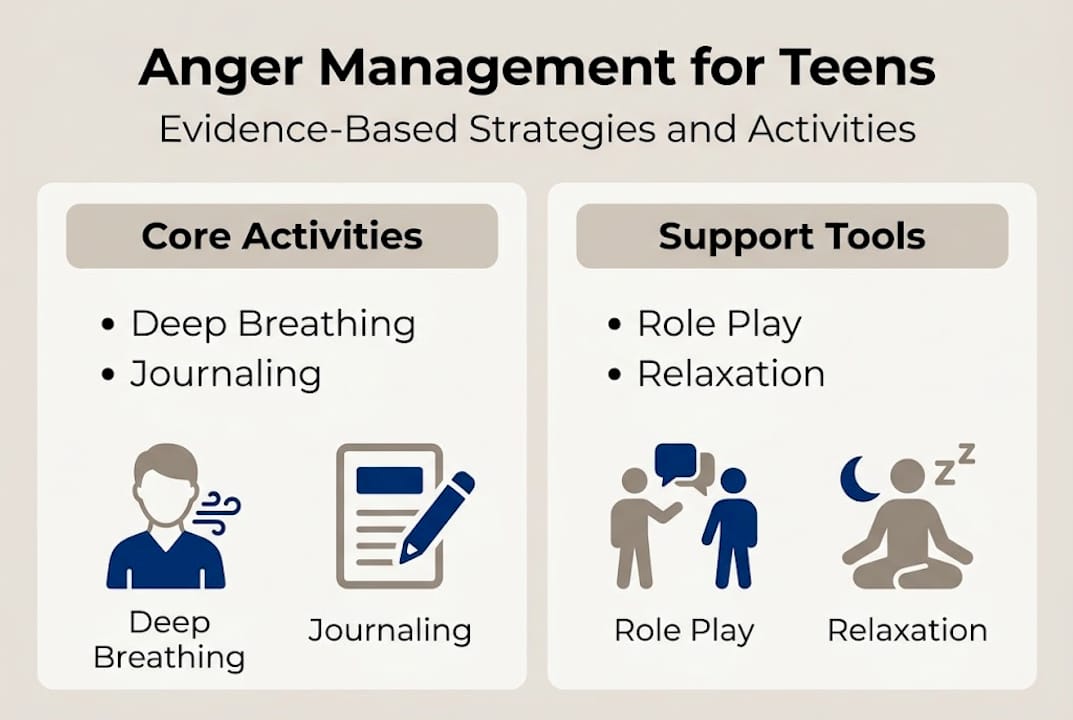
Theory is only useful when it becomes action. Here are seven evidence-aligned activities you can start using with your teen today. These are not quick fixes. They are skills, and like any skill, they get stronger with practice.
- Diaphragmatic breathing: Teach your teen to breathe in slowly for four counts, hold for four, and breathe out for six. The extended exhale activates the parasympathetic nervous system, which physically slows down the body’s anger response. Practice this when things are calm so it becomes automatic during a conflict.
- Emotion thermometer: Draw or print a thermometer scaled from 0 to 10. Help your teen identify what each level feels like physically and emotionally. A “3” might be mild irritation; a “9” is full rage. The goal is catching the rise early, ideally at a 4 or 5, when calming strategies are still accessible.
- Journaling with a prompt: Unstructured journaling can sometimes amplify frustration. Guided prompts work better. Try: “What happened? What did I feel in my body? What did I want to do? What would have helped?” This format mirrors the ABC analysis used in structured programs and builds self-awareness over time.
- Role-playing healthy responses: This technique comes directly from group counseling approaches that teach teens to identify the emotions beneath anger, challenge unrealistic expectations, and practice assertive rather than aggressive responses. Act out common conflict scenarios at home, like being blamed unfairly by a friend or getting a bad grade. Let your teen practice saying what they need without attacking.
- Physical release activities: Running, shooting hoops, hitting a punching bag, or even doing jumping jacks when anger peaks gives the body a safe outlet. This is not about avoiding the emotion. It is about lowering the physiological intensity before attempting any rational conversation.
- Assertiveness training: Many teens express anger aggressively because they have never learned the language of assertiveness. Practice phrases like: “I felt disrespected when… and I need…” This builds the communication competence that anger management activities designed for young people consistently include.
- Mindful time-out: This is not a punishment. It is a pre-agreed strategy where your teen removes themselves from a conflict for 10 to 20 minutes to use a calming technique, then returns to resolve the issue. It requires planning in advance, not in the heat of the moment.
Pro Tip: Match the activity to your teen’s personality. An introverted teen might connect more deeply with journaling or breathing. A more physical or extroverted teen might need the role-play or movement-based outlets first. You know your child. Start with the activity most likely to get a “yes” rather than the one that looks best on paper. Use guided relaxation exercises together to lower the barrier to entry.
Fostering long-term change: Supporting your teen at home and beyond
Activities work best when they are embedded in a home environment that consistently supports emotional growth. One-off exercises rarely lead to lasting change. What creates real progress is a combination of a supportive home atmosphere, ongoing skill reinforcement, and, when needed, professional help.
Here is how to build that foundation at home:
- Model emotional regulation yourself. Your teen is watching how you handle frustration, disappointment, and conflict. When you name your own emotions and use calming strategies openly, you normalize the process.
- Avoid shaming anger. Saying “stop being so dramatic” teaches teens to hide their anger, not manage it. Instead, validate the emotion and redirect the expression: “It makes sense you’re frustrated. Let’s figure out how to deal with this.”
- Create predictable routines. Structure reduces the number of daily stressors that pile up into anger. Consistent mealtimes, sleep schedules, and family check-ins give teens a sense of control.
- Set clear and fair boundaries. Teens who feel rules are arbitrary or unfair are more likely to resist with anger. Explain the reasoning behind expectations and invite input where possible.
- Celebrate progress, not perfection. If your teen catches themselves at a “5” on the emotion thermometer and uses a breathing technique instead of yelling, that is a genuine win worth acknowledging.
Tracking behavior over time helps you and your teen see real progress, which builds motivation. Here is a simple framework:
| Week | Number of anger episodes | Highest intensity (0-10) | Skills used | Notes |
|---|---|---|---|---|
| 1 | 6 | 9 | None yet | Introduced breathing |
| 2 | 5 | 8 | Breathing x2 | Journaling started |
| 3 | 4 | 7 | Breathing, journaling | Role-play practiced |
| 4 | 3 | 6 | All three skills | Visible improvement |
Research supports this kind of parent-engaged approach. Adaptive anger regulation in boys receiving CBT was directly linked to reductions in both self-reported and parent-reported aggression, confirming that parental observation and involvement strengthen outcomes.
Knowing when to seek outside help is also critical. If your teen’s anger leads to physical aggression, property destruction, self-harm, or significant disruption to school or family life, home strategies alone are not enough. A licensed counselor who specializes in adolescent behavior can provide the structured, clinical support your teen needs. School counselors, community mental health centers, and online therapy platforms all offer accessible entry points. Learning more about mindfulness and anger reduction can also help you understand what clinical programs often incorporate, so you can ask better questions when seeking help.
For parent involvement in anger management, the evidence is clear: when parents are active participants rather than passive observers, teens make faster and more durable progress.
A fresh perspective: What most advice misses about teen anger
Most articles on teen anger give you a checklist. Practice breathing. Try journaling. Set boundaries. The advice is not wrong, but it misses something important: the goal is never to eliminate anger. The goal is to help your teen express it in a way that does not damage themselves or the people around them.
Research actually shows no strong evidence for suppression as an effective strategy. Teaching teens to push feelings down creates more problems than it solves. Healthy expression, not suppression, is the real target.
Another thing most advice misses: the techniques only work when the relationship is right. A teen who feels judged, controlled, or misunderstood by their parent will resist every strategy, no matter how evidence-based it is. Trust comes first. That means being willing to sit with your teen’s anger without immediately trying to fix it or shut it down.
Flexibility matters too. What works for one teen will frustrate another. The willingness to keep trying, adjust your approach, and stay patient is not a soft skill. It is the most critical ingredient in the whole process. Explore building family resilience as an ongoing practice, not a one-time intervention.
Find more support: Next steps for your family
Sometimes the home strategies in this guide are enough to create meaningful change. Other times, families need a more structured level of support to make progress stick.
At Mastering Conflict, we offer clinical services for families specifically designed to address teen anger, family conflict, and emotional regulation challenges using evidence-based methods. Whether your family needs short-term counseling, a structured anger management program, or ongoing support, our team is equipped to help. Not sure where to start? Review evidence-based anger support to deepen your understanding, or explore how coaching vs therapy for conflict compares so you can make an informed choice about the right path for your teen.
Frequently asked questions
What is the first step if my teen can’t control their anger?
Start by helping your teen identify what triggers their anger, then introduce simple calming activities like deep breathing exercises, which interrupt the anger cycle before it escalates.
Do group counseling and activities really help teens manage anger?
Yes. A structured group program significantly improved anger control, problem-solving, and communication skills in teens aged 13 to 16 after just six sessions.
What activities can a parent do with a teen to manage anger at home?
Deep breathing, journaling with guided prompts, role-playing healthy responses, and using an emotion thermometer are all practical home activities. Group counseling research confirms these tools build assertiveness and reduce reactive behavior.
When should we seek professional help for teen anger?
Seek help if anger leads to aggression, self-harm, or persistent family disruption. CBT-based programs delivered by a trained counselor produce clinically significant reductions in teen aggression that home strategies alone cannot always achieve.